

Let’s be honest. “Have a good day” has been said so many times it barely registers anymore. You hear it from cashiers, coworkers, and automated customer service bots alike. It’s the verbal equivalent of elevator music, technically pleasant but completely forgettable.
The good news? There are dozens of other ways to say “have a good day” that actually land with warmth, humor, or genuine meaning. Whether you’re signing off a professional email, texting your best friend, or waving your kid off to school, the right phrase turns a throwaway moment into a real human connection.
This guide breaks down 100+ alternatives (organized by situation, relationship, and tone) so you’ll never default to the same tired line again.
Why “Have a Good Day” Feels Hollow Sometimes
Words are powerful. But repetition drains them dry.
Think about the last time someone said “have a good day” to you. Did it make you feel anything? Probably not. It’s become a social reflex, like saying “fine” when someone asks how you are. Automatic. Effortless. Empty.
There is a name for this. Linguists call it phatic communication: language whose job is social rather than informational. “Have a good day,” “how are you,” and “nice weather” all belong to this category. They are not really carrying content. They are signalling that a relationship exists.
That is why the phrase still works and also why it feels empty. It performs its social function perfectly. What it stops doing, once it becomes automatic, is convincing anyone that you meant it.
“The difference between the right word and the almost right word is the difference between lightning and a lightning bug.” Mark Twain
That’s the whole point of finding a have a good day alternative that fits the moment. Not to sound clever. Just to sound like you actually mean it.
Another Way to Say “Have a Good Day”: The Master List by Category
Here’s where it gets useful. Instead of one endless flat list, these alternatives are sorted by context so you can grab exactly what you need, fast.
Formal and Professional Alternatives
A generic sign-off is a missed opportunity, and professional email is where that shows most.
These phrases work well in professional emails, end-of-meeting farewells, and workplace conversations:
- “Wishing you a productive day ahead”
- “I hope your day runs smoothly”
- “May your work today be rewarding”
- “Here’s to a successful day”
- “I trust your day goes well”
- “Wishing you clarity and focus today”
- “I hope the rest of your day is seamless”
- “Enjoy a well-spent and fulfilling day”
- “Wishing you continued success today”
- “May your day be both efficient and enjoyable”
| Phrase | Tone | Best Used When |
|---|---|---|
| “Wishing you a productive day ahead” | Professional, warm | Email sign-offs |
| “I trust your day goes well” | Formal, respectful | Senior colleagues or clients |
| “May your work today be rewarding” | Thoughtful, sincere | After a meaningful meeting |
| “Enjoy a well-spent day” | Polished, positive | Formal workplace farewell |
| “Wishing you clarity and focus today” | Supportive, professional | Before a big project day |
At work, the key is balancing professionalism with genuine warmth. Cold and corporate sounds robotic. Overly casual sounds sloppy. Aim for the sweet spot.
The same balancing act applies to the rest of a professional email, from the opener to the request. Our guide to professional ways to say “please let me know” covers the phrase most people over-use in the middle.

Casual and Friendly Alternatives
For friends, family members, or coworkers you’re close with, loosen up.These are for when you want to sound like a real person, not a corporate template:
- “Have an awesome one!”
- “Make it a great day”
- “Hope your day is as good as you are”
- “Enjoy every bit of today”
- “Go crush it today!”
- “Have the best day ever”
- “Hope today’s a good one for you”
- “Catch you on the flip side of a great day”
- “Go make some good memories today”
- “Hope it’s a banger of a day”
Short. Punchy. Human. That’s the goal.
Warm and Heartfelt Alternatives
Sometimes generic just won’t cut it, especially with people you genuinely love. These carry real emotional weight:
- “I hope today brings you joy”
- “Wishing you a day full of good moments”
- “May today treat you kindly”
- “Sending you good vibes for your whole day”
- “Hope today feels as wonderful as you make others feel”
- “Wishing you peace and happiness today”
- “May every hour of today be gentle with you”
- “Hope today surprises you in the best way”
- “You deserve a beautiful day. Go have one.”
- “Wishing you a day as bright as your smile”
These phrases work especially well as morning texts or parting words after a meaningful conversation. They don’t just wish someone well, they make them feel seen.
Funny and Lighthearted Alternatives
Sometimes the best option is the one that makes someone laugh. These are perfect for humor-loving friends, playful coworkers, or anyone who’d roll their eyes at something too sincere:
- “Don’t do anything I wouldn’t do — so basically, anything goes”
- “Try not to have too much fun without me”
- “Go forth and conquer… or at least survive”
- “May your coffee be strong and your meetings be short”
- “Have a day that’s at least 40% good”
- “May your Wi-Fi be fast and your coworkers be tolerable”
- “Try to be the least stressed person in the room today”
- “Go have a day you won’t need to vent about later”
- “Here’s hoping your Tuesday feels nothing like a Monday”
- “Don’t let the chaos win today”
Humor is a bonding tool. One well-placed joke in a farewell phrase does more for a relationship than a dozen generic “have a good days.”
Inspirational and Motivational Alternatives
When someone’s facing a tough day (a big presentation, a difficult conversation, or just a rough patch), a motivational send-off hits differently. These ways to say “have a good day” double as genuine encouragement:
- “Go show today what you’re made of”
- “Make today count”
- “You’ve got everything it takes — go prove it”
- “Today’s yours. Own it.”
- “Wishing you the strength to make this day remarkable”
- “Whatever today throws at you, you can handle it”
- “Go make something great happen today”
- “Believe in the kind of day you want to have”
- “Every hour today is a fresh chance — use it well”
- “The world’s a better place with you in it — go remind it”
“Write it on your heart that every day is the best day of the year.” Ralph Waldo Emerson
These phrases are especially powerful when they’re specific. “Good luck in your interview today” beats every generic alternative on this list.
Alternatives for Kids and Students
Parents and teachers spend a lot of time on school drop-off. The words you say in that final moment matter more than you think. Here are different ways to say “have a good day” that actually connect with kids:
- “Go learn something amazing today”
- “Be kind, be brave, have fun”
- “I can’t wait to hear about your day”
- “Make someone smile today”
- “Go be the best part of someone’s day”
- “Show them what you’ve got today”
- “Every mistake today is just practice — keep going”
- “You’re going to do great things today”
- “Find one thing to be curious about today”
- “Remember: you’re braver than you think”
The specificity matters more than the sentiment. “Go learn something amazing today” gives a child something to do. “Have a good day” gives them nothing to hold on to. The difference costs you two seconds at the door.
That’s worth thinking about next time you’re rushing out the door.
Romantic Alternatives
For partners and significant others, a good morning send-off is a small but powerful act of love. Skip the generic. Try these instead:
- “I hope your day is as beautiful as you are”
- “Thinking of you — go have a wonderful day”
- “Can’t wait to see you later. Have a great one”
- “Your smile is going to brighten everyone’s day”
- “Have the kind of day you deserve — perfect”
- “Go be amazing today. Not that you need reminding”
- “I’ll be thinking about you all day. Make it a good one”
- “You make my mornings better — go make someone else’s day better too”
- “Hope today is as wonderful as last night was”
- “Go conquer your day — I’ll be cheering from here”
Small gestures compound over time. A thoughtful farewell phrase, repeated daily, becomes part of what makes a relationship feel secure and warm.
Spiritual and Mindful Alternatives
For those who appreciate a deeper dimension in their well-wishes, these alternatives carry a reflective, grounded energy:
- “May today bring you peace and clarity”
- “Wishing you a day grounded in gratitude”
- “May blessings follow you throughout the day”
- “Go gently through your day”
- “I pray your day is filled with grace”
- “May you find stillness even in the busiest moments today”
- “Wishing you a day aligned with your truest self”
- “May today bring more than you hoped for”
- “Go with intention today”
- “Wishing you a day of deep breaths and open doors”
These phrases land particularly well in communities where faith and mindfulness are central. They’re also genuinely comforting to anyone going through difficulty.
Alternatives for Goodbye Texts and Email Sign-Offs
This question comes up constantly in written communication. Email sign-Here’s the thing about unique ways to say “have a good day”, it’s not about being fancy or cleveroffs especially tend to go stale fast. Here are fresher options:
- “Talk soon — enjoy your day!”
- “Until next time — take care of yourself today”
- “Wishing you well until we speak again”
- “Go make today worth talking about”
- “See you on the other side of a great day”
- “Looking forward to connecting again — have a wonderful one”
- “Enjoy the rest of your day!”
- “Here’s hoping the rest of your day is smooth sailing”
- “Take care and have a brilliant rest of the day”
- “Until then — wishing you all the best today”
| Sign-Off Phrase | Best For | Tone |
|---|---|---|
| “Talk soon — enjoy your day!” | Friends, casual colleagues | Warm, breezy |
| “Wishing you well until we speak again” | Clients, formal contacts | Professional, polished |
| “Go make today worth talking about” | Motivated peers | Energetic, inspiring |
| “Here’s hoping the rest of your day is smooth sailing” | After solving a problem | Relieved, friendly |
| “Take care and have a brilliant rest of the day” | British English users, formal | Elegant, sincere |
The sign-off is only half the email. If your opener is doing as little work as the phrase you just replaced, there is another way to say “I hope you are doing well” worth having ready.
How to Pick the Right Phrase
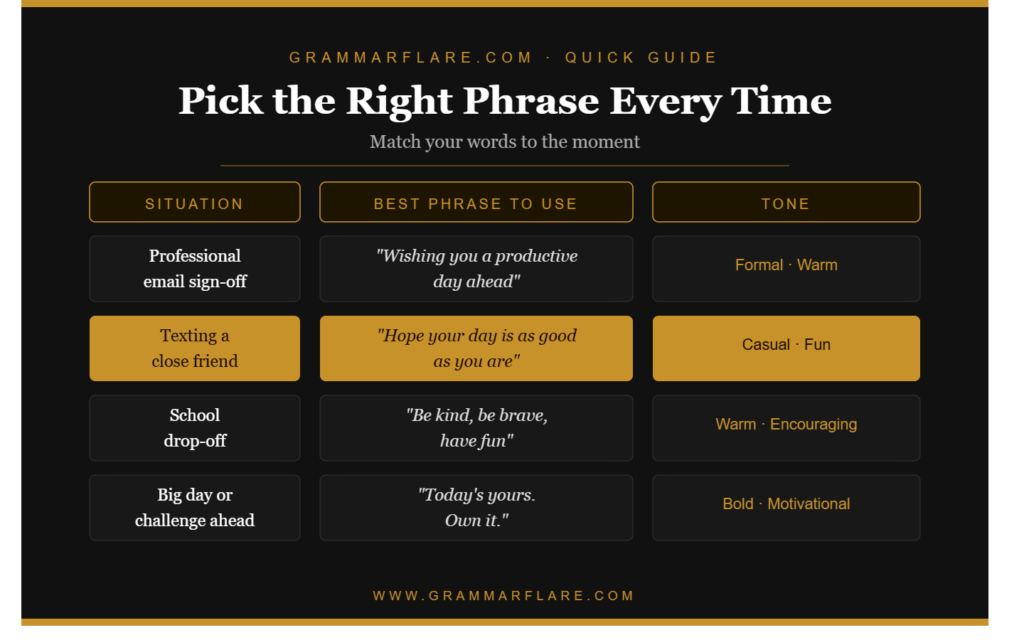
Not every phrase works in every situation. Here’s how to choose:
Match the relationship. Don’t send “Go crush it!” to your company’s CEO. But “Wishing you a productive and successful day” works perfectly.
Read their mood. Someone anxious or stressed needs warmth and calm. Someone fired up needs energy and encouragement. Mirror what they need, not just how you feel.
Tone carries more of a message than word choice does, which is why the same phrase can land as warm from one person and perfunctory from another. Our guide to the importance of tone in conversation covers how that works.
Consider the medium. A text message can handle emoji and slang. A formal email cannot. Calibrate accordingly.
Be specific when possible. “Good luck in your presentation today” will always beat any phrase on this list. Specificity is the highest form of personalization.
| Situation | Best Category |
|---|---|
| Professional email sign-off | Formal & Professional |
| Texting a close friend | Casual & Funny |
| Sending off a nervous child | Kids & Heartfelt |
| Ending a tough conversation | Warm & Spiritual |
| Motivating someone before a big day | Inspirational |
| Romantic morning text | Romantic |
| Group work chat farewell | Casual or Funny |
The Power of Going Beyond “Have a Good Day”: What thWhy Specific Wishes Land Harder
Repetition is what drains a phrase, not the words themselves. “Have a good day” was never a bad sentence. It has simply been said to most people several thousand times, and a sentence you have heard several thousand times stops registering as a message and starts registering as background noise.
Specificity restores what repetition removes. Compare these:
- Have a good day.
- Good luck with the presentation this afternoon.
The second one proves something the first cannot: that you remembered. That is the entire mechanism. Not warmth, not cleverness, not vocabulary. Evidence of attention.
This is also why the best phrase on this page is often not on this page at all. If you know what the person is doing today, say that instead. Every alternative listed here is a fallback for the situations where you do not know.
Two practical consequences:
Match the weight to the moment. An elaborate send-off before a routine Tuesday reads as odd. A generic one before someone’s first day in a new job reads as careless.
Rotate your defaults. If the same person hears the same phrase from you daily, it becomes background noise again within a fortnight, whichever phrase you picked.
Cultural Variations: How the World Says “Have a Good Day”

Language is a window into culture. Different languages don’t just translate the phrase, they reframe it entirely.
| Language | Phrase | Literal Meaning |
|---|---|---|
| French | Bonne journée | Good day/journey |
| Spanish | Que tengas un buen día | May you have a good day |
| Japanese | 良い一日を (Yoi ichinichi wo) | Wishing you a good one day |
| Arabic | أتمنى لك يوماً طيباً | I wish you a pleasant day |
| German | Einen schönen Tag noch | Have a beautiful remaining day |
| Italian | Buona giornata | Good daytime/journey |
| Portuguese | Tenha um ótimo dia | Have an excellent day |
| Mandarin | 祝你今天愉快 (Zhù nǐ jīntiān yúkuài) | Wishing you happiness today |
Notice how several languages (French, German, Italian) frame the day as a journey. That’s a beautiful reframe worth borrowing in English too. “Have a great journey today” hits different from “have a good day.”
More Reading at GrammarFlare
- Creative Ways to Say Hello for Every Situation
- Another Way to Say “I Hope You Are Doing Well”
- Professional Ways to Say “Please Let Me Know”
- How to End a Conversation Politely
- The Importance of Tone in Conversation
Sources
Frequently Asked Questions
What’s a more creative way to say “have a good day”?
Try something context-specific. “Go make today memorable,” “Wishing you a day worth smiling about,” or “Hope today brings you something unexpected and wonderful” are all more memorable than the default.
How do you say “have a good day” professionally?
Stick to polished, warm phrases like “Wishing you a productive day ahead,” “I trust your day goes smoothly,” or “May your work today be both rewarding and fulfilling.” Avoid anything too casual or playful in formal contexts.
What can I say instead of “have a good day” in an email?
“Wishing you well,” “Enjoy the rest of your day,” “Looking forward to connecting again — have a wonderful one,” or “Here’s hoping your day runs smoothly” all work beautifully as email sign-offs.
Is “have a good one” too informal for work?
Depends entirely on your workplace culture. In a creative agency or startup? Totally fine. In a law firm or corporate setting? Probably lean toward something more polished like “Wishing you a great rest of the day.”
How do you wish someone well without sounding generic?
Be specific. Reference something real, their upcoming meeting, their project, their week. “Good luck with the launch today” is infinitely more meaningful than anything on a generic phrases list.
Small Words. Big Impact.
Here’s the thing: it is not about being fancy or clever. It’s about being present. It’s about actually thinking about the person in front of you for one extra second and choosing words that fit them instead of everyone.
That’s all it takes. One deliberate word swap per farewell. Done consistently, it changes how people feel around you. It changes how they remember you. And in professional contexts, it can quietly, powerfully set you apart.
So next time you’re about to default to the same old phrase, pause. Flip back to this list. Pick something that actually means something.
Which phrase are you going to try first? Drop it in the comments, would love to hear which one resonates most with you.

Ahmad Waheed has spent five years editing academic and professional writing for universities, publishers, and software companies. He founded Grammar Flare after noticing the same handful of mistakes in almost every draft that crossed his desk, and that most grammar guides explained the rule without explaining when it actually matters.
Ahmad writes every guide on this site, checking usage questions against Merriam-Webster, the Chicago Manual of Style, and the AP Stylebook, and noting where those sources disagree rather than quietly picking a side.