

Words matter. Tone decides whether those words land softly, sharply, warmly, or like a dropped suitcase on someone’s foot. You can say the “right” sentence and still hurt someone. You can also say something difficult with care and make the other person feel respected. That’s the real importance of tone in conversation. Tone shapes how people hear your message before they fully process your words.
Quick answer: Tone in conversation is the emotional sound of your message, carried by your volume, pace, pitch, pauses, word choice, and expression. It works as a filter between what you mean and what the other person hears, which is why the same sentence can land as warm or hostile depending on delivery.
Think about the difference between these two versions:
“Fine. Do whatever you want.”
Now imagine it said with a relaxed smile.
Then imagine it said through clenched teeth.
Same words. Completely different weather.
Tone works like seasoning. Too little and your message feels flat. Too much and it overpowers everything. The goal isn’t to sound fake, sugary, or overly careful. The goal is simple: speak in a way that matches what you actually mean.
If you want people to listen, understand, and respond well, your tone needs to help your message rather than fight it.
For more on how phrasing changes the way a message lands, see our guides on professional communication and conversation skills.
What Is Tone in Conversation?
Tone in conversation is the emotional sound of your message. It includes your voice, word choice, rhythm, facial expression, timing, and attitude.
In spoken conversation, tone comes through in:
- Volume: loud, soft, steady, intense
- Pace: fast, slow, rushed, calm
- Pitch: high, low, rising, falling
- Inflection: where your voice lifts or drops
- Pauses: where you stop, breathe, or let words sink in
- Word choice: gentle, direct, sarcastic, formal, warm
- Facial expression: smiling, frowning, blank, tense
- Body language: open, closed, relaxed, defensive
In writing, tone comes through differently. Text messages, emails, and comments don’t carry your voice. So readers rely on punctuation, sentence length, emojis, word choice, and context.
Compare these:
| Message | Likely Tone |
|---|---|
| “Okay.” | Cold, annoyed, or neutral |
| “Okay!” | Friendly or eager |
| “Okay…” | Unsure, disappointed, or suspicious |
| “Okay, that works for me.” | Clear and calm |
| “Sure. Whatever.” | Dismissive or irritated |
Tone is not decoration. It’s meaning.
Why the Importance of Tone in Conversation Is Bigger Than People Think
Tone tells people how to feel around your words.
A harsh tone can make a simple comment feel like criticism. A calm tone can make criticism easier to hear. A playful tone can make a joke land. A sarcastic tone can make kindness sound fake.
That’s why people often respond to the tone before the message.
You may say:
“I was only trying to help.”
But if your tone sounds irritated, superior, or impatient, the other person may hear:
“You should already know this.”
That gap causes many everyday arguments.
The NCBI Bookshelf guide on active listening explains that communication involves verbal, written, and nonverbal signals. In active listening, the listener gives feedback to make sure both people understand each other. Tone plays directly into that process because it helps signal patience, respect, and attention.
Put simply, your tone answers silent questions:
- “Are you angry with me?”
- “Are you judging me?”
- “Do you care?”
- “Can I trust you?”
- “Are you actually listening?”
- “Do you want to solve this or win this?”
People may not ask those questions out loud. Still, they hear your tone answering them.
Tone of Voice in Communication: The Hidden Filter
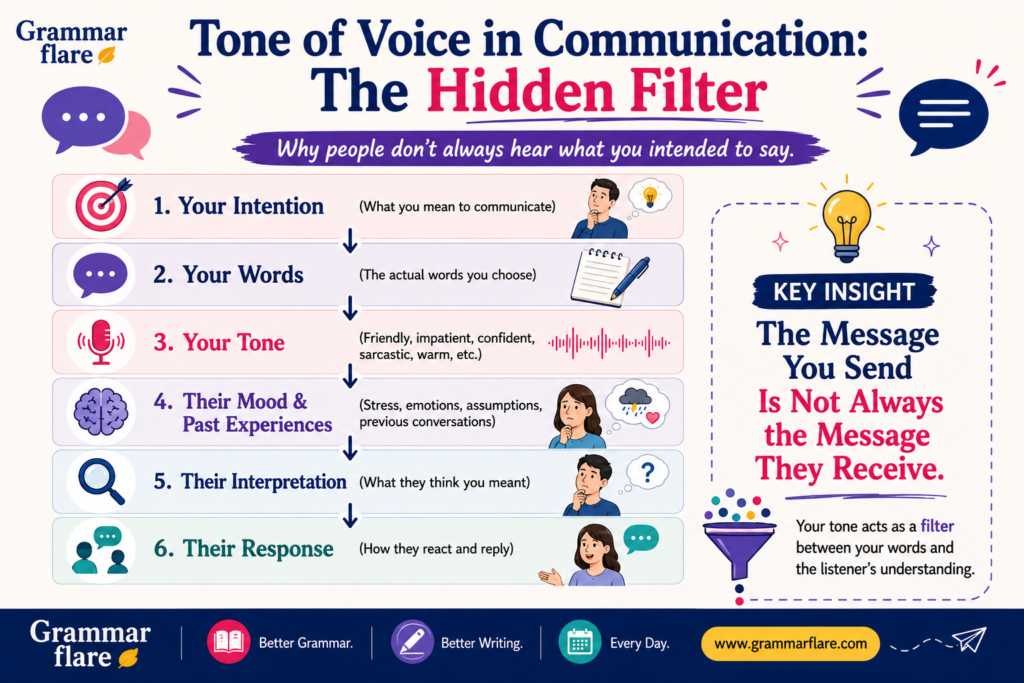
Your tone works like a filter between your intention and the listener’s interpretation.
You may intend to sound helpful. The other person may hear control.
You may intend to sound funny. They may hear mockery.
You may intend to sound direct. They may hear disrespect.
This doesn’t mean everyone else is too sensitive. It means communication has two sides: what you mean and what they receive.
Here’s a useful way to picture it: What you mean → your tone → what they hear
Tone sits right in the middle. It can smooth the path or scatter nails across it.
How Tone Affects Whether You Feel Heard
People listen better when they don’t feel attacked. That is what makes tone matter so much when you want to be heard.
A respectful tone doesn’t weaken your point. It strengthens it.
You can be firm without sounding cruel, honest without sounding harsh, and set a boundary without sounding like a villain in a courtroom drama.
Harsh vs. Clear Tone Examples
| Harsh Tone | Clearer Tone |
|---|---|
| “You never listen.” | “I don’t feel heard when I’m interrupted.” |
| “That’s a foolish idea.” | “I don’t think that approach will work.” |
| “You’re always late.” | “When plans start late, I feel frustrated.” |
| “Calm down.” | “Let’s slow this down for a second.” |
| “Whatever.” | “I’m upset and need a minute.” |
| “You don’t care.” | “I need more support right now.” |
Notice the difference.
The clearer versions still say something real. They don’t hide the issue. They just remove the extra sting.
Tone Is Not the Same as Being Nice
This part matters.
A good tone does not mean smiling through every problem. It does not mean swallowing your feelings. It does not mean becoming soft, vague, or fake.
Good tone means your delivery matches your goal.
If your goal is to solve a problem, use a tone that invites problem-solving.
If your goal is to set a boundary, use a tone that sounds steady.
If your goal is to comfort someone, use a tone that feels gentle.
If your goal is to disagree, use a tone that keeps the door open.
Here’s the difference:
Nice but unclear: “It’s fine. Don’t worry about it.”
Kind and clear: “I know you didn’t mean harm. Still, I felt hurt when that happened.”
The second one carries more courage. It also gives the other person something useful to respond to.
The Main Types of Tone in Conversation
Tone has many shades. Some help the conversation. Others quietly sabotage it.
| Type of Tone | How It Sounds | Effect |
|---|---|---|
| Warm | Friendly, open, relaxed | Builds comfort |
| Calm | Steady, measured, patient | Reduces tension |
| Assertive | Clear, firm, respectful | Helps set boundaries |
| Curious | Interested, open-ended | Encourages sharing |
| Supportive | Gentle, validating, present | Builds trust |
| Sarcastic | Mocking, sharp, hidden meaning | Can create defensiveness |
| Dismissive | Short, flat, uninterested | Makes people feel small |
| Aggressive | Loud, blaming, intense | Escalates conflict |
| Passive-aggressive | Polite words with bitter delivery | Confuses and frustrates |
| Condescending | Slow, superior, patronizing | Creates resentment |
The strongest communicators use tone intentionally. They don’t let stress, ego, or impatience drive the whole conversation.
The Four-Part Tone Check: Voice, Words, Body, Timing
Before a meaningful conversation, check four things.
Voice
Your voice carries emotional color.
Ask yourself:
- Am I speaking too loudly?
- Am I rushing?
- Do I sound tense?
- Does my voice match my message?
- Am I using a steady pace?
A steady voice helps people relax. A rushed voice can sound anxious. A loud voice can sound aggressive. A flat voice can sound uninterested.
Words
Your words either soften or sharpen your tone.
Compare:
- “You’re wrong.”
- “I see it differently.”
- “That makes no sense.”
- “Can you explain how you got there?”
- “You always do this.”
- “This has happened a few times and I want to talk about it.”
Small word changes can prevent big emotional fires.
Body Language
Your body talks too.
Crossed arms, eye rolls, heavy sighs, sharp gestures, and walking away mid-sentence can change the whole meaning of your words.
A calm tone pairs best with:
- Relaxed shoulders
- Steady eye contact
- Open posture
- Slower gestures
- Less interrupting
- A neutral or warm face
You don’t need to perform like a motivational speaker. Just avoid sending mixed signals.
Timing
Even the right tone can fail at the wrong time.
A tired person won’t hear feedback well. A hungry person may hear everything as an attack. A stressed person may not have room for a deep talk.
Before you speak, ask:
- Is this the right moment?
- Are they able to listen?
- Am I calm enough to explain?
- Should this be a quick comment or a longer talk?
- Would this be better in person than over text?
Timing doesn’t fix everything. It does give your words a fighting chance.
How to Be Heard Without Sounding Harsh
Being heard takes more than volume. In fact, louder often works worse.
Here’s a practical framework.
Start With the Point
Don’t circle the runway forever.
Say what you mean clearly:
“I want to talk about something that bothered me.”
“I need to explain how that came across.”
“I don’t want to argue. I want us to understand each other.”
A clear opening lowers confusion.
Use “I” Statements
“I” statements help you speak from your experience rather than blaming the other person.
The Boston University Ombuds handout on I-messages describes them as a way to open healthy conversation. They don’t magically fix conflict. They simply make your perspective clearer.
Use this structure:
“When ___ happened, I felt ___ because ___. I’d like ___.”
Examples:
- “When I didn’t get a reply, I felt worried because the plan was still unclear. I’d like us to confirm earlier next time.”
- “When the joke was made in front of everyone, I felt embarrassed. I’d rather we not joke about that topic.”
- “When I’m interrupted, I lose my train of thought. Can I finish this first?”
This style sounds calmer because it explains impact instead of throwing blame.
Lower the Heat
If the conversation gets tense, slow down.
Say:
- “Let me say that more clearly.”
- “I’m not trying to attack you.”
- “I want to understand your side too.”
- “Can we pause for a second?”
- “This matters to me, so I want to say it well.”
These lines don’t make you weak. They make you easier to hear.
Ask for Their View
A person listens better when they know they’ll also get a turn.
Try:
- “How did that land for you?”
- “What did you mean when you said that?”
- “Am I missing something?”
- “How do you see it?”
- “What would feel fair to you?”
This turns the conversation from a courtroom into a table.
Tone Examples: Same Message, Different Results
Tone changes everything. Here are real-life examples.
At Work
| Situation | Poor Tone | Better Tone |
|---|---|---|
| A coworker missed a deadline | “You messed this up again.” | “The deadline passed and we need a plan to fix it.” |
| A meeting ran too long | “This meeting is pointless.” | “Can we refocus on the decision we need today?” |
| Someone misunderstood your idea | “That’s not what I said.” | “Let me explain it a different way.” |
With Friends
| Situation | Poor Tone | Better Tone |
|---|---|---|
| Friend cancels plans | “Of course you canceled again.” | “I was looking forward to seeing you. Can we pick a day that works better?” |
| Friend seems distant | “You’re acting weird.” | “You’ve seemed quiet lately. Is everything okay?” |
| Friend makes a hurtful joke | “You’re so rude.” | “That joke hit a sore spot. Please don’t joke about that.” |
In Relationships
| Situation | Poor Tone | Better Tone |
|---|---|---|
| Partner is on their phone | “You never pay attention.” | “I’d like a few minutes without phones so we can actually talk.” |
| Plans feel one-sided | “I do everything.” | “I’m feeling worn out because I’ve handled most of the planning.” |
| Argument gets heated | “You’re impossible.” | “I need a short break before I say this badly.” |
Better tone does not water down the message. It removes the static.
The Role of Listening in Tone
Tone isn’t only about speaking. Listening has a tone too.
You can listen warmly. You can listen impatiently. You can also listen with your face while your brain is already writing a comeback.
Active listening helps you sound more grounded because it slows the conversation down. The Harvard Business Review overview of active listening explains that active listening includes reading body language and tone, maintaining attention, and managing emotional responses.
That last part is crucial.
You can’t control your tone well if you’re only waiting to win.
Listening Phrases That Improve Tone
Use these:
- “That makes sense.”
- “I hear you.”
- “Tell me more.”
- “I didn’t realize it felt that way.”
- “Let me make sure I understand.”
- “So you felt ignored when that happened?”
- “I can see why that bothered you.”
- “I’m listening. Keep going.”
These phrases soften the room. They show that you’re not just present. You’re available.
Tone in Text Messages and Online Conversation
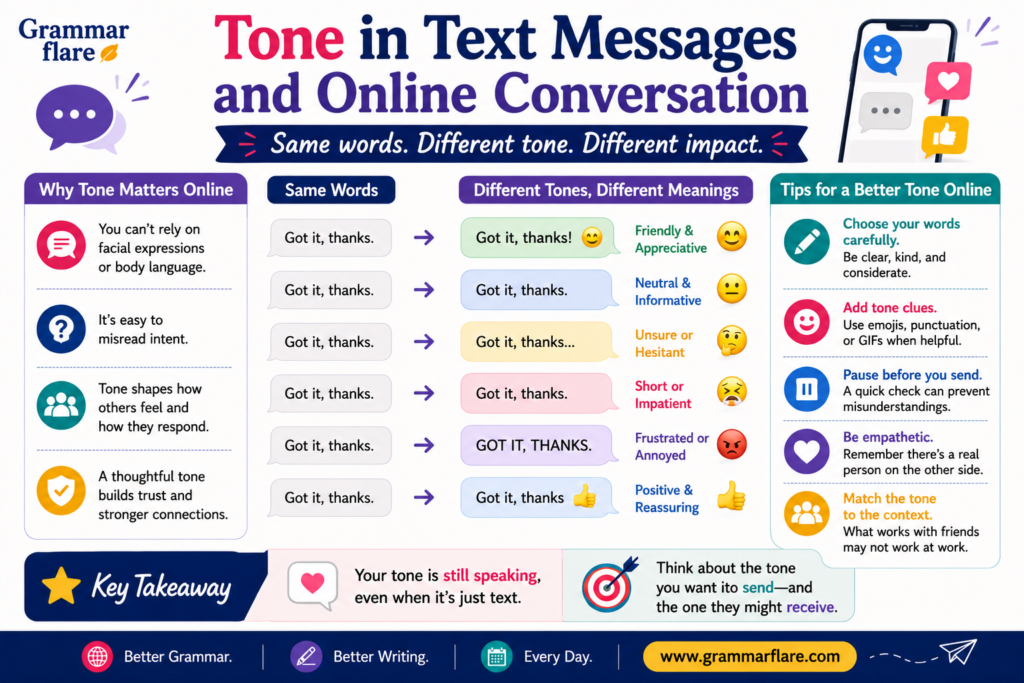
Text tone is tricky because the reader fills in the missing voice.
That’s why short messages can feel colder than intended.
For example:
“Fine.”
Maybe you mean, “That works.”
They may read, “I’m annoyed and plotting quietly.”
How to Make Text Tone Clearer
Use these small fixes:
| Risky Text | Clearer Text |
|---|---|
| “K.” | “Okay, sounds good.” |
| “Do what you want.” | “I’m okay with either option.” |
| “We need to talk.” | “Can we talk later about the plan? Nothing scary.” |
| “Sure.” | “Sure, that works for me.” |
| “Whatever.” | “I’m not sure yet. Let me think.” |
| “Why did you do that?” | “Can you help me understand what happened?” |
Tone in writing depends on context. A period can feel normal in a formal email. In a casual text, it can feel icy.
Better Digital Tone Habits
Try these:
- Add context when your message could sound sharp.
- Use names carefully. “Sarah.” can sound serious.
- Avoid all caps unless you mean excitement.
- Don’t argue through long angry paragraphs.
- Use emojis when they fit your style.
- Read the message once before sending.
- Ask yourself, “Could this sound harsher than I mean?”
This matters most when you are chasing someone, because a nudge that reads as relaxed in your head can read as impatient on screen. If that is the message you are writing, there is another way to say “just checking in” that usually lands better.
How to Fix Your Tone After It Comes Out Wrong
Everyone messes up tone.
You say something too sharply. You sound annoyed when you’re actually tired, or you make a joke that lands badly, or you rush your words and the other person shuts down.
The repair matters.
Quick Repair Phrases
Use these:
- “That came out harsher than I meant.”
- “Let me try again.”
- “I’m sorry. My tone wasn’t fair.”
- “I’m frustrated, but I don’t want to take it out on you.”
- “I said that badly. What I meant was…”
- “You didn’t deserve that tone.”
- “Can I restart this conversation?”
These phrases work because they take responsibility without turning the moment into a dramatic courtroom apology. Short. Honest. Clean.
Proportion matters just as much in writing, where over-apologizing can make a small delay look larger than it was. The same principle applies when you need another way to say “sorry for the late reply”.
What Not to Say
Avoid:
- “You’re too sensitive.”
- “I was joking.”
- “That’s just how I talk.”
- “You know what I meant.”
- “I didn’t say anything wrong.”
- “Calm down.”
Those lines usually make things worse. They defend the tone instead of repairing the damage.
How to Develop a Better Tone Naturally
You don’t need a fake customer-service voice. You need awareness and practice.
Record Yourself
This feels awkward. Do it anyway.
Record yourself explaining something for one minute. Then listen for:
- Pace
- Volume
- Warmth
- Clarity
- Pauses
- Sharpness
- Filler words
- Monotone delivery
You may hear habits you never noticed.
Practice Pausing
A pause can save a conversation.
Before responding to something emotional, take one breath. That tiny pause gives your tone a chance to catch up with your values.
Use:
“Let me think for a second.”
“I want to answer that carefully.”
“I’m feeling reactive, so give me a moment.”
This is grown-up communication. Not robotic. Not dramatic. Just steady.
Choose a Tone Goal
Before a difficult conversation, pick one tone word.
For example:
- Calm
- Honest
- Warm
- Firm
- Curious
- Respectful
- Patient
- Direct
- Supportive
Then ask:
“What would this tone sound like?”
A calm tone speaks slower.
A firm tone uses clear words.
A curious tone asks more questions.
A supportive tone validates before advising.
A respectful tone avoids cheap shots.
Case Study: The Same Problem With Two Different Tones
The Situation
Maya and Jordan planned dinner at 7:00. Jordan arrived at 7:35 without texting. Maya felt embarrassed and annoyed.
Version One: The Tone That Starts a Fight
Maya says:
“Wow. Nice of you to finally show up.”
Jordan replies:
“Relax. It’s not that serious.”
Now both people feel attacked. The real issue gets buried under defensiveness.
Version Two: The Tone That Opens a Conversation
Maya says:
“I’m glad you’re here. I was frustrated because I waited without knowing what happened. Next time, can you text me if you’re running late?”
Jordan replies:
“You’re right. I should’ve texted. I’m sorry.”
Same issue. Different tone. Better outcome.
Maya didn’t pretend everything was fine. She also didn’t turn the first sentence into a weapon.
That’s the sweet spot.
Common Tone Mistakes That Make People Stop Listening
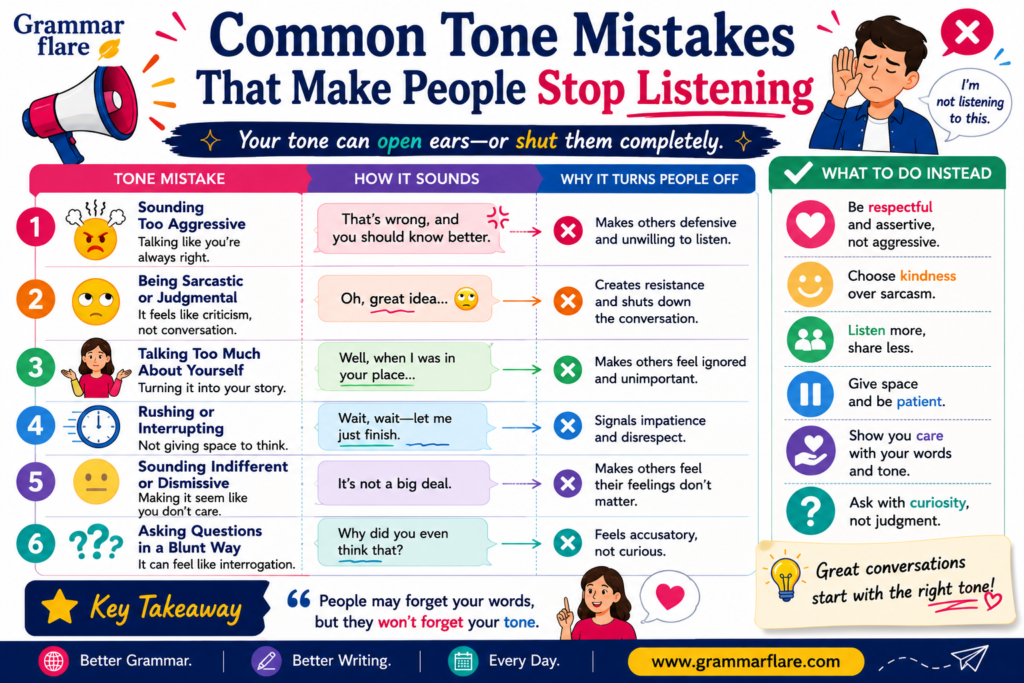
Most people don’t ruin conversations on purpose. They fall into habits.
Sounding Accusatory
Words like “always” and “never” often create instant defense.
Instead of:
“You never listen.”
Say:
“I didn’t feel heard during that conversation.”
Sounding Dismissive
Short replies can sting.
Instead of:
“Whatever.”
Say:
“I don’t have the energy to talk about this right now.”
Sounding Superior
Nobody likes being spoken to like a confused toddler.
Instead of:
“Obviously, that won’t work.”
Say:
“I see a problem with that plan.”
Sounding Sarcastic
Sarcasm can be funny between people who trust each other. In conflict, it usually pours gasoline on a fire.
Instead of:
“Great job. Really impressive.”
Say:
“That created a problem and we need to fix it.”
Clear beats clever when feelings run hot.
Tone and Boundaries: How to Be Firm Without Being Mean
A boundary doesn’t need a sharp tone to be strong.
In fact, a calm tone often makes a boundary harder to argue with.
Boundary Scripts
Use these:
- “I can’t do that today.”
- “I’m not comfortable with that.”
- “Please don’t speak to me that way.”
- “I need more notice next time.”
- “I’m happy to help, but I can’t take over.”
- “I want to talk, but not while we’re yelling.”
- “That topic is private for me.”
- “No, that doesn’t work for me.”
A good boundary is clear, brief, and steady.
You don’t need to over-explain. Over-explaining can make your boundary sound negotiable. That is most obvious when you are turning something down, where a long explanation invites the other person to solve your problem rather than accept your answer. Our guide to declining a meeting politely works through the same principle with scripts.
Tone in Difficult Conversations
Difficult conversations need three things: clarity, respect, and emotional control.
You can’t control the other person’s reaction. You can control how you enter the conversation.
Before You Start
Ask yourself:
- What is the real issue?
- What outcome do I want?
- What tone will help that outcome?
- What tone will make things worse?
- Am I trying to be understood or trying to punish?
That last question is uncomfortable. It’s also useful.
During the Conversation
Use grounding phrases:
- “I want this to go well.”
- “I’m not here to blame you.”
- “I want to explain my side.”
- “I also want to understand yours.”
- “Let’s stay on the actual issue.”
- “Can we slow down?”
The right tone keeps the conversation from becoming a tug-of-war. That is hardest when the other person has more authority than you, where tone has to carry the disagreement without turning it into a challenge. Our guide to disagreeing with your boss covers the wording for exactly that situation.
Tone at Work: How to Sound Professional Without Sounding Cold
Workplace tone needs balance. Too casual may sound careless. Too formal may sound stiff. Too blunt may sound rude. Too soft may sound unsure.
Aim for clear, respectful, and useful.
Professional Tone Examples
| Instead of | Try |
|---|---|
| “You forgot the file.” | “Could you send the file when you get a chance?” |
| “This makes no sense.” | “I’m not following this section yet. Can you clarify it?” |
| “That’s not my job.” | “That falls outside my role, but I can point you to the right person.” |
| “ASAP.” | “Can you send this by 3 p.m. today?” |
| “Per my last email.” | “Just following up on the note below.” |
Professional tone doesn’t mean sounding like a legal notice taped to a glass door. It means making your message easy to understand and hard to misread.
Much of workplace tone comes down to a handful of stock phrases we reach for without thinking, which is why it helps to have better versions ready for the ones you use most, such as professional ways to say “please let me know”.
Tone With Friends and Family
Tone with close people can get messy because comfort lowers the filter.
You may speak more sharply to people you love because you assume they’ll understand. That’s risky. Familiarity should not become permission to sound careless.
Warm Phrases That Help
Use:
- “I’m not mad. I’m trying to explain.”
- “I love you, but this bothered me.”
- “I don’t want this to become a fight.”
- “Can we talk about this gently?”
- “I hear your side.”
- “I need you to hear mine too.”
Close relationships need repair, not perfection.
A Simple Tone Checklist Before You Speak
Use this when the conversation matters.
| Question | Why It Helps |
|---|---|
| What do I want them to understand? | Keeps you focused |
| What emotion am I bringing in? | Builds self-awareness |
| Is my volume helping? | Prevents intensity |
| Am I using blame words? | Reduces defensiveness |
| Did I choose the right time? | Improves reception |
| Am I listening too? | Creates fairness |
| Do I need a pause? | Prevents regret |
Tape this idea to your brain:
Tone should serve the message, not sabotage it.
Quick Tone Upgrade Phrases
Sometimes, one phrase can change the whole direction.
Softer Sound
- “Can I say this gently?”
- “I might be reading this wrong.”
- “Help me understand.”
- “I don’t want to assume.”
- “This may sound small, but it mattered to me.”
Clearer Sound
- “Here’s what I need.”
- “The main issue is…”
- “What I’m asking for is…”
- “Let me be direct.”
- “I want to avoid confusion.”
Calmer Sound
- “Let’s slow down.”
- “I need a second.”
- “I don’t want to react too quickly.”
- “Can we take this one piece at a time?”
- “I’m trying to stay fair.”
More Respectful Sound
- “I see your point.”
- “That makes sense from your side.”
- “I appreciate you explaining.”
- “I disagree, but I hear you.”
- “Thanks for telling me.”
These phrases don’t solve everything. They simply keep the door open.
FAQs About the Importance of Tone in Conversation
What is the importance of tone in conversation?
Tone is important because it shapes how people interpret your words. A calm tone can make a difficult message easier to hear. A harsh tone can make even a simple comment feel like criticism.
How does tone affect communication?
Tone affects communication by showing emotion, attitude, and intention. It helps people decide whether you sound respectful, annoyed, interested, dismissive, warm, or aggressive.
What is a good tone of voice in communication?
A good tone of voice matches your message and situation. In most conversations, a good tone sounds clear, respectful, steady, and honest. It doesn’t have to sound overly cheerful.
How can I improve my tone when speaking?
Slow down, pause before reacting, lower your volume, choose clearer words, and listen to how your message may land. You can also record yourself to notice habits in pace, pitch, and sharpness.
How do I sound assertive without sounding rude?
Use clear words, steady volume, and respectful phrasing. Say what you need without insults or blame. For example, “I can’t do that today” sounds firmer and better than “Stop bothering me.”
Why do people misunderstand my tone in texts?
Text messages don’t include facial expression or voice. Short replies, periods, delayed responses, and blunt wording can seem colder than intended. Add context when your message could be misread.
What should I do if my tone sounded rude?
Repair it quickly. Say, “That came out harsher than I meant,” or “Let me try again.” Taking responsibility for tone builds trust faster than defending it.
Final Thoughts on the Importance of Tone in Conversation
Good tone doesn’t mean perfect speech. It means thoughtful delivery.
You do not need to sound polished every second. You do not need to hide frustration or pretend everything is fine. You just need to notice how your words arrive.
Tone can turn honesty into connection. It can turn disagreement into understanding. It can turn a hard conversation into a useful one.
The next time you want to be heard, don’t just ask, “What should I say?”
Ask this too:
“How can I say this in a way they can actually receive?”
That one question can change the whole conversation.
More Reading at GrammarFlare
- How to Disagree With Your Boss
- How to Politely Decline a Meeting
- How to Keep a Conversation Going
- How to End a Conversation Politely
- Professional Ways to Say “Please Let Me Know”
- Conversation Skills

Ahmad Waheed has spent five years editing academic and professional writing for universities, publishers, and software companies. He founded Grammar Flare after noticing the same handful of mistakes in almost every draft that crossed his desk, and that most grammar guides explained the rule without explaining when it actually matters.
Ahmad writes every guide on this site, checking usage questions against Merriam-Webster, the Chicago Manual of Style, and the AP Stylebook, and noting where those sources disagree rather than quietly picking a side.