
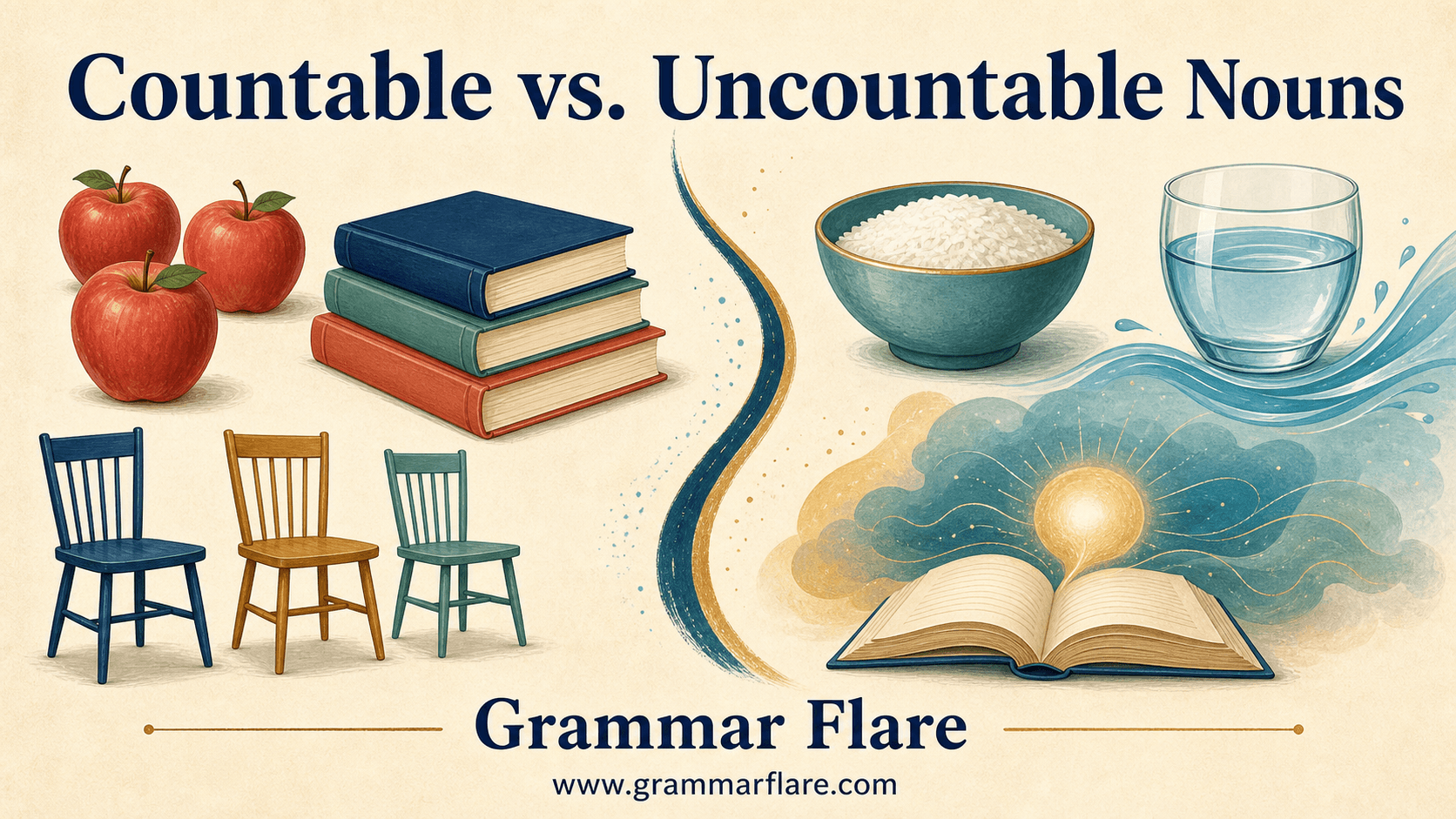
If you are learning English grammar, one of the first questions that causes trouble is what is the difference in countable vs uncountable nouns. The difference affects articles, plurals, and quantity words such as many, much, few, and little.
The good news is that the core rule is simple. The harder part is learning the common exceptions and real-life patterns. This guide explains both.
Quick Answer
Countable nouns can be counted one by one, so they have singular and plural forms. Uncountable nouns are treated as masses, substances, or abstract ideas, so they usually do not use a/an or regular plural forms.
Examples:
- countable: a book, two books
- countable: an apple, three apples
- uncountable: water, rice, information
- uncountable: advice, furniture, knowledge
That one distinction explains many other grammar choices.

The Rule in One Sentence
If you can naturally count the noun as one, two, three, it is usually countable. If you treat it as a substance, idea, or mass, it is usually uncountable.
What Are Countable Nouns?
Countable nouns are nouns you can count as separate items.
They usually:
- use a or an in the singular
- have a plural form
- work with words like many, few, and several
Countable noun examples
- a chair / two chairs
- a student / five students
- an email / three emails
- a mistake / several mistakes
How countable nouns work in sentences
- I bought a notebook.
- She has three assignments to finish.
- We saw many cars on the road.
- He made a useful suggestion.
What Are Uncountable Nouns?
Uncountable nouns are nouns we usually do not count as separate units. They are often substances, materials, categories, or abstract ideas.
They usually:
- do not take a or an
- do not use a normal plural form in everyday grammar
- work with words like much, little, and some
Uncountable noun examples
- water
- rice
- sugar
- information
- advice
- furniture
- traffic
- knowledge
How uncountable nouns work in sentences
- We need more water.
- She gave me useful advice.
- I do not have much information yet.
- There is too much traffic today.
Countable vs Uncountable Nouns in One Table
| Type | Main idea | Singular/plural? | Common quantity words | Example |
|---|---|---|---|---|
| countable | separate items | yes | many, few, several | a pencil, two pencils |
| uncountable | mass, substance, or idea | usually no | much, little, some | water, advice, furniture |
How to Tell if a Noun Is Countable or Uncountable
Use these three quick tests.
1. Can you count it one by one?
If yes, it is probably countable.
- one apple, two apples
- one chair, two chairs
If no, it may be uncountable.
- one water
- two informations
Those sound wrong in standard English.
2. Does a or an sound natural?
Countable nouns often take a or an in the singular.
- a report
- an idea
Uncountable nouns usually do not.
- advice
- furniture
- research
3. Which quantity word fits: many or much?
- many + countable nouns: many books, many reasons
- much + uncountable nouns: much time, much money
If the noun fits naturally after many, it is probably countable. If it fits naturally after much, it is probably uncountable.
Common Countable and Uncountable Nouns
Countable nouns
- book
- bottle
- apple
- teacher
- problem
- article
- conversation
- sentence
Uncountable nouns
- information
- advice
- luggage
- equipment
- homework
- progress
- bread
- music
Nouns That Can Be Both Countable and Uncountable
This is where many learners get stuck. Some nouns can be countable in one meaning and uncountable in another.

Coffee
- uncountable: I drink coffee every morning.
- countable: We ordered two coffees.
In the second sentence, coffees means cups or servings.
Paper
- uncountable: The printer needs paper.
- countable: I wrote three papers this semester.
In the second sentence, papers means essays or articles.
Chicken
- uncountable: We had chicken for dinner.
- countable: There are five chickens in the yard.
Hair
- uncountable: Her hair is very long.
- countable: I found a hair on my jacket.
Time
- uncountable: I do not have much time.
- countable: We had a great time at the event.
This is the part worth remembering, because the same noun can be either depending on what you mean. If you are counting servings, units, or types, the countable form is usually right.
Common Mistakes to Avoid in Countable vs Uncountable Nouns

Using a or an with uncountable nouns
Wrong:
- an advice
- an information
- a furniture
Correct:
- some advice
- some information
- a piece of furniture
Using plural forms with uncountable nouns
Wrong:
- advices
- informations
- homeworks
Correct:
- advice
- information
- homework
Using many with uncountable nouns
Wrong:
- many money
- many traffic
- many research
Correct:
- much money
- heavy traffic
- much research
Using much with ordinary countable nouns
Wrong:
- much books
- much ideas
Correct:
- many books
- many ideas
Helpful Unit Expressions for Uncountable Nouns
When you need to count something uncountable, add a unit word.
| Uncountable noun | Better counted form |
|---|---|
| advice | a piece of advice |
| information | a piece of information |
| furniture | a piece of furniture |
| bread | a loaf of bread / a slice of bread |
| water | a glass of water / a bottle of water |
| rice | a bowl of rice |
| equipment | a piece of equipment |
This is one of the most useful fixes for English learners because it turns a vague rule into a usable sentence pattern.
Much, Many, Few, and Little
These quantity words are closely connected to the countable vs uncountable rule.
Use these with countable nouns
- many books
- a few questions
- several students
Use these with uncountable nouns
- much time
- a little sugar
- less noise
Quick comparison table
| Countable | Uncountable |
|---|---|
| many emails | much mail |
| a few chairs | a little furniture |
| fewer mistakes | less confusion |
Countable vs Uncountable Noun Examples in Sentences
Here are natural examples readers can reuse.
Countable noun examples
- She wrote three emails before lunch.
- I need a pen for this form.
- They asked several questions during the meeting.
- He bought two apples and a banana.
Uncountable noun examples
- We need more time to finish the project.
- She gave me good advice before the interview.
- I did not get much sleep last night.
- There is too much noise in this room.
Mixed examples
- I need some paper for the printer.
- I wrote two papers for class.
- Would you like some coffee?
- We ordered three coffees after the meeting.
A Fast Checklist for Proofreading
Before publishing, sending, or submitting a piece of writing, check these questions:
- Can this noun be counted one by one?
- Should it take a/an, or should it stay uncountable?
- Does it need many/few or much/little?
- If it is uncountable, do I need a unit expression such as a piece of or a glass of?
- Is this one of the nouns that can be both countable and uncountable depending on meaning?
Why This Rule Matters in Real Writing
This topic is not just for grammar tests. It improves everyday clarity in:
- emails
- essays
- resumes
- professional reports
- English-learning practice
Mini Quiz: Countable or Uncountable?
Decide whether each noun is countable or uncountable in the sentence.
- She gave me useful advice.
- We bought three chairs.
- I need more information before I decide.
- He made two small mistakes.
- There is too much traffic today.
- We ordered two coffees.
Answers
- advice = uncountable
- chairs = countable
- information = uncountable
- mistakes = countable
- traffic = uncountable
- coffees = countable in this meaning because it refers to servings
FAQ
What is the difference between countable and uncountable nouns?
Countable nouns can be counted as separate items and usually have singular and plural forms. Uncountable nouns are treated as masses, substances, or ideas and usually do not take a/an or regular plural forms.
Is information countable or uncountable?
In standard English, information is uncountable. Say some information or a piece of information, not an information or informations.
Is advice countable or uncountable?
Advice is uncountable. Say some advice or a piece of advice, not an advice or advices.
Can one noun be both countable and uncountable?
Yes. Words like coffee, paper, chicken, and time can be countable or uncountable depending on meaning.
Do uncountable nouns ever have plural forms?
Some do in specialized contexts, but for everyday grammar learners, the safest rule is that common uncountable nouns usually do not take ordinary plural forms.
Is furniture countable?
No. Furniture is uncountable. Say some furniture or a piece of furniture.
What is the best quick test?
Try counting the noun one by one and see whether a/an sounds natural. Then check whether many or much fits better.
Short Answers for Quick Overviews
- Best quick answer: Countable nouns can be counted one by one and usually have singular and plural forms. Uncountable nouns are treated as masses or ideas and usually do not use a/an or regular plurals.
- Fast rule: If you can say one, two, three naturally, the noun is probably countable.
- Most common learner mistake: Using a/an or plural forms with nouns like advice, information, and furniture.
- Best correction pattern: Use unit phrases such as a piece of advice, a piece of information, or a glass of water.
- Important nuance: Some nouns like coffee and paper can be countable or uncountable depending on meaning.
More Reading at GrammarFlare
- How to End a Conversation Politely: Natural Lines for Any Situation
- Another Way to Say I Hope You Are Doing Well in an Email
- When to Use A vs An: The Sound Rule With Easy Examples
- What Is the Plural of Fungus? Fungi, Funguses, or Both?
- How to Use AI to Improve Your Writing Without Sounding Robotic
Sources
- Cambridge Dictionary Grammar: Nouns – countable and uncountable
- British Council: Countable and uncountable nouns 1
- Purdue OWL: Using Articles

Ahmad Waheed has spent five years editing academic and professional writing for universities, publishers, and software companies. He founded Grammar Flare after noticing the same handful of mistakes in almost every draft that crossed his desk, and that most grammar guides explained the rule without explaining when it actually matters.
Ahmad writes every guide on this site, checking usage questions against Merriam-Webster, the Chicago Manual of Style, and the AP Stylebook, and noting where those sources disagree rather than quietly picking a side.