
A comma before but is correct when but joins two complete sentences. If but connects only words, phrases, or incomplete thoughts, you usually do not need a comma.
That sounds simple, but it gets tricky because many writers follow their ear instead of checking the sentence structure. Speech has natural pauses. Written punctuation has rules. The goal is not to pause wherever the sentence feels long. The goal is to guide the reader through the relationship between ideas.
Quick Answer: Comma Before But
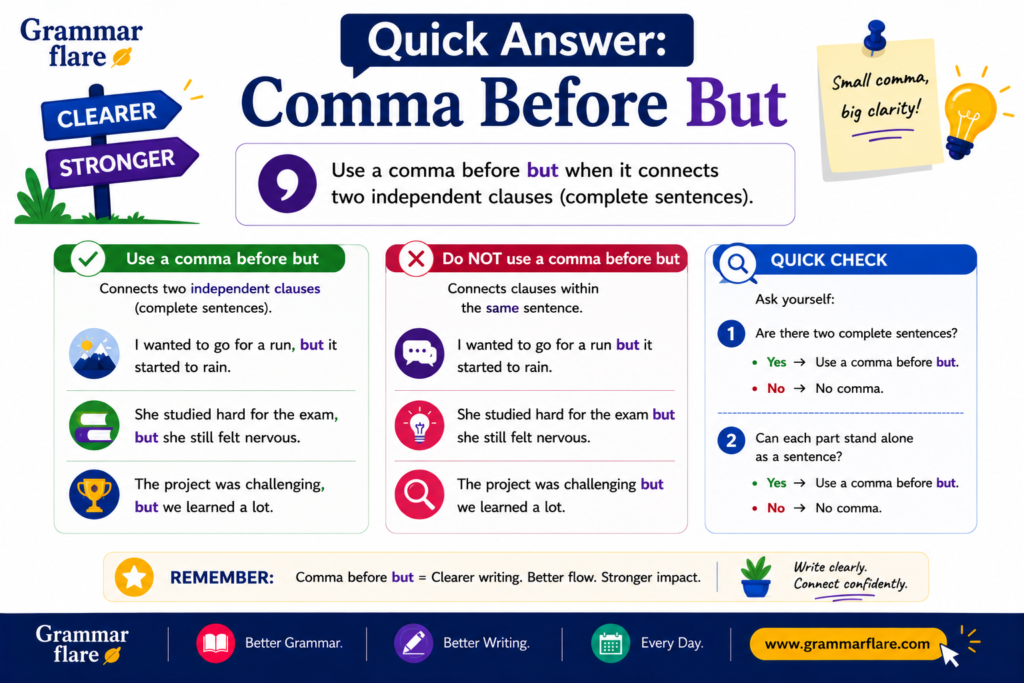
Use a comma before but when but connects two independent clauses.
Correct: I wanted to leave early, but the meeting ran long.
Do not use the comma when but connects a word, a phrase, or another incomplete part of a sentence.
Correct: The meeting was long but useful.
The quick test is easy: read the words before but, then read the words after but. If both sides can stand alone as complete sentences, use the comma. If one side cannot stand alone, leave it out.
For more help, browse the punctuation rules hub.
Simple Rule
The basic comma rule is this:
Complete sentence + but + complete sentence = use a comma before but.
Here is the same rule in a sentence:
I like the idea, but I need more time.
The first half, “I like the idea,” is a complete sentence. The second half, “I need more time,” is also a complete sentence. Because but joins two full thoughts, the comma belongs before the coordinating conjunction.
Now compare this sentence:
I like the idea but need more time.
This sentence does not need the comma. The words after but do not form a complete sentence because there is no subject. The subject “I” is understood from the first part, so the second part is only a verb phrase.
For word-pair help, see the to vs too guide.
When You Need a Comma Before But
You need the comma when but joins two independent clauses. In everyday terms, that means each side has enough information to stand alone.
Use the comma in sentences like these:
- I planned to call, but my phone died.
- The explanation was short, but it answered the question.
- She wanted to join us, but she had to finish work.
- The rule looks simple, but the examples make it easier to remember.
Each sentence has a complete thought on the left and a complete thought on the right. The comma signals that the first thought is ending and a contrast is beginning.
This pattern often appears when the second half pushes against the first half:
- I studied the rule, but I still made the mistake.
- The sentence sounded fine, but the punctuation was wrong.
- He knew the answer, but he could not explain why.
That contrast is exactly why but is useful. The comma helps the reader see the turn clearly.
When You Do Not Need a Comma Before But
Do not add a comma when but joins two smaller parts of one sentence. Those smaller parts may be adjectives, nouns, verbs, or phrases.
No comma is needed here:
- The rule is simple but important.
- She was tired but focused.
- He wanted tea but not coffee.
- The sentence is long but still clear.
- I opened the draft but did not edit it.
In each example, the words after but are not a complete sentence. “Important,” “focused,” “not coffee,” “still clear,” and “did not edit it” all depend on the earlier part of the sentence.
A common mistake is putting a comma into a short contrast just because you hear a pause:
Incorrect: The rule is simple, but important.
Correct: The rule is simple but important.
The corrected version reads smoothly and follows the structure of the sentence.
Independent Clauses Explained Simply
An independent clause is a group of words that can stand alone as a sentence. It usually has a subject and a verb, and it expresses a complete thought.
These are independent clauses:
- I finished the draft.
- The comma belongs here.
- She checked the example.
These are not independent clauses:
- after the meeting
- but not today
- still useful
- needed more time
When you are checking punctuation with but, do not ask only whether the sentence sounds paused. Ask whether both sides are independent clauses.
Here is a quick comparison:
I finished the draft, but I need to proofread it.
Both sides are complete. Use the comma.
I finished the draft but need to proofread it.
The second side has no subject. Do not use the comma.
Correct Examples
Use these examples as models when you edit your own sentences:
- I wanted to reply, but I needed more time.
- The answer sounded right, but the example proved it was wrong.
- We can keep the sentence, but we should fix the punctuation.
- The guide is short but practical.
- She likes grammar but dislikes long explanations.
- The first draft was messy but promising.
- He read the rule, but he forgot the exception.
- The message was polite but too vague.
Notice how the comma appears only when both sides can stand alone. The shorter no-comma examples still show contrast, but they do not join two full sentences.
Incorrect Examples
These examples show the most common errors:
- Incorrect: I wanted to reply but I needed more time.
- Incorrect: The answer sounded right but the example proved it was wrong.
- Incorrect: The guide is short, but practical.
- Incorrect: She likes grammar but, dislikes long explanations.
- Incorrect: The first draft was messy, but promising.
The first two examples need a comma because both sides are complete sentences. The third and fifth examples use a comma before a phrase, so the punctuation interrupts the flow. The fourth example puts the comma after but, which is not the normal place for this rule.
Side-by-Side Examples
Example 1
Sentence: I wanted to call, but my phone died.
Comma? Yes.
Why: Both sides are complete sentences.
Example 2
Sentence: The answer is short but useful.
Comma? No.
Why: “Useful” is an adjective, not a complete sentence.
Example 3
Sentence: She practiced, but she wanted one more example.
Comma? Yes.
Why: But joins two independent clauses.
Example 4
Sentence: He was tired but focused.
Comma? No.
Why: But joins two adjectives.
Example 5
Sentence: The rule looks easy, but it takes practice.
Comma? Yes.
Why: Each side has its own subject and verb.
Example 6
Sentence: I opened the email but did not answer it.
Comma? No.
Why: The second part shares the subject I.
These examples show why structure matters more than sentence length.
Before and After Corrections
Correction 1
Before: I wanted to reply but I needed more time.
After: I wanted to reply, but I needed more time.
What changed: Added the comma between two complete sentences.
Correction 2
Before: The answer was short, but useful.
After: The answer was short but useful.
What changed: Removed the comma before a single adjective.
Correction 3
Before: She opened the file but, it would not load.
After: She opened the file, but it would not load.
What changed: Moved the comma before the conjunction.
Correction 4
Before: The lesson was simple, but helpful.
After: The lesson was simple but helpful.
What changed: Removed punctuation before a phrase.
Correction 5
Before: He checked the rule but he missed the example.
After: He checked the rule, but he missed the example.
What changed: Added punctuation between two independent clauses.
These corrections use the same pattern. Check whether the words after but can stand alone, then add or remove the comma.
Common Mistakes
The first common mistake is using a comma whenever you hear a pause. Pauses can help you notice contrast, but they are not reliable enough on their own. Use the clause test instead.
For another quick comparison, see than vs then.
The second mistake is forgetting the comma in short sentences:
Incorrect: I tried but I failed.
Correct: I tried, but I failed.
Both sides are short, but both sides are complete.
The third mistake is adding a comma before a phrase:
Incorrect: The lesson was brief, but helpful.
Correct: The lesson was brief but helpful.
“Helpful” is not a sentence. It completes the description started before but.
The fourth mistake is placing the comma after but:
Incorrect: I wanted to call but, my phone died.
Correct: I wanted to call, but my phone died.
For this punctuation pattern, the comma goes before the coordinating conjunction.
Special Cases and Style Notes
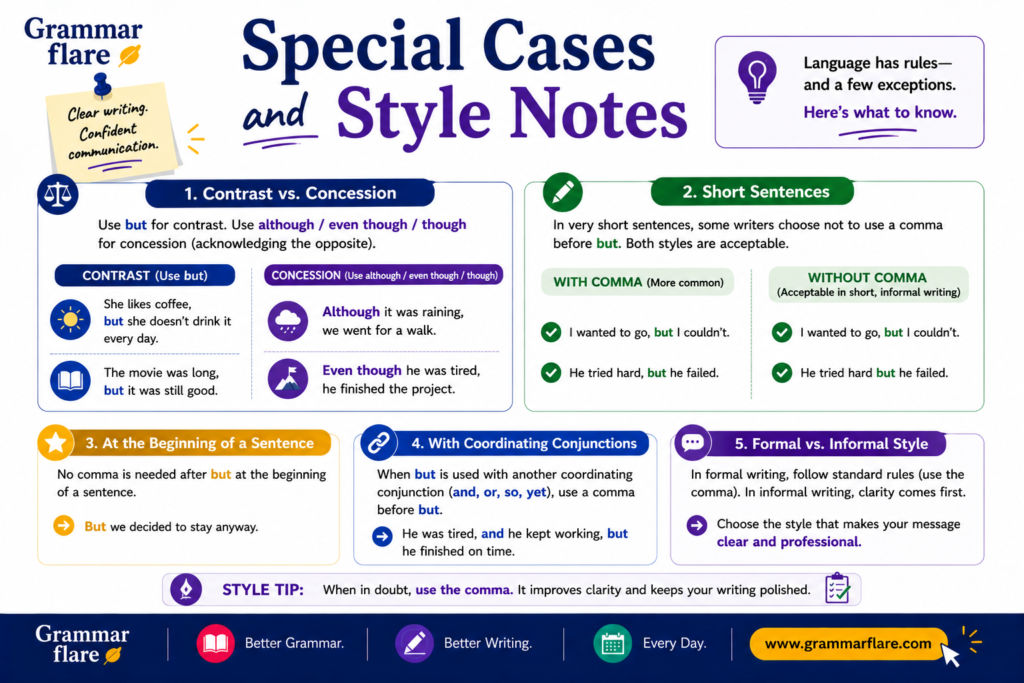
Sometimes you may see a comma before a short phrase for dramatic emphasis, especially in creative writing. That choice is stylistic, not the standard rule for school, business, or web writing. For Grammar Flare drafts and most everyday writing, keep the punctuation tied to sentence structure.
You may also see a comma after but when an interrupting phrase follows it:
I wanted to call, but, to be honest, I forgot.
That sentence is grammatical, but it is heavier than most readers need. A cleaner version is usually better:
I wanted to call, but I forgot.
When a sentence starts to need several punctuation decisions, consider rewriting it. Clearer wording often helps more than extra marks.
How to Check Your Own Sentence
Use this quick editing process:
- Find the word but.
- Read the words before it.
- Ask, “Could this stand alone as a sentence?”
- Read the words after it.
- Ask the same question again.
- If both answers are yes, put the comma before but.
- If either answer is no, skip the comma.
Try it with this sentence:
The explanation was clear but too long.
“The explanation was clear” is complete. “Too long” is not. That means no comma.
Now try this one:
The explanation was clear, but it was too long.
Both sides are complete. That means the comma belongs before but.
Checklist
Use this checklist before you publish a sentence:
- Does but join two complete sentences?
- Does each side have its own subject and verb?
- Would each side still make sense if you put a period between them?
- If the right side is only a word or phrase, did you leave the comma out?
- Is the comma placed before but, not after it?
- Would rewriting make the sentence clearer than adding more punctuation?
If the first three answers are yes, you probably need the comma. If the right side is only a phrase, skip it.
Memory Trick
Use this memory trick: complete plus complete gets the comma.
If the left side is complete and the right side is complete, the comma acts like a small traffic sign. It tells the reader, “One idea is ending, and a contrast is coming.”
If the right side is only a word or phrase, the sign is not needed. The sentence is already moving in one smooth line.
Mini Quiz
Choose the correct sentence in each pair.
A. I liked the first draft, but I changed the ending.
B. I liked the first draft but I changed the ending.A. The answer was simple, but helpful.
B. The answer was simple but helpful.A. She wanted to join us, but she had a deadline.
B. She wanted to join us but she had a deadline.A. The email was short but clear.
B. The email was short, but clear.A. He opened the file, but it would not load.
B. He opened the file but it would not load.
Answers: 1A, 2B, 3A, 4A, 5A.
The reason is the same each time. Use the comma when but joins two complete sentences. Leave it out when but joins smaller parts of one sentence.
Helpful References
Related Grammar Flare Guides
- punctuation rules
- commonly confused words
- plural nouns
- conversation skills
- better ways to say things
- titles and greetings
FAQs
Do you always need a comma before but?
No. Use one when but joins two complete sentences. Leave it out when but joins words, phrases, or incomplete thoughts.
What if the words after but are not a complete sentence?
Do not add the comma. A phrase such as ‘but helpful’ or ‘but not today’ is not a complete sentence, so the comma usually gets in the way.
Can I use a comma with but for emphasis?
Usually, no. In polished writing, base the comma on sentence structure. If you want emphasis, rewrite the sentence instead of adding punctuation that the grammar does not need.
How can I check the rule quickly?
Read each side of but by itself. If both sides can stand alone as sentences, put the comma before the conjunction.
Summary Box
Key point: Use the comma when but joins two complete sentences. Skip it when but joins words, phrases, or shared sentence parts. If you are unsure, read each side by itself and check whether both sides can stand alone.
Final Takeaway
Remember the simple test: complete sentence plus but plus complete sentence needs the comma. If but joins only words or phrases, skip it. That one check will fix most mistakes with this punctuation pattern.
