
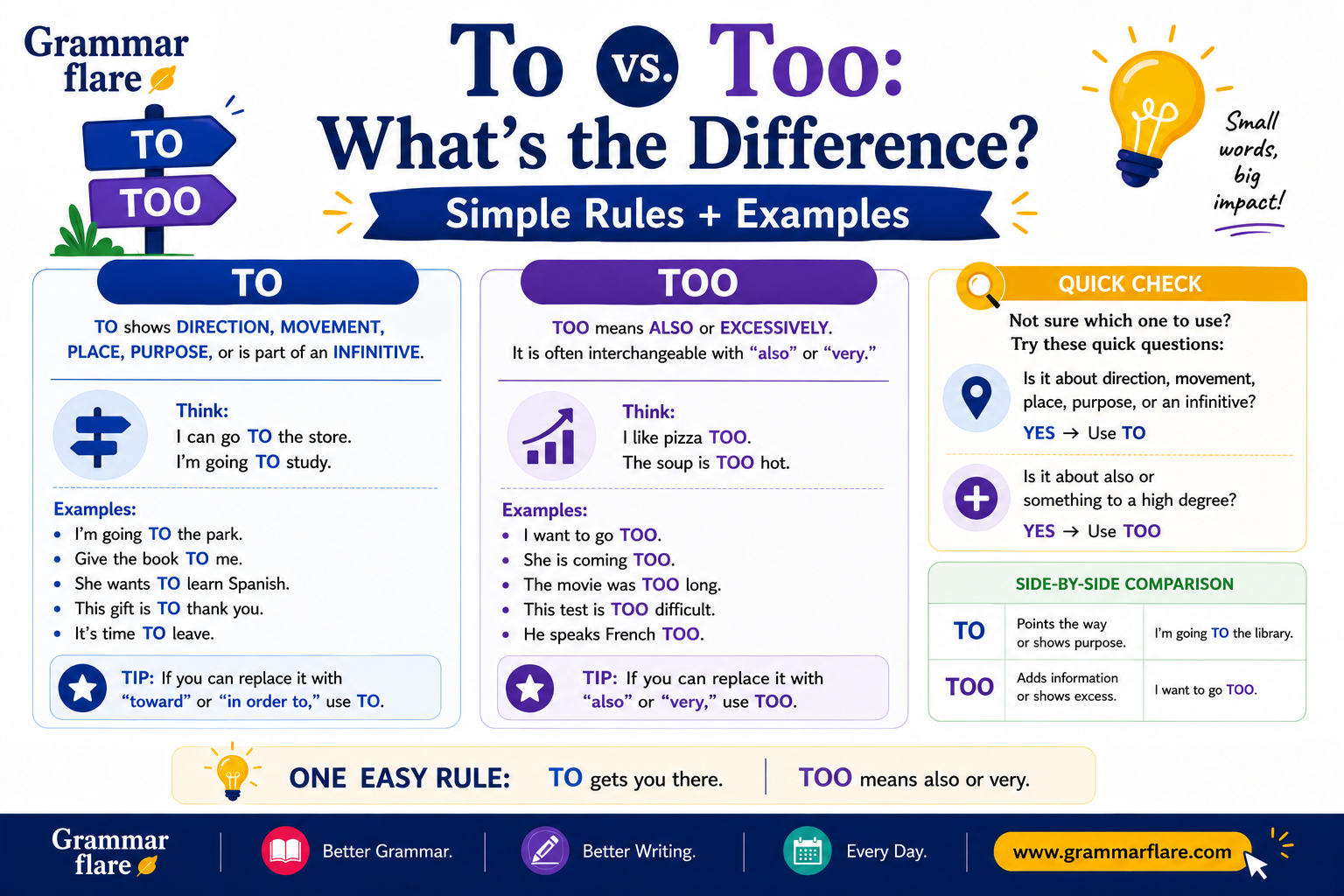
If you mix up to vs too, you are not alone. These two short words appear everywhere in English, and they often sound the same in normal speech. That makes them one of the most common grammar mistakes in emails, school assignments, text messages, captions, and website copy.
The good news is that the rule is simple once you know what to check.
Quick Answer
Use to for direction, purpose, connection, or as part of a verb. Use too to mean also or more than enough.
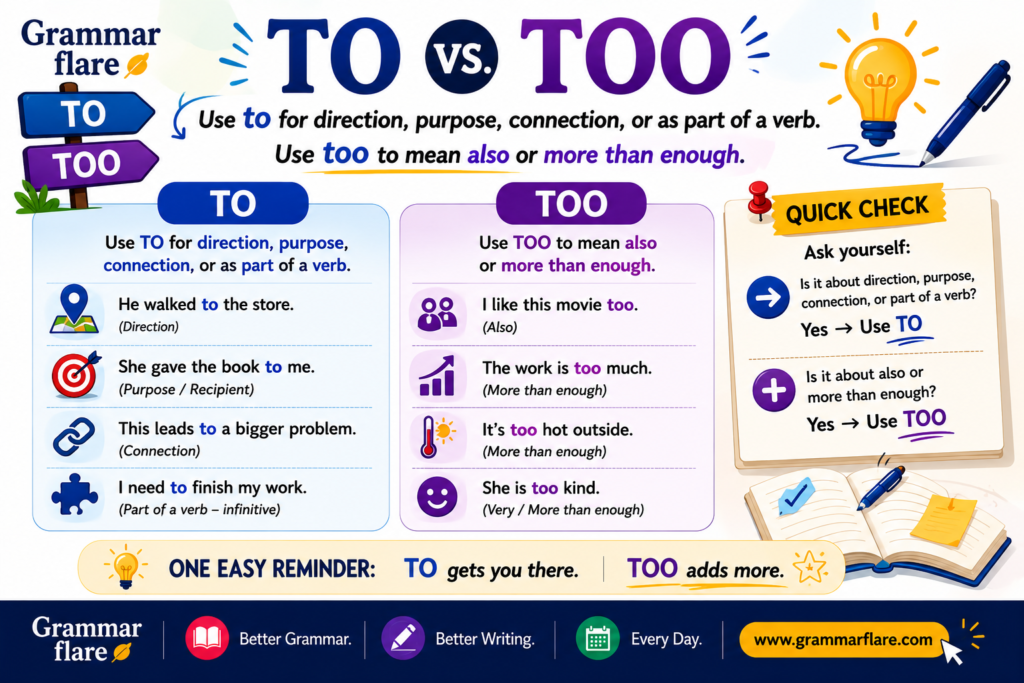
Examples:
- I am going to the store.
- I want to learn faster.
- I want coffee too.
- This bag is too heavy.
If you can replace the word with also, as well, or excessively, use too. In most other cases, use to.
What Is the Difference Between To and Too?
The main difference is simple:
- to is the everyday workhorse word in English
- too adds the idea of also or extra
That means to often shows direction, purpose, range, or connection, while too usually adds meaning like “in addition” or “more than needed.”
To vs Too in One Table
| Word | Main meaning | Common job in a sentence | Example |
|---|---|---|---|
| to | direction, purpose, relationship, infinitive marker | preposition or particle | We drove to the airport. |
| too | also; more than enough | adverb | She wants to come too. |
The Rule in One Sentence
Use too when you mean also or extra. Use to almost everywhere else.
That is the fastest way to remember the difference.
When Should You Use To?
To has several jobs in English, which is why you see it so often.
1. Use To for Direction or Destination
Use to when something moves toward a place, person, or target.
Examples:
- We walked to the library.
- Send the email to Carlos.
- She drove to work early.
2. Use To as Part of a Verb
Use to before the base form of a verb in an infinitive.
Examples:
- I want to improve my writing.
- They plan to travel next month.
- She forgot to lock the door.
This is one of the most common uses of to in English.
3. Use To for Range, Relationship, or Comparison
You also use to in expressions that show a relationship between two things.
Examples:
- The score was 4 to 2.
- I prefer tea to coffee.
- The office is open from 9 to 5.
When Should You Use Too?
Too has a much narrower job than to, which makes it easier to spot once you know the pattern.
1. Use Too to Mean Also
If too means also, as well, or in addition, then too is correct.
Examples:
- I would like dessert too.
- She speaks Spanish and French too.
- If you are going, I want to come too.
2. Use Too to Mean More Than Enough
Use too when something is more than needed, more than wanted, or more than is comfortable.
Examples:
- This room is too cold.
- The test was too long.
- He arrived too late to join the call.
You will often see this pattern with adjectives and adverbs:
- too loud
- too expensive
- too quickly
- too far
Do You Put a Comma Before “Too”?
This is the question that comes after the spelling one, and the guides do not fully agree.
When too means also and sits at the end of a sentence, the comma is optional:
- I liked the film too.
- I liked the film, too.
Both are correct. The comma adds a slight pause and a little emphasis, which is why it often appears in more formal writing. Chicago treats it as optional and driven by the writer’s intended emphasis. AP, which is comma-light generally, usually leaves it out.
The comma matters more in the middle of a sentence, where it sets too off from what surrounds it:
- She, too, had forgotten the deadline.
Here the commas are standard, because too is interrupting the sentence rather than finishing it.
What to do: pick one habit for sentence-final too and keep it consistent within a document. Always use the pair of commas when too falls mid-sentence.
Quick Test: Should You Use To or Too?
When you are not sure which word is correct, use this fast check:
- Try replacing the word with also or as well.
- If the sentence still works, use too.
- If not, ask whether the word shows direction, purpose, connection, or belongs before a verb.
- If yes, use to.
Examples:
- I am going ___ call her later.
You cannot say I am going also call her later, so the correct word is to. - Do you want to join us ___?
You can say Do you want to join us also?, so the correct word is too. - The soup is ___ salty.
You can say The soup is excessively salty, so the correct word is too.
Common To vs Too Mistakes
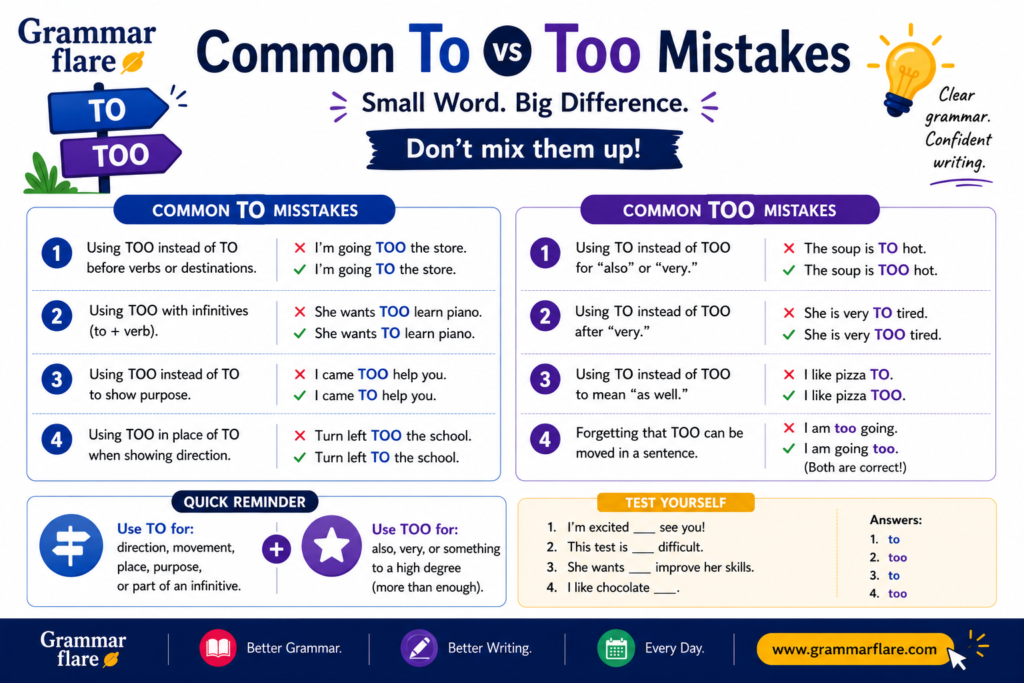
These errors are common because both words are short and often unstressed in speech.
Mistake 1: Using Too Instead of To Before a Verb
Incorrect:
- I am going too study tonight.
Correct:
- I am going to study tonight.
Why? Because the word is part of the verb phrase to study, not the word also.
Mistake 2: Using To When You Mean Also
Incorrect:
- Can I come to?
Correct:
- Can I come too?
Why? Because the sentence means also.
Mistake 3: Using To When You Mean Excessively
Incorrect:
- This coffee is to hot.
Correct:
- This coffee is too hot.
Why? Because the sentence means more than comfortable or more than wanted.
What About Two?
Many writers confuse to, too, and two together.
Here is the quick difference:
- to = direction, purpose, connection, or part of a verb
- too = also or more than enough
- two = the number 2
Examples:
- I brought two notebooks to class too.
- We have two options to discuss.
If your sentence refers to a number, use two, not to or too.
To vs Too Examples in Everyday Writing
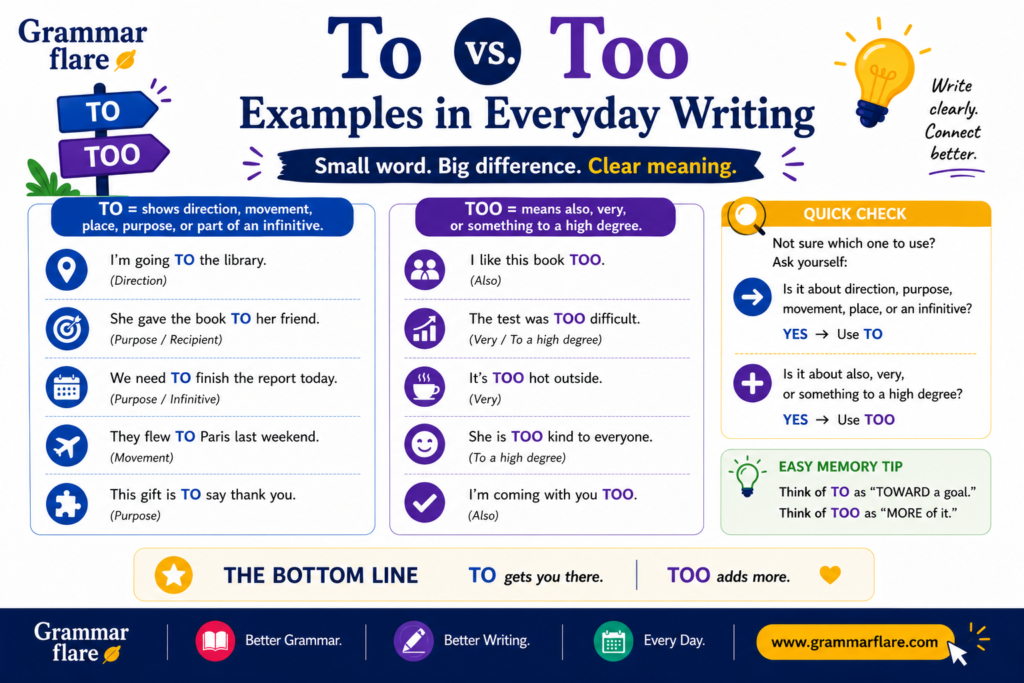
Here are more examples you can use as a model.
Everyday Conversation
- I need to leave now.
- Do you want to sit here?
- I like that song too.
- It is too noisy in this room.
School Writing
- The student tried to answer every question.
- This paragraph is too long and needs editing.
- I want to improve my grammar skills.
- The explanation was too vague.
Work and Professional Writing
- Please send the document to the manager.
- We need to update the website copy.
- The deadline is too close for a full redesign.
- I would like to review that proposal too.
Social Media and Casual Writing
- I want to try that restaurant.
- That joke was too good.
- She posted the photo, and I shared it too.
- It is too late to pretend I am not hungry.
Easy Memory Trick
The easiest memory trick is this:
Too has an extra O, and that extra letter reminds you of something extra.
That works in both common meanings:
- too = also
An extra person or thing is included. - too = more than enough
There is extra amount or extra intensity.
By contrast, to is the shorter everyday form that handles direction, purpose, and verb phrases.
Why People Mix Up To and Too
There are three main reasons this mistake happens:
- They sound the same in most spoken English.
- To is one of the most common words in English, so writers type it automatically.
- Too is short, so small spelling errors are easy to miss during proofreading.
That is why a simple last-pass grammar check matters. If you often slow down over small wording choices, The same instinct causes the same slip elsewhere. Our guides to your versus you’re and affect versus effect cover two more pairs that spell-check waves straight through.
Final Takeaway
If you only remember one thing, remember this:
Use to for direction, purpose, and verbs. Use too for also or more than enough.
When you proofread, test the sentence with also or excessively. If that replacement works, you probably need too. If not, to is usually the right choice.
FAQ
What is the difference between to and too?
To usually shows direction, purpose, connection, or appears before a verb. Too means also or more than enough.
When should I use too?
Use too when you mean also, as well, or excessively.
Examples:
- I want to go too.
- This backpack is too heavy.
Is it ever correct to end a sentence with too?
Yes. That is common when too means also.
Example:
- I liked the movie too.
Is to always a preposition?
No. To can be a preposition, but it can also be part of an infinitive verb phrase, as in to write or to learn.
What is the difference between to, too, and two?
- to shows direction, purpose, or connection
- too means also or more than enough
- two is the number 2
How can I remember to vs too fast?
Remember that too has an extra o, and that extra letter points to the idea of extra. That makes it easier to connect too with also or more than enough.
Do you need a comma before “too”?
At the end of a sentence it is optional: I liked it too and I liked it, too are both correct. Mid-sentence, use a pair of commas: She, too, had forgotten.
More Reading at GrammarFlare
- Your vs You’re
- It’s vs Its
- There vs Their vs They’re
- Than vs Then
- Affect vs Effect
- Commonly Confused Words
Sources

Ahmad Waheed has spent five years editing academic and professional writing for universities, publishers, and software companies. He founded Grammar Flare after noticing the same handful of mistakes in almost every draft that crossed his desk, and that most grammar guides explained the rule without explaining when it actually matters.
Ahmad writes every guide on this site, checking usage questions against Merriam-Webster, the Chicago Manual of Style, and the AP Stylebook, and noting where those sources disagree rather than quietly picking a side.