

If you mix up lose vs loose, you are not alone. These two words look very similar, but they do not mean the same thing. One is usually an action word, and the other usually describes something that is not tight.
This small spelling difference causes a big number of writing mistakes in emails, assignments, captions, resumes, and everyday messages. If you like clear, practical GrammarFlare guides such as Your vs You’re: Simple Rule, Examples, and Easy Memory Trick or It’s vs. Its: Simple Rule, Examples, and Easy Memory Trick.
Quick Answer
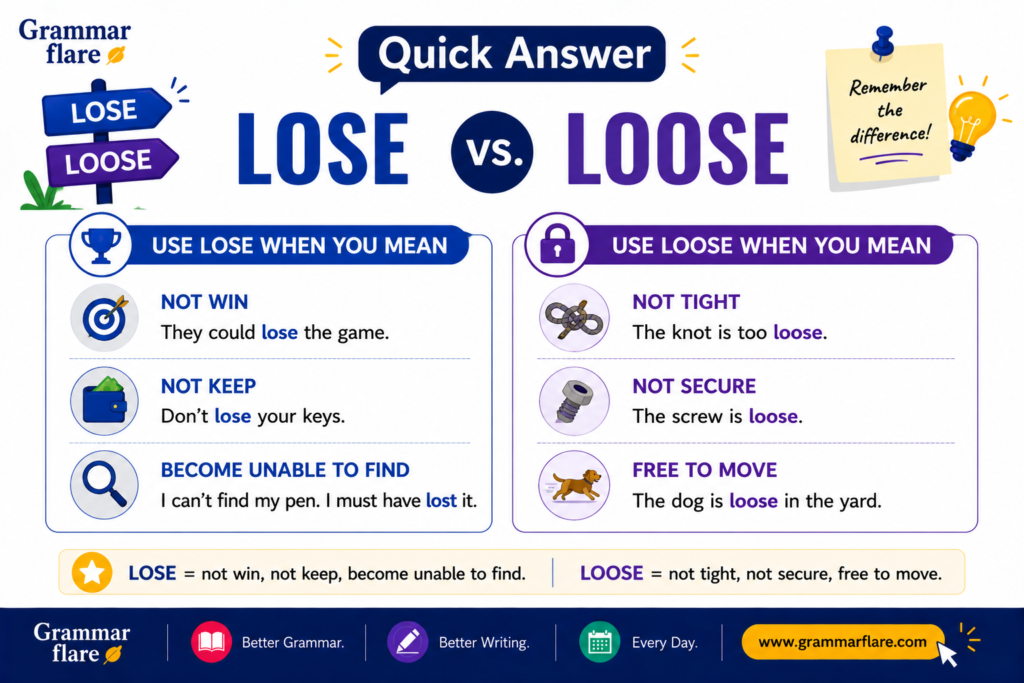
Use lose when you mean not win, not keep, or become unable to find something. Use loose when you mean not tight, not secure, or free to move.
Examples:
- I do not want to lose my keys.
- That screw is loose.
- Our team might lose the game.
- Her shoelace is loose.
If the sentence needs an action, use lose. If the sentence describes the condition of something, use loose.
The Rule in One Sentence
Lose is about losing something. Loose is about extra space or something that is not tight.
Lose vs. Loose in One Table
| Word | Usual part of speech | Main meaning | Example |
|---|---|---|---|
| lose | verb | fail to keep, fail to win, misplace, become without | Do not lose your ticket. |
| loose | adjective | not tight, not secure, free | This handle feels loose. |
What Does Lose Mean?
Lose is a verb. It shows an action or result.
1. Use Lose for Not Winning
Use lose when a person or team does not win.
Examples:
- We could lose the match if we stop focusing.
- She hates to lose at cards.
- They did not want to lose the election.
2. Use Lose for Misplacing Something
Use lose when something is no longer in your control or you cannot find it.
Examples:
- Try not to lose your phone at the airport.
- I always lose one sock in the laundry.
- He does not want to lose the document before the meeting.
3. Use Lose for No Longer Having Something
You can also use lose when you become without something.
Examples:
- She hopes not to lose her job.
- The company could lose money this quarter.
- He wants to lose weight before the race.
In each example, lose shows that something is gone, reduced, or no longer kept.
What Does Loose Mean?
Loose is usually an adjective. It describes the condition of something.
1. Use Loose for Something That Is Not Tight
This is the most common use of loose.
Examples:
- These jeans feel loose after washing.
- One tooth is loose.
- Her watch strap is too loose.
2. Use Loose for Something Not Securely Attached
Use loose when something is shaky, detached, or not firmly held in place.
Examples:
- The doorknob is loose.
- A loose wire can be dangerous.
- The bike chain is loose.
3. Use Loose for Something Free or Uncontrolled
Sometimes loose describes something that is free to move, not contained, or not strict.
Examples:
- The dog got loose in the yard.
- There is some loose paper on the desk.
- They had only a loose plan for the weekend.
In everyday writing, loose is almost always an adjective.
What About “Loss”?
There is a third word in this group, and leaving it out is why some writers still get stuck after learning the first two.
Loss is the noun. It names the thing that happens when you lose something.
- The company reported a loss this quarter.
- Her loss of income made the move difficult.
- It was a narrow loss in the final.
So the three words split cleanly by job:
| Word | Part of speech | Example |
|---|---|---|
| lose | verb | We might lose the game. |
| loss | noun | It was a painful loss. |
| loose | adjective | The handle is loose. |
A quick check: if you can put a or the in front of it, you want loss. You can say a loss, but not a lose.
Why Do People Confuse Lose and Loose?
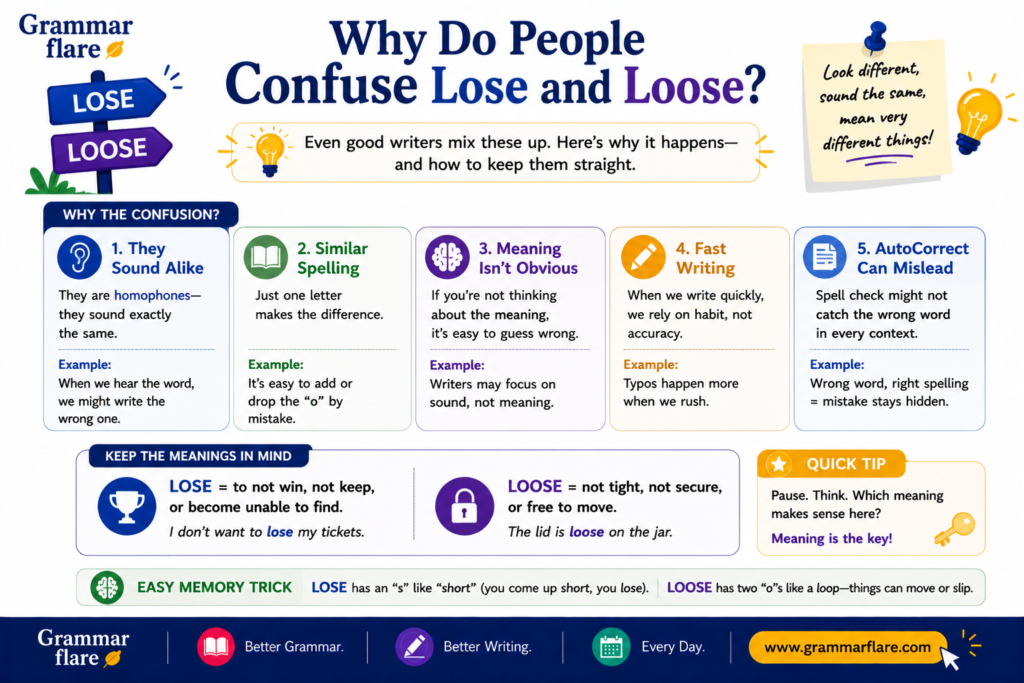
There are a few reasons:
- the words look almost the same
- both relate to ideas of separation or lack of control
- many writers type quickly and rely on visual memory
- the pronunciation difference is small: lose ends with a z sound, while loose ends with an s sound
Lose rhymes with choose. Loose rhymes with goose. Saying the sentence aloud catches the error faster than looking at it does.
That is why a quick proofreading check matters. If you often mix up similar pairs, GrammarFlare’s guide to Affect vs. Effect: What’s the Difference? Simple Rules + Examples can help you practice the same kind of word-choice awareness.
Common Lose vs. Loose Mistakes
Here are some mistakes people make all the time:
- Wrong: I do not want to loose my keys.
- Right: I do not want to lose my keys.
- Wrong: My shoes are lose.
- Right: My shoes are loose.
- Wrong: We might loose the game.
- Right: We might lose the game.
- Wrong: That button is lose.
- Right: That button is loose.
The shortcut is simple: if the word names an action, choose lose. If it describes a fit or condition, choose loose.
Quick Proofreading Test
When you are not sure which word to use, ask these questions:
1. Does the sentence mean not win, not keep, or not find?
If yes, use lose.
Example:
- I do not want to lose this chance.
2. Does the sentence mean not tight or not secure?
If yes, use loose.
Example:
- This shelf feels loose.
3. Can you imagine the word describing a physical fit?
If yes, loose is probably correct.
Example:
- The lid is too loose.
4. Does the word need to show an action happening?
If yes, use lose.
Example:
- They could lose control of the match.
Easy Memory Trick for Lose vs. Loose
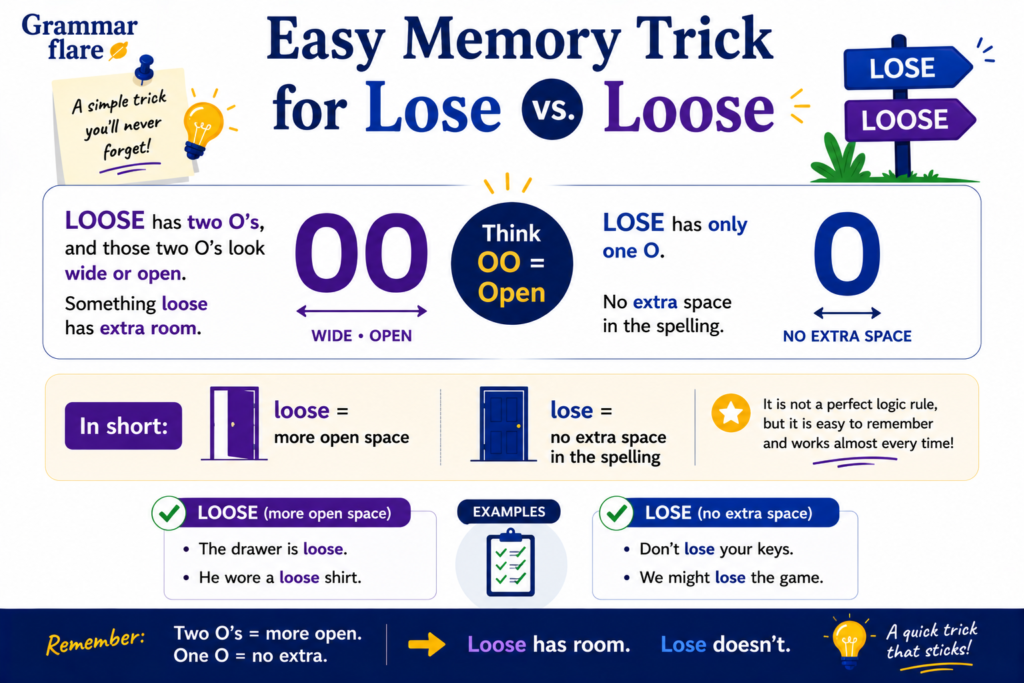
The best memory trick is this:
Loose has two O’s, and those two O’s look wide or open. Something loose has extra room. Lose has only one O.
That means:
- loose = more open space
- lose = no extra space in the spelling
It is not a perfect logic rule, but it is easy to remember during proofreading.
Lose vs. Loose Examples in Sentences
Here are more side-by-side examples:
Lose Examples
- Be careful not to lose your passport.
- If we stop now, we could lose momentum.
- She does not want to lose contact with old friends.
- He is trying to lose ten pounds.
Loose Examples
- The hinge is loose.
- She wore a loose sweater.
- One page came loose from the notebook.
- The horse got loose after the gate opened.
Practice Sentences
Choose the correct word in each sentence.
- I do not want to (lose / loose) my wallet.
- This zipper feels (lose / loose).
- Our team could (lose / loose) the final.
- One tile in the kitchen is (lose / loose).
- If you do not save the file, you may (lose / loose) your work.
- His tie is too (lose / loose) for the interview.
Answers
- lose
- loose
- lose
- loose
- lose
- loose
Lose vs. Loose for English Learners
If English is not your first language, this pair can be frustrating because the spelling difference is small. Focus on the job of the word:
- lose does something
- loose describes something
That single check will solve most cases. When you edit your writing, slow down around short, familiar words. They are often the easiest mistakes to miss.
If you slip on this pair, you probably slip on the others too. Our guides to to versus too and than versus then cover two more that spell-check waves through.
Final Takeaway
The difference between lose and loose is simple once you separate action from description.
- use lose for not winning, not keeping, or misplacing
- use loose for not tight, not secure, or free
If you remember that loose has extra room in the spelling, you will catch this mistake much faster.
FAQ
What is the difference between lose and loose?
Lose is a verb that means fail to keep, fail to win, or misplace. Loose is usually an adjective that means not tight or not secure.
Is it lose weight or loose weight?
The correct phrase is lose weight. Here, lose is a verb that means reduce or get rid of something.
Is loose ever correct as a verb?
Yes, but it is uncommon in everyday writing. In rare cases, loose can mean release, as in to loose the dogs. Most writers rarely need that meaning.
Which word means not tight?
Loose means not tight.
Which word means fail to win?
Lose means fail to win.
How can I remember lose vs. loose quickly?
Remember that loose has two O’s, which look more open. That visual can remind you that loose means not tight.
Is it “lose” or “loss”?
Lose is the verb and loss is the noun. You lose a match, and the result is a loss. If the word follows a or the, you need loss.
More Reading at GrammarFlare
Sources Used

Ahmad Waheed has spent five years editing academic and professional writing for universities, publishers, and software companies. He founded Grammar Flare after noticing the same handful of mistakes in almost every draft that crossed his desk, and that most grammar guides explained the rule without explaining when it actually matters.
Ahmad writes every guide on this site, checking usage questions against Merriam-Webster, the Chicago Manual of Style, and the AP Stylebook, and noting where those sources disagree rather than quietly picking a side.