
You’re writing a professional email to a woman you’ve never met. You type “Dear” and then freeze. Ms.? Mrs.? Miss? You pick one, second-guess it, delete it, try again. It feels like a small thing, but getting it wrong can make the wrong impression before you’ve said anything at all. Knowing when to use the title Ms., and when Mrs. or Miss is the better fit, is one of those practical writing skills that pays off every time you sit down to draft a professional message.
This kind of hesitation is common, and it’s completely fixable. The three titles follow a clear logic once you understand what each one signals. At Grammar Flare, we cover exactly these kinds of everyday writing decisions: the ones that seem minor but matter more than people realize. This guide breaks down all three titles so you know what each means, when to use which one, how to punctuate them correctly in American English, and what to do when you genuinely don’t know someone’s preference.
What the title “Ms.” actually means
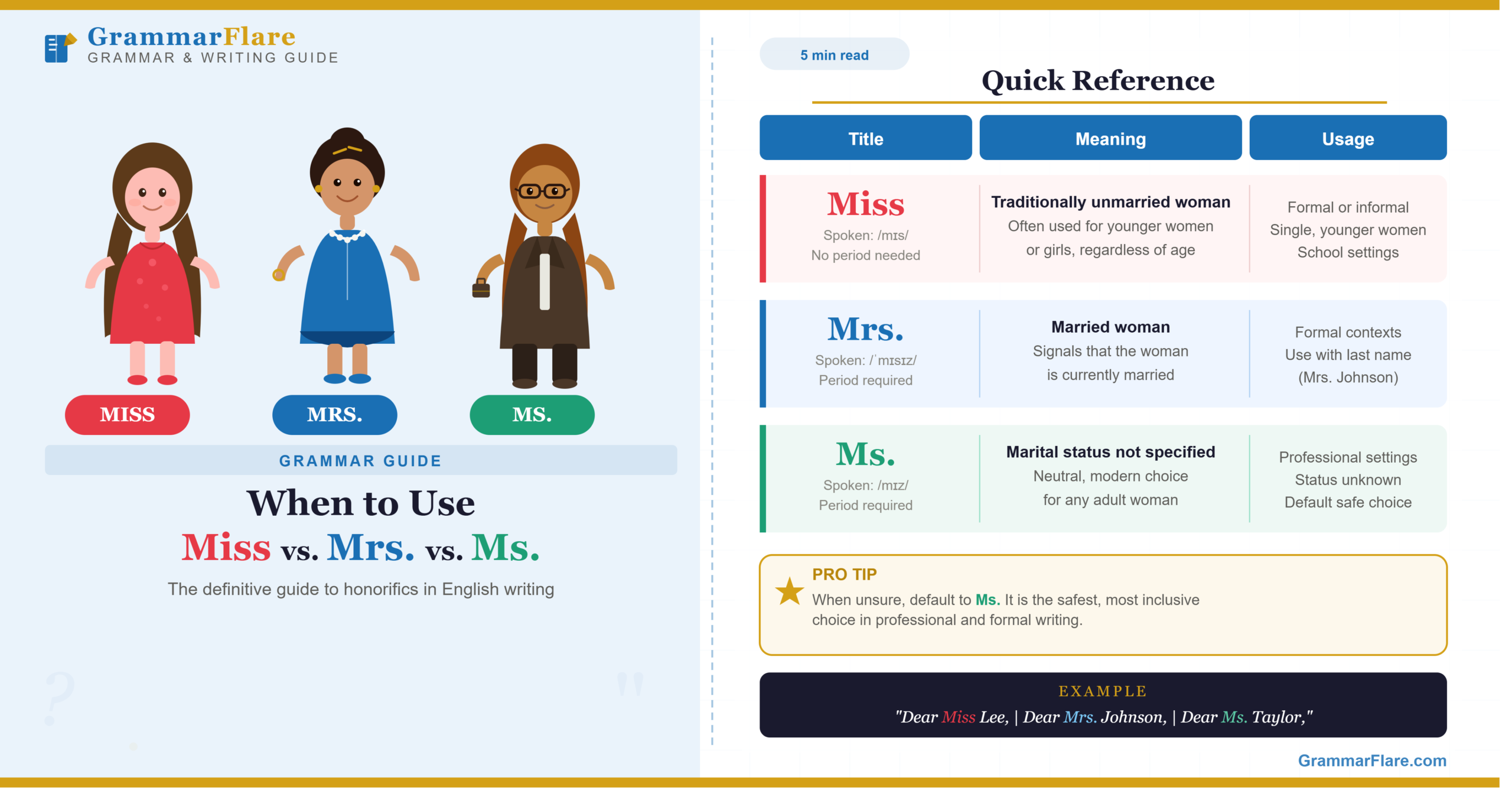
“Ms.” is a marriage-status-neutral title for a woman. It doesn’t tell you whether she’s married, single, divorced, or widowed. That’s the whole point: it functions exactly the way “Mr.” functions for men, conveying respect without requiring any personal information about the person’s relationship status.
The title has older roots, tracing back to abbreviations of “Mistress” used centuries ago, but its modern form gained real momentum in the 20th century. Proposals for a neutral female title appeared as early as 1901, and by the 1960s feminist advocates were promoting “Ms.” as the professional standard. After Gloria Steinem named her magazine Ms. in 1972, its cultural visibility expanded rapidly. By the 1980s, even the New York Times had adopted it. The practical reason “Ms.” exists is straightforward: professional correspondence needed a way to address women without requiring or revealing marital status, the same way “Mr.” has always worked for men.
When to Use the Title Ms. vs. Mrs. vs. Miss
“Mrs.” signals that a woman is married and has chosen that title. It’s appropriate when you know both of those things. In traditional personal contexts, handwritten notes, formal invitations to people you know well, or wedding correspondence, “Mrs.” has a clear place. In professional settings, though, defaulting to “Mrs.” for a woman you don’t know well is a mistake. You’re making an assumption about her personal life that she may not want made, and she may not use that title at all.
“Miss” is traditionally used for unmarried women and girls. In modern professional writing, it can come across as dated when applied to adult women, and in some contexts it carries a condescending tone. It’s still appropriate for young girls and for women who have stated they prefer it. Outside those situations, especially in any formal workplace or business context, “Miss” is rarely the right call for an adult woman you don’t know. For a clear overview of the common distinctions and when to choose each form, see this guide on the difference between Ms., Mrs., and Miss.
“Ms.” is the safe professional default. When you don’t know a woman’s preference, “Ms.” removes the guesswork entirely. It respects her privacy, makes no assumptions, and fits every professional context. It mirrors how you’d address a man without having to ask anything personal about him first.
When to Use the Title Ms. in Professional Emails and Formal Letters
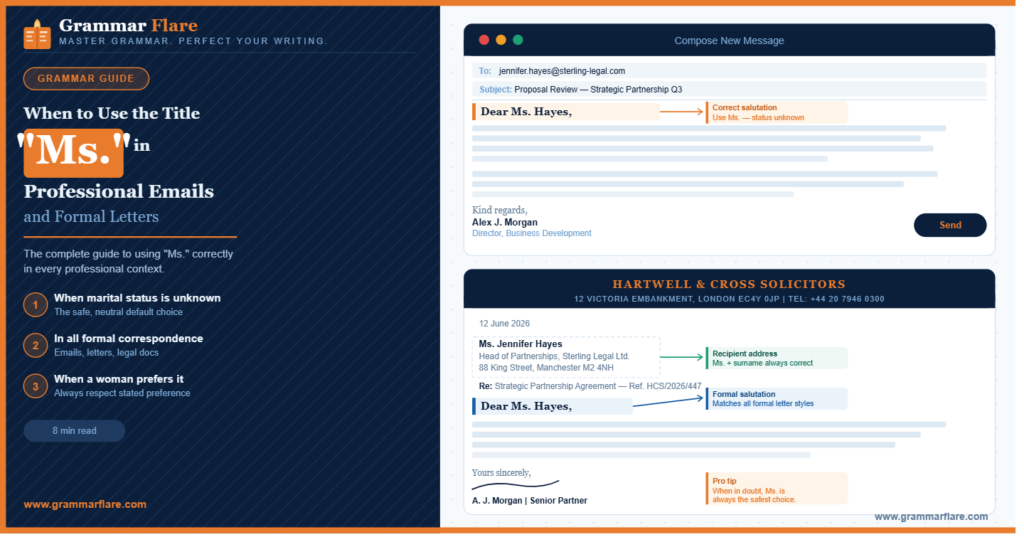
In business emails, “Dear Ms. [Last Name],” is the standard salutation when you’re addressing a woman whose preference you don’t know. This applies whether you’re reaching out to a potential client, writing to a hiring manager, or following up after a meeting. The logic is simple: it’s neutral, respectful, and parallel to “Dear Mr. [Last Name],” which you’d use for a man without a second thought.
Email salutations
For everyday professional emails, “Dear Ms. Johnson,” is your go-to. The comma after the salutation is standard in email correspondence, and “Ms.” stays consistent regardless of what you know, or don’t know, about the recipient. One rule overrides everything else: if a woman has told you her preferred title, use it. Her stated preference always comes first, regardless of any default rule or style guide recommendation.
Formal letters and other written contexts
Formal business letters shift the punctuation slightly: “Dear Ms. Johnson:” uses a colon instead of a comma. This is standard in formal letter style and applies regardless of which title you’re using. Formal event invitations typically list “Ms.” before the last name or full name depending on the occasion and the invitation’s style. For wedding invitations specifically, “Ms.” is the appropriate choice on the outer envelope when addressing a woman whose preference is unknown or who uses that title. In workplace announcements and professional introductions, “Ms.” appears naturally and cleanly: “Please welcome Ms. Sarah Brown to the team.”
Punctuation and style guide rules for Ms. in American English
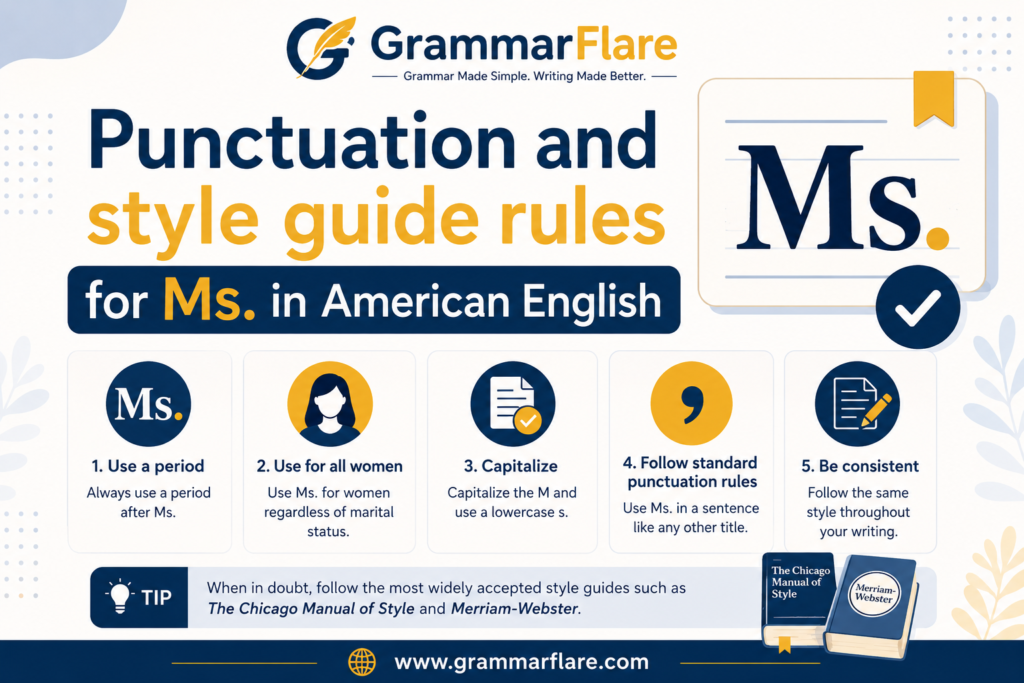
In American English, “Ms.” is always written with a period, in formal professional writing, leaving it out is an error. The period distinguishes American style from British English, where “Ms” without a period is standard. Any American professional writing context requires it.
The three major style guides approach “Ms.” consistently, though with some differences in when they recommend using titles at all:
- AP Style avoids courtesy titles like Ms., Mr., and Mrs. in most editorial contexts. It uses “Ms.” in direct quotations or when needed to distinguish between two people who share the same last name.
- Chicago Style recommends “Ms.” as the neutral default courtesy title for women when a title is needed in formal prose. Chicago treats it as the direct parallel to “Mr.” and does not make assumptions based on marital status.
- MLA Style accepts “Ms.” as the preferred courtesy title when one is appropriate in academic writing, following standard American punctuation conventions.
The practical takeaway for most writers: in professional emails, business letters, formal announcements, and workplace writing, “Ms.” with a period is the correct and appropriate choice across American style conventions.
Salutation templates you can use right now
The format of your salutation changes slightly depending on the context, but “Ms.” works cleanly in all of them. Here are ready-to-use examples:
For emails and business correspondence:
- Business email:
Dear Ms. Johnson, - Formal business letter:
Dear Ms. Johnson: - Letter addressing two people:
Dear Ms. Johnson and Mr. Williams: - Professional announcement:
Ms. Sarah Brown is pleased to announce...
For invitations and formal documents:
- Wedding invitation outer envelope:
Ms. Emily Jones - Formal event listing:
Ms. Sarah Brown and Mr. John Williams - Professional bio or introduction:
Ms. Brown joined the team in 2024...
Notice that the comma follows “Ms.” in email salutations, while a colon is standard in formal letters. That shift is a formatting rule, not a title rule, and it applies the same way regardless of which title you’re using. “Ms.” itself stays consistent across all of these formats. For additional ideas on salutation phrasing and context-specific greetings, see these salutation templates.
What to do when you don’t know someone’s preferred title
“Mx.” (pronounced “mix”) is the gender-neutral title for people who don’t identify with gendered titles or who prefer not to use “Mr.,” “Ms.,” “Mrs.,” or “Miss.” It does not indicate gender or marital status, and it appears in formal writing exactly the way other titles do: “Dear Mx. Taylor,” or “Mx. Jordan Smith attended the conference.” The critical point is that “Mx.” should only be used when a person has stated it as their preference. It’s not a default you assign when you’re unsure; it’s a title you use because someone has told you it’s theirs. For the term’s usage and background, see this entry on Mx. as a gender-neutral title.
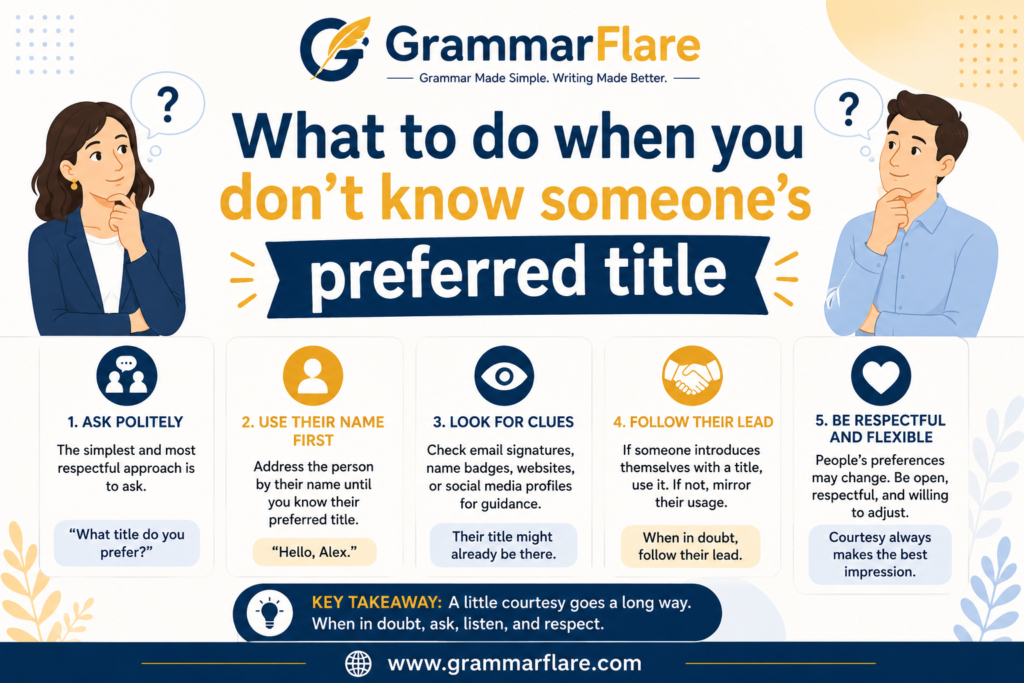
When you genuinely don’t know someone’s preferred title and can’t check, you have two solid options. The first is to ask. Requesting someone’s preferred title in contexts where it matters, such as workplace records or formal event registration, is a straightforward act of respect. It signals care, not awkwardness. The second option, when asking isn’t practical, is to skip the title entirely and use the person’s full name: “Dear Sarah Johnson,” is completely professional and sidesteps the problem without sounding careless or informal.
Both approaches work. What doesn’t work is guessing at “Mrs.” or “Miss” for an adult woman you don’t know, because both choices carry assumptions that may be wrong or unwelcome. For everything else, ask or use the full name.
The short version, ready to use
“Ms.” is the correct default title for adult women in professional writing when you don’t know their preference. “Mrs.” and “Miss” both have their place, but only when you know a woman uses them. In American English, always write “Ms.” with a period, use a comma after the salutation in emails, and use a colon in formal letters. Understanding when to use the title Ms., and when to reach for an alternative, is a small skill with a real impact on how professional your writing reads.
Titles and honorifics are one piece of a larger set of professional writing decisions, and small choices like these shape how competent and considerate you come across on the page. Grammar Flare publishes practical guides on exactly these topics: formal versus informal writing, salutation styles, and the situational language choices that make written communication sharper and more confident. Learn more about our mission on our About Us, Grammar Flare page.
The next time you start a salutation, you won’t freeze. You’ll know exactly which title to reach for and why.