
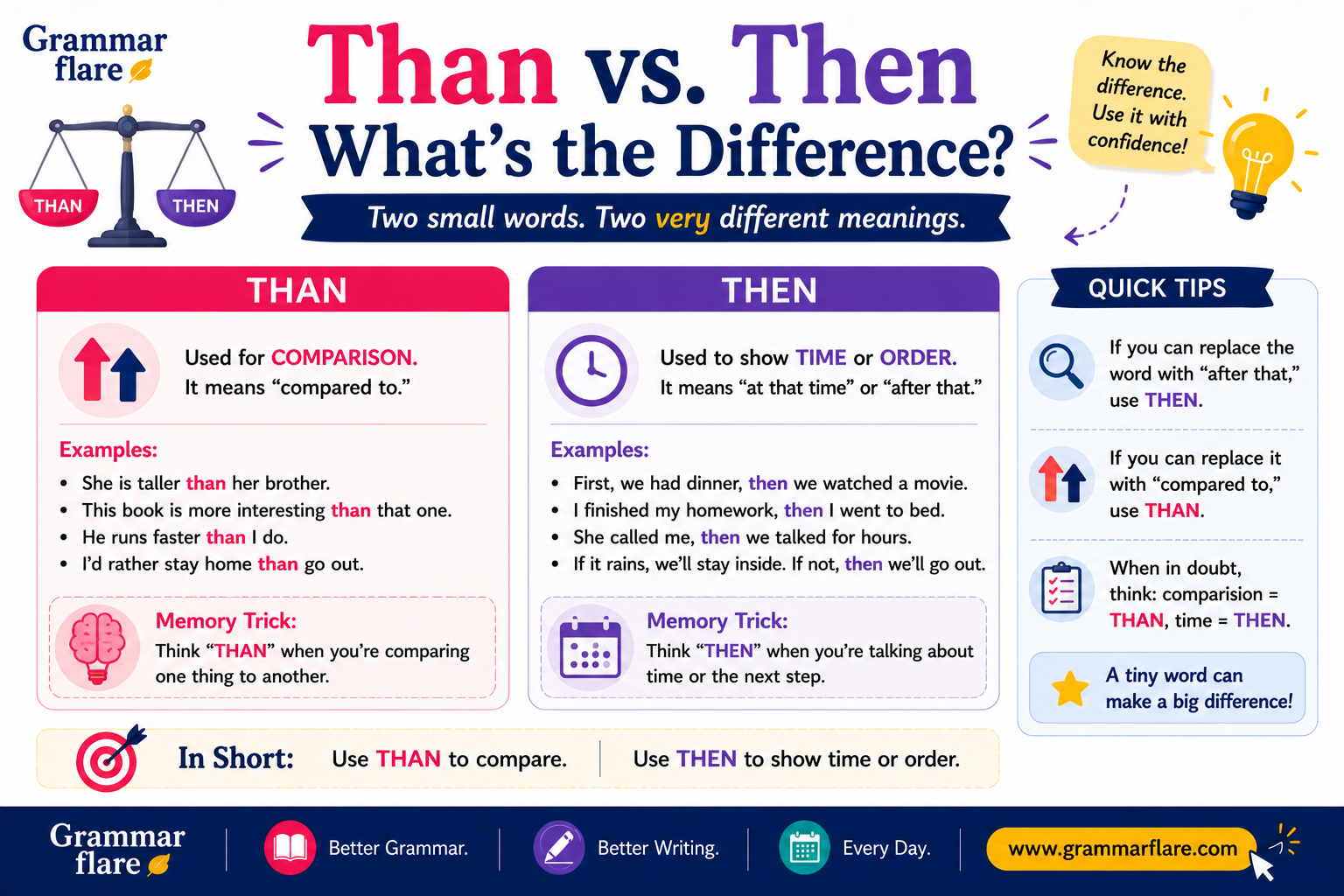
If you mix up than vs then, you are not alone. These two words look similar, sound close in fast speech, and show up in everyday writing all the time. That makes them one of the most common grammar mistakes in emails, school assignments, captions, and casual messages.
The good news is that the difference is simple once you know what to look for.
Quick Answer
Use than for comparison. Use then for time, order, or result.
Examples:
- She is taller than her brother.
- Finish your homework, then watch TV.
- If you agree, then we can start.
If the sentence compares two things, use than. If the sentence refers to when something happens, what comes next, or what happens as a result, use then.
Than vs Then in One Table
| Word | Main meaning | Common job in a sentence | Example |
|---|---|---|---|
| than | comparison | conjunction or preposition | This quiz was easier than the last one. |
| then | time, sequence, result | adverb, adjective, or noun in some uses | We ate dinner, then took a walk. |
The Simple Rule in One Sentence
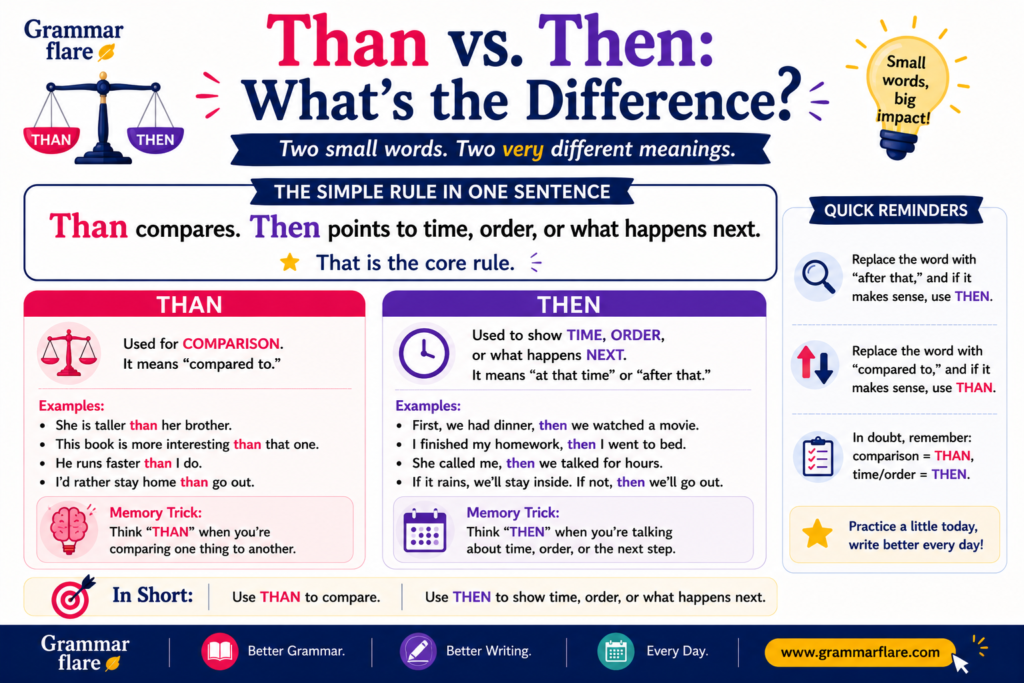
Than compares. Then points to time, order, or what happens next.
That is the core rule.
What Does Than Mean?
Than is mostly used for comparison.
Use it when you compare:
- one thing with another
- one amount with another
- one choice with another
- one action with another
Examples:
- My new laptop is faster than my old one.
- This route is shorter than the highway.
- She would rather read than watch TV.
- No one understands the plan better than Maya.
In each example, than sets up a comparison.
What Does Then Mean?
Then usually relates to time, order, or result.
It can show:
- what happens next
- what was true at that time
- what follows from a condition
Examples:
- We checked the outline, then started writing.
- Back then, I wrote everything by hand.
- If the sentence sounds wrong, then revise it.
- She finished the lesson and then took the quiz.
In each example, then tells the reader something about sequence, timing, or consequence.
Why People Mix Up Than and Then
These words are easy to confuse because:
- they look almost the same
- they are both short function words
- spell-check may not catch the mistake
- both appear in quick everyday writing
Writers often type too quickly and choose the wrong form without noticing.
These are common mistakes:
- He is older then me.
Incorrect, because the sentence compares two people. - We packed our bags than left.
Incorrect, because the sentence shows what happened next.
Quick Test: Should You Use Than or Then?
Use this 10-second test:
- Ask whether the sentence is making a comparison.
- If yes, use than.
- If not, ask whether the sentence refers to time, sequence, or result.
- If yes, use then.
Examples:
- This version is clearer than the first draft.
The sentence compares two versions, so than is correct. - First open the file, then check the heading.
The sentence shows sequence, so then is correct. - If the answer is no, then choose the second option.
The sentence shows result, so then is correct.
Than vs Then Examples in Sentences
Here are clear side-by-side examples:
| Meaning | Correct sentence |
|---|---|
| comparison | A short answer is better than a vague one. |
| time/order | Read the question, then answer it. |
| comparison | This lesson is easier than yesterday’s lesson. |
| result | If you practice daily, then your writing improves faster. |
| preference | I would rather proofread than publish too soon. |
| past time | Back then, we used printed style guides more often. |
Correct and Incorrect Examples
Correct
- This explanation is shorter than the old one.
- We edited the headline, then rewrote the introduction.
- I would rather learn one clear rule than memorize ten weak tricks.
- The article performed better than expected.
Incorrect version of the last sentence
- The article performed better then expected.
Incorrect because the sentence compares expectation and result.
More Correct Examples
- The second example is more helpful than the first one.
- Check the grammar, then hit publish.
- Back then, I always mixed these words up.
Incorrect
- This answer is clearer then the last one.
Incorrect because the sentence compares two answers. - We reviewed the outline than started the draft.
Incorrect because the sentence shows sequence. - If the page loads slowly, than readers may leave.
Incorrect because the sentence shows result.
When to Use Than
Use than when:
- you compare people, things, ideas, or actions
- you talk about more, less, better, worse, or other comparisons
- you use phrases such as rather than or more than
Examples:
- Grammar matters more than speed when clarity is the goal.
- This example is less confusing than the last one.
- They chose a plain-English explanation rather than a technical one.
If the sentence compares, use than.
Is It “Than I” or “Than Me”?
This is the one genuine disagreement about than, and both forms are defensible.
Traditional grammar treats than as a conjunction, which makes the full sentence She is taller than I am. Drop the verb and you get She is taller than I.
Modern usage also treats than as a preposition, which gives you She is taller than me. Merriam-Webster records both, and the second is far more common in speech and ordinary writing.
Practical guidance: use than me in most writing. It is standard and nobody will object. Use than I in formal academic prose, or when the sentence keeps its verb: She is taller than I am.
There is one case where the choice changes the meaning:
- She likes him more than I. (more than I like him)
- She likes him more than me. (more than she likes me)
When a sentence could be read either way, keep the verb: She likes him more than I do. That removes the ambiguity entirely.
When to Use Then
Use then when:
- you show what happens next
- you talk about a time in the past or future
- you show the result of a condition
Examples:
- Write the first sentence, then revise it.
- I did not understand the rule back then.
- If the reader pauses, then the sentence probably needs work.
If the sentence answers a question like when? what next? what follows?, use then.
Then as an Adjective
Then can also work as an adjective meaning “at that time,” placed before a job title or role:
- The then president signed the agreement.
- Our then manager approved the budget.
Style guides differ on the hyphen. Chicago hyphenates it as the then-president; other guides leave it open. Either is defensible, so pick one and stay consistent.
Common Phrases With Than and Then
Certain phrases make the difference easier to remember.
Common phrases with than
- more than
- less than
- rather than
- other than
- better than
Examples:
- The final draft needed more than a spell-check.
- She chose examples rather than long definitions.
Common phrases with then
- back then
- since then
- every now and then
- if…then
- and then
Examples:
- Back then, I did not know the difference.
- If you slow down, then you catch more errors.
A Memory Trick for Than vs Then
Try this:
- than has an a, and so does compArison
- then has an e, and it often points to something that happens nExt
The letter trick is not perfect grammar theory, but it is a quick way to stop the mistake before you publish.
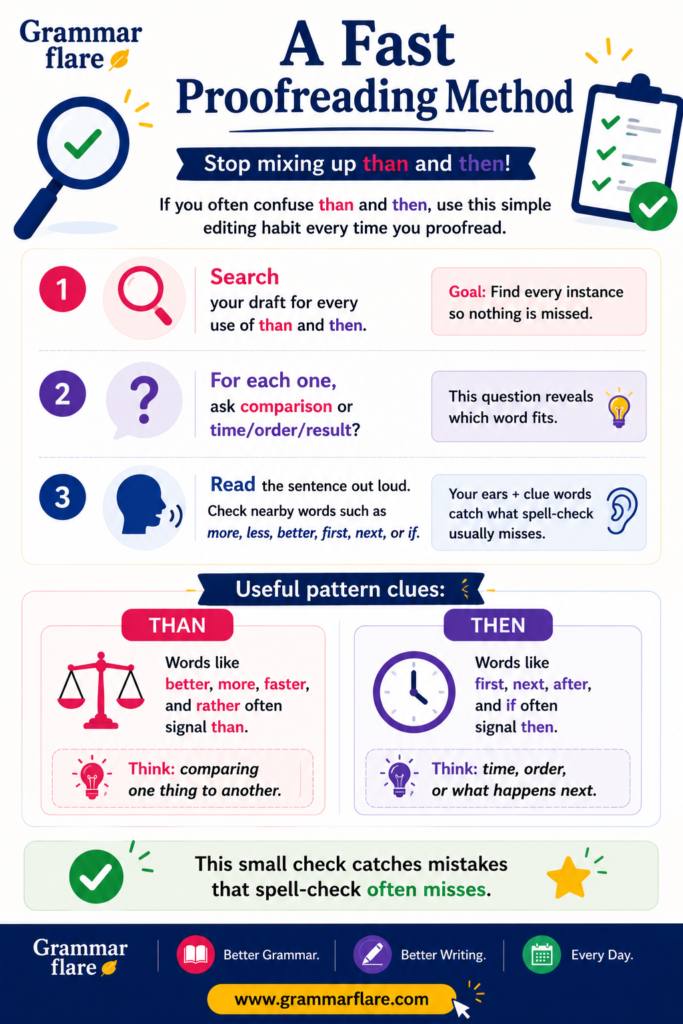
A Fast Proofreading Method
If you often confuse than and then, use this editing habit:
- Search your draft for every use of than and then.
- For each one, ask comparison or time/order/result?
- Read the sentence out loud.
- Check nearby words such as more, less, better, first, next, or if.
Useful pattern clues:
- Words like better, more, faster, and rather often signal than
- Words like first, next, after, and if often signal then
This small check catches mistakes that spell-check often misses.
The same habit catches other pairs that spell-check waves through, including to versus too and affect versus effect.
Than vs Then in Real-Life Writing
This word pair matters in:
- school assignments
- work emails
- resumes and cover letters
- blog posts
- captions and social posts
Examples:
- Our newer process is faster than the old one.
- Open the attachment, then review the comments.
- I would rather be clear than sound impressive.
Because both words are common and short, readers notice the mistake quickly. Fixing it makes your writing look more careful and more professional.
American English Style Note
In both American English and British English, the rule is the same:
- than for comparison
- then for time, order, or result
This is not a regional spelling difference. It is a meaning difference.
Mini Quiz: Than or Then?
Choose the correct word in each sentence:
- This guide is easier to follow ___ the last one.
- Finish the example sentences, ___ check the answers.
- I would rather practice ten minutes a day ___ cram once a week.
- Back ___, I thought both words meant the same thing.
- If the sentence compares two ideas, ___ use than.
Answers
- than
- then
- than
- then
- then
FAQ
What is the difference between than and then?
Than is used for comparison. Then is used for time, sequence, or result.
Is it “better than” or “better then”?
The correct phrase is better than because the sentence compares two things.
Is it “and than” or “and then”?
The correct phrase is usually and then because it shows what happens next.
Can then be used in an if statement?
Yes. In a sentence like If the answer is yes, then continue, then shows the result that follows the condition.
Why does spell-check not always catch than vs then mistakes?
Because than and then are both real words. A spelling tool may miss the error if the sentence is grammatically possible on the surface.
Grammar checkers miss this pair for the same reason they miss most real-word errors. Our guide to proofreading with AI covers where the tools are reliable and where they are not.
More Reading at GrammarFlare
Sources
Final Takeaway
If you remember one rule, make it this:
Than compares. Then tells when, what next, or what follows.
When in doubt, ask whether the sentence compares two things. If it does, use than. If the sentence shows time, sequence, or result, use then.

Ahmad Waheed has spent five years editing academic and professional writing for universities, publishers, and software companies. He founded Grammar Flare after noticing the same handful of mistakes in almost every draft that crossed his desk, and that most grammar guides explained the rule without explaining when it actually matters.
Ahmad writes every guide on this site, checking usage questions against Merriam-Webster, the Chicago Manual of Style, and the AP Stylebook, and noting where those sources disagree rather than quietly picking a side.