
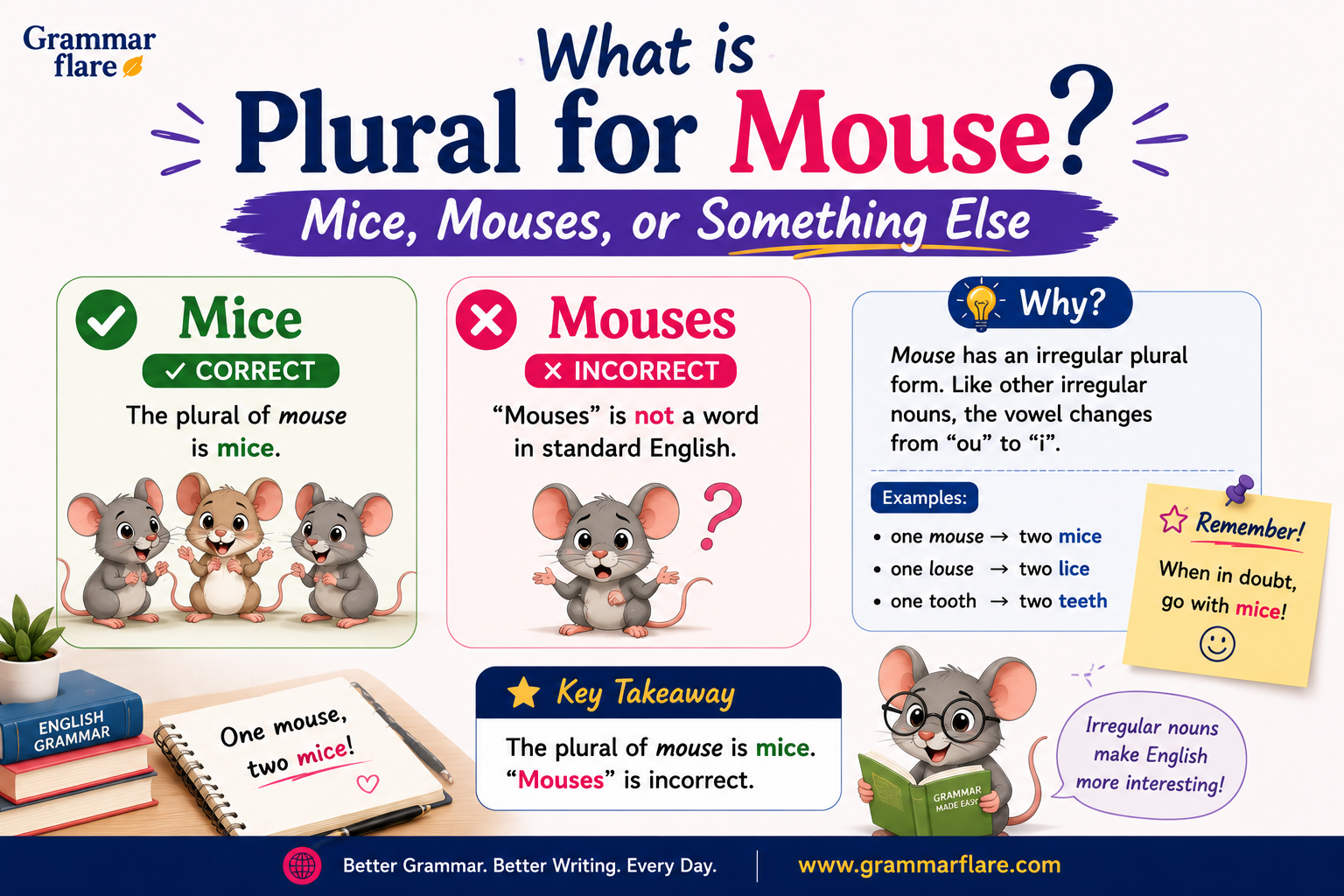
If you’ve ever paused mid-sentence wondering whether to write “mouses” or “mice,” you’re not alone. English has a habit of breaking its own rules, and mouse happens to be one of its most famous rule-breakers. Let’s settle the question once and for all, then dig into why this odd little word behaves the way it does.
Quick Answer
The plural of mouse is mice. This holds true whether you’re talking about the small rodent scurrying behind your fridge or the computer device sitting next to your keyboard. If you searched for “what is the plural of mouse,” here’s your answer in one line: mice, not mouses.
That said, language is rarely that tidy. Tech writers occasionally use “mouses” for the plural of the computer device, and we’ll explain exactly when that’s acceptable later in this guide. For now, just remember this: in standard English, mice is correct in nearly every context.
And if you landed here searching “mouse ka plural” (a common phrase among Hindi and Urdu speakers learning English), the answer is the same: mouse becomes mice, never “mouses,” when you’re following standard English grammar.
Why Doesn’t Mouse Just Take an “-s”?
Most English nouns follow a wonderfully simple rule. You add an “-s” or “-es” to the end, and you’re done. Cat becomes cats. Dog becomes dogs. Box becomes boxes. This is called the regular plural rule, and it covers the overwhelming majority of nouns in the language.
So why does mouse refuse to play along?
The short answer: mouse belongs to a small, ancient class of English nouns that change their internal vowel sound instead of tacking on a suffix. These are called irregular plurals, and while they make up a tiny fraction of English vocabulary, they include some of the most commonly used words in the language. Man becomes men. Foot becomes feet. Tooth becomes teeth. And mouse becomes mice.
Here’s a side-by-side comparison so you can see the contrast clearly:
| Word Type | Singular | Plural | Rule Applied |
|---|---|---|---|
| Regular | cat | cats | add “-s” |
| Regular | box | boxes | add “-es” |
| Irregular | mouse | mice | vowel change |
| Irregular | foot | feet | vowel change |
| Irregular | man | men | vowel change |
Where “Mice” Actually Comes From
This is where things get genuinely interesting, so stick with me.
Old English Roots
Mouse traces back to the Old English word mūs, which already had an irregular plural form: mȳs. That’s right. English speakers were saying something close to “mice” over a thousand years ago, long before modern English existed in anything close to its current form.
The change from mūs to mȳs didn’t happen randomly. It happened because of a sound shift linguists call i-mutation (sometimes written as i-umlaut). According to the Oxford English Dictionary, this process occurred widely across Old English and other Germanic languages during the early medieval period.
What Is i-Mutation, in Plain English?
Here’s the simplified version. In Old English, certain plural nouns originally ended in a sound similar to “-iz” or “-i.” Over time, that ending sound influenced the vowel earlier in the word, pulling it forward in the mouth. Eventually, the ending sound disappeared entirely, but the vowel shift it caused stuck around permanently.
Think of it like this: imagine you’re mimicking a friend’s accent so much that your own voice starts to change, and even after your friend leaves the room, you keep talking that way. The “trigger” (the original ending) vanished, but its effect remained baked into the word.
This single sound change explains why English has so many oddly paired singular-plural nouns. It’s also why these words feel ancient and a little stubborn. They survived centuries of language reform simply because they were used too often to “fix.”
Other Survivors of the Same Sound Change
Mouse isn’t alone. Several common English words pluralize the exact same way, because they went through identical i-mutation centuries ago:
- louse → lice
- man → men
- woman → women
- foot → feet
- tooth → teeth
- goose → geese
Notice the pattern? Every single one of these words is short, common, and probably among the first hundred nouns you learned as a child. That’s not a coincidence. Linguists generally agree that frequently used words resist regularization far better than rare ones, which is exactly why “mice” never got replaced by “mouses” over the centuries, even though plenty of less common irregular plurals did get smoothed out over time.
For a related deep dive, see our article on plural nouns,where we break down dozens of these vowel-shifting word pairs.
Is “Mouses” Ever Correct?
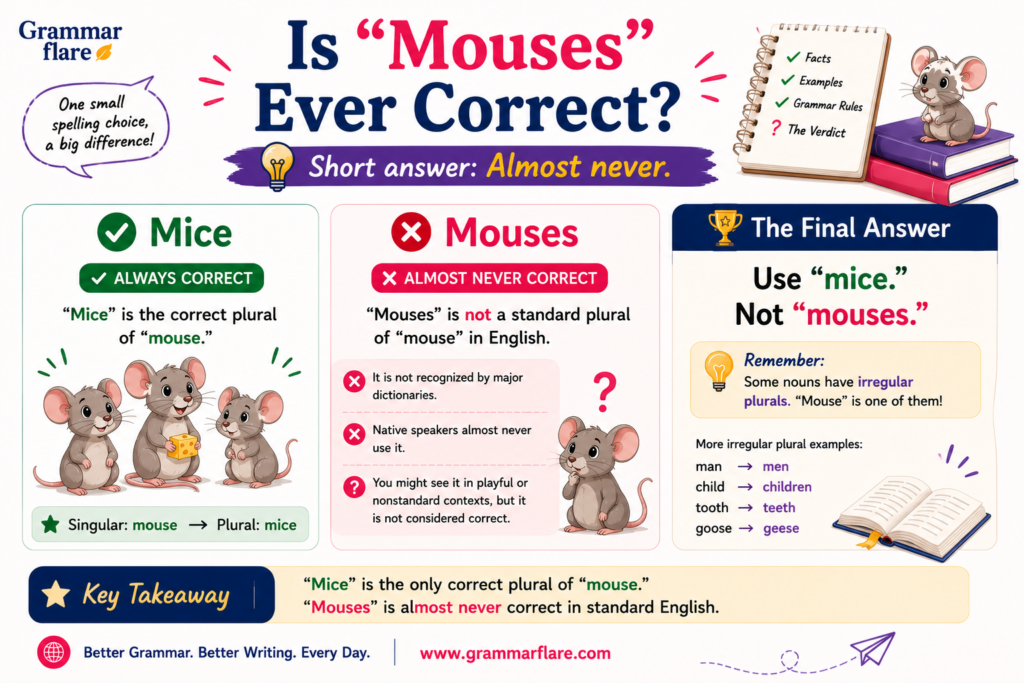
This is genuinely one of the most searched questions related to mouse pluralization, especially among people writing tech documentation, software manuals, or instructional content involving computer hardware.
Here’s the honest, slightly nuanced answer.
What the Major Dictionaries Say
Merriam-Webster lists “mice” as the standard plural for both the animal and the computer peripheral, though it does note “mouses” as an accepted variant specifically for the computer device. Cambridge Dictionary takes a similar stance, treating “mice” as primary while acknowledging “mouses” exists in informal technical usage.
So technically, you won’t be wrong if you write “mouses” when referring to multiple computer mice. But you’ll be in the minority.
Real-World Usage
In actual published writing, “mice” wins by a landslide, even in tech contexts. Apple, Microsoft, Logitech, and virtually every major hardware manufacturer use “mice” in their official product documentation when referring to multiple units. Search engine data backs this up too: “computer mice” appears far more often than “computer mouses” across published web content and printed style guides.
Our Recommendation
Unless your specific company style guide explicitly calls for “mouses” (some do, particularly in software engineering documentation, to avoid confusion with the animal), stick with mice. It’s grammatically standard, universally understood, and won’t raise eyebrows in professional or academic writing.
| Context | Recommended Plural | Acceptable Alternative |
|---|---|---|
| Animal (rodent) | mice | none |
| Computer device | mice | mouses (informal/technical) |
| Mixed group (animal + device, humor) | mice | mouses (for clarity/joke) |
Which One Do Readers Expect? Mice vs. Mouses in Real Writing
Picture two technical writers working on competing product manuals for the same wireless mouse. One writes, “This package includes two mice.” The other writes, “This package includes two mouses.” Both sentences are grammatically defensible, but only one of them matches what most readers expect to see.
If you scan major hardware brands’ websites, support documents, and packaging, “mice” shows up far more consistently than “mouses.” Style guides used by large publishers, including the Chicago Manual of Style, default to standard irregular plurals unless a specific technical convention overrides them. That’s a strong signal: when in doubt, your readers will find “mice” more natural, even when you’re describing hardware rather than rodents.
Common Mistakes People Make With the Plural of Mouse
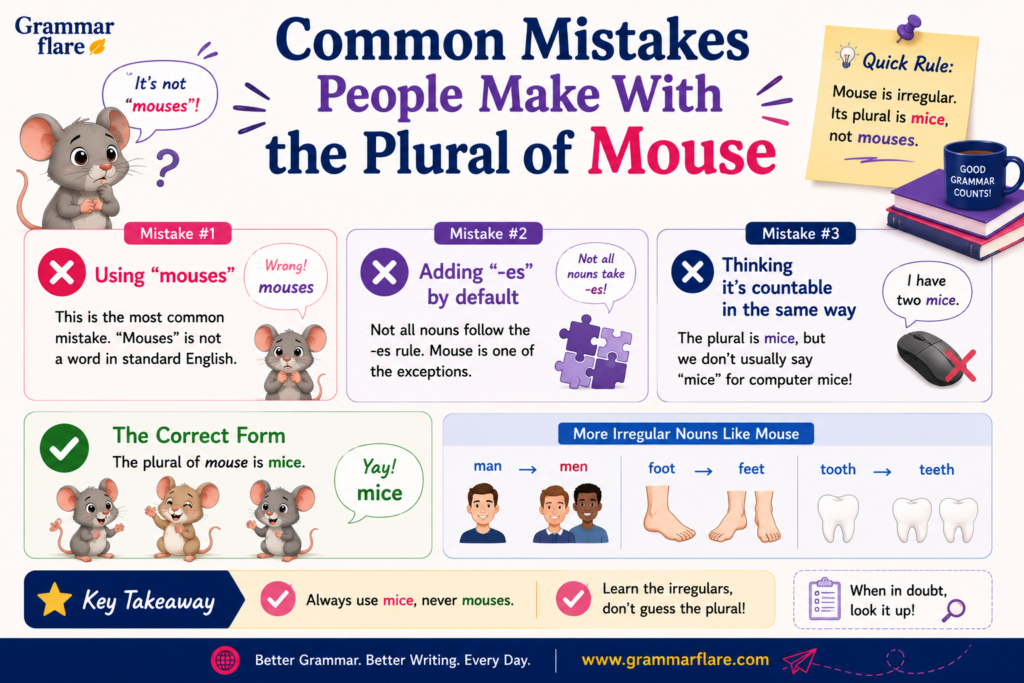
Even confident writers slip up on this word from time to time. Here are a few patterns worth watching for:
- Adding “-s” by habit. Because regular plurals dominate English, some writers default to “mouses” without thinking, simply because that’s the pattern their brain reaches for first.
- Overcorrecting proper nouns. Writers sometimes assume Mickey Mouse should pluralize as “Mickey Mice,” forgetting that names follow a different rule entirely.
- Mixing up mice and mouse mid-sentence. It’s easy to start a sentence with “mouse” and accidentally finish it with a verb or pronoun that assumes a plural, especially in longer, more complex sentences.
- Treating “meese” as legitimate slang for formal contexts. It’s fine in a text message to a friend. It’s not fine in a résumé, a report, or a customer email.
A simple way to avoid all four mistakes: read your sentence out loud before you publish it. If “mice” sounds natural and “mouses” sounds forced, trust your ear. Most native speakers’ instincts on this particular word are remarkably reliable, even when they couldn’t explain the underlying grammar rule if you asked them directly.
What About “Meese”?
If you’ve spent any time around internet humor, you’ve probably seen “meese” used as a joke plural for mouse. It’s modeled after geese, the plural of goose, and it shows up constantly in memes, casual conversation, and comedic writing.
Here’s the thing: meese is not a real word. It has zero standing in any dictionary, style guide, or grammar reference. It’s purely a playful construction that exploits the fact that English already has one irregular animal plural (geese) that rhymes with the “wrong” plural people sometimes guess for mouse.
People enjoy “meese” precisely because it sounds plausible. English speakers have an intuitive sense that some animal plurals just change vowels, so the brain doesn’t immediately reject “meese” the way it would reject something truly nonsensical. That’s the whole joke. Use it for laughs, never in formal writing.
Proper Nouns Break the Rule: Mickey Mouse and Friends
Here’s a grammar quirk that trips up even careful writers: proper nouns generally don’t follow irregular plural patterns, even when they’re based on a word that does.
So if you’re writing about multiple statues, figurines, or costumed performers of Mickey Mouse at a theme park, the correct plural is “Mickey Mouses,” not “Mickey Mice.” That probably sounds strange at first, but it follows a consistent rule across English: names are treated as fixed units, and they typically just add “-s” or “-es” regardless of what the base word would normally do.
An example of this same principle in action:
- “There are three Mickey Mouses in the parade lineup.”
This is a subtle distinction, but it matters in professional and editorial writing.
Other English Nouns With the Same Kind of Irregular Plural
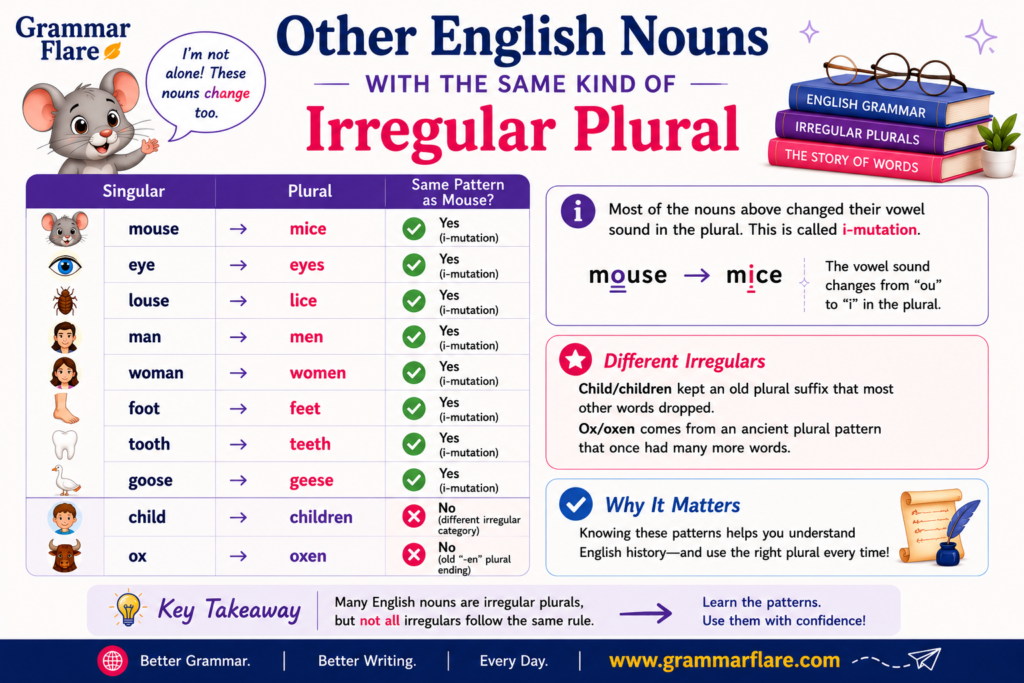
It helps to see mouse in context alongside its grammatical relatives. Some of these words share mouse’s exact i-mutation history. Others are irregular for completely different reasons (Old English had several distinct irregular plural categories, not just one).
| Singular | Plural | Same Pattern as Mouse? |
|---|---|---|
| mouse | mice | yes (i-mutation) |
| louse | lice | yes (i-mutation) |
| man | men | yes (i-mutation) |
| woman | women | yes (i-mutation) |
| foot | feet | yes (i-mutation) |
| tooth | teeth | yes (i-mutation) |
| goose | geese | yes (i-mutation) |
| child | children | no (different irregular category) |
| ox | oxen | no (old “-en” plural ending) |
Notice that “child” and “ox” are irregular too, but they didn’t go through the same vowel-shifting process. Child/children kept an old plural suffix that most other words eventually dropped, and ox/oxen is one of the last survivors of a plural pattern that used to be far more common in Old English. English grammar isn’t one single set of exceptions. It’s actually several overlapping historical layers, each leaving behind its own fossilized rule.
Quick Reference Table
Here’s a clean summary you can bookmark for fast reference:
| Term | Correct Plural | Notes |
|---|---|---|
| mouse (animal) | mice | always irregular |
| mouse (computer device) | mice | “mouses” accepted informally |
| Mickey Mouse | Mickey Mouses | proper noun rule applies |
| mouse pad | mouse pads | regular plural (compound noun) |
| mousetrap | mousetraps | regular plural (compound noun) |
Notice how compound words built from mouse, like mouse pad and mousetrap, pluralize normally with an “-s.” Only the standalone word mouse keeps its irregular form. That’s because in compound nouns, the pluralization rule typically applies to whichever part of the word functions as the “head” of the phrase grammatically, and in these particular compounds, the regular rule simply takes over.
Latin borrowings form a separate layer again. Our guide to the plural of cactus covers why some -us words take -i and others do not.
Frequently Asked Questions
Is the plural of mouse “mice” or “mouses”? It’s mice. That’s the standard, dictionary-approved plural of mouse in English, whether you mean the animal or the computer device. “Mouses” is only considered acceptable in casual, technical contexts referring to computer hardware.
Can I say “mouses” for computer mice? You can, and some tech documentation does, but it’s still less common than “mice.” If you want your writing to follow standard usage, go with mice even in tech contexts.
What’s the plural of “mouse pad”? Mouse pads. Compound nouns built from mouse follow the regular “-s” plural rule, unlike the standalone word mouse itself.
Is “meese” a real word? No. It’s a humorous, made-up plural modeled after “geese.” You’ll see it in jokes and memes, but it has no grammatical legitimacy and shouldn’t appear in formal writing.
What is the singular form of mice? The singular of mice is mouse. Mice is plural, and mouse is its singular counterpart, the same relationship as feet and foot, or teeth and tooth.
Why do some English words have irregular plurals at all? Many irregular plurals, including mouse, survive from Old English sound changes like i-mutation. These words were common enough in everyday speech that they resisted later grammatical “regularization,” unlike rarer words that eventually fell in line with the standard “-s” rule.
Is the plural of mouse in English the same in every dialect? Yes. Whether you’re reading British, American, Australian, or any other major English dialect, the plural of mouse in English stays consistent: mice. Regional spelling differences don’t affect irregular plurals like this one.
The Bottom Line
So here’s everything boiled down to one simple takeaway: the plural of mouse is mice, full stop, in virtually every situation you’ll encounter, whether you’re talking about a furry rodent or the device next to your keyboard. “Mouses” survives only as a niche, informal alternative in tech writing, and “meese” is nothing more than a fun joke borrowed from “geese.”
Mouse earned its irregular plural the old-fashioned way: through a sound change that happened over a thousand years ago and simply never got ironed out. That makes it one of English’s oldest surviving grammatical fossils, hiding in plain sight every time you talk about pest control or click your way around a desktop.
More reading at Grammarflare
- What Is the Plural of Fungus?
- Plural of Cactus
- What Is the Plural of Hoof?
- Countable vs Uncountable Nouns
- Plural Nouns
Sources

Ahmad Waheed has spent five years editing academic and professional writing for universities, publishers, and software companies. He founded Grammar Flare after noticing the same handful of mistakes in almost every draft that crossed his desk, and that most grammar guides explained the rule without explaining when it actually matters.
Ahmad writes every guide on this site, checking usage questions against Merriam-Webster, the Chicago Manual of Style, and the AP Stylebook, and noting where those sources disagree rather than quietly picking a side.