

You’re writing an important email to your manager. You pause. Did you loan him the report last week or did you lend it? And what’s the past tense again: loaned or lent? Suddenly, a grammar question that seemed trivial turns into a small crisis.
You’re not alone. Millions of native English speakers trip over this exact pair every single day. The good news? Once you understand the logic behind these words, you’ll never second-guess yourself again.
Let’s break it all down clearly, from roots to rules to real-world use.
Loaned or Lent: The Quick Answer for Those in a Hurry

Here’s the short version. Both loaned and lent are correct. The word you choose depends on which verb you started with.
- Lent is the past tense of lend
- Loaned is the past tense of loan (when used as a verb)
In American English, both are widely accepted in everyday speech and writing. In British English, lent is strongly preferred. A quick reference before we dive deeper:
| Word | Type | Example |
|---|---|---|
| Lend | Verb (present) | “Can you lend me your pen?” |
| Lent | Verb (past tense of lend) | “She lent me her umbrella.” |
| Loan | Noun or Verb | “He took out a loan.” / “She loaned me her car.” |
| Loaned | Verb (past tense of loan) | “The bank loaned him $10,000.” |
Still with me? Good. Now let’s go deeper.
Understanding the Root Words: Loan vs. Lend

Before you can pick the right past tense, you need to understand what loan and lend actually mean and how they differ. This is the lend vs loan debate that grammar enthusiasts have argued about for centuries.
What Does “Lend” Mean?
Lend is a verb. Full stop. It means to give something to someone temporarily, with the expectation that they’ll return it. It’s been used this way in English since at least the 13th century and shows up across literature, law, and everyday conversation.
The lend past tense is lent, an irregular form (just like send becomes sent). So when you say:
“I lent my brother $200 last month.”
You’re using the grammatically traditional and universally accepted form.
What makes lend even more special? Certain fixed phrases lock it in permanently. You’ll never hear anyone say “loaned a hand” or “loaned credibility.” Those idioms belong to lend and lend alone:
- Lend a hand (to help someone)
- Lend credibility (to add believability)
- Lend your support (to offer backing)
- Lend itself to (to be suitable for)
These aren’t interchangeable. Ever. So if someone tells you loan and lend are completely identical, they’re missing a big piece of the picture.
What Does “Loan” Mean?
Historically, loan was almost exclusively a noun. Think bank loans, student loans, mortgage loans. That’s its natural habitat. The phrase lend money meaning is actually rooted in the verb lend, not loan, though in American English, “loan money” has become perfectly acceptable as well.
Over time, particularly in American English, loan evolved into a verb too. So “Can you loan me your car?” became just as natural as “Can you lend me your car?”
According to Merriam-Webster, using loan as a verb is “standard” and has been part of American English for centuries. The dictionary traces verbal uses of loan back to the 12th century, which surprises many people who think it’s a modern invention.
For a deeper look at how verbs evolve in English, check out advice vs advise about how the same root works as both noun and verb.
How Loan and Lend Overlap (and Where They Don’t)
Here’s where it gets interesting. In the loan vs lend comparison, the two words share a lot of ground in American English. But they’re not perfectly interchangeable. Let’s see this in action:
Where they overlap:
- “Can you lend me $10?” = “Can you loan me $10?” (Both work in American English.)
- “She lent him her notes.” = “She loaned him her notes.” (Both are acceptable.)
Where they diverge:
- Fixed idioms: Only lend works here. “Lend me your ears” (Shakespeare). You simply can’t swap in loan.
- British writing: Loan as a verb is considered informal or incorrect by many British editors.
- Legal and financial documents: Loan (as a noun) dominates here. “The loan agreement was signed.”
Loaned or Lent: Breaking Down the Past Tense

This is the heart of the matter. The past tense of lend creates lent. The past tense of loan (as a verb) creates loaned. Both are real words. Both are used. But context decides which one fits.
When “Lent” Is the Correct Past Tense
Lent is the irregular past tense of lend. It follows the same pattern as:
- Send → Sent
- Spend → Spent
- Bend → Bent
So “I lent him my jacket last Tuesday” is grammatically impeccable. You’ll see lent used almost exclusively in:
- British and Australian English
- Literary and academic writing
- Formal correspondence
- Historical documents
It carries a certain elegance. Writers from Charles Dickens to modern novelists have always defaulted to lent in their prose.
“She lent him her last coin and never saw him again.” (Clearly past tense, clearly lend-derived.)
When “Loaned” Is the Correct Past Tense
Loaned works perfectly when you’re treating loan as a verb, which is fully standard in American English. You’ll encounter it most naturally in:
- Banking and finance: “The institution loaned the startup $5 million in seed capital.”
- Legal writing: “The asset was loaned under the terms of the agreement.”
- Casual American speech: “My neighbor loaned me his lawnmower.”
Major American publications use loaned routinely. The Associated Press Stylebook, one of the most widely used editorial guides in US journalism, accepts loaned without hesitation.
Can You Use Both Interchangeably?
Honestly? Most of the time, yes. In everyday American conversation, “she lent me her car” and “she loaned me her car” mean exactly the same thing. Neither sounds wrong to American ears.
But apply this simple decision framework before you write:
Ask yourself these three questions:
- Am I writing for a British audience? If yes, use lent.
- Does the sentence involve a fixed idiom (lend a hand, lend credibility)? If yes, use lend/lent.
- Is this a formal financial or legal context? If yes, loaned (or the noun form loan) fits best.
If none of those apply, you’re free to use either one.
American English vs. British English: A Real Divide
The loaned or lent debate isn’t just about grammar rules. It’s partly a cultural and geographic divide. Where you learned English shapes what sounds natural to you.
How American English Treats “Loan” as a Verb
Americans started using loan as a verb centuries ago. By the 1800s, it was completely normalized in everyday speech and writing. Today, respected American style guides position it as fully standard:
- Merriam-Webster: Lists loan as a verb without restrictions
- AP Stylebook: Accepts loaned as past tense
- American Heritage Dictionary: Notes verbal use of loan as “standard American usage”
This isn’t slang or laziness. It’s simply how the language evolved on one side of the Atlantic.
Why British English Sticks to “Lend”
British grammarians have long viewed loan as a noun and nothing more. The verb form? They consider it an Americanism, and not always a welcome one.
- Oxford English Dictionary: Acknowledges verbal loan but marks it as chiefly North American
- Cambridge Dictionary: Treats lend as the standard verb, with loan as a verb noted for American use
If you’re publishing content for a UK audience, writing for a British publication, or submitting academic work to a British institution, stick with lend and lent. It’ll keep your writing clean and credible.
Common Mistakes People Make (and How to Avoid Them)
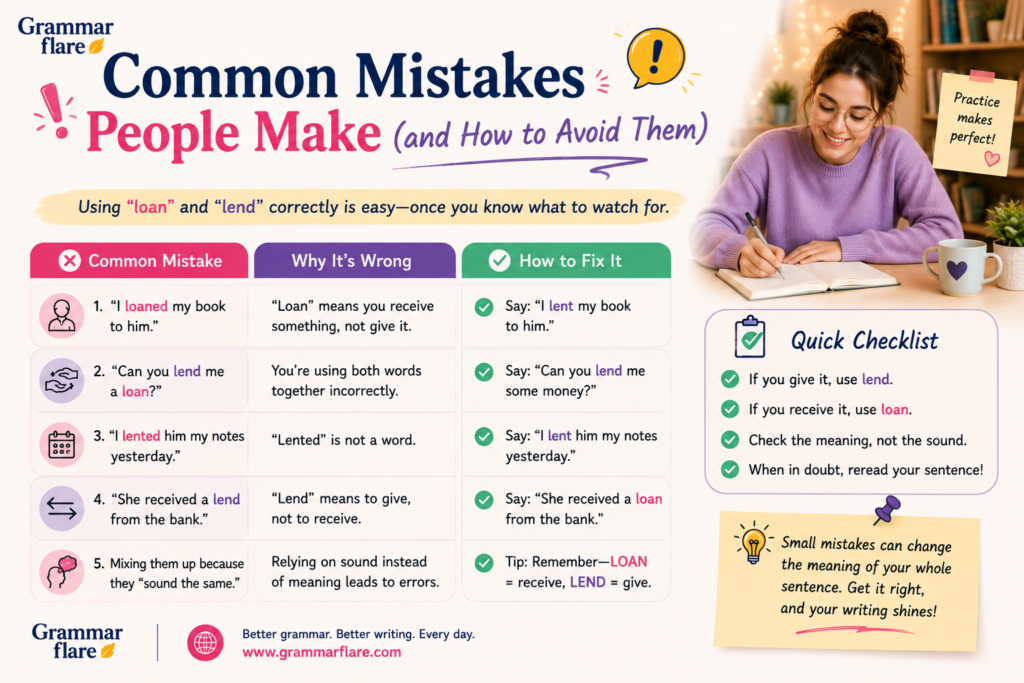
Grammar mistakes with this word pair fall into three main categories. Knowing them puts you miles ahead of the average writer.
Using “Borrowed” When You Mean “Loaned” or “Lent”
This is one of the most common mix-ups in English and it comes down to direction.
- Lend/loan: You give something temporarily. You’re the one handing it over.
- Borrow: You receive something temporarily. You’re the one taking it.
Think of it as a transaction with two sides:
“I lent him $50.” (You gave it.) “He borrowed $50 from me.” (He received it.)
You can’t say “I borrowed him $50.” That’s backwards. This confusion trips up even careful writers, because the two words describe opposite roles in the same transaction.
Here’s a table to make it crystal clear:
| Situation | Correct Word | Incorrect Word |
|---|---|---|
| You gave money temporarily | Lend / Loan / Lent / Loaned | Borrow |
| You received money temporarily | Borrow / Borrowed | Lend / Loan |
| You’re asking to receive something | “Can I borrow your pen?” | “Can I lend your pen?” |
| You’re offering to give something | “I’ll lend you my pen.” | “I’ll borrow you my pen.” |
Mixing Up “Lent” With the Religious Season
Yes, Lent (with a capital L) is also the Christian season of fasting observed between Ash Wednesday and Easter. Don’t let that confuse you. Context makes the distinction obvious every time:
- “She lent me her dress.” (Past tense verb, lowercase)
- “He gave up sugar for Lent.” (Religious season, capitalized)
No overlap. No confusion. Just pay attention to capitalization and context.
Using “Loaned” in Idioms Where It Never Works
Fixed English expressions are non-negotiable. You can’t substitute loaned here, no matter how comfortable it feels:
| Correct Idiom | Incorrect Substitution |
|---|---|
| “Lend a hand” | “Loan a hand” (wrong) |
| “Lend credibility to” | “Loan credibility to” (wrong) |
| “Lend your support” | “Loan your support” (wrong) |
| “Lend itself to” | “Loan itself to” (wrong) |
These phrases are frozen in time. Lend owns them completely.
Real-World Usage Examples You’ll Actually Encounter
Theory is useful. Real examples are better. Here’s how loaned and lent appear across different writing contexts.
In Everyday Conversation
Spoken language is relaxed and both forms show up freely:
- “Hey, didn’t I lend you that book three months ago?”
- “My dad loaned me his truck for the weekend.”
- “She lent me her charger at the airport, total lifesaver.”
- “The gym loaned me a spare lock since I forgot mine.”
Neither form sounds strange here. Americans use both comfortably.
In Professional and Business Writing
Financial and corporate contexts tend to favor loaned when the verb form is necessary, but they more often prefer the noun loan:
- “The firm loaned the subsidiary $2.3 million to cover operational deficits.”
- “Under the revised terms, the institution loaned the funds at a fixed interest rate of 4.5%.”
- “He was loaned the equipment under a three-month trial agreement.”
For a detailed guide on business writing conventions, visit GrammarFlare’s professional writing resources.
In Literature and Formal Essays
Literary writing almost always favors lent:
- “The autumn light lent the room a golden, melancholy warmth.”
- “Years of hardship had lent his face a severity that strangers found unnerving.”
- “Her presence lent the ceremony a dignity it might otherwise have lacked.”
Notice something? In these examples, lent isn’t about money or objects at all. It’s being used figuratively. This figurative use is exclusive to lend and its past tense lent. You’d never say “her presence loaned the ceremony a dignity.” That’s not how the word works.
The “Lent vs Leant” Question: A Quick Detour
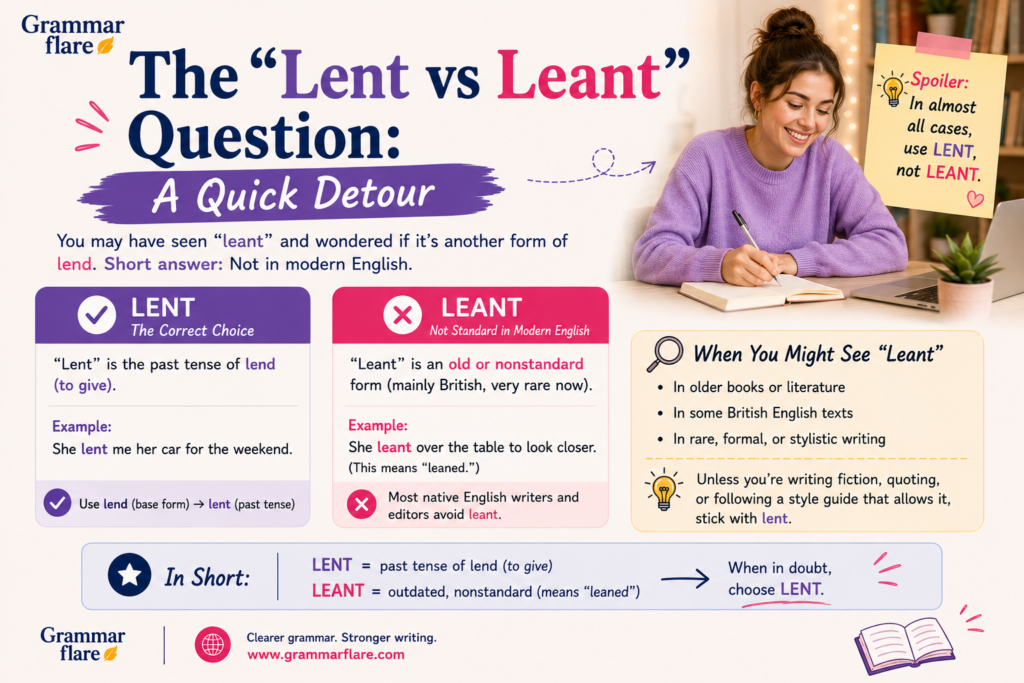
While we’re here, let’s address a related confusion that comes up often: lent vs leant.
These are completely different words from different verbs:
- Lent: Past tense of lend (to give temporarily)
- Leant: Past tense of lean (to incline or rest against something), used in British English
“She lent him her book.” (Give temporarily) “He leant against the wall.” (Physical position, British past tense of lean)
In American English, the past tense of lean is leaned, not leant. So if you’re writing for American readers, you’ll rarely see leant at all. Don’t confuse these two. They come from entirely different verbs with entirely different meanings.
What Major Style Guides Actually Say
Style guides are the rulebooks that publishers, editors, and journalists live by. Here’s where the major ones stand on the loaned vs lent question:
| Style Guide | “Loan” as Verb | Preferred Past Tense | Audience |
|---|---|---|---|
| Merriam-Webster | Fully accepted | Both “loaned” and “lent” | American general |
| AP Stylebook | Accepted | “Loaned” | American journalism |
| Chicago Manual of Style | Cautiously accepted | “Lent” preferred in formal writing | American academic/publishing |
| Oxford English Dictionary | Limited (marks as chiefly N. American) | “Lent” | British/international |
| Cambridge Dictionary | Limited | “Lent” strongly preferred | British/international |
The takeaway? If you’re American, you have flexibility. If you’re writing for a British, international, or academic audience, lean toward lend and lent to stay on safe ground.
Irregular verbs like lend do not follow the standard -ed pattern, so learners generally memorise them as vocabulary rather than deriving them from a rule.
When the Difference Actually Matters
Most of the time nobody notices which form you used. Three situations where they might:
Writing across dialects. An American writing loaned to a British editor may be marked as informal. It is not an error, but it will read as one to them.
Academic and formal writing. Lent is the safer choice in any register where a marker or reviewer might have traditional preferences, because it is accepted everywhere while loaned is accepted in most places.
Idioms and figurative use. This is the one place where getting it wrong is a genuine error rather than a preference. Loan a hand and her presence loaned the ceremony dignity are both wrong in every variety of English.
A Simple Rule to Remember Forever
Still feeling unsure? Use this mental checklist:
Step one: Is this a noun? (A bank loan, a car loan, a personal loan.) If yes, loan is your word. Done.
Step two: Is this a verb describing giving something temporarily?
- If you’re writing in American English for American readers: use either lend/lent or loan/loaned.
- If you’re writing in British English or for a formal/academic audience: use lend/lent.
Step three: Is the sentence an idiom (lend a hand, lend credibility)? If yes, always use lend/lent. Non-negotiable.
Step four: Is the sentence figurative (the light lent warmth, time lent perspective)? If yes, always use lend/lent.
That’s it. Four steps and you’re done.
Quick-Reference Summary
Here’s everything you need in one place:
- Lend is a verb; its irregular past tense is lent
- Loan is primarily a noun; as a verb, its past tense is loaned
- The lend vs loan distinction matters more in British English than American English
- Lent vs leant are completely different words (lent from lend, leant from lean)
- Lent meaning borrow is a common misconception; they’re opposites, not synonyms
- Fixed idioms always use lend, never loan (“lend a hand,” “lend credibility”)
- Figurative uses (light lent warmth, silence lent gravity) always use lend/lent
- American style guides (Merriam-Webster, AP) accept both; British guides prefer lend/lent
- When in doubt for formal writing, lent is the safer, more universally accepted choice
More Reading at
- Advice vs Advise
- Affect vs Effect
- Passed vs Past
- What’s the Difference Between Grey and Gray?
- Commonly Confused Words
Frequently Asked Questions
Is “loaned” a real word?
Yes, absolutely. Loaned is the standard past tense of loan when it’s used as a verb. It’s been part of American English for centuries and appears in major dictionaries without any restrictions. Merriam-Webster lists it as fully standard.
Is it correct to say “I lent him money” or “I loaned him money”?
Both are correct. “I lent him money” uses the irregular past tense of lend. “I loaned him money” uses the regular past tense of loan as a verb. In American English, either works. In British English, “I lent him money” is preferred.
Can “lend” ever be used as a noun?
No. Lend is always a verb. You can’t say “give me a lend” in standard formal English, though some regional British dialects use it informally. In standard usage, the noun is always loan.
Why do some grammar guides say “loan” as a verb is wrong?
Traditionally, many grammar guides (especially British ones) classified loan strictly as a noun. They viewed its use as a verb as an Americanism and not always a welcome one. That position has softened significantly as American English has influenced global usage but some prescriptive British guides still hold the traditional line.
What’s the difference between “lent” and “borrowed”?
They describe opposite sides of the same transaction. If you lent something, you gave it temporarily. If you borrowed something, you received it temporarily. “She lent me her bike” and “I borrowed her bike” describe the exact same event from two different perspectives. They’re not interchangeable because they describe opposite roles.
What does it mean to lend money?
The phrase “lend money” simply means to give someone money temporarily with the expectation of repayment. It’s the verbal act of providing funds. Historically, the verb lend was used exclusively for this purpose, though American English now accepts loan as a verb in the same way. Both “I’ll lend you the money” and “I’ll loan you the money” mean the same thing in modern American usage.

Ahmad Waheed has spent five years editing academic and professional writing for universities, publishers, and software companies. He founded Grammar Flare after noticing the same handful of mistakes in almost every draft that crossed his desk, and that most grammar guides explained the rule without explaining when it actually matters.
Ahmad writes every guide on this site, checking usage questions against Merriam-Webster, the Chicago Manual of Style, and the AP Stylebook, and noting where those sources disagree rather than quietly picking a side.