
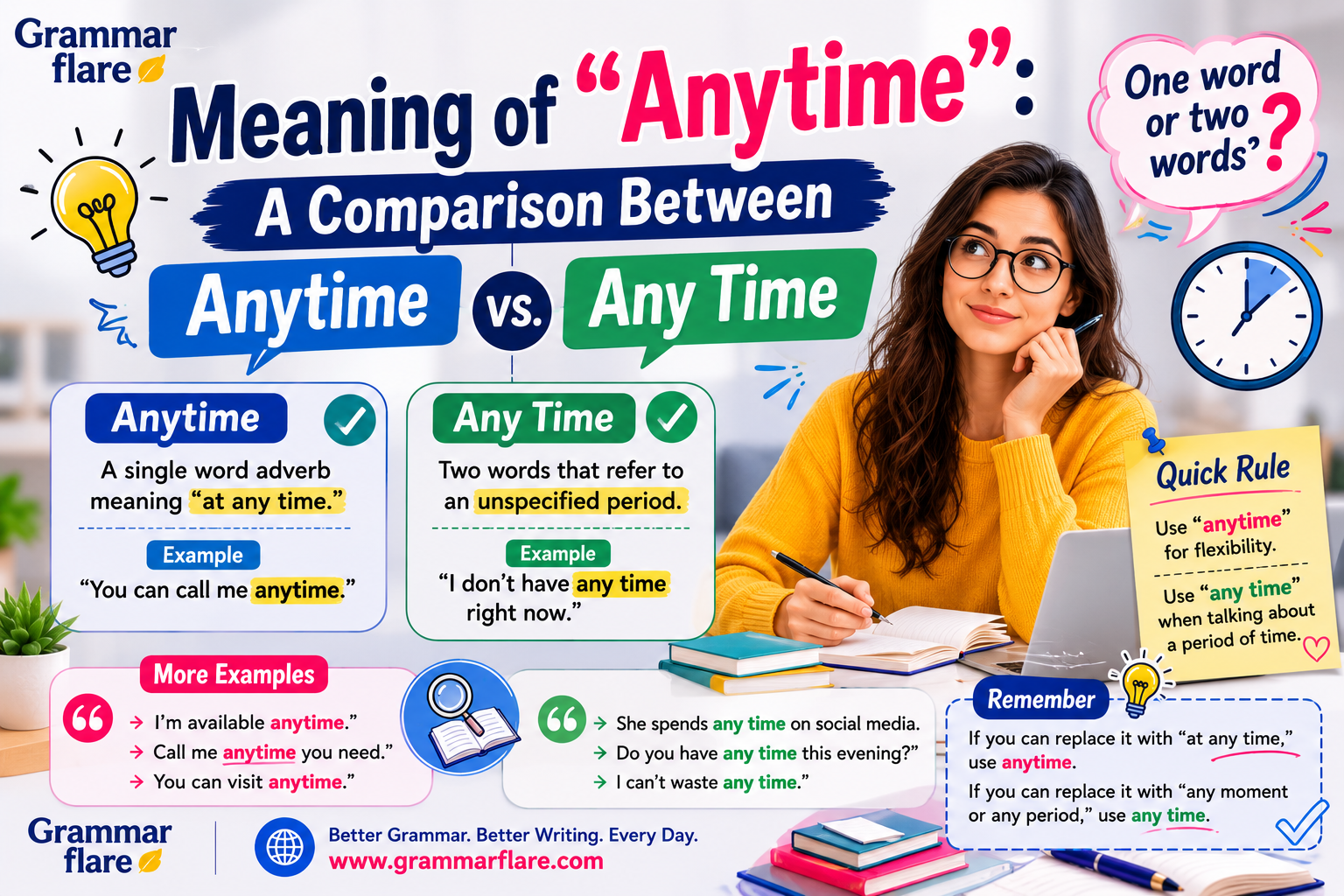
You’ve typed both versions. Maybe you paused for a second, shrugged, and picked one. Most people do. But here’s the thing: “anytime” and “any time” aren’t interchangeable. One wrong choice in a formal email or legal document can quietly undermine your credibility. This guide settles it once and for all by explaining the true meaning of anytime.
A Quick Answer for People in a Hurry
Not everyone has ten minutes. So here’s the short version.
“Anytime” (one word) is an adverb. Use it when you mean “whenever” or as a casual standalone reply.
“Any time” (two words) is a noun phrase. Use it after prepositions like at, for, or in and in formal writing.
The fastest rule you’ll ever learn: if a preposition comes before it, use two words. “At any time.” Never “at anytime.” That single test eliminates most errors instantly.
| Feature | Anytime | Any Time |
|---|---|---|
| Part of speech | Adverb | Noun phrase |
| Follows a preposition? | No | Yes |
| Works as a solo reply? | Yes (“Anytime!”) | No |
| Formality level | Informal | Formal and informal |
| Replaceable with “whenever”? | Yes | Sometimes |
| Example | “Call me anytime.” | “Feel free to call at any time.” |
Bookmark that table. It’ll save you more than once.
The True Meaning of “Anytime” (The One-Word Adverb)
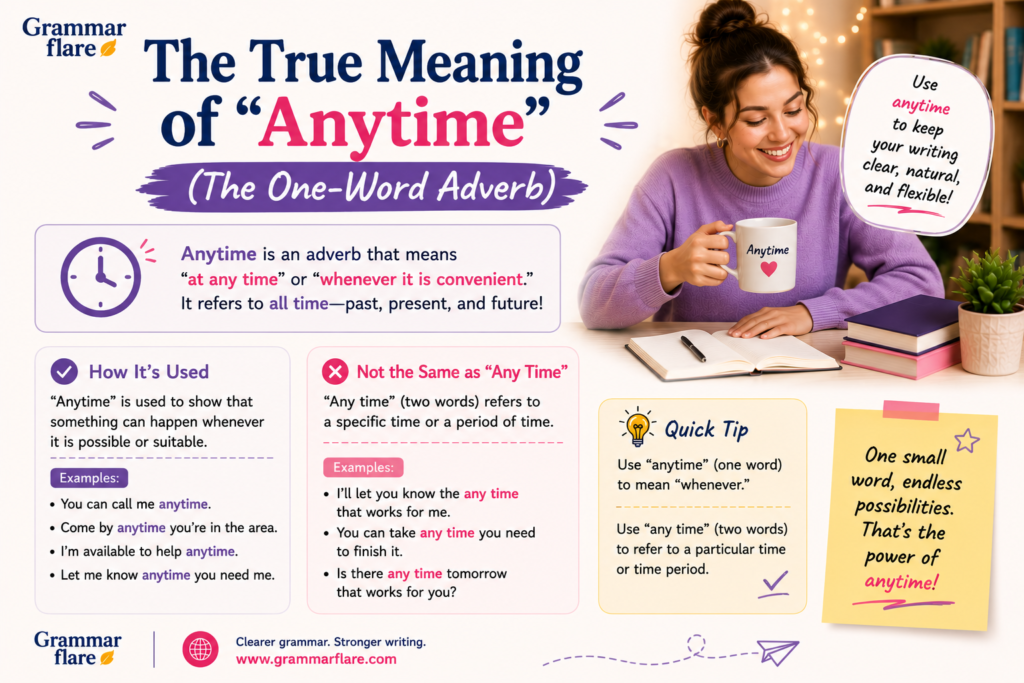
So what is the exact meaning of anytime? Merriam-Webster defines it as an adverb meaning “at any time whatever.” It signals flexibility, openness, and often warmth. When someone says “Call me anytime,” they’re not just conveying information. They’re expressing availability and willingness.
The one-word form is a relatively modern consolidation. English loves merging two-word phrases into single words over time: “some time” became “sometime,” “every one” became “everyone,” and “any time” gradually became “anytime” in informal contexts. Linguists call this process lexicalization.
Here’s what makes anytime unique: it modifies verbs, adjectives, or entire clauses. It answers the question “When?” without pointing to a specific moment.
- “You can leave anytime.” (modifies the verb)
- “Anytime you’re ready, we’ll start.” (modifies the whole clause)
- “This could happen anytime.” (open-ended time reference)
What anytime cannot do is follow a preposition. You can’t write “at anytime” or “for anytime.” The grammar simply doesn’t hold. That’s the wall, separating the meaning of anytime from its two-word cousin.
How “Anytime” Functions as a Sentence Opener
Starting a sentence with “Anytime” shifts the emphasis to timing and condition. It creates a subtle “if/when” relationship between two ideas.
- “Anytime you feel overwhelmed, take a five-minute break.”
- “Anytime the system crashes, restart the server manually.”
- “Anytime she walked in, the room got louder.”
Notice how each sentence carries a conditional tone. “Anytime” here works almost like “whenever,” and you can swap the two without changing meaning. That’s your secondary test: if “whenever” fits, “anytime” is likely correct.
“Anytime” as a Standalone Response
This is where “anytime” earns a completely unique badge. No other single English word does quite what it does as a social reply.
Person A: “Thanks so much for your help!”
Person B: “Anytime!”
That one word communicates: I was happy to help, I’d do it again, and there’s no debt between us. It’s warm, casual, and distinctly American in flavor. “You’re welcome” is polite. “Anytime” is generous.
You’d never say “Any time!” as a reply. It sounds incomplete, almost rude. That’s a function only the one-word adverb performs.
The True Meaning of “Any Time” (The Two-Word Noun Phrase)
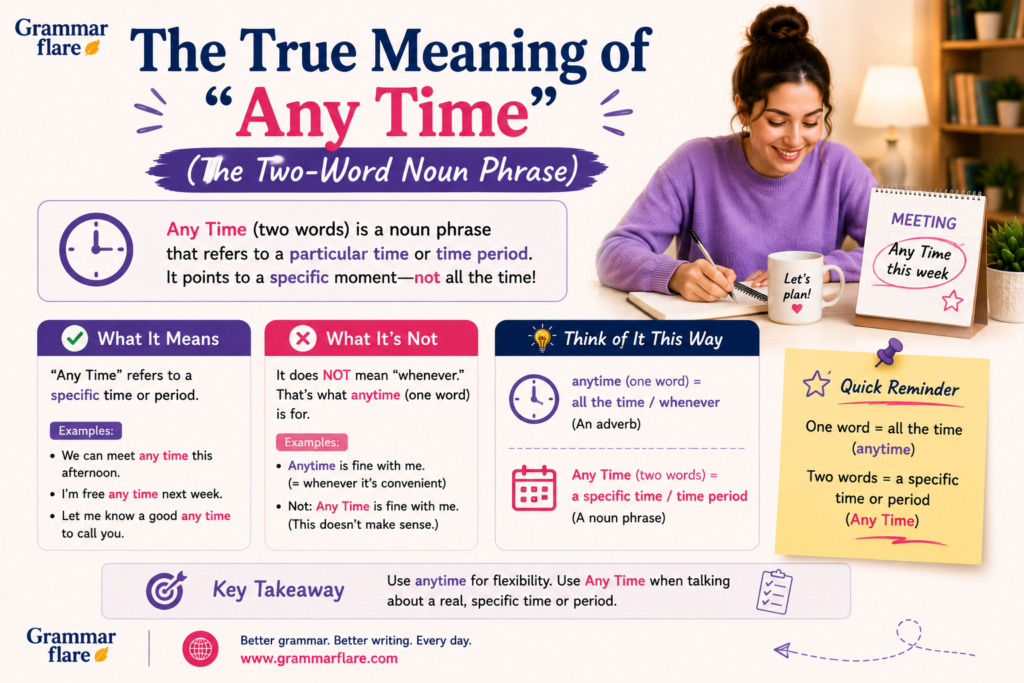
Here’s what any time means at its core: “any amount of time” or “any point in time.” It’s a noun phrase where “any” modifies the noun “time.” They work as a unit but they haven’t fused into a single word the way “anytime” has.
Any time is the grammatically correct choice whenever:
- A preposition precedes it
- You’re writing in a formal or professional context
- You could replace it with “any amount of time” or “any given moment”
Think of “any time” as the more versatile, context-neutral version. It fits everywhere, including places “anytime” can’t go.
- “You may contact us at any time.”
- “She didn’t waste any time getting started.”
- “Is there any time left on the clock?”
In all three sentences, the one-word form would be wrong or awkward.
“Any Time” After Prepositions: The Rule That Settles It
This is the cornerstone rule. Prepositions need noun phrases to complete them, not adverbs. “Anytime” is an adverb so it can’t follow a preposition. “Any time” is a noun phrase so it can.
Common prepositions that trigger the two-word form:
| Preposition | Correct Usage | Wrong Version |
|---|---|---|
| at | “at any time” | “at anytime” |
| for | “for any time” | “for anytime” |
| before | “before any time” | “before anytime” |
| during | “during any time” | “during anytime” |
| by | “by any time” | “by anytime” |
The pattern is consistent. Preposition plus “anytime” is always wrong. No exceptions.
A useful way to remember it: prepositions need a noun to lean on. “Anytime” is an adverb. It can’t carry that weight.
“Any Time” in Legal, Academic, and Professional Writing
Formal writing almost always favors “any time.” Legal documents, contracts, academic papers, and policy briefs use the two-word form because precision matters in those contexts.
Consider this clause from a standard service agreement:
“Either party may terminate this agreement at any time with 30 days’ written notice.”
Swap in “anytime” and the sentence sounds oddly casual for a legal document. The informal register of “anytime” clashes with the gravity of contract language.
Style guides back this up:
- AP Stylebook recommends “any time” in most cases and treats “anytime” as informal
- Chicago Manual of Style acknowledges both but leans toward “any time” in formal prose
- Merriam-Webster lists “anytime” as a valid adverb but notes its informal register
If you write for business, law, or academia, defaulting to “any time” is the safer, more professional choice. For everything else, context decides. Register matters as much as grammar in professional email, and the same instinct that picks “any time” over “anytime” applies to the phrases around it. Our guide to professional ways to say “please let me know” covers the ones people over-use most.
Side-by-Side: Anytime vs. Any Time Compared Directly
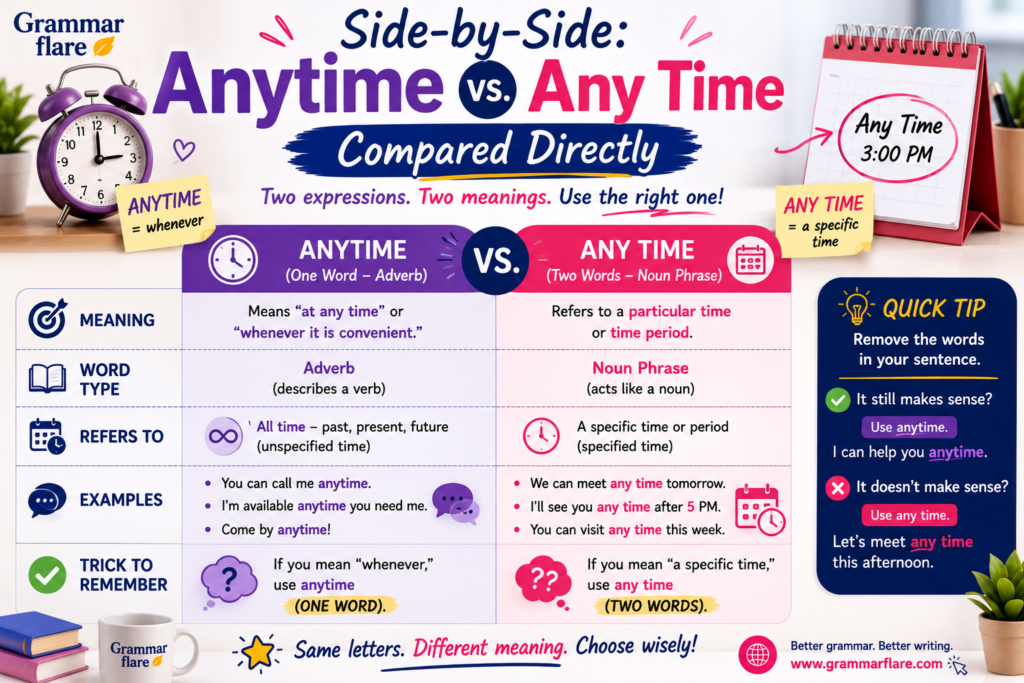
Let’s put both forms head-to-head across every dimension that matters for writers.
| Dimension | Anytime | Any Time |
|---|---|---|
| Part of speech | Adverb | Noun phrase |
| Grammatical role | Modifies verbs/clauses | Acts as subject or object |
| Follows a preposition | Never | Always |
| Standalone social reply | Yes (“Anytime!”) | No |
| Formal writing | Avoid | Preferred |
| Informal writing | Natural | Acceptable |
| Replaceable with “whenever” | Yes | Sometimes |
| Replaceable with “any amount of time” | No | Yes |
The key insight here: both forms are correct English. The question isn’t which one is right in general. It’s which one is right in your specific sentence.
The Preposition Test: The Simplest Way to Never Confuse These Again
You don’t need to memorize every grammar rule. You just need one reliable test.
The Preposition Test:
Before you write “anytime” or “any time,” ask: “Is there a preposition directly before this word?”
- Yes? Use two words: “any time.”
- No? You can likely use one word: “anytime.”
Try it on these five sentences:
- “Call me ___ you need help.” (No preposition before the blank. Answer: anytime)
- “You may leave ___ time of your choosing.” (A preposition is needed here. Answer: at any)
- “Drop by ___ this weekend.” (No preposition. Answer: anytime)
- “Submit the form ___ before the deadline.” (Tricky: no preposition before the blank. Answer: anytime)
- “We’ll be available ___ during business hours.” (No preposition directly before blank. Answer: anytime)
Practice this for a week and it becomes instinct.
Real Sentence Examples in Context (Grouped by Situation)
Casual Conversation and Texting
In everyday speech and messaging, the one-word form is the natural choice. It flows without friction.
- “Borrow my car anytime, seriously.”
- “Anytime you want to hang out, just text me.”
- “You can stream this show anytime on the app.”
- “Thanks for dinner!” / “Anytime!“
- “She could show up anytime now.”
- “Anytime works for me, your schedule is the priority.”
- “I can hop on a call anytime this afternoon.”
Formal Emails and Business Writing
Shift to “any time” when the stakes go up.
- “Please feel free to reach out at any time.”
- “The report is available for review at any time this week.”
- “You may reschedule at any time prior to the appointment.”
- “We are committed to assisting you at any time during business hours.”
- “Any time spent on revisions will be billed at the standard rate.”
- “Approval may be revoked at any time without prior notice.”
- “We do not have any time remaining in the budget for additional scope.”
Legal and Academic Documents
Precision is non-negotiable here. Always use two words.
- “The licensor may terminate access at any time upon written notice.”
- “Participants may withdraw from the study at any time without penalty.”
- “The board reserves the right to amend these bylaws at any time.”
- “Any time allocated for independent research must be documented.”
- “This policy applies at any time the employee is on company premises.”
Tricky Sentences Where Both Look Correct (But Only One Is)
These are the sentences that trip even careful writers.
Sentence 1: “Feel free to contact us ___ day or night.”
Apply the test: no preposition before the blank.
Answer: anytime (“Feel free to contact us anytime day or night.”)
Sentence 2: “She was ready to leave ___ someone suggested it.” The blank follows a clause, not a preposition. Answer: anytime (“She was ready to leave anytime someone suggested it.”)
Sentence 3: “The service is available at ___ of your choosing.”
“At” is a preposition and “any time” is the object.
Answer: any time (“The service is available at any time of your choosing.”)
Sentence 4: “Is ___ good for a quick call?”
This means “Is any moment convenient?” No preposition.
Answer: anytime (“Is anytime good for a quick call?”)
Sentence 5: “We don’t have ___ left to waste.”
“Any time” means “any amount of time” here.
Answer: any time (“We don’t have any time left to waste.”)
What Style Guides Actually Say About Anytime vs. Any Time
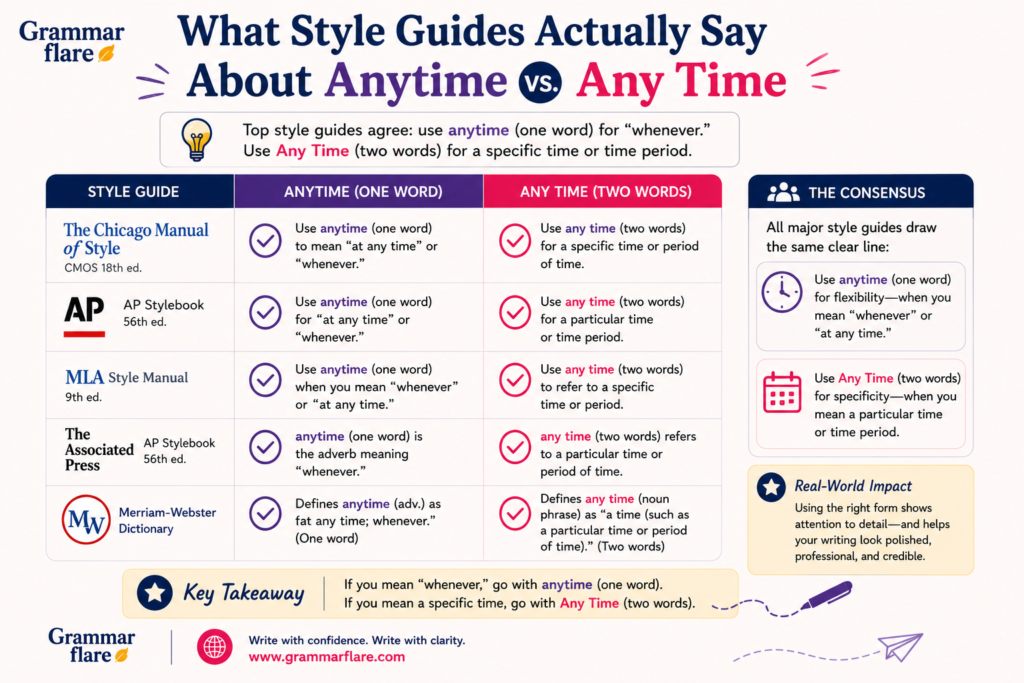
Writers who care about craft always check what authorities say. Here’s a summary of where the major style guides stand.
| Style Guide | Recommendation |
|---|---|
| AP Stylebook | Prefers “any time” in most uses; treats “anytime” as informal |
| Chicago Manual of Style | Accepts both; recommends “any time” in formal prose |
| Merriam-Webster | Lists “anytime” as a legitimate adverb; notes informal register |
| Cambridge Dictionary | Treats “any time” as the standard two-word form; notes “anytime” as chiefly American |
| Oxford English Dictionary | Recognizes “anytime” as valid but more common in American English |
The consensus is clear: when in doubt, use two words. You’ll never be wrong with “any time.” You might be wrong with “anytime” in formal contexts.
Common Mistakes Native Speakers Make (And How to Spot Them)
Even fluent writers slip up. These are the most frequent errors:
Mistake 1: “At anytime”
This is the most widespread error on the internet. A quick Google search reveals millions of instances. It’s always wrong. The preposition “at” demands a noun phrase, not an adverb.
Mistake 2: “For anytime”
Same logic applies. “For” is a preposition. It needs “any time,” not “anytime.”
Mistake 3: Using “any time” as a social reply
“Thanks!” / “Any time!” sounds incomplete and slightly odd. The one-word form owns that social function entirely.
Mistake 4: Inconsistent usage within a single document
This is subtler but damaging. If you use “anytime” in paragraph two and “at any time” in paragraph seven, careful readers notice the inconsistency. Pick a style and stick to it throughout.
Consistency here is not pedantry. Within a single document, mixed forms are the thing a careful reader actually notices.
Anytime vs. Any Time in British English vs. American English
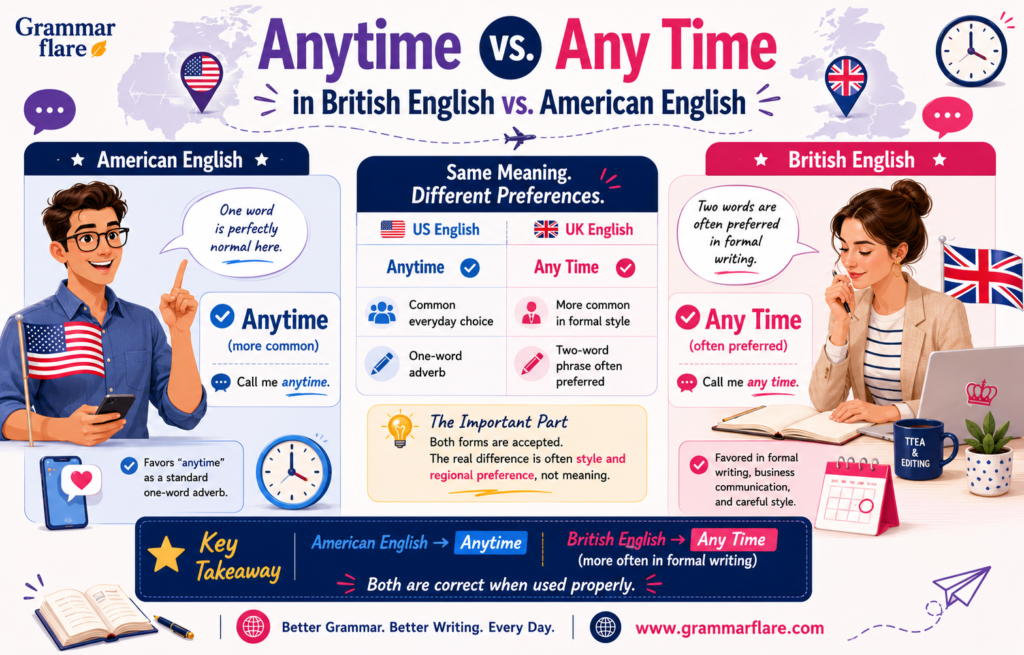
One thing most guides skip: usage patterns differ across dialects.
In American English, “anytime” as a one-word adverb is fully standard and widely accepted. American publications, apps, and casual writing embrace it freely.
In British English, the two-word form “any time” remains far more common. British style guides tend to be more conservative about compound word formations and resist fusing “any time” into a single word. You’ll rarely see “anytime” in a British newspaper or formal British document.
What this means for global writers:
- Writing for a US audience? Either form works but follow the preposition rule.
- Writing for a UK or international audience? Default to “any time” and you’ll satisfy every reader.
- Writing for a mixed audience? Use “any time” throughout. It’s universally correct.
If you use a grammar checker, make sure its dialect setting matches your audience. Suggestions for this pair differ depending on whether the tool is set to American or British English.
Synonyms and Alternatives Worth Knowing
Sometimes neither form fits perfectly. Here are your best alternatives.
Synonyms for “Anytime” (Adverb)
| Synonym | Example | Notes |
|---|---|---|
| Whenever | “Call whenever you need me.” | Most direct substitute |
| At any point | “Stop at any point if you have questions.” | Slightly more formal |
| At any moment | “He could arrive at any moment.” | Implies imminence |
| Feel free to | “Feel free to reach out.” | Conversational opener |
| Without notice | “Changes may occur without notice.” | More formal alternative |
Alternatives to “Any Time” (Noun Phrase)
| Alternative | Example | Notes |
|---|---|---|
| Any moment | “You may leave at any moment.” | Implies urgency or imminence |
| Any period | “Select any period for the report.” | Works in data/analytics contexts |
| Any occasion | “Suitable for any occasion.” | More idiomatic, less time-specific |
| Any given point | “Pausing is allowed at any given point.” | Emphasizes choice and flexibility |
Another pair that trips up the same writers is loaned and lent, where the choice depends on which verb you started from.
Frequently Asked Questions
Is it “at anytime” or “at any time”?
Always “at any time.” The word “at” is a preposition and prepositions require noun phrases. Since “anytime” is an adverb, it can’t follow “at.” This is one of the most common errors in written English.
Can you use “anytime” in a formal email?
Technically yes, if no preposition precedes it. But “any time” is the safer choice for professional communication. “Please contact us at any time” sounds more polished than “Please contact us anytime” in a business context.
Is “anytime soon” one word or two?
One word. “Anytime soon” uses the adverb form correctly. No preposition precedes it and it modifies the implied timing of the sentence. “I don’t expect this to change anytime soon” is perfectly correct.
What does “anytime” mean when used as a reply?
Used as a reply, the word shifts slightly in sense, expressing willingness and warmth. It communicates “I was glad to help and would do it again without hesitation.” It’s the informaanytime meaning shifts slightlyl, generous alternative to “you’re welcome.”
Is “any time now” correct?
Yes. “Any time now” means “very soon” or “imminently.” No preposition precedes “any time” here so either form could work technically but “any time now” is the idiomatic standard. You’d never say “anytime now” in formal writing.
Which version should you use in a cover letter or resume?
Always “any time” in professional documents. Cover letters and resumes are formal writing contexts. “I am available to interview at any time” is correct and appropriate. Avoid “anytime” in these documents entirely.
More Reading at GrammarFlare
The Bottom Line
The confusion between any time or anytime is understandable. They look almost identical and most readers won’t catch the error. But writers who know the difference produce cleaner, more credible prose.
Here’s the one rule worth tattooing on your brain: if a preposition comes before it, use two words. Everything else flows from that principle.
Anytime is warm, casual, and flexible. It works great in conversation, texting, and informal content.
Any time is precise, formal, and universally correct. When in doubt, reach for it.
Good writing isn’t just about grammar rules. It’s about respecting your reader enough to get the details right. And now, you know exactly how to do that.

Ahmad Waheed has spent five years editing academic and professional writing for universities, publishers, and software companies. He founded Grammar Flare after noticing the same handful of mistakes in almost every draft that crossed his desk, and that most grammar guides explained the rule without explaining when it actually matters.
Ahmad writes every guide on this site, checking usage questions against Merriam-Webster, the Chicago Manual of Style, and the AP Stylebook, and noting where those sources disagree rather than quietly picking a side.