
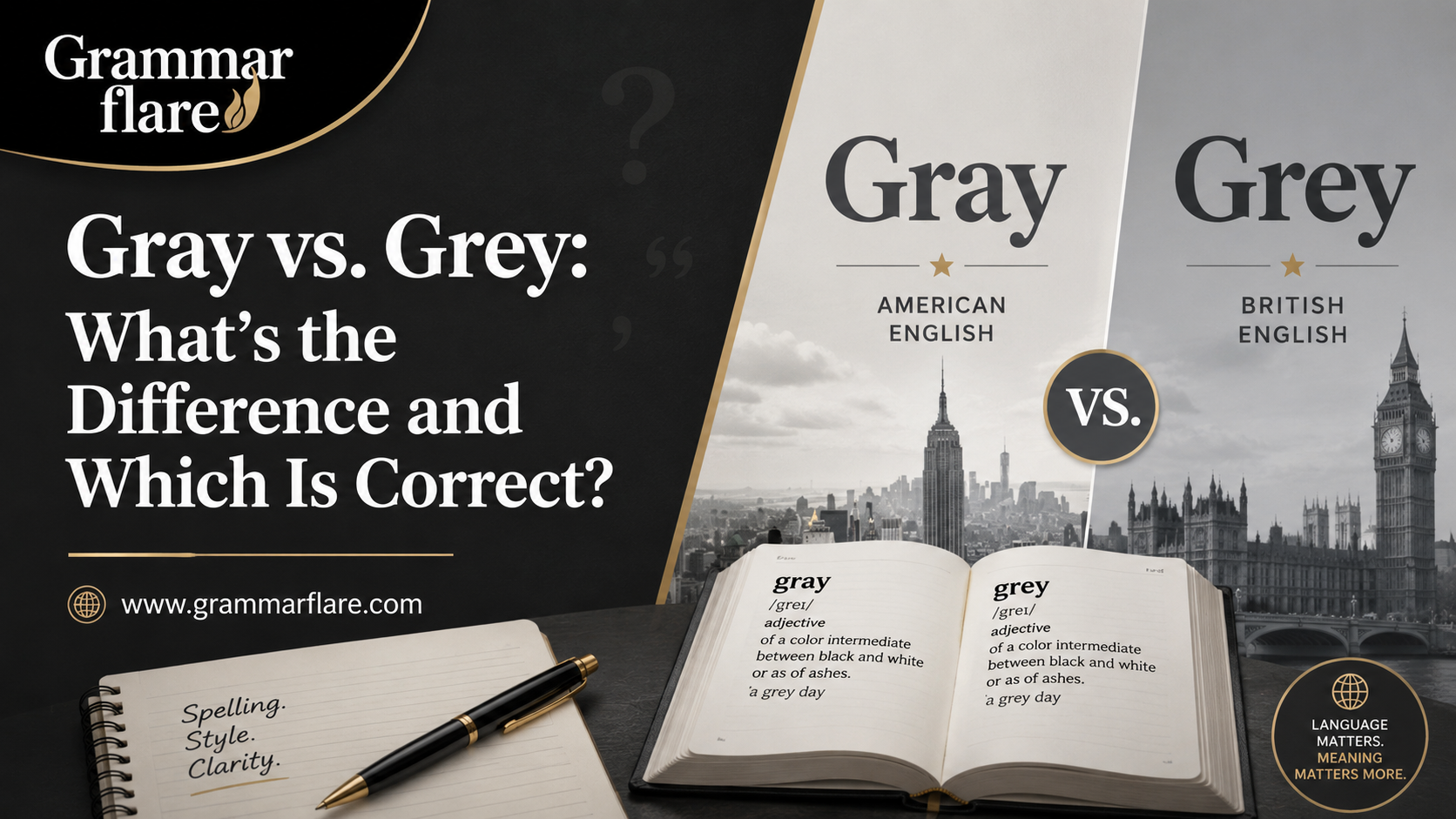
What is the difference between grey and gray? If that question has ever stopped you mid-sentence, cursor blinking, you’re not alone. I remember pausing over it once after writing thousands of words that week. I was not a beginner. And yet there I was, stuck on a four-letter color word.
This particular spelling question trips up native speakers, ESL learners, and professional writers alike, not because they’re careless, but because both spellings look perfectly correct. Both appear in published books, respected brand names, and everyday conversation. So which one is actually right?
There is a clear answer, and it comes down to one factor: where your audience is. In American English, “gray” is the standard spelling. In British and Commonwealth English, “grey” is what readers expect. By the time you finish this article, you’ll know exactly which one to reach for and why, without stopping to wonder again.
The Simple Rule Behind the Gray vs. Grey Spelling Split
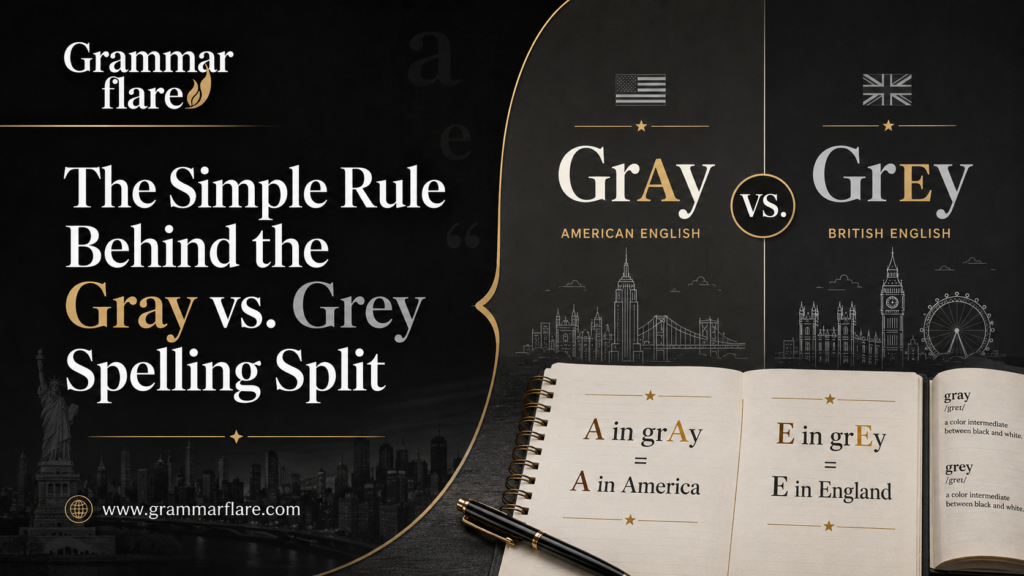
No preamble needed here. “Gray” is the standard American English spelling, and “grey” is the preferred spelling in British English and across Commonwealth countries including Canada, Australia, and New Zealand. Both spellings refer to the exact same color, carry the same meaning, and are pronounced identically. The difference is purely a matter of regional convention.
Think of it the way you think about “color” and “colour,” or “center” and “centre.” Americans write one way; the British write another. The word for that particular shade between black and white follows the exact same transatlantic pattern.
Gray Is What American English Expects
In the United States, “gray” is the default across nearly every context: journalism, academic writing, business communication, and everyday use. Published books, newspapers, and professional documents written for American audiences use “gray” as a matter of course. When an American publication uses “grey,” it’s almost always a deliberate stylistic or branding choice, not standard usage.
Grey Belongs to British and Commonwealth English
Across the UK, Canada, Australia, and New Zealand, “grey” is simply the regional standard. For those audiences, it isn’t a quirk or a mistake, it’s the spelling they learned and the one they expect in any professional context. Switching to “gray” in a document written for British readers would read as the error, not the other way around.
How Two Spellings of the Same Word Ended Up on Different Continents
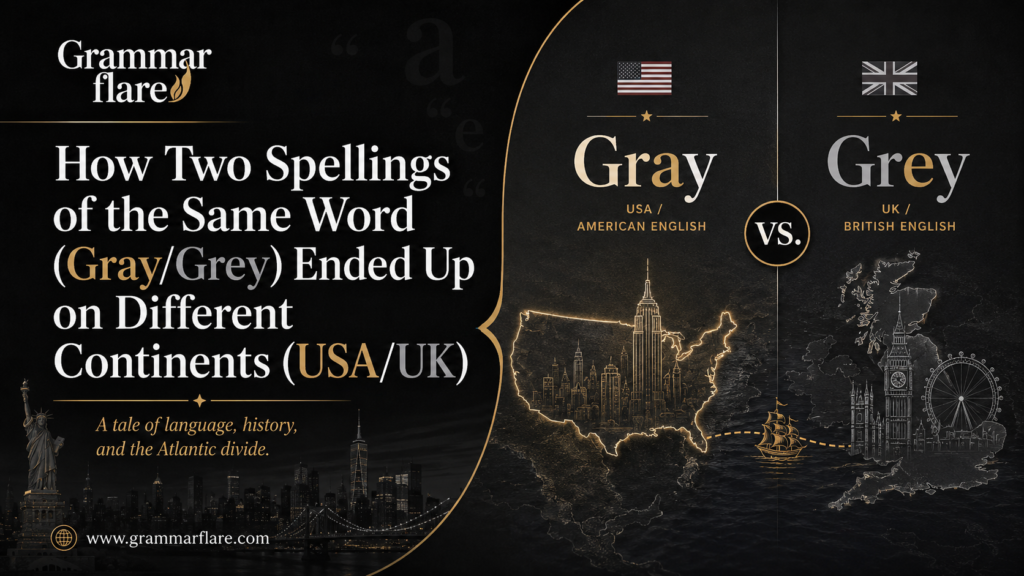
This part genuinely interested me when I first looked into it. The word traces back to Old English grǣg, a Proto-Germanic root with cousins in German (grau) and Dutch (grauw). In Middle English, the spelling wandered freely: you’d find greye, greie, and graye in manuscripts from the same era, sometimes from the same author.
By the 18th century, “grey” was gaining ground in English broadly, while dictionaries of the period sometimes recommended “gray” as the standard form. Neither camp fully won. The split we recognize today solidified in the 20th century as American and British publishing conventions went their separate ways across the Atlantic.
Why the Split Happened and Why It Stuck
Language doesn’t change uniformly across an ocean. American English and British English evolved in relative isolation long enough that certain spellings calcified differently on each side. “Gray” became the American standard; “grey” became the British one. Neither choice reflects a deeper etymological truth or a stronger claim to the original word. Geography encoded itself in the letters, and both conventions stuck.
What This History Tells Us About the Rule
The real lesson here is that neither spelling is a mistake. “Grey” is not an old-fashioned holdover, and “gray” is not an American simplification. They are parallel standards that developed at the same time from the same word. Knowing that makes the rule easier to trust: you’re not choosing between right and wrong. You’re choosing which standard fits your audience.
What Is the Difference Between Grey and Gray in Major Style Guides?
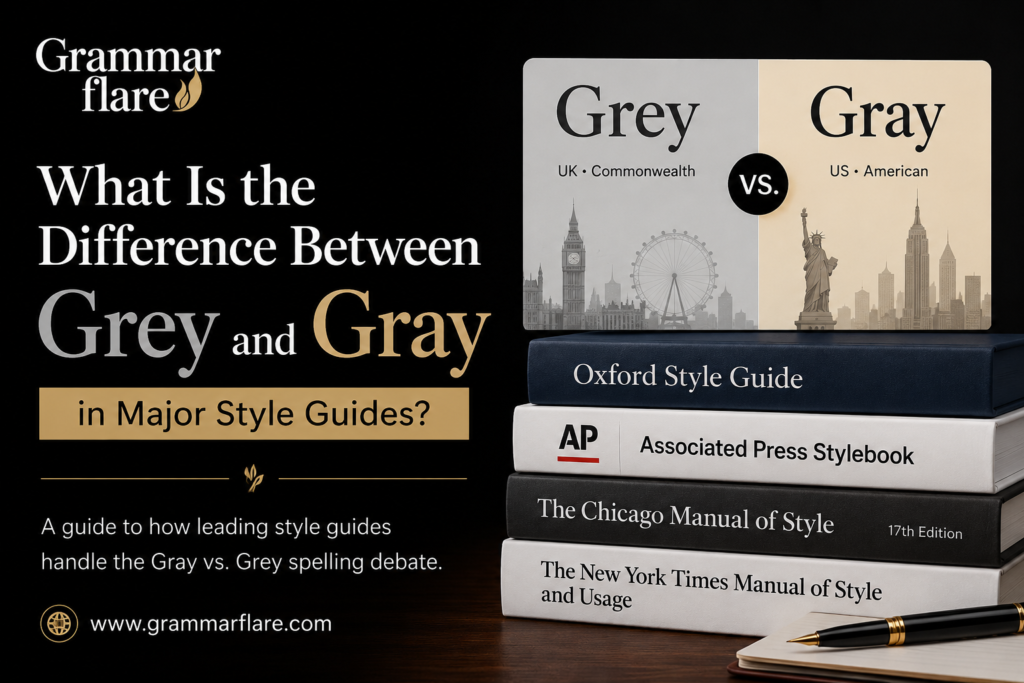
For writers who work inside editorial or academic systems, the style guides settle the question. Three matter most for American writers, and each takes a clear position.
The AP Stylebook Comes Down Firmly on “Gray”
The Associated Press Stylebook, the standard reference for American journalism and a common guide in corporate communications, prefers “gray.” For U.S. writers working in news, PR, marketing, or business content, this is the practical default. If AP governs your work, the decision is already made for you.
Chicago and Oxford Reflect Their Regional Orientations
The Chicago Manual of Style acknowledges the regional variation and, for writers producing American English content, aligns with American conventions. Oxford’s style tradition leans toward “grey” in British English contexts, which makes sense given its audience. Both guides recognize the variation; what matters is knowing which regional standard applies to your own work.
The Practical Takeaway for Writers
Whichever guide governs your writing, the rule is the same: match the guide’s regional standard. If no style guide applies to your work, American writers should default to “gray” and stay consistent throughout the document. Mixing the two spellings in a single piece of writing reads as an oversight, not a stylistic choice.
When “Grey” Is Actually Correct in American Writing
The rule bends in a few specific places, and being honest about those cases matters. Even in American English, “grey” appears in certain contexts and should be preserved exactly as written. These aren’t exceptions to the rule so much as a different category altogether.
Proper Names and Brand Spellings Always Win
Names override regional spelling conventions. “Earl Grey” is a tea with a fixed spelling tied to a historical person. “Grey’s Anatomy” is both a medical textbook and a television series; that spelling belongs to the title, not to the writer. “Fifty Shades of Grey” uses “grey” because the author chose it. When you reproduce a proper noun, copy the official spelling exactly, regardless of your regional defaults. Grey Goose vodka is spelled with an E. Greyhound keeps its E in every variety of English, whether you mean the dog breed or the bus company. The standing rule is simple: look it up and match it.
Grayscale vs. Greyscale in Technical and Design Contexts
In computing and graphic design, ‘grayscale’ is the dominant technical term. It appears in software interfaces, image format specifications, and design documentation used by American professionals. “Greyscale” exists as a variant and is more common in British-oriented writing, but for technical American English content, “grayscale” is the cleaner, more consistent choice. When in doubt, check the software or standard you’re writing about and match its terminology.
Memory Tricks That Make the Gray vs. Grey Distinction Stick
Rules stick better when you have a mental hook. These two mnemonics are the ones that actually work, and I’ve seen writers reach for them years after first learning them.
Two Mnemonics That Cover Every Standard Case
“GrAy” contains the letter A, and America begins with A. If you’re writing for an American audience, the spelling with the A is your default. “GrEy” contains the letter E, and England begins with E. If your audience is British, the E spelling is the one they expect. The pair works together cleanly: A for America, E for England. Between them, they cover every standard case you’ll encounter, and you can lock both in about ten seconds.
A 10-Second Check Before You Hit Publish
Search the document for both spellings before you finalize anything. If both appear, standardize to one. For American English writers, that almost always means replacing “grey” with “gray,” except in proper nouns. Spell-checkers set to American English will flag “grey” in most standard contexts, but the manual search takes ten seconds and catches what autocorrect misses. It’s a small habit that eliminates an easy, avoidable inconsistency.
Building an Editing Habit So This Never Trips You Up Again
Knowing a rule once is a start. Building it into your workflow is what keeps you from searching the same question six months from now. The three habits below make that automatic, and they take less than a minute to set up.
Set Your Spell-Checker Locale to US English
Most word processors and browsers let you specify American English as the default language. Once that’s set, “grey” will flag as an error in standard American contexts. That real-time feedback reinforces the rule without requiring you to think about it consciously every time you type a color description.
Keep a Personal Style Sheet for Your Own Writing
A personal style sheet is a short document where you record your preferred spellings for words that come up repeatedly. Adding “gray (not grey)” to that list takes five seconds and eliminates future hesitation. If you write for a specific publication or platform, a style sheet also captures any exceptions that apply to your particular context, including brand names with unconventional spellings.
Where to Turn When Other Everyday Spellings Trip You Up
For these kinds of American English usage questions, commonly confused words is a practical next step. The site covers spelling variants, phrase alternatives, and grammar points that fluent speakers still pause over, explained in plain language with real examples. It’s a straightforward reference to keep bookmarked alongside your style guide.
Frequently Asked Questions
Is it grey or gray in the USA?
Gray, with an A, is the standard American spelling. It appears in AP style, American journalism, and everyday US writing. Grey is not wrong, but it will read as British to an American audience.
Is grey or gray more common?
Globally, grey is more common, because British and Commonwealth English covers more countries. In the United States, gray dominates by a wide margin.
Which is correct, greyhound or grayhound?
Greyhound, always. The breed name and the bus company both use the E spelling regardless of where you are writing. It is one of the fixed exceptions.
Is it grayscale or greyscale?
In technical and design contexts, grayscale is the dominant form, including in software interfaces and image standards. Greyscale appears in British-oriented writing.
Does grey mean something different from gray?
No. Same colour, same meaning, same pronunciation. The only difference is regional convention.
Is Earl Grey spelled with an E?
Yes. It is a proper noun tied to a historical person, so the spelling is fixed. The same applies to Grey’s Anatomy and Grey Goose.
The Short Version You’ll Actually Remember
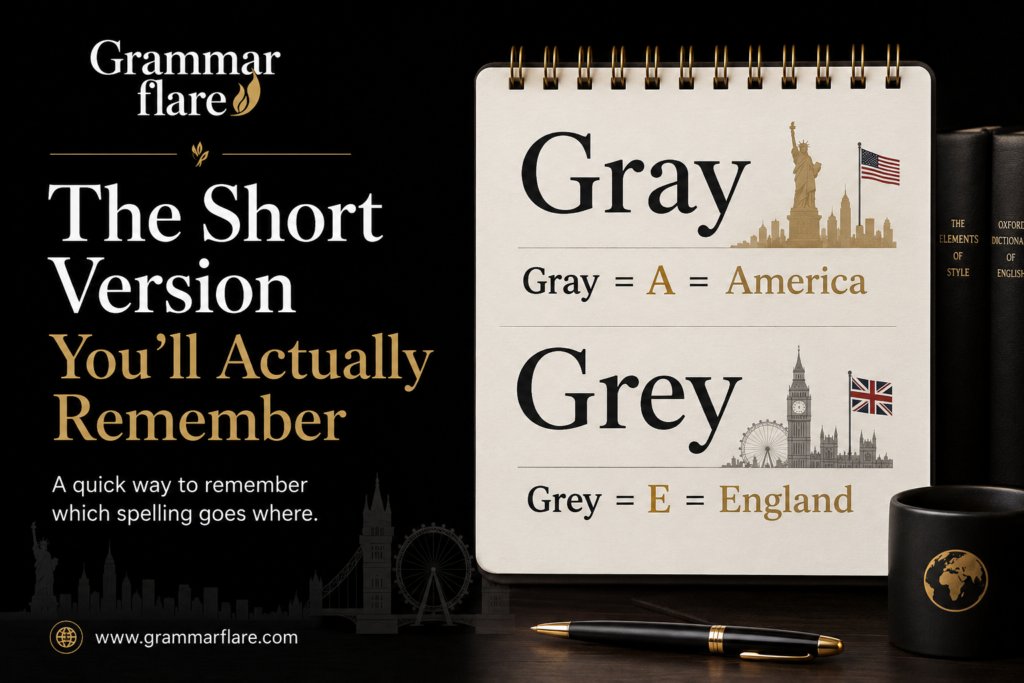
So what is the difference between grey and gray? At its core, it’s a question of audience, not correctness. Gray is the American English standard. Grey is the British English standard. Proper nouns carry their own spelling no matter where you’re writing. And once you’ve set your spell-checker and added the rule to your style sheet, this question will stop pulling your focus mid-sentence.
“Gray vs. grey” feels like a small question. In some ways, it is. But getting it right signals something larger: careful, intentional writing. It shows you paid attention to your audience and to the conventions they work within.
Language has dozens of these small forks in the road. “Color vs. colour” is another one just like it. Each fork you understand clearly makes the next decision a little faster. You’ve handled this one. Our guide to advice vs advise covers another pair that stops fluent writers mid-sentence.
More Reading at GrammarFlare
Sources

Ahmad Waheed has spent five years editing academic and professional writing for universities, publishers, and software companies. He founded Grammar Flare after noticing the same handful of mistakes in almost every draft that crossed his desk, and that most grammar guides explained the rule without explaining when it actually matters.
Ahmad writes every guide on this site, checking usage questions against Merriam-Webster, the Chicago Manual of Style, and the AP Stylebook, and noting where those sources disagree rather than quietly picking a side.