
If you mix up passed vs past, you are not alone. These two words sound the same, but they do different jobs in a sentence. One is usually the past-tense form of a verb, and the other usually talks about time, position, or movement beyond something.
This is a common mistake in emails, school writing, blog posts, captions, and everyday proofreading.
Quick Answer
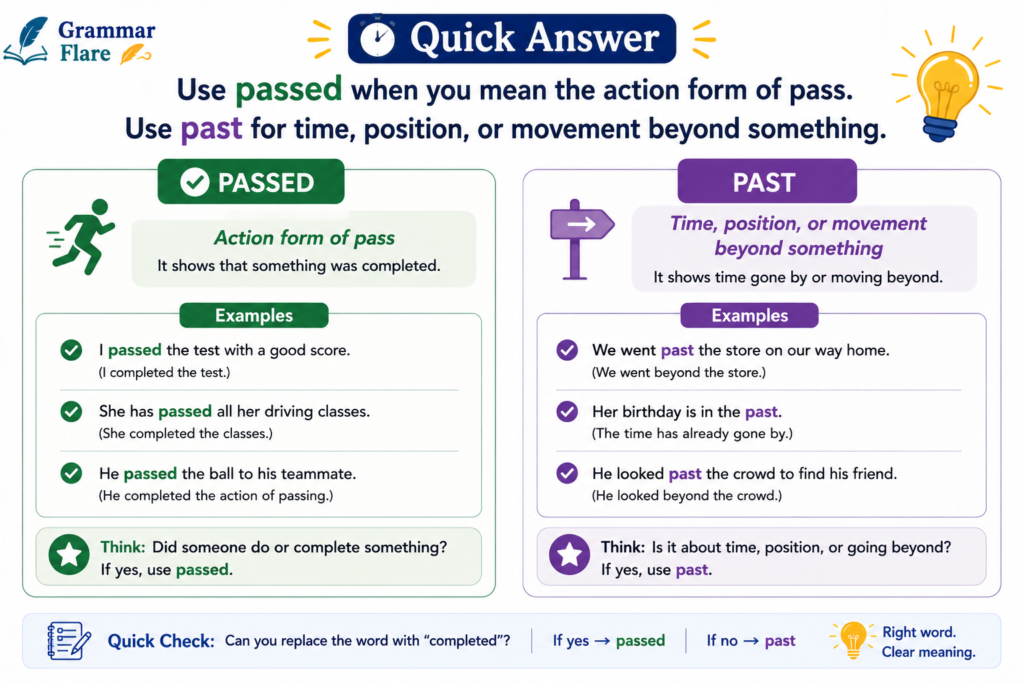
Use passed when you mean the action form of pass. Use past for time, position, or movement beyond something.
Examples:
- She passed the test.
- We walked past the bank.
- An hour passed quickly.
- That happened in the past.
If the sentence needs an action verb, use passed. If the sentence points to time, place, or the idea of beyond, use past.
Passed vs Past in One Table
| Word | Main job | What it usually means | Example |
|---|---|---|---|
| passed | verb | completed the action of pass | He passed the exam. |
| past | usually preposition, adjective, adverb, or noun | beyond, earlier time, previous | We drove past the school. |
The Rule in One Sentence
Passed is a verb. Past is usually not.
That is the fastest way to spot the difference.
What Does Passed Mean?
Passed is the past tense and past participle of the verb pass.
That means passed shows an action that already happened.
Examples:
- She passed the final exam.
- The car passed us on the highway.
- Time passed slowly during the storm.
- He passed the note to his friend.
In each example, passed describes something that happened.
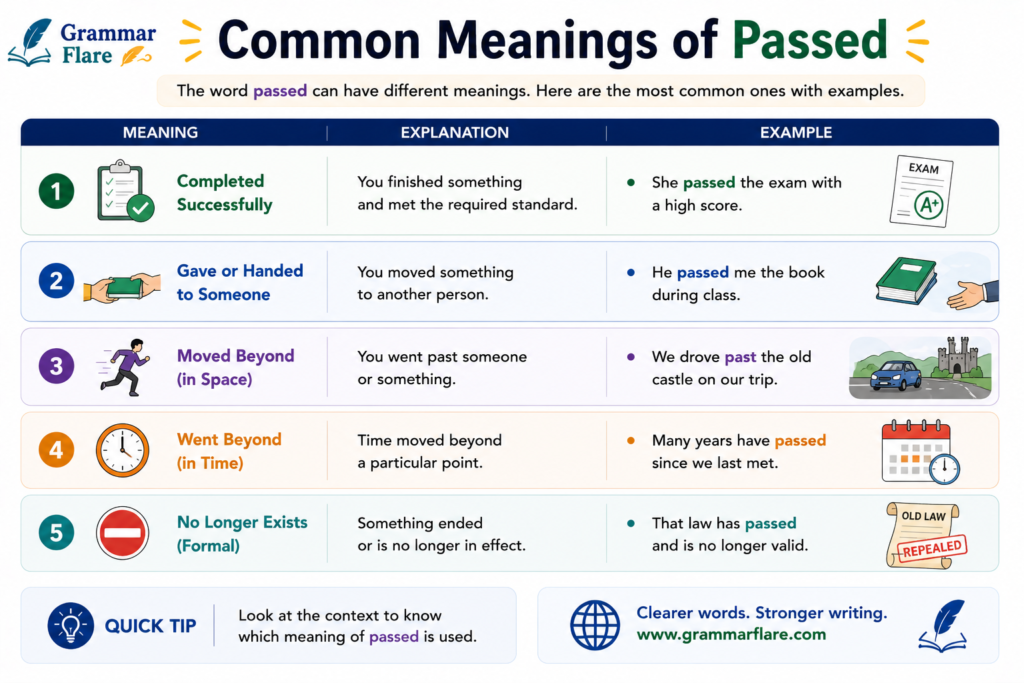
Common Meanings of Passed
1. Passed Can Mean Succeeded
Use passed when someone succeeds in a test, course, inspection, or check.
Examples:
- Nina passed her driving test.
- The building passed inspection.
- He studied hard and passed the course.
2. Passed Can Mean Moved By
Use passed when someone or something went by another person, place, or object.
Examples:
- The bus passed our stop.
- A runner passed me near the finish line.
- We passed three small towns on the trip.
3. Passed Can Mean Time Went By
Use passed when time moved or elapsed.
Examples:
- Two weeks passed before they replied.
- The afternoon passed quickly.
- Several years passed after graduation.
4. Passed Can Mean Gave or Transferred Something
Use passed when something was handed, transferred, or moved to someone else.
Examples:
- She passed the salt across the table.
- The teacher passed out the worksheets.
- He passed the message to the team.
What Does Past Mean?
Past usually refers to time, position, or movement beyond a point. Unlike passed, it is usually not a verb in everyday use.
Examples:
- We walked past the library.
- That happened in the past.
- It is half past six.
- In the past week, sales improved.
Common Meanings of Past
1. Past Can Show Movement Beyond Something
Use past when something goes beyond a place or point.
Examples:
- Drive past the gas station and turn left.
- She ran past the finish line.
- We walked past the post office.
Here, past shows position or direction beyond something else.
2. Past Can Refer to Earlier Time
Use past when talking about an earlier period.
Examples:
- In the past, people wrote more letters.
- The past few days have been busy.
- Her past experience helped her stay calm.
3. Past Can Be Part of Time Expressions
Use past in clock expressions and other common time phrases.
Examples:
- It is ten past four.
- We arrived just past midnight.
- The meeting ran past lunch.
Why People Mix Up Passed and Past
These words are easy to confuse because they are homophones. They sound the same in normal speech, but they do different jobs in writing.
Writers also get confused because both words can appear in sentences about movement:
- The car passed us.
- The car drove past us.
Those sentences are related, but the grammar is different. In the first sentence, passed is the verb. In the second sentence, drove is the verb and past shows direction.
Quick Test: Should You Use Passed or Past?
Use this fast proofreading test:
- Ask whether the sentence needs a verb.
- If it needs the past form of pass, use passed.
- If the sentence already has a verb and you are describing time, position, or beyond, use past.
Examples:
- She passed the exam.
The sentence needs a verb, so passed is correct. - We walked past the bakery.
The verb is walked, so past is correct. - An hour passed before dinner.
The sentence needs the action verb passed. - That mistake is in the past now.
The sentence talks about earlier time, so past is correct.
Passed vs Past Examples in Sentences
Here are clear side-by-side examples:
| Meaning | Correct sentence |
|---|---|
| passed = succeeded | Jamal passed the interview. |
| past = beyond a place | Jamal walked past the office. |
| passed = time went by | A month passed before we heard back. |
| past = earlier time | That problem is in the past. |
| passed = moved by | The bike passed the truck. |
| past = clock expression | It is quarter past eight. |
Correct and Incorrect Examples
Correct
- She passed the math test.
- We drove past the museum.
- The worst part is in the past now.
- Several minutes passed before the lights came back on.
Incorrect
- She past the math test.
- We drove passed the museum.
- The worst part is in the passed now.
- Several minutes past before the lights came back on.
Passed vs Past in Common Phrases
Passed the Test
Use passed because the sentence needs the verb form of pass.
- She passed the test.
- He passed the background check.
Walked Past the Store
Use past because walked is already the verb.
- We walked past the store.
- She jogged past the school.
In the Past
Use past when talking about earlier time.
- In the past, I overthought every email.
- That happened in the past.
Time Passed
Use passed because time is doing the action of passing.
- A few days passed before he answered.
- Winter passed faster than expected.
Passed Away
Use passed in the phrase passed away.
- Her grandfather passed away peacefully.
The phrase needs the verb form, so past away is not correct.
Past Due
Use past. An invoice that is overdue is past due, because past is working as an adjective meaning beyond the due date.
- The invoice is 30 days past due.
- Your account is past due.
Passed due is always wrong. This is one of the most common versions of the mistake in business writing, where it appears on invoices, reminders, and account notices.
Related phrasal verbs all take passed, because they are built on the verb: passed out, passed on, passed over, passed up.
Is “Past” Ever a Verb?
No, not in modern standard English. If your sentence needs a verb, you want passed.
Past works as four things: a preposition (we drove past the school), an adjective (the past few weeks), an adverb (the bus went past), and a noun (leave the past behind). None of those is a verb.
The one place you may see past used verbally is in very old or legal texts, where it is now archaic. In anything you write today it would read as an error.
The test: if you can put did in front of the base form, you need the verb. Did she pass the test? becomes She passed the test. You cannot do that with past.
Memory Trick for Passed vs Past
Try this:
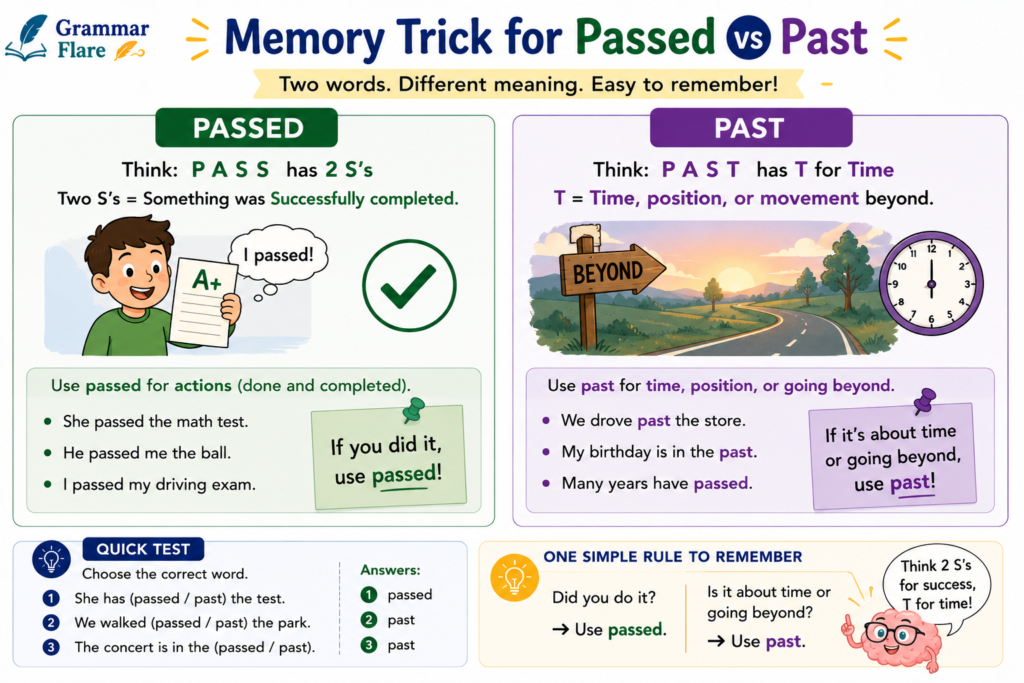
- passed has -ed, which often signals a completed action
- past does not have -ed, so it usually is not the past-tense verb
That makes the quick memory rule:
If you need an action that already happened, choose passed.
Why This Mistake Matters in Proofreading
Mixing up passed and past can make your writing look rushed, even when the rest of the sentence is strong. It is a common mistake in:
- student essays
- emails
- resumes
- captions
- business writing
- website copy
This is exactly the kind of error a quick proofreading pass should catch. If you are working on tone and clarity too, GrammarFlare’s guide to The Importance of Tone in Conversation: How to Be Heard is a useful next read.
Passed vs Past: Mini Practice
Choose the correct word for each sentence:
- We drove ___ the courthouse before turning around.
- She ___ every section of the certification exam.
- The hardest part is now in the ___.
- A full hour ___ before anyone noticed the error.
Answers:
- past
- passed
- past
- passed
Final Answer
Use passed when the sentence needs the verb form of pass. Use past when the sentence is about time, place, or going beyond something.
That one check will fix most passed vs past mistakes immediately.
FAQ
What is the difference between passed and past?
Passed is the past tense of pass and works as a verb. Past usually refers to earlier time, position, or movement beyond something.
Is it passed away or past away?
The correct phrase is passed away because it uses the verb passed.
Is it walked past or walked passed?
The correct phrase is walked past because walked is already the verb and past shows direction.
Is it passed the test or past the test?
The correct phrase is passed the test because the sentence needs the verb form of pass.
Can past be a noun?
Yes. Past can be a noun when it means earlier time, as in leave the past behind.
How can I remember passed vs. past quickly?
Remember that passed ends in -ed, which often signals a completed action. If the sentence needs an action, passed is usually the right choice.
Is it “past due” or “passed due”?
Past due. Here past is an adjective meaning beyond the due date. Passed due is never correct.
Sources
More Reading at GrammarFlare
- Loaned or Lent
- Lose vs Loose
- Than vs Then
- Affect vs Effect
- Past Perfect Tense Exercises
- Commonly Confused Words

Ahmad Waheed has spent five years editing academic and professional writing for universities, publishers, and software companies. He founded Grammar Flare after noticing the same handful of mistakes in almost every draft that crossed his desk, and that most grammar guides explained the rule without explaining when it actually matters.
Ahmad writes every guide on this site, checking usage questions against Merriam-Webster, the Chicago Manual of Style, and the AP Stylebook, and noting where those sources disagree rather than quietly picking a side.