
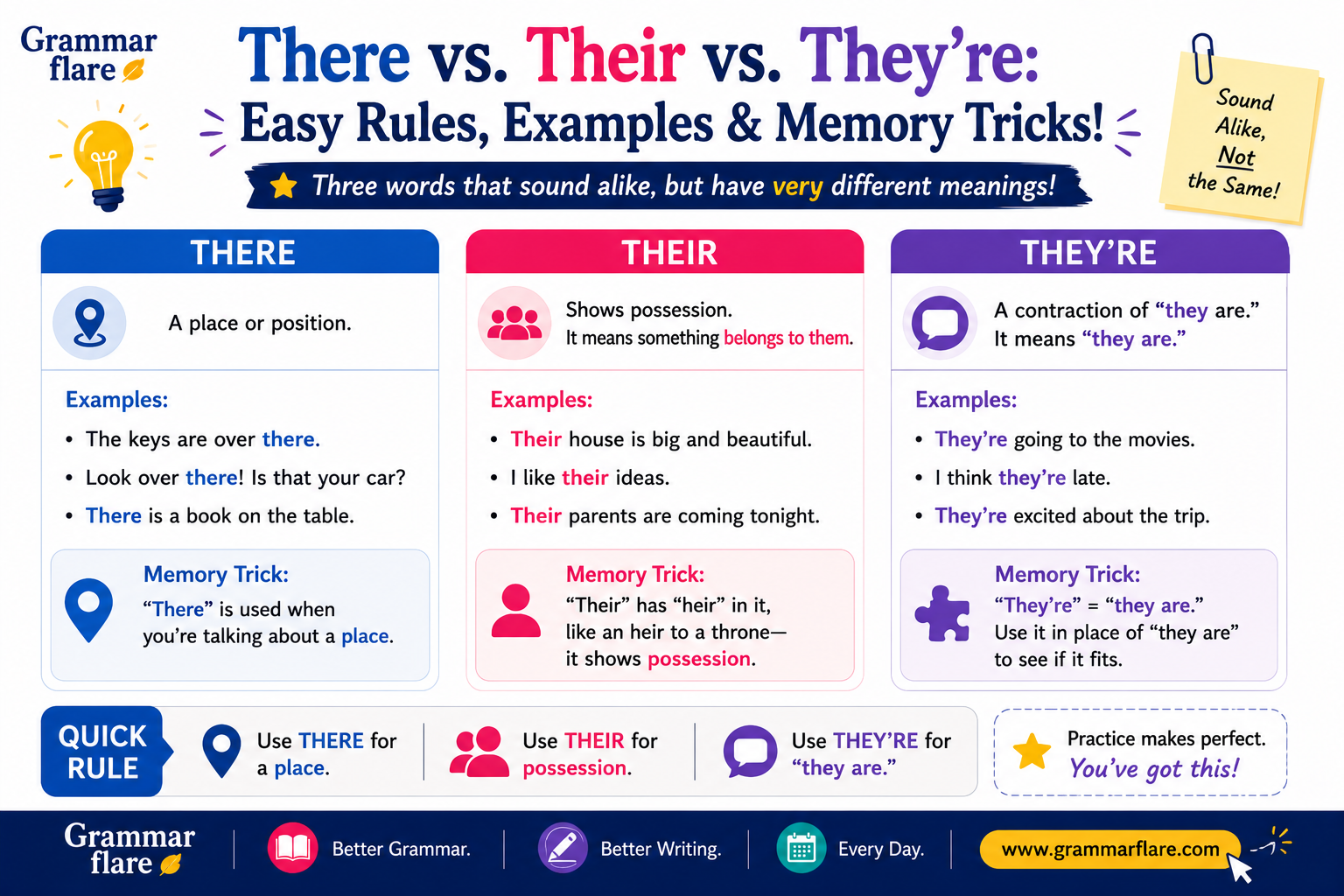
If you mix up there vs their vs they’re, you are not alone. These three words sound the same, but they do very different jobs in a sentence. That makes them one of the most common homophone problems in English.
The good news is that the rule is easy once you break it into three parts.
Quick Answer
Use there for place or existence, their for possession, and they’re for they are.
Examples:
- The books are over there.
- The students forgot their notes.
- They’re ready to begin.
If you can expand the word to they are, use they’re; if you are showing ownership, use their; if you are talking about location or starting a sentence like there is or there are, use there.
There vs Their vs They’re in One Table
| Word | Meaning | Part of speech | Example |
|---|---|---|---|
| there | place, position, or existence | adverb, pronoun, or introductory word | Put the bag over there. |
| their | belonging to them | possessive determiner | The kids packed their lunches. |
| they’re | they are | contraction | They’re waiting outside. |
The Simple Rule in One Sentence
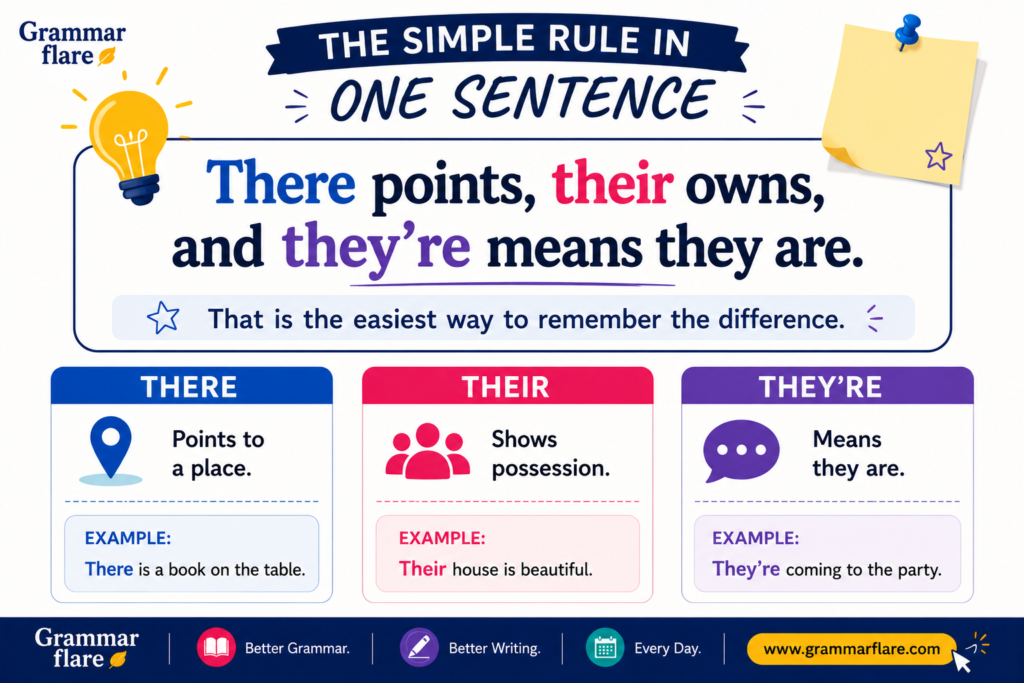
There points, their owns, and they’re means they are.
That is the easiest way to remember the difference.
What Does There Mean?
There usually relates to place or existence.
There for Place
Use there when you mean in that place or to that spot.
Examples:
- Your glasses are over there on the desk.
- We walked there after dinner.
- Please put the package there by the door.
In each example, there answers a location question.
There in “There Is” and “There Are”
Use there at the beginning of a sentence when you are saying that something exists.
Examples:
- There is a mistake in the second paragraph.
- There are two reasons this sentence sounds awkward.
- There was too much noise in the room.
This use confuses some writers because there is not showing location here. It is helping introduce the sentence.
What Does Their Mean?
Their is the possessive form of they. Use it when something belongs to a group of people, a group of things, or a person whose gender is unknown or not being specified.
Examples:
- The players washed their uniforms.
- The neighbors repainted their fence.
- Each student should bring their laptop.
- The writers revised their draft before submitting it.
If the word answers whose?, you probably need their.
What Does They’re Mean?
They’re is a contraction of they are.
Examples:
- They’re late because traffic was heavy.
- I think they’re ready for the meeting.
- They’re usually careful with punctuation.
Use they are as a quick test. If the sentence still makes sense, they’re is correct.
What About “There’s” and “Theirs”?
Two more forms belong to this group, and they cause their own confusion.
There’s is a contraction of there is or there has. It follows the same logic as they’re: the apostrophe marks a missing letter.
- There’s a mistake in the second paragraph. (there is)
- There’s been a change to the schedule. (there has)
Theirs is a possessive pronoun, and it never takes an apostrophe. It stands alone where their would need a noun after it.
- The blue folder is theirs.
- Our deadline moved; theirs did not.
Writing their’s is always incorrect. Possessive pronouns such as hers, ours, yours, and theirs take no apostrophe, for the same reason its does not.
A 10-Second Test
Use this quick check when you are unsure:
- Try expanding the word to they are.
- If that works, use they’re.
- If it does not work, ask whether something belongs to them.
- If it does, use their.
- If neither fits and the sentence points to a place or begins with there is or there are, use there.
Examples:
- ___ going to call you later.
They are going to call you later works, so use they’re. - The dogs chased ___ ball.
The ball belongs to them, so use their. - Your keys are over ___.
The sentence points to a place, so use there.
There vs Their vs They’re Examples in Sentences
Here are clear side-by-side examples:
| Meaning | Correct sentence |
|---|---|
| place | The chairs are over there near the window. |
| possession | The children hung up their coats. |
| they are | They’re already inside the theater. |
| existence | There are three problems with that idea. |
| possession | The editors updated their style guide. |
| they are | I heard they’re moving next month. |
Correct and Incorrect Examples
Correct
- There is a better way to phrase that sentence.
- The team forgot their schedule.
- They’re trying to finish before noon.
- The files are still over there on the shelf.
Incorrect
- The team forgot there schedule.
Incorrect because the sentence needs a possessive form. - Their going to be late.
Incorrect because the sentence means they are going to be late. - Put the box over their.
Incorrect because the sentence needs a word for place, not possession.
When to Use There
Use there when:
- you are talking about place or direction
- you mean in that location
- you are starting a sentence with there is, there are, there was, or there were
Examples:
- We left the car there overnight.
- There are several ways to revise that sentence.
- The restaurant is right there across the street.
When to Use Their
Use their when:
- something belongs to them
- the sentence answers the question whose?
- you need the possessive form of they
Examples:
- The students submitted their essays.
- The twins brought their own snacks.
- Many companies update their websites every year.
When to Use They’re
Use they’re when:
- you mean they are
- the apostrophe replaces the missing a
- the sentence still works after expansion
Examples:
- They’re excited about the trip.
- I know they’re doing their best.
- They’re the ones who fixed the formatting.
Common Mistakes With There, Their, and They’re
One common mistake is writing too quickly and choosing the word that simply looks familiar. Because all three words sound the same, spell-check alone may not catch the problem.
Another common mistake is forgetting that there has two major jobs:
- it can point to a place
- it can introduce a sentence such as there is or there are
Writers also confuse their and they’re because both refer to people. The difference is simple:
- their shows ownership
- they’re means they are
If homophones slow you down, the same apostrophe logic explains your versus you’re and its versus it’s. In every case, the apostrophe marks a missing letter rather than possession.
Memory Tricks for There, Their, and They’re
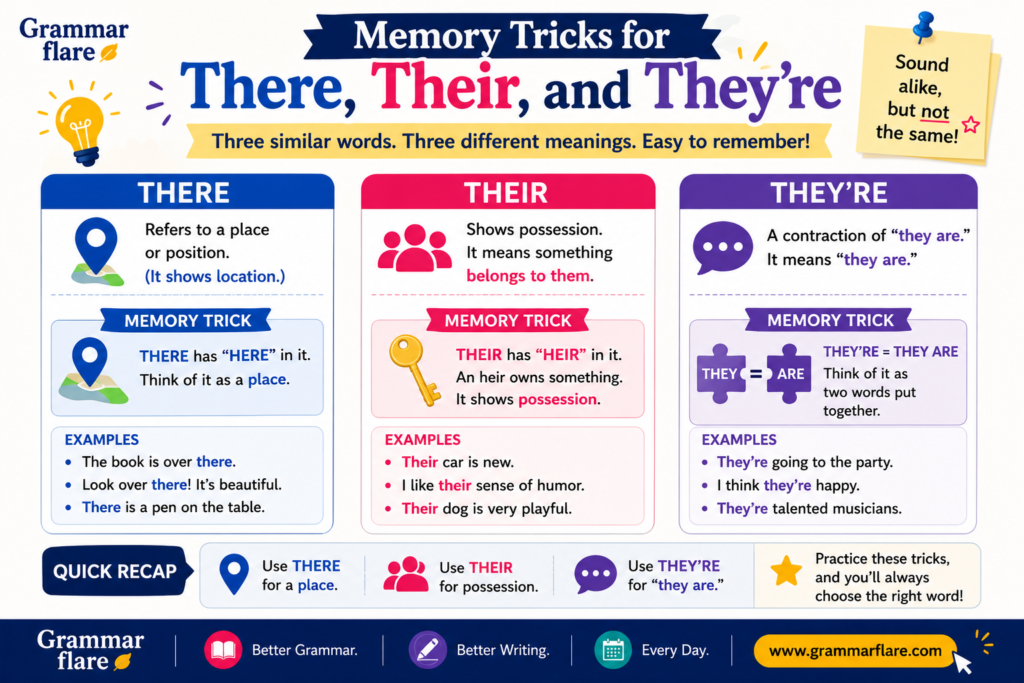
Use these simple memory tricks:
- there has the word here inside it, and both relate to place
- their contains heir, which can help you remember ownership
- they’re has an apostrophe because it is short for they are
Another quick reminder:
- there = location or existence
- their = belonging to them
- they’re = they are
A Fast Proofreading Method
When you edit your writing, pause every time you see one of these words and ask:
- Can I replace it with they are?
- If not, am I showing possession?
- If not, am I talking about place or existence?
That check only takes a second, but it catches a lot of real mistakes in emails, essays, captions, and website copy.
There vs Their vs They’re in Real-Life Writing
This rule matters in more than grammar worksheets. You may need it in:
- emails
- school assignments
- resumes
- reports
- social captions
- website copy
- client messages
Examples:
- There are two updates in today’s email.
- The interns finished their slides.
- I think they’re ready to present.
- Please place the signed forms over there.
The full apostrophe rules cover why their takes no apostrophe even though it shows possession, which is the part that trips up most writers.
American English Style Note
In standard American English, the rule is straightforward:
- there = place or existence
- their = possessive
- they’re = they are
For dictionary support, compare Merriam-Webster’s entry for there, their, and they’re.
Mini Quiz: There, Their, or They’re?
Choose the correct word in each sentence.
- ___ planning to leave after lunch.
- The hikers forgot ___ map in the car.
- Please set the groceries down over ___.
- ___ are several reasons the sentence feels unclear.
- I think ___ going to enjoy the workshop.
Mini Quiz Answers
- They’re
- their
- there
- There
- they’re
FAQ
What is the difference between there, their, and they’re?
There usually refers to place or existence, their shows possession, and they’re means they are.
How can I remember there vs their vs they’re?
Remember: there has here inside it for place, their shows ownership, and they’re expands to they are.
Is there ever possessive?
No. There is not the possessive form in this word group. The possessive form is their.
Is they’re always short for they are?
Yes. They’re is the contraction of they are.
Why do people confuse there, their, and they’re so often?
Because they are homophones. They sound the same, but they have different meanings and grammar roles.
Which is correct: their going to the store or they’re going to the store?
The correct form is they’re going to the store because the sentence means they are going to the store.
Is it there’s or theirs?
There’s means there is or there has. Theirs is a possessive pronoun meaning belonging to them. Their’s is never correct.
More Reading at GrammarFlare
Sources
Final Takeaway
If you want the shortest rule possible, remember this:
there = place or existence
their = belonging to them
they’re = they are
When you are unsure, test they are first. If that works, use they’re; if not, check for ownership. If the sentence points to a place or begins with there is or there are, use there.

Ahmad Waheed has spent five years editing academic and professional writing for universities, publishers, and software companies. He founded Grammar Flare after noticing the same handful of mistakes in almost every draft that crossed his desk, and that most grammar guides explained the rule without explaining when it actually matters.
Ahmad writes every guide on this site, checking usage questions against Merriam-Webster, the Chicago Manual of Style, and the AP Stylebook, and noting where those sources disagree rather than quietly picking a side.