
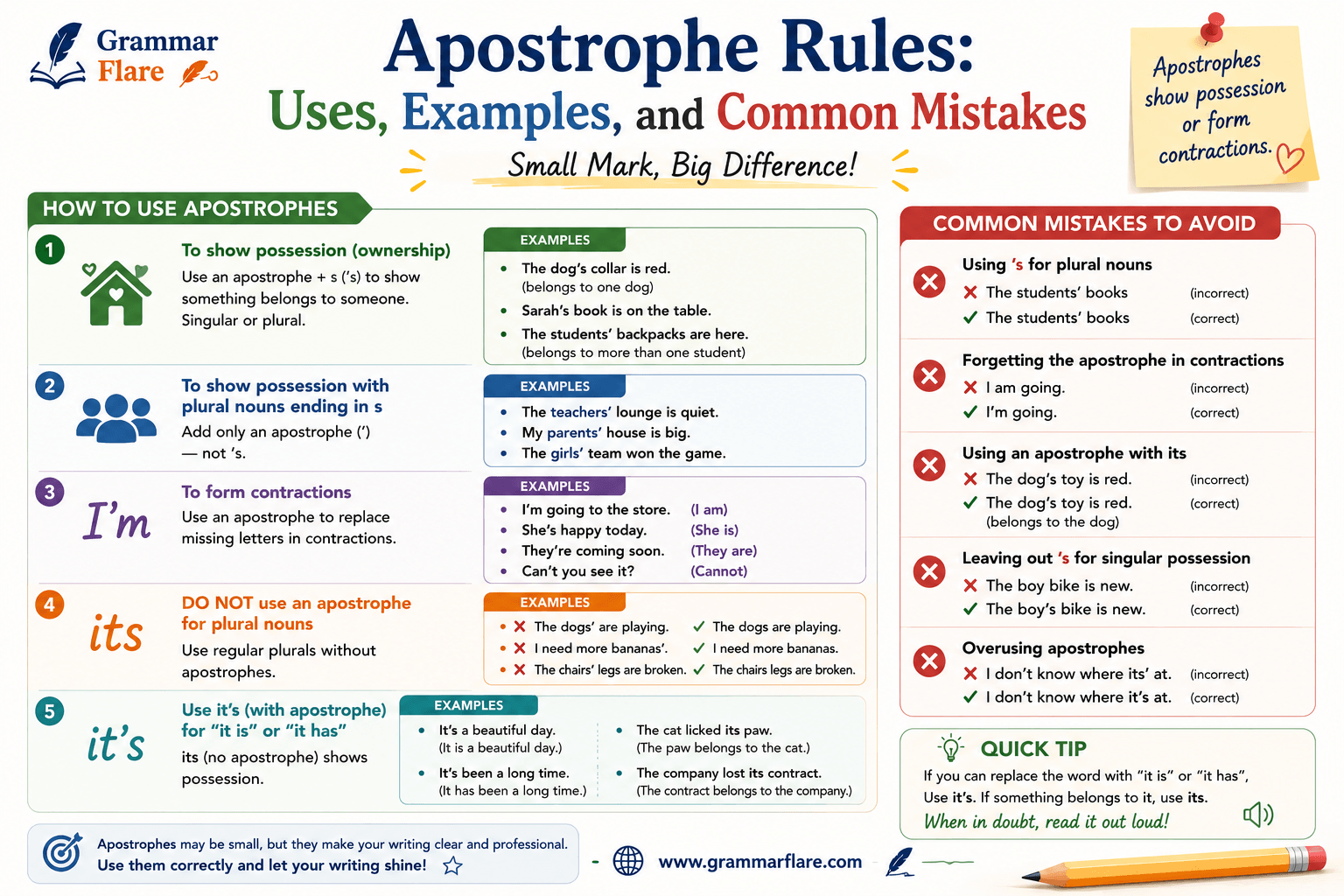
Apostrophe rules can feel confusing because the same tiny punctuation mark performs several different jobs. You may know that apostrophes show possession, but why do we write the student’s book, the students’ books, and the children’s books differently? And why does it’s contain an apostrophe when its shows possession?
The good news is that you do not need to memorize dozens of unrelated instructions. Most apostrophe mistakes disappear once you understand whether the word shows possession, contains missing letters, or is simply plural.
Quick answer: Use an apostrophe to show possession, mark missing letters or numbers, and form a few special plurals when clarity requires it. Do not normally use an apostrophe simply to make a word plural.
What Are the Main Apostrophe Rules?
The three main apostrophe rules are:
- Use an apostrophe to show possession.
- Use an apostrophe where letters or numbers have been omitted.
- Use an apostrophe in a few unusual plurals when it prevents confusion.
The most important warning is equally simple:
Do not add an apostrophe just because a word ends in s.
Compare these examples:
- Correct: three dogs
- Incorrect: three dog’s
- Correct: several laptops
- Incorrect: several laptop’s
- Correct: the dog’s collar
- Correct: the laptops’ screens
The Purdue Online Writing Lab also identifies possession and omitted letters as the apostrophe’s principal uses.
Apostrophe Rules at a Glance
| Situation | Rule | Example |
|---|---|---|
| Singular noun | Add ’s | the student’s book |
| Singular noun ending in s | Usually add ’s | James’s laptop |
| Regular plural ending in s | Add only ’ | the students’ books |
| Irregular plural not ending in s | Add ’s | the children’s room |
| Contraction | Place the apostrophe where letters are missing | don’t, it’s, they’re |
| Ordinary plural | Do not use an apostrophe | books, phones, teachers |
| Possessive pronoun | Do not use an apostrophe | its, yours, hers, theirs |
| Omitted numbers | Use an apostrophe for the missing numbers | the class of ’26 |
| Lowercase-letter plural | Use an apostrophe when clarity requires it | mind your p’s and q’s |
The Rule in One Sentence
Use an apostrophe for possession or omitted letters, not for an ordinary plural.
That single sentence summarizes the most important apostrophe rules and prevents many common errors.
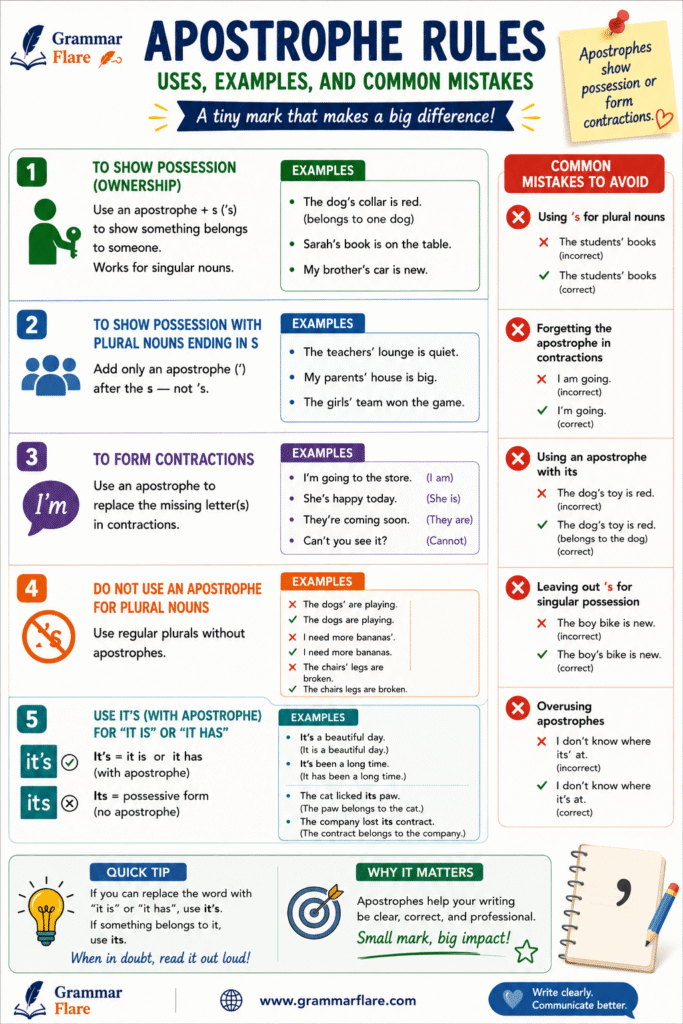
What Is an Apostrophe?
An apostrophe is the punctuation mark that looks like this:
’
It appears near the top of a letter and should not be confused with a comma, which sits near the bottom of a line.
You will commonly see apostrophes in expressions such as:
- Sarah’s notebook
- can’t
- we’re
- two weeks’ notice
- the class of ’26
- mind your p’s and q’s
Depending on the sentence, the apostrophe may show possession, replace missing letters, or make an unusual plural easier to understand.
Apostrophe Rules for Singular Possessive Nouns
A possessive form shows ownership, association, origin, connection, or another close relationship.
For most singular nouns, add an apostrophe followed by s.
Pattern
singular noun + ’s
Examples
- the student’s essay
- the manager’s office
- the child’s backpack
- the restaurant’s menu
- my brother’s car
- the computer’s screen
Examples in sentences
- The student’s essay was carefully researched.
- We waited outside the manager’s office.
- The restaurant’s menu changes every season.
- My brother’s car needs a new battery.
- The computer’s screen suddenly went dark.
These apostrophe rules apply whether the singular noun refers to a person, animal, organization, place, object, or idea.
Possession does not always mean literal ownership. A day cannot own anything, but today’s meeting means the meeting associated with today.
Apostrophe Rules for Singular Nouns Ending in S
A singular noun or name that already ends in s usually still takes ’s.
Examples
- the boss’s office
- the class’s schedule
- the bus’s engine
- the glass’s edge
- James’s laptop
- Chris’s jacket
In sentences
- The boss’s office is at the end of the hall.
- Our class’s schedule changed this morning.
- The bus’s engine made a strange noise.
- I found James’s laptop on the table.
- Chris’s jacket is hanging by the door.
For general American English, Grammar Flare recommends:
- James’s book
- Chris’s phone
- the boss’s decision
- the class’s results
Some journalistic and organizational styles prefer James’ or Chris’. The Chicago Manual of Style generally recommends adding ’s to singular nouns, including most singular names ending in s.
The most important point is consistency. Follow the style required by your school, employer, journal, or publisher.
Style guides disagree on more punctuation than most writers realise. The same is true of the comma before “but”, where Chicago allows an omission that AP does not.
Plural Possessive Nouns Ending in S
When a plural noun already ends in s, add only an apostrophe after the final s.
Pattern
plural noun ending in s + ’
Examples
- the students’ books
- the teachers’ lounge
- the dogs’ bowls
- the customers’ complaints
- the players’ uniforms
- my parents’ house
In sentences
- The students’ books were stacked near the window.
- The meeting took place in the teachers’ lounge.
- We washed the dogs’ bowls.
- The company responded to the customers’ complaints.
- The players’ uniforms arrived yesterday.
- We spent the weekend at my parents’ house.
Compare
- the student’s book: the book belongs to one student
- the students’ books: the books belong to multiple students
The location of the apostrophe changes the meaning.
Irregular Plural Possessive Nouns
Some plural nouns do not end in s. Add ’s to make these irregular plural nouns possessive.
Examples
- children’s toys
- women’s clothing
- men’s shoes
- people’s opinions
- mice’s nests
- geese’s feathers
In sentences
- The store sells children’s clothing.
- We discussed people’s reactions.
- The women’s team reached the final.
- The men’s changing room is downstairs.
- The researcher studied the mice’s behavior.
| Singular | Plural | Plural possessive |
|---|---|---|
| child | children | children’s |
| woman | women | women’s |
| man | men | men’s |
| person | people | people’s |
| mouse | mice | mice’s |
Explore more irregular forms in Grammar Flare’s Plural Nouns guides.
Joint Possession and Separate Possession
Apostrophe placement can show whether two people share something or own separate things.
Joint possession
When two people share one thing, add ’s only to the final name.
- Mia and Noah’s apartment
- Alex and Jordan’s business
- Sam and Priya’s wedding
- my mother and father’s house
Examples
- We visited Mia and Noah’s apartment.
- Alex and Jordan’s business opened last year.
- I received an invitation to Sam and Priya’s wedding.
Only one apartment, business, or wedding is involved.
Separate possession
When each person owns a separate thing, make both names possessive.
- Mia’s and Noah’s apartments
- Alex’s and Jordan’s offices
- Sam’s and Priya’s schedules
Examples
- Mia’s and Noah’s apartments are in different neighborhoods.
- Alex’s and Jordan’s offices are on separate floors.
- We compared Sam’s and Priya’s schedules.
Possessives With Compound Nouns
Place the apostrophe at the end of the complete compound expression.
Correct examples
- my mother-in-law’s recipe
- the editor in chief’s decision
- someone else’s problem
- the post office’s opening hours
- the attorney general’s statement
In sentences
- This is my mother-in-law’s recipe.
- We are waiting for the editor in chief’s decision.
- Do not take someone else’s phone.
- The post office’s opening hours changed.
Avoid placing the apostrophe in the middle.
- Correct: mother-in-law’s
- Incorrect: mother’s-in-law
- Correct: someone else’s
- Incorrect: someone’s else
Apostrophe Rules for Contractions
A contraction combines two words by removing one or more letters. The apostrophe marks the place where those letters are missing.
| Full form | Contraction |
|---|---|
| do not | don’t |
| cannot | can’t |
| is not | isn’t |
| will not | won’t |
| I am | I’m |
| I will | I’ll |
| you are | you’re |
| they are | they’re |
| we have | we’ve |
| who is | who’s |
| it is | it’s |
Examples
- I don’t understand the question.
- She can’t attend the meeting.
- You’re doing a great job.
- They’re waiting outside.
- We’ve already finished.
- Who’s responsible for the report?
- It’s going to rain.
The apostrophe does not simply appear before the final s. It replaces omitted letters.
- do not → don’t
- you are → you’re
- they are → they’re
- it is → it’s
- who is → who’s
Contractions That Commonly Cause Confusion
It’s vs. its
- it’s means it is or it has
- its is the possessive form of it
Examples:
- It’s getting late.
- It’s been a busy week.
- The company changed its policy.
Use the expansion test. Replace the word with it is or it has. If the sentence still makes sense, use it’s.
Read the complete Grammar Flare guide to It’s vs. Its. You can also compare the explanation from Merriam-Webster.
Who’s vs. whose
- who’s means who is or who has
- whose shows possession
Examples
- Who’s coming with us?
- Who’s completed the assignment?
- Whose bag is this?
Read Who’s vs. Whose for more examples.
You’re vs. your
- you’re means you are
- your shows possession
Examples
- You’re welcome.
- You’re doing well.
- Is this your notebook?
See the complete guide to Your vs. You’re.
They’re vs. their vs. there
- they’re means they are
- their shows possession
- there refers to a place or introduces a sentence
Examples
- They’re waiting outside.
- Their car is parked nearby.
- Put the box over there.
All three appear constantly in professional email, where a slip is more visible than usual. Our guide to tone in conversation covers what else shapes how a written message lands.
Do Not Use Apostrophes for Ordinary Plurals
One of the most important apostrophe rules is that ordinary plurals normally do not need apostrophes.
To make most nouns plural, add s or es.
Correct plurals
- books
- phones
- teachers
- students
- computers
- apples
- restaurants
- videos
- emails
- weekends
Incorrect plurals
- book’s
- phone’s
- teacher’s
- student’s
- computer’s
- apple’s
- restaurant’s
- video’s
- email’s
- weekend’s
Compare these forms
| Form | Meaning |
|---|---|
| book | one book |
| books | more than one book |
| book’s | belonging to one book |
| books’ | belonging to multiple books |
Examples
- I bought three books.
- The book’s cover was damaged.
- The books’ covers were damaged.
The same three-way split causes trouble with Latin plurals. Cactuses is a plural, cactus’s is a possessive, and the two are not interchangeable. Our guide to the plural of cactus covers the difference alongside when to use cacti.
Do Not Use Apostrophes in Decade Plurals
Use a plain s to make a decade plural.
Correct
- the 1980s
- the 1990s
- the early 2000s
- music from the 1960s
Incorrect
- the 1980’s
- the 1990’s
- the 2000’s
- the 1960’s
Use an apostrophe only when numbers have been omitted.
Correct shortened forms
- the class of ’26
- music from the ’90s
- the election of ’08
In ’90s, the apostrophe replaces the missing 19. The final s makes the decade plural.
Apostrophe Rules for Family Names
Do not use an apostrophe simply to pluralize a last name.
Correct plural names
- the Smiths
- the Johnsons
- the Parkers
- the Joneses
- the Martinezes
Incorrect plural names
- the Smith’s
- the Johnson’s
- the Parker’s
- the Jones’
- the Martinez’s
For most names, add s:
- Smith → Smiths
- Parker → Parkers
- Johnson → Johnsons
For names ending in s, x, z, ch, or sh, you will often add es:
- Jones → Joneses
- Martinez → Martinezes
- Bush → Bushes
Add an apostrophe only when the plural family name becomes possessive:
- the Smiths’ house
- the Johnsons’ car
- the Joneses’ invitation
- the Martinezes’ garden
Possessive Pronouns Do Not Take Apostrophes
Possessive pronouns and possessive determiners already express possession. They do not need apostrophes.
Correct forms
- his
- hers
- its
- ours
- yours
- theirs
- whose
Examples
- That jacket is hers.
- The final decision is yours.
- The company changed its website.
- The victory was theirs.
- Whose keys are these?
Incorrect forms
- her’s
- your’s
- our’s
- their’s
- its’
- whose’
These are not standard English forms.
A useful memory trick is:
If a possessive word already works by itself, do not add an apostrophe.
Apostrophe Rules for Time and Measurement
Use possessive forms in many expressions involving time, value, and measurement.
Singular expressions
- a day’s work
- an hour’s delay
- a week’s vacation
- a dollar’s worth
- a moment’s silence
Plural expressions
- two days’ work
- three hours’ delay
- two weeks’ notice
- five years’ experience
- ten dollars’ worth
Examples
- I completed a day’s work before lunch.
- The train experienced an hour’s delay.
- Please give us two weeks’ notice.
- She has five years’ experience in marketing.
- We bought ten dollars’ worth of snacks.
Compare
- one week’s notice
- two weeks’ notice
Apostrophes in Academic Degrees
Write
- bachelor’s degree
- master’s degree
Examples
- She earned a bachelor’s degree in biology.
- He is completing a master’s degree in education.
Do not use an apostrophe in formal degree names or abbreviations
- Bachelor of Science
- Master of Arts
- BS
- BA
- MS
- MA
Read Grammar Flare’s guide to Bachelor Degree or Bachelor’s Degree.
If you are writing a CV or a cover letter, our guide to professional ways to say “please let me know” covers the phrasing that usually goes around it.
Apostrophes With Letters and Numbers
Apostrophes may be used to pluralize individual lowercase letters when doing so prevents confusion.
Examples
- Mind your p’s and q’s.
- The word accommodate contains two c’s and two m’s.
- Remember to dot your i’s and cross your t’s.
Many modern styles prefer a plain s with capital letters and numbers when the result is clear:
- She earned three As.
- The password contains two 7s.
- The player scored several 3s.
- The document contains four URLs.
Follow the style guide required for your work and remain consistent.
Common Apostrophe Mistakes
Adding apostrophes to ordinary plurals
Incorrect
- We sell fresh apple’s.
- The student’s are waiting.
- I received several email’s.
Correct
- We sell fresh apples.
- The students are waiting.
- I received several emails.
Forgetting an apostrophe in a possessive
Incorrect
- The teachers desk is near the window.
- Sarah phone is ringing.
- The company policy changed.
Correct
- The teacher’s desk is near the window.
- Sarah’s phone is ringing.
- The company’s policy changed.
Putting the apostrophe in the wrong place
Incorrect
- the student’s books, when the books belong to several students
- the childrens’ room
- my parent’s house, when referring to both parents
Correct
- the students’ books
- the children’s room
- my parents’ house
Adding apostrophes to possessive pronouns
Incorrect
- The choice is your’s.
- The dog hurt it’s leg.
- The responsibility is their’s.
Correct
- The choice is yours.
- The dog hurt its leg.
- The responsibility is theirs.
Confusing contractions with possessives
Incorrect
- Its going to rain.
- The company changed it’s logo.
- Whose attending the meeting?
Correct
- It’s going to rain.
- The company changed its logo.
- Who’s attending the meeting?
A Fast Method for Checking Apostrophes
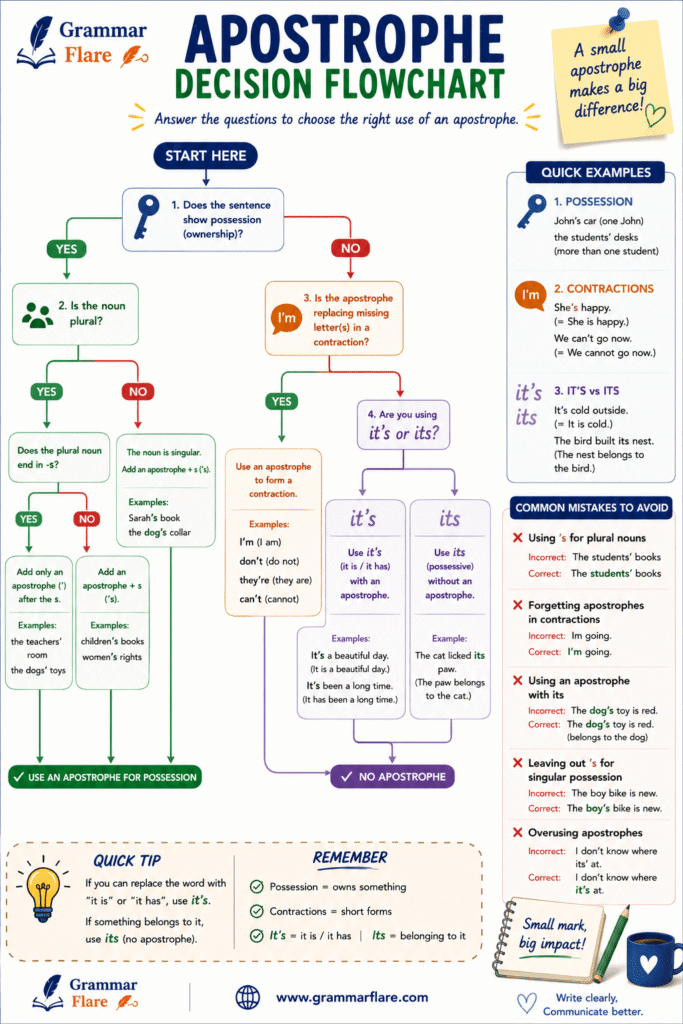
These apostrophe rules become much easier when you ask three questions.
Does the word show possession?
Ask who or what owns, uses, or is associated with the noun.
- the student’s laptop
- the students’ laptops
- the children’s laptops
Then decide whether the owner is singular, a regular plural, or an irregular plural.
Are letters or numbers missing?
Try expanding the expression.
- it’s → it is or it has
- you’re → you are
- who’s → who is or who has
- didn’t → did not
- ’90s → 1990s
If the longer form works, the apostrophe marks an omission.
Is the word simply plural?
If the word only means more than one, it probably does not need an apostrophe.
- books
- students
- phones
- videos
- 1990s
- Smiths
Apostrophe Examples in Everyday Writing
Emails
- I’ve attached today’s meeting notes.
- Please send the client’s revised document.
- We need two days’ notice before cancellation.
- You’re welcome to suggest changes.
School writing
- The author’s argument becomes clearer in the final chapter.
- The students’ results were compared.
- Shakespeare’s plays remain widely studied.
- The children’s responses were recorded.
Business writing
- The company’s revenue increased.
- The employees’ concerns were discussed.
- The manager’s decision will be announced tomorrow.
- It’s important to review the contract.
Social media
- Here are this week’s highlights.
- We’re celebrating our customers’ stories.
- It’s finally Friday.
- The team’s new video is online.
Signs and advertisements
Correct
- Fresh apples
- Customers’ entrance
- Men’s clothing
- Women’s shoes
- Children’s books
Incorrect
- Fresh apple’s
- Customer’s entrance, when intended for all customers
- Mens clothing
- Womens shoes
- Childrens books
Mini Quiz: Test Your Knowledge
1. The two ___ projects were displayed.
A. student’s
B. students’
C. students
2. ___ going to be a long day.
A. Its
B. It’s
C. Its’
3. The company changed ___ policy.
A. it’s
B. its
C. its’
4. We need three ___ notice.
A. days
B. day’s
C. days’
5. The ___ toys were scattered across the floor.
A. childrens
B. children’s
C. childrens’
6. Happy holidays from the ___.
A. Smith’s
B. Smiths
C. Smiths’
7. We visited the ___ new house.
A. Smiths
B. Smith’s
C. Smiths’
8. ___ jacket is hanging by the door?
A. Who’s
B. Whose
C. Whos’
9. I found ___ phone on the desk.
A. James
B. James’s
C. Jameses
10. She earned two ___ in her final exams.
A. A’s
B. As
C. Either may be accepted depending on style
Quiz Answers
- B: students’ — The projects belong to multiple students.
- B: It’s — The sentence means It is going to be a long day.
- B: its — Its is the possessive form.
- C: days’ — The notice covers multiple days.
- B: children’s — Children is an irregular plural.
- B: Smiths — The family name is simply plural.
- C: Smiths’ — The house belongs to the Smith family.
- B: Whose — The question asks about possession.
- B: James’s — James is one person.
- C — Many modern styles prefer As, while some use A’s for clarity.
Frequently Asked Questions About Apostrophe Rules
What are the basic apostrophe rules?
Use apostrophes to show possession, mark missing letters or numbers, and form a few special plurals when clarity requires them. Do not use an apostrophe to create an ordinary plural.
How do I know whether the apostrophe goes before or after the s?
Place the apostrophe before the s for a singular possessive or an irregular plural possessive:
- the teacher’s desk
- the children’s room
Place the apostrophe after the s for a regular plural possessive:
- the teachers’ desks
- the students’ room
Is it James’s or James’?
Both appear in edited writing. Grammar Flare recommends James’s for general American English because James is singular.
Is it students or student’s?
Use students for more than one student. For Example: The students arrived.
Use student’s when something belongs to one student.
- The student’s bag is missing.
Use students’ when something belongs to multiple students.
- The students’ bags are outside.
Do decades need apostrophes?
Ordinary decade plurals do not:
- the 1980s
- the 1990s
Use an apostrophe when numbers are omitted:
- the class of ’26
- music from the ’90s
Do family names need apostrophes?
Not when you are simply making the name plural.
- the Smiths
- the Joneses
Use an apostrophe to show possession.
- the Smiths’ house
- the Joneses’ car
Is its’ ever correct?
No. Its’ is not a standard English form.
Use
- it’s for it is or it has
- its for possession
Why does its not have an apostrophe?
Its follows the same pattern as his, hers, yours, ours, and theirs. These possessive forms do not use apostrophes.
Related Grammar Flare Guides
- How to Use a Colon in a Sentence
- When to Use a Semicolon
- It’s vs Its
- Who’s vs Whose
- Bachelor Degree or Bachelor’s Degree
Final Takeaway
The essential apostrophe rules are easier to remember when you identify the apostrophe’s job.
- Add ’s to most singular possessive nouns.
- Add only ’ to regular plural possessive nouns ending in s.
- Add ’s to irregular plural possessive nouns.
- Use apostrophes to mark missing letters or numbers.
- Do not use apostrophes for ordinary plurals.
- Do not add apostrophes to its, yours, hers, ours, or theirs.
When you are unsure, ask whether the word shows possession, contains missing letters, or simply means more than one. That quick check will solve most apostrophe problems.

Ahmad Waheed has spent five years editing academic and professional writing for universities, publishers, and software companies. He founded Grammar Flare after noticing the same handful of mistakes in almost every draft that crossed his desk, and that most grammar guides explained the rule without explaining when it actually matters.
Ahmad writes every guide on this site, checking usage questions against Merriam-Webster, the Chicago Manual of Style, and the AP Stylebook, and noting where those sources disagree rather than quietly picking a side.