
If you have ever stopped mid-sentence to wonder whether the plural of fungus is fungi or funguses, you are not alone. This word causes confusion because English accepts two plural forms, and one of them sounds much more familiar in science class than in everyday conversation.
The short answer is simple: both fungi and funguses are correct. The better choice depends on tone, audience, and context. This guide gives you the fast answer first, then shows the difference with examples you can copy.
Quick Answer
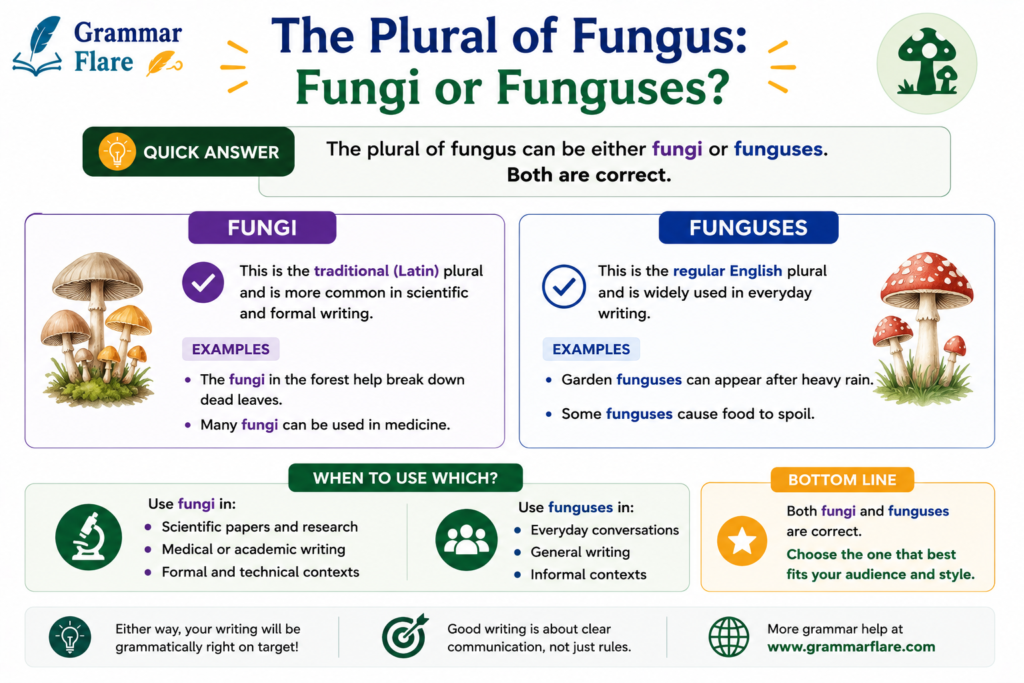
The plural of fungus can be either fungi or funguses. Both are correct.
- Fungi is the traditional Latin-style plural.
- Funguses is the regular English plural.
In formal, scientific, or academic writing, fungi is usually more common. In plain-English everyday writing, funguses is still accepted.
Plural of Fungus in One Table
| Singular | Correct plurals | Tone / common use | Example |
|---|---|---|---|
| fungus | fungi, funguses | fungi sounds more traditional or scientific; funguses sounds more regular and plain-English | Several fungi were growing on the fallen log. |
The Rule in One Sentence
Use fungi when you want the traditional or scientific plural, and use funguses when you prefer the regular English plural.
Is the Plural of Fungus “Fungi” or “Funguses”?
The correct answer is both.
English often keeps older plural patterns from Latin, but it also turns borrowed words into regular English plurals over time. That is why:
- fungi is correct
- funguses is correct
- neither form is a grammar mistake
The real difference is not correctness. It is style and usage.
Why Does Fungus Have Two Plurals?
Fungus is a Latin second-declension noun, and those form their plural by changing -us to -i. English borrowed the word along with that plural, then later built a regular one alongside it.
The same pattern governs cactus, radius, nucleus, and alumnus. It does not govern every word ending in -us, which is why octopi and viri are wrong. Our guide to the plural of cactus sets out which groups take which ending.
“Fungi” Is Also a Kingdom
There is a second reason fungi dominates in scientific writing, and it has nothing to do with Latin plurals.
Fungi, capitalised, is the name of one of the biological kingdoms, alongside Animalia and Plantae. It covers mushrooms, moulds, yeasts, and rusts. So in biology the word carries a technical meaning rather than simply being a plural count noun.
- Mushrooms belong to the kingdom Fungi. (taxonomic name, capitalised)
- Several fungi were growing on the log. (ordinary plural, lowercase)
This is why funguses can look wrong in a science context even though it is perfectly correct English. A biologist reaching for fungi is often naming the group, not just counting mushrooms.
It also explains why the word behaves differently from cactus, where no taxonomic pull exists. Cactuses raises no eyebrows in a garden centre. Funguses in a lab report will.
One more distinction worth knowing: fungal is the adjective, and it is the only option. There is no funguses-related or fungi-related form in standard use. A fungal infection, never a fungus infection in medical writing.
Which Form Sounds More Natural in Everyday English?
For many readers, fungi still sounds more familiar because it appears often in school and science contexts. But funguses is not wrong, and some writers prefer it because it follows the regular English pattern more clearly.
A practical rule:
- use fungi in formal, scientific, or educational writing
- use funguses if you want a plain-English feel and do not need a more technical tone
Plural of Fungus Examples in Sentences
Here are simple examples showing both accepted forms.
| Form | Correct sentence |
|---|---|
| fungi | The forest floor was covered with small fungi after the storm. |
| fungi | Some fungi are harmless, while others can damage crops. |
| funguses | The kids pointed at the bright orange funguses on the old branch. |
| funguses | The worksheet compared mushrooms with other funguses. |
Is “Funguses” Wrong?
No. Funguses is not wrong.
This is the most important point for learners. Many people assume only fungi is correct because it sounds more academic, but major dictionaries accept funguses too. The best choice depends on whether you want a more technical tone or a more regular English one.
When to Use Fungi
Choose Fungi for:
- science or biology writing
- school assignments
- formal edited prose
- situations where a traditional plural sounds more natural
Example:
- The report described several harmful fungi that affect wheat crops.
When to Use Funguses
Choose Funguses for:
- beginner-friendly explanations
- casual educational writing
- plain-English examples
- cases where the regular English plural feels easier for the reader
Example:
- We saw small funguses growing near the wet rocks.
A Quick Proofreading Check
If you are unsure which plural to use, ask these questions:
- Am I writing for a scientific, school, or formal audience?
- Do I want the sentence to sound more traditional or more conversational?
- Will one form feel more natural to my reader?
- Have I stayed consistent throughout the piece?
That last question matters most. Switching between fungi and funguses in the same article can look careless unless you are explaining the difference on purpose.
Fungus Plural in American English
In American English, fungi is often the more familiar plural in published writing, especially in educational or scientific contexts. But funguses is still accepted. In most writing, the safest advice is:
- choose fungi for a polished, standard-looking answer
- choose funguses if you want a regular English plural and a less technical feel
Other Words Like Fungus
The plural of fungus feels tricky because English handles borrowed nouns in mixed ways. You may notice similar questions with words like:
- cactus -> cacti or cactuses
- syllabus -> syllabi or syllabuses
- focus -> focuses in everyday writing, foci in technical contexts
- nucleus -> nuclei
That is why plural nouns are worth learning as patterns, not just one-off exceptions.
Common Mistakes to Avoid
| Mistake | Why it hurts | Better move |
|---|---|---|
| assuming only fungi is correct | it turns an accepted form into a fake rule | remember that funguses is also accepted |
| mixing both plurals randomly | it makes polished writing look inconsistent | choose one form and keep it throughout the piece |
| forcing the scientific form in every sentence | it can sound stiff in plain-English writing | match the plural to the audience and tone |
| treating every Latin-style plural as better | usage depends on the word and context | check the actual accepted forms for that noun |
Mini Quiz: Fungi or Funguses?
Try these before checking the answers.
- The textbook described several soil ___.
- The children spotted colorful ___ after the rain.
- In formal biology writing, ___ is usually the more expected choice.
- In beginner-friendly plain-English writing, ___ can still be correct.
- The mushroom guide listed forty edible ___ found in the region.
Answers
- fungi
- funguses
- fungi
- funguses
- fungi
FAQ
What is the plural of fungus?
The plural of fungus can be fungi or funguses. Both are correct.
Is fungi more correct than funguses?
No. Fungi is not more correct. It is simply the more traditional and scientific-looking plural. Funguses is also accepted English.
Is funguses a real word?
Yes. Funguses is a real and correct plural form of fungus.
Which plural should I use in everyday writing?
If you want the form that sounds more standard in formal writing, use fungi. If you want the regular English plural, funguses is also fine.
Should I use fungi in school writing?
Usually yes, especially in science or formal writing, because it often sounds more expected there.
Short Answers for Quick Reference
- Plural of fungus quick answer: The plural of fungus can be fungi or funguses. Both are correct.
- Fast usage rule: Use fungi for a more traditional or scientific feel, and funguses for a regular English plural.
- Best editing tip: Pick one form and stay consistent throughout the piece.
- Biggest misconception:
fungusesis not wrong; it is simply less formal-looking than fungi.
More Reading at GrammarFlare
- Plural of Cactus: Cacti or Cactuses?
- What Is the Plural of Mouse?
- What Is the Plural of Hoof?
- Countable vs Uncountable Nouns
- Plural Nouns
Sources

Ahmad Waheed has spent five years editing academic and professional writing for universities, publishers, and software companies. He founded Grammar Flare after noticing the same handful of mistakes in almost every draft that crossed his desk, and that most grammar guides explained the rule without explaining when it actually matters.
Ahmad writes every guide on this site, checking usage questions against Merriam-Webster, the Chicago Manual of Style, and the AP Stylebook, and noting where those sources disagree rather than quietly picking a side.