

If you have ever paused over whether the plural of hoof is hooves or hoofs, you are not alone. This word looks simple, but English allows two plural forms, and one of them is much more common than the other.
The short answer is easy: both hooves and hoofs are correct, but hooves is the form most readers expect in everyday English. This guide explains the difference, gives you clear examples, and shows which form is safest for most writing.
Quick Answer
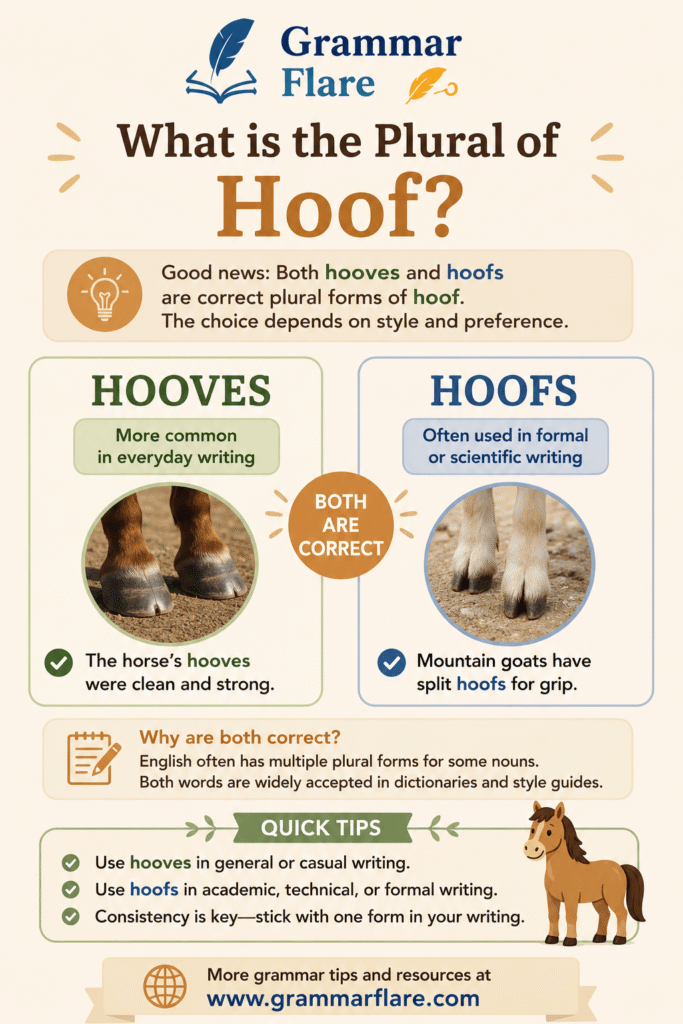
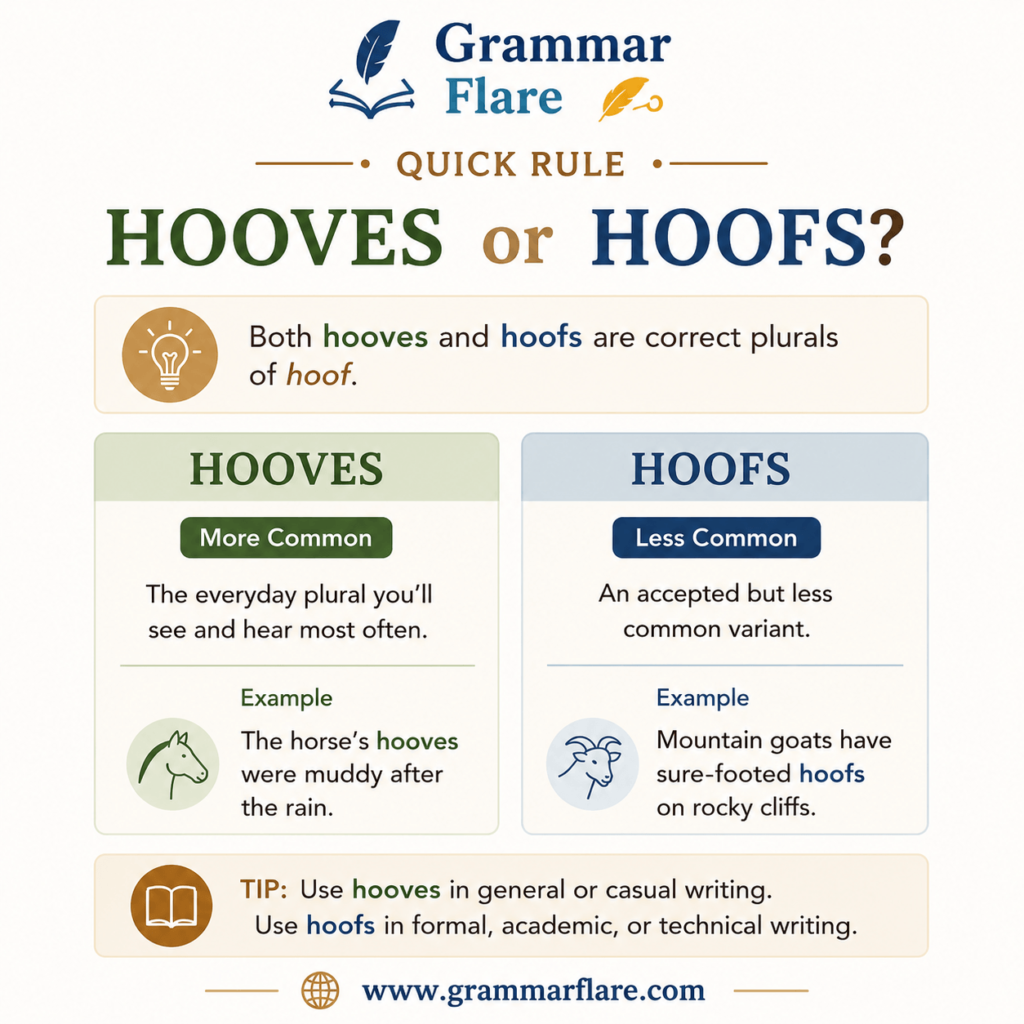
The plural of hoof can be either hooves or hoofs. Both are correct, but hooves is more common.
- Hooves is the standard everyday choice most readers expect.
- Hoofs is also accepted, but it appears less often.
If you want the safest, most natural-looking answer for most readers, use hooves.
Plural of Hoof in One Table
| Singular | Correct plurals | Most common choice | Example |
|---|---|---|---|
| hoof | hooves, hoofs | hooves | The horse lifted its front hooves. |
The Rule in One Sentence
Use hooves as your default plural of hoof; treat hoofs as a less common but still accepted variant.
Is the Plural of Hoof “Hooves” or “Hoofs”?
The correct answer is both, but not equally in everyday use.
English has several nouns that can form plurals in more than one way. With hoof, that gives us:
- hooves
- hoofs
Both forms are accepted by major dictionaries, but hooves is the one most people expect to see in normal writing.
Why Does Hoof Have Two Plurals?
The -f to -ves change is a survival from Old English, where the f sound became a v sound when it sat between two vowels. The plural ending supplied that second vowel, so hof became hofas and the consonant softened.
Spelling later caught up with pronunciation, which is why we write leaves, wolves, and knives rather than leafs, wolfs, and knifes.
Words that entered English later never went through that change, which is the cleanest way to predict the pattern:
| Always -ves | Always -fs | Both accepted |
|---|---|---|
| leaf, wolf, knife, thief, loaf, calf, half, shelf | roof, chief, belief, chef, proof, cliff | hoof, scarf, dwarf, wharf, turf |
Roof is the useful test case. It looks exactly like hoof and rhymes with it, but rooves is not standard in modern English. The plural is always roofs. There is no rule that predicts this from the spelling; it is simply which words were in the language early enough to be affected.
Hoof sits in the middle group because it was old enough for the change but common enough in later technical and agricultural writing for the regular plural to take hold alongside it.
Which Form Sounds More Natural in Everyday English?
In most writing, hooves is the better default.
It usually sounds:
- more familiar
- more polished
- more natural in ordinary writing
Hoofs is still accepted, but many readers will see it as less common or slightly unusual. If your goal is smooth, standard-looking English, choose hooves.
Plural of Hoof Examples in Sentences
Here are clear examples showing how the word works in real sentences.
Examples with hooves
- The horse stamped its hooves on the ground.
- Mud clung to the deer’s hooves after the rain.
- The farrier checked all four hooves carefully.
- The goats tapped their hooves against the wooden floor.
Examples with hoofs
- The ranch record used the form hoofs in an older note.
- Some dictionaries also list hoofs as an accepted plural.
The first group sounds more natural to most modern readers because hooves is the more common form.
Is “Hoofs” Wrong?
No. Hoofs is not wrong.
This is the main point readers usually want clarified. The issue is not correctness. The issue is common usage.
- Hooves = correct and more common
- Hoofs = correct but less common
So if you see hoofs, you do not need to treat it as a grammar error. But if you are choosing the form yourself, hooves is usually the better option.
When to Use Hooves
Choose hooves for:
- school writing
- blog posts
- professional writing
- animal-related articles
- most everyday English
Example:
- The veterinarian examined the horse’s hooves.
When to Use Hoofs
Choose hoofs only when:
- you are following a house style that uses it
- you are quoting a source that already uses it
- you simply prefer the less common accepted variant
Example:
- The editor kept hoofs to match the quoted source text.
For most writers, this is not the form to choose by default.
Hoof Plural in American English
In American English, hooves is usually the more familiar and natural plural in published writing. Hoofs remains accepted, but it is much less common.
For GrammarFlare readers, the safest advice is:
- use hooves if you want the standard polished choice
- recognize hoofs as accepted, but not the usual first choice
After you fix the grammar detail, some readers also want their wording to feel smoother in real conversation and writing.
Other Words Like Hoof
The plural of hoof feels tricky because English does not handle every -f word the same way.
You may notice similar patterns with words like:
- leaf -> leaves
- wolf -> wolves
- scarf -> scarves or scarfs
- dwarf -> dwarfs or dwarves
This is why plural nouns are best learned as patterns instead of assuming one fixed rule always works.
The dwarfs and dwarves story
Dwarfs was the standard plural in English for centuries, and it is still the correct form in astronomy: white dwarfs, red dwarfs.
Dwarves became common because J. R. R. Tolkien used it in The Hobbit and The Lord of the Rings. He knew it was non-standard and used it deliberately to distinguish his characters from the dwarfs of fairy tales. The spelling spread through fantasy writing and is now widely accepted in that context.
It is a rare case of one author changing a plural, and it shows how these forms shift: usage decides, not logic.
Common Mistakes to Avoid
| Mistake | Why it hurts | Better move |
|---|---|---|
| assuming only hooves is correct | it turns an accepted variant into a fake rule | remember that hoofs is also accepted |
| using hoofs without realizing it is less common | it may sound unusual to some readers | choose hooves as the default |
| switching between both plurals in one piece | it makes the writing look inconsistent | pick one form and keep it throughout |
| forcing a rule from another -f noun | English plural patterns vary | check the accepted forms for each noun |
Quick Proofreading Check
If you are unsure which form to use, ask:
- Do I want the version most readers expect?
- Am I writing for everyday readers rather than documenting a house-style exception?
- Do I want the sentence to sound natural immediately?
- Have I stayed consistent across the full piece?
If the answer to the first three questions is yes, use hooves.
Mini Quiz: Hooves or Hoofs?
Try these before checking the answers.
- The farrier trimmed all four of the horse’s ______.
- Cattle leave deep prints with their ______ in soft mud.
- Both ______ and ______ are accepted plurals of hoof.
- The older veterinary manual used the form ______ throughout.
- Most modern readers expect the form ______.
Answers
- hooves
- hooves
- hooves / hoofs
- hoofs
- hooves
FAQ
What is the plural of hoof?
The plural of hoof can be hooves or hoofs. Both are correct, but hooves is more common.
Is hooves more correct than hoofs?
Not exactly. Hooves is not more correct, but it is more common and usually sounds more natural in everyday English.
Is hoofs a real word?
Yes. Hoofs is a real and accepted plural form of hoof.
Which plural should I use in everyday writing?
Use hooves. It is the form most readers expect.
Should I correct hoofs to hooves?
Only if you want the more common modern form or you need consistency with the rest of your writing. Hoofs is not automatically wrong.
Short Answers for Quick Overviews
- Plural of hoof quick answer: The plural of hoof can be hooves or hoofs, but hooves is more common.
- Best default rule: Use hooves in most everyday writing.
- Important nuance: Hoofs is accepted, but many readers see it less often.
- Best editing tip: Pick one plural and stay consistent throughout the piece.
More Reading at GrammarFlare
- What Is the Plural of Fungus?
- Plural of Cactus: Cacti or Cactuses?
- What Is the Plural of Mouse?
- Countable vs Uncountable Nouns
- Apostrophe Rules
- Plural Nouns
Sources

Ahmad Waheed has spent five years editing academic and professional writing for universities, publishers, and software companies. He founded Grammar Flare after noticing the same handful of mistakes in almost every draft that crossed his desk, and that most grammar guides explained the rule without explaining when it actually matters.
Ahmad writes every guide on this site, checking usage questions against Merriam-Webster, the Chicago Manual of Style, and the AP Stylebook, and noting where those sources disagree rather than quietly picking a side.