

Both cacti and cactuses are correct. Cacti is the more common form and the one you will see in most published writing. Cactuses is entirely standard and sounds plainer. Neither is a mistake, so the choice is about register rather than correctness.
What is more interesting is why a plant nobody in ancient Rome had ever seen ended up with a Latin plural at all, and why the same logic gives you octopuses rather than octopi.
Quick Answer
Cacti is the most common plural and the safe default in almost any context.
Cactuses is fully correct and sounds more everyday. Use it freely.
Cactus as its own plural is listed in some dictionaries but is rare, and many readers will take it for an error.
Cactus plants sidesteps the question entirely when neither plural fits your sentence.
If you have no reason to prefer one, write cacti.
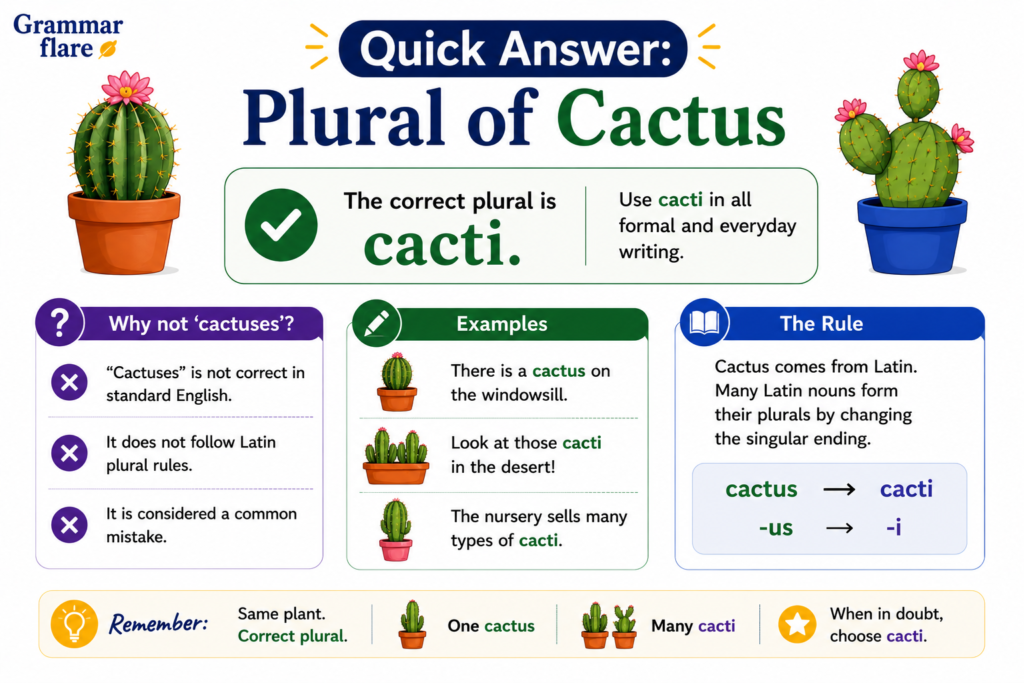
Cacti or Cactuses: Which Should You Use?
| Form | Status | Best for | Example |
|---|---|---|---|
| cacti | Standard, most common | General writing, botany, horticulture, journalism | The greenhouse holds forty cacti. |
| cactuses | Standard, less common | Casual writing, speech, anywhere the Latin form feels stiff | Our neighbours have three cactuses on the porch. |
| cactus | Listed in some dictionaries, rare | Almost nothing; most readers will read it as a mistake | He photographs cactus in the Sonoran Desert. |
The practical rule: cacti sounds like a species list, cactuses sounds like a windowsill. Both are correct, and the one that fits depends on how formal your sentence already is.
Why Is It “Cacti” at All?
This is where the word gets genuinely odd.
Cactus is not originally a Latin word. It comes from the Greek kaktos, which referred to a spiny plant that grew in Sicily, most likely a kind of thistle or cardoon. The Greeks had never seen an American cactus, because American cacti did not reach Europe until after 1492.
The Greek word passed into Latin, where it was treated as a standard second-declension noun ending in -us. Second-declension nouns form their plural by changing -us to -i, which gives cacti.
Then, in the eighteenth century, Linnaeus needed a botanical name for the spiny succulents arriving from the Americas. He reached for Cactus, a Latin word already meaning “spiny plant,” and applied it to a family of plants it had never described before.
So cacti is a legitimate Latin plural of a genuinely Latin word. The strangeness is that the word travelled from Greek, through Latin, into eighteenth-century botany, and landed on plants from a continent none of those languages knew existed.
Is “Cactus” Correct as a Plural?
Some dictionaries, including Merriam-Webster, record cactus itself as a third plural form alongside cacti and cactuses. This is called a zero plural, the same pattern as sheep, deer, and fish.
It is genuinely attested, mostly in horticultural and regional American usage: he grows cactus in the back garden.
Should you use it? Probably not in general writing. It is rare enough that most readers will assume you made a mistake, and being technically defensible is small comfort when your reader has stopped to wonder. Keep it in mind so that you do not mark it wrong if you see it, and write cacti or cactuses yourself.
Not Every “-us” Word Takes “-i”
This is the part worth remembering, because the -us to -i pattern gets applied where it does not belong.
English borrowed -us nouns from several different sources, and they behave differently.
| Latin group | Plural pattern | Examples |
|---|---|---|
| Second declension | -us becomes -i | cactus/cacti, fungus/fungi, radius/radii, nucleus/nuclei, alumnus/alumni |
| Third declension | -us becomes -ora or -era | corpus/corpora, genus/genera |
| Fourth declension | Plural looks the same in Latin, so English regularises | status/statuses, apparatus/apparatuses |
| Greek in origin | -i is a hypercorrection | octopus/octopuses, platypus/platypuses |
| Not classical at all | Regular English plural | bonus/bonuses, campus/campuses, virus/viruses |
The octopus case
Octopus is the famous example. It comes from Greek oktopous, meaning “eight-foot.” Because it ends in -us, people apply the Latin rule and produce octopi.
Most usage guides treat that as a hypercorrection, because the word is Greek rather than Latin and never had a Latin second-declension plural to inherit. The standard English plural is octopuses. The strict Greek plural, octopodes, is correct but almost nobody uses it.
So why is cacti fine and octopi not? Because cactus was fully naturalised into Latin before English borrowed it, and octopus was not. The plural you can inherit depends on the language the word actually passed through.
The virus case
Virus looks like it should give viri, and it never does. In Latin the word was a mass noun meaning poison or slime, and it had no ordinary plural at all. English supplied the regular one: viruses.
The takeaway: an -us ending tells you almost nothing about the plural on its own. When you are unsure, check the dictionary rather than applying the pattern.
Which Form Do Writers Actually Use?
In published English, cacti clearly outnumbers cactuses. It is the form you will see in field guides, botanical writing, nature documentaries, and most journalism.
Cactuses is more common in speech and in casual writing, where the Latin plural can sound slightly formal for a plant on a windowsill.
Neither is regional. This is not like grey and gray, where British and American English part ways. Both plurals appear on both sides of the Atlantic, and the choice is about tone.
One rule that always applies: pick one and stay consistent within a piece of writing. Switching between cacti and cactuses in the same article is the only version of this choice that will actually look like an error.
Common Mistakes
Adding an apostrophe. Cactus’s is possessive, not plural. The cactus’s spines is correct; the cactus’s are outside is not. Our guide to apostrophe rules covers the distinction in full.
Writing “cacties.” This is not a form in any variety of English. The -ies pattern applies to nouns ending in a consonant plus y, such as city and cities.
Using “cactuses” for the plant family. When you mean the botanical family, the name is Cactaceae, not a plural of cactus. This only matters in scientific writing.
Assuming “cacti” is more correct. It is more common, not more correct. Editors who “fix” cactuses to cacti are imposing a preference, not correcting an error.
Mixing both forms in one document. The one genuine mistake on this page.
A Memory Trick That Actually Helps

Forget the plural for a moment and ask what register your sentence is in.
If the sentence would comfortably take fungi, it will take cacti. If fungi would sound stiff there, write cactuses.
The survey recorded fungi across twelve sites. → The survey recorded cacti across twelve sites. There are funguses growing behind the shed. → There are cactuses on the windowsill.
The two words came into English by the same route and carry the same formality, so one is a reliable test for the other.
Practice
Choose the better form for each sentence, then check below.
- The botanical garden displays over two hundred (cacti / cactuses) from across the Americas.
- We keep a few small (cacti / cactuses) on the kitchen windowsill.
- The (cactus’s / cactuses) spines are longer than I expected.
- Desert (cacti / cacties) store water in their stems.
Answers
- cacti. A botanical context, so the Latin plural fits naturally. Cactuses would not be wrong.
- cactuses. Casual and domestic. Cacti would sound slightly formal for a windowsill, though it is still correct.
- cactus’s. The sentence is possessive, not plural. The spines belong to one cactus.
- cacti. Cacties is not a word in any variety of English.
FAQ
Is it cacti or cactuses?
Both are correct. Cacti is more common and works in almost any context. Cactuses is standard and sounds plainer. Pick one and stay consistent.
Which is more correct, cacti or cactuses?
Neither. Both appear in every major dictionary. Cacti is more frequent in published writing, which is a difference in usage rather than in correctness.
Can cactus be its own plural?
Some dictionaries list it, and it appears in horticultural and regional American usage. It is rare enough that most readers will take it for an error, so cacti or cactuses is the safer choice.
Why does cactus become cacti?
Because cactus was treated as a second-declension Latin noun, and those form their plural by changing -us to -i. The word reached Latin from Greek before Linnaeus applied it to American plants in the eighteenth century.
Is cacties ever correct?
No. It is not a form in any variety of English. The -ies ending belongs to nouns ending in a consonant plus y, such as city and cities.
Is it cactus’s or cactuses?
Cactus’s is the possessive of one cactus: the cactus’s spines. Cactuses is a plural. An apostrophe never makes a noun plural.
Do British and American English differ on this?
No. Both plurals appear in both varieties, and the choice is about formality rather than region. This is unlike grey and gray, where the split is genuinely regional.
Why is it cacti but not octopi?
Because cactus passed through Latin and inherited a Latin plural, while octopus is Greek and never had one. Most usage guides treat octopi as a hypercorrection and prefer octopuses.
What is the plural of cactus in botany?
Botanical and horticultural writing overwhelmingly uses cacti. The plant family itself is Cactaceae, which is not a plural of cactus.
How do I avoid choosing?
Write cactus plants. It is clear, natural, and sidesteps the question when neither plural fits the tone of your sentence.
Short Answers for Quick Reference
- The default: cacti.
- Also correct: cactuses, and never wrong.
- Rare but listed: cactus as its own plural.
- Never correct: cacties.
- Possessive, not plural: cactus’s.
- The only real mistake: using both plurals in the same document.
- The wider rule: an -us ending does not guarantee an -i plural. Check the word, not the pattern.
More Reading at GrammarFlare
- What Is the Plural of Fungus? Fungi, Funguses, or Both?
- What Is Plural for Mouse?
- What Is the Plural of Hoof?
- Apostrophe Rules
- Countable vs Uncountable Nouns
- Plural Nouns
Sources
- Merriam-Webster: cactus
- Merriam-Webster: octopus
- Cambridge Dictionary: cactus
- Online Etymology Dictionary: cactus

Ahmad Waheed has spent five years editing academic and professional writing for universities, publishers, and software companies. He founded Grammar Flare after noticing the same handful of mistakes in almost every draft that crossed his desk, and that most grammar guides explained the rule without explaining when it actually matters.
Ahmad writes every guide on this site, checking usage questions against Merriam-Webster, the Chicago Manual of Style, and the AP Stylebook, and noting where those sources disagree rather than quietly picking a side.