
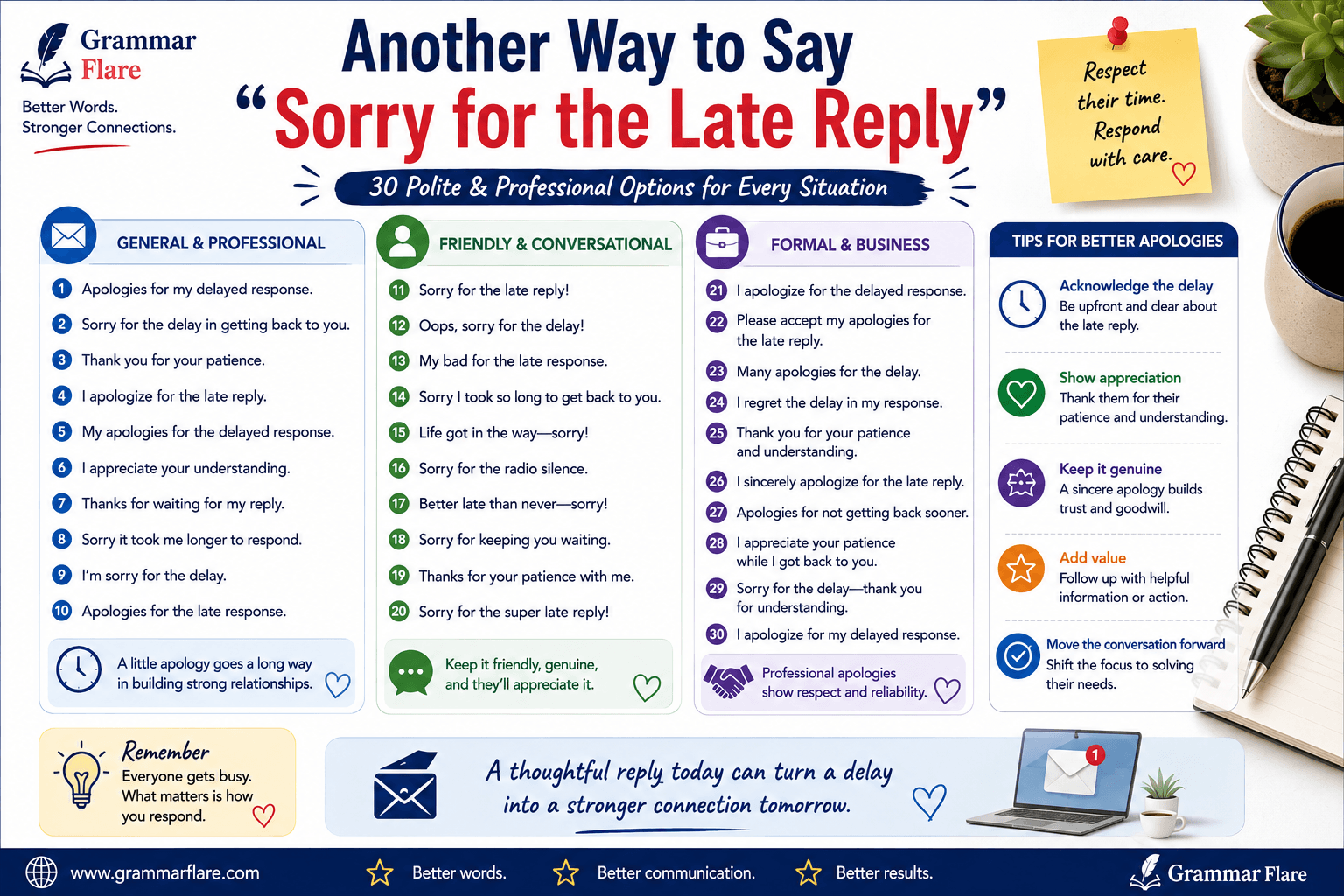
Instead of “sorry for the late reply,” thank them and get to the answer: Thanks for your patience. Here’s the figure you asked for. Most late replies do not need an apology at all, and opening with one draws attention to a delay the reader may not have noticed.
This guide gives you 30 alternatives of “sorry for the late reply,” graded by how late you actually are, plus a short answer to the question underneath all of them: should you apologize at all?
Quick Answer
Match the response to the delay:
- One or two days: say nothing. Just reply.
- Three to five days: one short line. Thanks for your patience.
- One to two weeks: acknowledge it without explaining. Apologies for the slow reply.
- A month or more: address it directly and briefly. I owe you a reply, and an apology.
- Any delay that caused a problem: a real apology plus a remedy.
The most common mistake is apologising too much for a short delay, which makes the delay seem larger than it was.
Best Alternatives in One Table
| Alternative | Best use | Tone | Example |
|---|---|---|---|
| Thanks for your patience. | delays of a few days | warm, confident | Thanks for your patience. The figures are attached. |
| Thanks for waiting on this. | short delays | friendly | Thanks for waiting on this. Here’s the revised draft. |
| Coming back to you on this. | picking up a thread | neutral | Coming back to you on this with the numbers you needed. |
| Apologies for the slow reply. | a week or so | brief, professional | Apologies for the slow reply. Here’s where things stand. |
| Thanks for bearing with me. | you asked them to wait | appreciative | Thanks for bearing with me while we checked the data. |
| This took longer than expected. | genuine complexity | honest | This took longer than expected because we had to re-run the numbers. |
| Apologies for the long silence. | several weeks | direct | Apologies for the long silence. I should have updated you sooner. |
| I owe you a reply. | badly overdue | accountable | I owe you a reply, and an apology for how long it took. |
| This sat in my inbox longer than it should have. | you dropped it | plain | This sat in my inbox longer than it should have. Answering properly now. |
| This slipped past me entirely, and I’m sorry. | you missed it completely | honest | This slipped past me entirely, and I’m sorry. |
| I’m sorry for the delay and the position it put you in. | your delay caused harm | serious | I’m sorry for the delay and the position it put you in with your client. |
| Here’s what I can do to make up the time: | remedy needed | constructive | Here’s what I can do to make up the time: I’ll turn the next draft around in a day. |
| Sorry, this got buried. | informal internal | light | Sorry, this got buried. Answering now. |
| Just seeing this now. | genuinely just saw it | casual | Just seeing this now. Give me an hour and I’ll come back properly. |
| Good to hear from you. | delay not worth mentioning | easy | Good to hear from you. Yes, Thursday works. |
Should You Apologize at All?
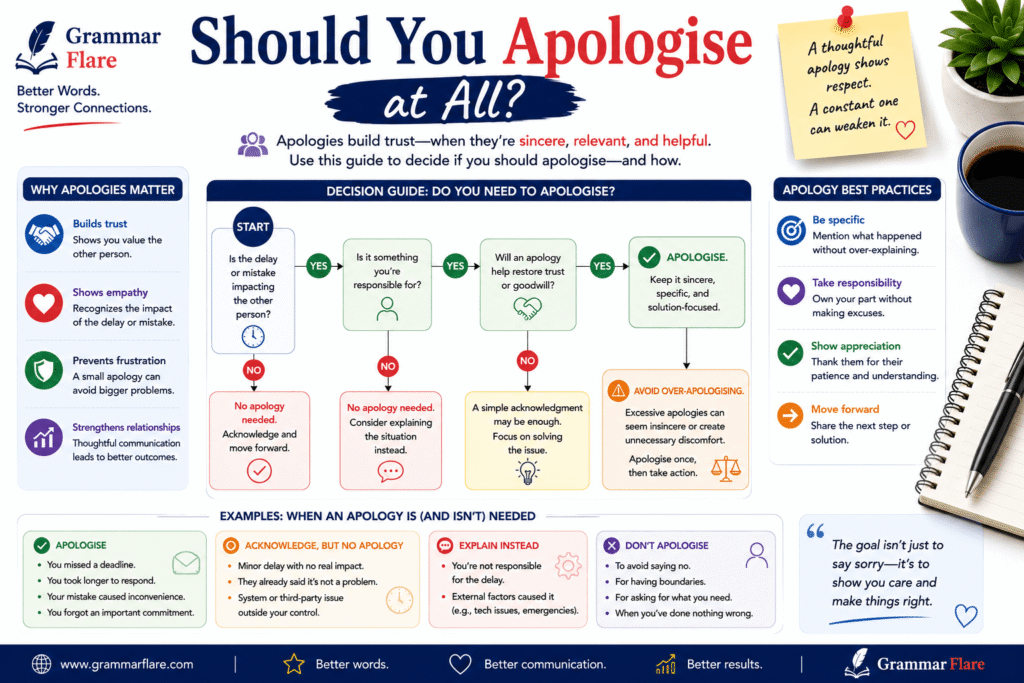
Usually not, and this is where most advice on the phrase goes wrong.
“Sorry for the late reply” is a reflex rather than a decision. It gets typed automatically, and it costs more than it gains for three reasons.
It draws attention to something the reader may not have noticed. People are far less aware of your response times than you are. A two-day gap that felt embarrassing to you was probably invisible to them until you named it.
It opens with your failure. The first line of an email sets what the exchange is about. Starting with an apology makes the delay the subject, and the reader has to process it before reaching the thing they actually wanted.
It invites judgement. An apology asks the reader to decide whether to accept it. That is a small piece of work you have handed them, and in a professional context it also quietly frames you as someone whose reliability is in question.
There is a well-established alternative: thank instead of apolozise. Thanks for your patience and sorry for the delay address the same gap, but the first credits the reader with a virtue while the second charges you with a fault. The information conveyed is identical. The impression is not.
That said, apologies are not always wrong. Where a delay has genuinely cost someone time, money, or a deadline, thanking them for their patience is evasive, and a real apology is the honest response. The rule is proportion.
How Late Is Actually Late?
There is no universal standard, but these are workable defaults for professional email:
| How late you are | What to say |
|---|---|
| Same day | Nothing. Reply and move on. |
| 1 to 2 days | Nothing, or thanks for your patience if the request was urgent |
| 3 to 5 days | One short line acknowledging the gap |
| 1 to 2 weeks | Acknowledge it, without a lengthy explanation |
| 3 weeks to a month | Address it directly and give a brief honest reason |
| More than a month | Address it plainly and do not over-explain |
| Any delay that caused a problem | A real apology plus a specific remedy |
Two things matter more than the wording. Never spend more than one sentence on the delay unless it caused actual harm, and never explain at length. A long explanation reads as a defence, and defences invite scrutiny that a short acknowledgement does not.
Sorry, Apologies, or I Apologize?
A usage question worth settling, since all three appear in these emails.
“Sorry” is an adjective here, and it is the most natural and least formal option. It is entirely appropriate in professional email and is not, as is sometimes claimed, too casual for business writing.
“Apologies” is a plural noun standing in for my apologies. It is slightly more formal than sorry and useful when you want to acknowledge something without the personal weight of I am sorry. Note that the singular, apology for the delay, is not idiomatic in this construction.
“I apologize” is the verb form and the most formal of the three. It carries more weight, which makes it the right choice when the delay genuinely mattered and the wrong choice for a two-day gap, where it sounds disproportionate.
On spelling: apologise is standard in British English, apologize in American English. Both are correct in their own varieties, and the noun apology is spelled the same either way. Since this site is written for American English, apologize is the default here, but neither form is an error.
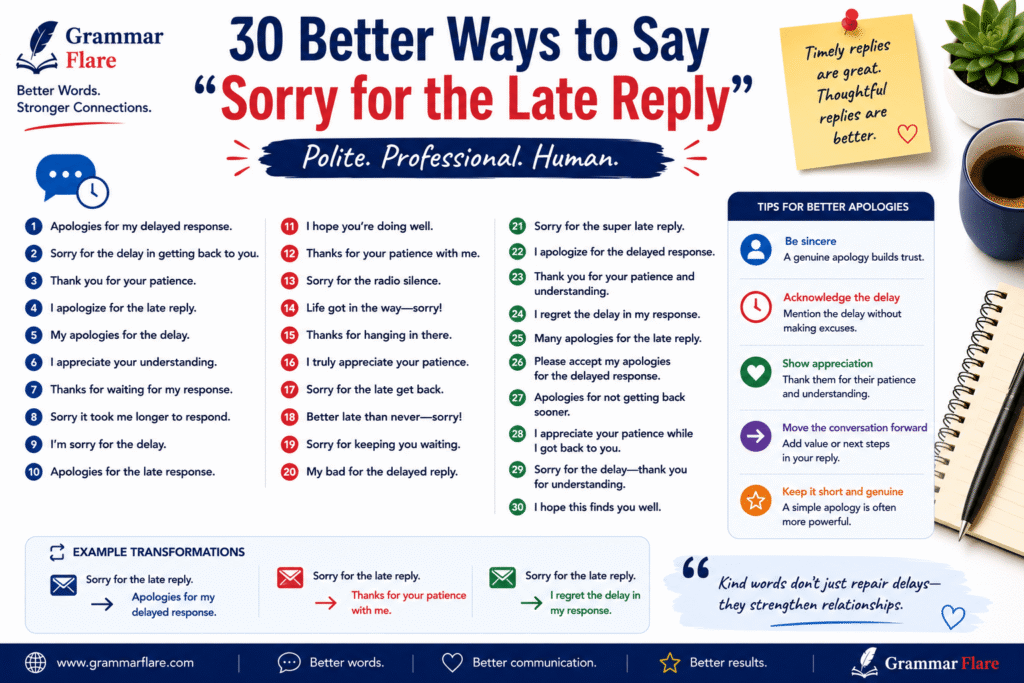
30 Better Ways to Say “Sorry for the Late Reply”
When you are barely late
For delays of a day or two, the strongest move is not to mention it. These openers get straight to the answer.
1. Thanks for your patience.
Credits the reader rather than charging yourself. The single most useful substitution on this page.
Thanks for your patience. The figures are attached.
2. Thanks for waiting on this.
Slightly warmer and more specific than the above.
Thanks for waiting on this. Here’s the revised draft.
3. Coming back to you on this.
Neutral and matter-of-fact. Implies a considered reply rather than a delayed one.
Coming back to you on this with the numbers you needed.
4. Picking this back up.
Useful when a thread has been paused for a reason both parties know about.
Picking this back up now the audit is finished.
5. Good to hear from you.
Works when the delay is genuinely not worth naming. It reframes the exchange as a conversation rather than a queue.
Good to hear from you. Yes, Thursday works on our side.
6. Here’s the answer to your question about [X].
No preamble at all. Best when the reader wanted one specific thing.
Here’s the answer to your question about the licence renewal: it renews automatically on 1 September.
When you are genuinely late
For roughly a week. One sentence, then move on.
7. Apologies for the slow reply.
Brief and professional. The standard option when an acknowledgement is warranted.
Apologies for the slow reply. Here’s where things stand.
8. Thanks for your patience while I worked through this.
Combines the acknowledgement with a reason, without turning the reason into an excuse.
Thanks for your patience while I worked through the contract with our legal team.
9. Sorry for the delay in getting back to you.
Slightly more formal than apologies for the slow reply and appropriate for clients.
Sorry for the delay in getting back to you. The revised quote is attached.
10. Thank you for waiting. Here’s where things stand.
Signals that a substantive update follows, which justifies the wait.
Thank you for waiting. Here’s where things stand on both outstanding items.
11. This took longer than I expected.
Honest without being apologetic. Best when the delay was caused by the work itself.
This took longer than I expected because we had to re-run the numbers.
12. Thanks for bearing with me.
Warm, and appropriate when you had already asked them to wait.
Thanks for bearing with me while we checked the data.
13. I appreciate you waiting on this.
A little more formal than thanks for your patience, and useful with senior recipients.
I appreciate you waiting on this. The board approved it yesterday.
When it has been weeks
Longer silences need naming. Address it once, plainly, then move to the substance.
14. Apologies for the long silence.
Names the gap without dramatizing it.
Apologies for the long silence. I should have updated you sooner.
15. Thank you for your patience over the past few weeks.
Turns a long delay into an acknowledged courtesy on their part.
Thank you for your patience over the past few weeks. Here’s the full update.
16. I owe you a reply.
Direct and accountable. Effective precisely because it is so short.
I owe you a reply, and an apology for how long it took.
17. This sat in my inbox far longer than it should have.
Honest about what happened. Readers generally respond well to plain admissions.
This sat in my inbox far longer than it should have. Answering properly now.
18. Sorry for the delay. [Brief honest reason.]
One clause of reason, no more. Detail beyond that reads as justification.
Sorry for the delay. I was out for two weeks and the thread got buried.
19. I’m sorry this took so long to come back to you.
Slightly warmer than apologies for the long silence and better suited to relationships you value.
I’m sorry this took so long to come back to you. It deserved a faster response.
When the delay caused a problem
Here the apology is not optional, and thanking them for their patience would read as evasion. Name the consequence and offer a remedy.
20. I’m sorry. The delay was mine, and it cost you time.
Takes ownership in the first two clauses, which is what makes the rest credible.
I’m sorry. The delay was mine, and it cost you time you didn’t have.
21. My delay pushed your timeline. Here’s what I’m doing about it.
Moves immediately to remedy, which is usually what the other party actually wants.
My delay pushed your timeline. Here’s what I’m doing about it: I’ve cleared tomorrow to turn this around.
22. I should have replied sooner, and I understand if this caused problems.
Acknowledges consequences you may not fully know about, without inviting a list of them.
I should have replied sooner, and I understand if this caused problems at your end.
23. I’m sorry for the delay and for the position it put you in.
Apologizes for the effect rather than only the act, which is what most weak apologies miss.
I’m sorry for the delay and for the position it put you in with your client.
24. Here’s what I can do to make up the lost time:
Follows an apology with something concrete. An apology without a remedy is only half a response.
Here’s what I can do to make up the lost time: I’ll deliver the next two stages together by Friday.
When you dropped it entirely
25. This slipped past me entirely, and I’m sorry.
Plain, complete, and free of excuses. Usually the fastest way to reset.
This slipped past me entirely, and I’m sorry. Answering now.
26. I missed this one. No excuse.
Very short, and the brevity is the point. Works best with people you know.
I missed this one. No excuse. Here’s the answer.
27. This fell through the cracks on my side.
Locates the failure clearly without over-apologising for it.
This fell through the cracks on my side. Picking it up now.
Casual and internal
28. Sorry, this got buried.
Standard internal shorthand. Nobody expects more.
Sorry, this got buried. Answering now.
29. Late to this one.
Minimal, unbothered, and fine among colleagues.
Late to this one. Agreed on all three points.
30. Just seeing this now.
Only accurate if true. If you saw it and postponed it, use one of the others.
Just seeing this now. Give me an hour and I’ll come back properly.
Which Alternative to Use, by Situation
Replying to a client after a few days
Thank rather than apologize, then lead with the substance. Clients notice competence more than speed.
Thanks for your patience. The revised quote is attached, and I’ve held the original pricing.
Replying to a client after several weeks
Name it once, briefly, and follow with something of value. A long apology invites them to weigh whether the relationship is working.
Apologies for the long silence. Here’s the full update, along with a revised timeline that accounts for the delay.
Replying to your manager
Keep it short and move to status. Managers generally want the information, not the contrition.
Thanks for waiting on this. Both items are now closed, and the third is with legal.
Replying to a colleague
Say very little. Internal threads rarely need an apology at all.
Sorry, this got buried. Agreed on the approach, and I’ll take the second half.
Replying to a recruiter or after a job application
Acknowledge briefly and reaffirm interest. Do not explain the delay in detail, and do not apologize twice.
Apologies for the slow reply. I’m still very interested in the role and available for a call this week.
Replying to someone who followed up on you
They have now written twice. Acknowledge that specifically, because ignoring it is what makes the exchange awkward.
Sorry, and thanks for the nudge. This should not have taken two emails.
Replying after a personal or medical absence
Give the fact, not the story. Most recipients need no more than a clause, and offering more can create an obligation to respond to it.
Apologies for the delay. I was away unexpectedly for a fortnight and I’m catching up now.
When the delay cost them money or a deadline
Apologize properly, name the consequence, and offer something concrete. Skipping the remedy is what makes an apology feel hollow.
I’m sorry. My delay pushed your deadline, and that’s on me. I’ve cleared tomorrow to turn the next stage around in a day rather than three.
When it has been so long that replying feels awkward
Reply anyway. A late reply is almost always better received than no reply, and the awkwardness is usually one-sided.
This is embarrassingly late, and I’m sorry. If it’s still useful, here’s the answer. If you’ve moved on, I completely understand.
Phrases to Avoid
“Sorry for the delayed response.” Not wrong, but stiff enough to sound like a template. Apologies for the slow reply does the same job in warmer register.
“Sorry for my late reply, I’ve been so busy.” Busyness is not a reason, because the reader is busy too. It reads as though your time was worth more than theirs. The same objection applies when you are declining a meeting, where one specific reason works better than a general appeal to workload.
“Sorry, I’ve been swamped.” Same problem, less formal.
“Sorry again for the delay.” A second apology in the same email. One is sufficient, and repetition draws out the thing you want to move past.
“I hope you can forgive the delay.” Asks the reader to do emotional work over a routine matter.
“Sorry for the late reply, but” The word but cancels the sentence before it. If there is a genuine reason, give it as its own statement.
“Please excuse the delay in my response.” Formal to the point of sounding legal, and unnecessary in almost every context.
One Test Before You Send
Read your opening line and ask: is the delay bigger in this email than it was in real life?
If you have spent three sentences on a two-day gap, you have made a small thing into a subject. Cut it to one line, or cut it entirely and answer the question. The reader wanted the answer, not the apology.
FAQ
What can I say instead of “sorry for the late reply”?
Thanks for your patience is the strongest general substitution. It addresses the same gap while crediting the reader rather than faulting yourself, and it works for anything up to about a week.
Should I apologize for a late reply at all?
Usually not. For delays under two or three days, most readers have not noticed, and naming it makes the gap visible. Apologize when the delay was long or when it caused an actual problem.
Is “sorry for the late reply” unprofessional?
No. It is standard and nobody will think less of you for it. It is simply overused and often disproportionate, which is why a more measured response tends to land better.
Is it better to say “sorry for the delay” or “thanks for your patience”?
Thanks for your patience is usually better, because it frames the reader as generous rather than framing you as at fault. Switch to a genuine apology when the delay had consequences, where thanking someone would read as evasive.
How late is too late to reply?
There is no fixed cut-off, and replying late is nearly always better than not replying. Past a month, acknowledge the gap plainly and offer the information anyway, with an easy exit if it is no longer needed.
Should I explain why I was late?
Only briefly, and only if the reason is genuine and relevant. One clause is enough. Longer explanations read as defences, and they invite scrutiny that a short acknowledgement avoids.
Is saying “I’ve been busy” a bad excuse?
Yes, in most cases. Everyone is busy, so it does not distinguish your situation, and it implies your time took priority over theirs. A specific reason works better, or no reason at all.
What if I’m replying weeks or months later?
Name it once, plainly, and give them an easy way out: This is very late, and I’m sorry. If it’s still useful, here’s the answer. Then answer the original question in full.
How do I apologize for a late reply to a client?
Keep it to one sentence, then demonstrate value immediately. Clients weigh reliability by outcome more than by response time, so a substantive reply repairs more than an extended apology does.
Should I apologize twice in the same email?
No. A second apology stretches out the thing you want to move past and can read as a request for reassurance.
Is “apologies for the delay” too formal for a colleague?
Slightly, in most workplaces. Sorry, this got buried fits internal threads better. Save apologies for external contacts and anything semi-formal.
What if they followed up before I replied?
Acknowledge the follow-up specifically: Sorry, and thanks for the nudge. Ignoring the fact that they had to chase you is what makes the exchange feel awkward.
Short Answers for Quick Reference
- Best all-purpose alternative: Thanks for your patience.
- Best for a week’s delay: Apologies for the slow reply.
- Best for several weeks: I owe you a reply, and an apology for how long it took.
- Best when the delay caused harm: A real apology plus a specific remedy.
- Best for a colleague: Sorry, this got buried.
- Best when you are barely late: Say nothing and answer the question.
- The rule underneath all of it: Apologize in proportion, and never spend more than one sentence on it.
More Reading at GrammarFlare
- Another Way to Say “Just Checking In”
- Another Way to Say “As Per My Last Email”
- Another Way to Say “Please Advise”
- Better Ways to Say “Thank You for Your Patience”
- How to Politely Decline a Meeting
- Better Ways to Say Things
Sources

Ahmad Waheed has spent five years editing academic and professional writing for universities, publishers, and software companies. He founded Grammar Flare after noticing the same handful of mistakes in almost every draft that crossed his desk, and that most grammar guides explained the rule without explaining when it actually matters.
Ahmad writes every guide on this site, checking usage questions against Merriam-Webster, the Chicago Manual of Style, and the AP Stylebook, and noting where those sources disagree rather than quietly picking a side.