

Instead of “just checking in,” say what you actually need and when you need it: Are we still on track for Friday, or should I push the date? The problem with “just checking in” is not that it is rude. It is that it asks the reader to do work without telling them what work, which is why so many of these emails go unanswered.
This guide gives you 35 alternatives sorted by situation, along with the reason most follow-ups get ignored and the three changes that fix it.
Quick Answer
If you want another way to say just checking in, pick an opener that does one of three things:
- States what you need: Are we still on track for Friday?
- Gives them something: I came across this and thought of your team.
- Makes it easy to say no: If this has dropped down the list, tell me and I’ll check back next month.
The strongest follow-ups do at least one of these. Just checking in does none of them, which is why it so often gets no reply.
Best Alternatives in One Table
| Alternative | Best use | Tone | Example |
|---|---|---|---|
| Following up on [specific thing] | first follow-up | neutral, clear | Following up on the contract I sent Tuesday. |
| Are we still on track for [date]? | deadline at risk | direct | Are we still on track for the 14th, or should I move it? |
| Any movement on [X]? | informal internal | casual | Any movement on the vendor quote? |
| Where did we land on [X]? | after a discussion | collaborative | Where did we land on the pricing tiers? |
| Is this still a priority on your end? | stalled projects | honest | Is this still a priority on your end? Happy either way. |
| I wanted to make sure this didn’t get buried | busy recipient | considerate | I wanted to make sure this didn’t get buried. No rush. |
| Do you need anything from me to move this forward? | you may be the blocker | helpful | Do you need anything from me to move this forward? |
| I came across [X] and thought of you | adds value | generous | I came across a benchmarking report and thought of your team. |
| Should I keep this on my list or close it out? | final follow-up | clean | Should I keep this on my list or close it out for now? |
| Quick nudge on [X] | informal, low stakes | light | Quick nudge on the invoice. No urgency. |
| Is [date] still realistic? | schedule check | practical | Is the 30th still realistic from your side? |
| Circling back with an update, not a request | you have news | non-demanding | Circling back with an update rather than a request. The figures came in. |
| Let me know if the timing is wrong | sensitive contexts | respectful | Let me know if the timing is wrong and I’ll come back later. |
| I’ll assume [X] unless I hear otherwise | forces a decision | decisive | I’ll assume we’re proceeding unless I hear otherwise by Thursday. |
| Closing the loop on [X] | wrapping up | tidy | Closing the loop on the audit request. |
Why “Just Checking In” Doesn’t Get Replies
Most advice on this phrase treats it as a style problem. It is not. It is a structural one.
A follow-up email asks the reader to spend effort. “Just checking in” asks for that effort while giving them nothing to work with:
- It doesn’t say what you need. The reader has to reconstruct your original request from memory or scroll back through the thread.
- It doesn’t say when you need it. With no deadline, the email has no reason to be answered today rather than next week, and next week it will be buried.
- It doesn’t make refusal easy. If the honest answer is “this isn’t happening,” there is no comfortable way to say so, and silence becomes the path of least resistance.
- The word “just” apologises for writing. It signals that you know you are being a nuisance, which quietly gives the reader permission to treat you as one.
Every good alternative below fixes at least one of these. That is the whole principle: give the reader something to do, or something to say no to.
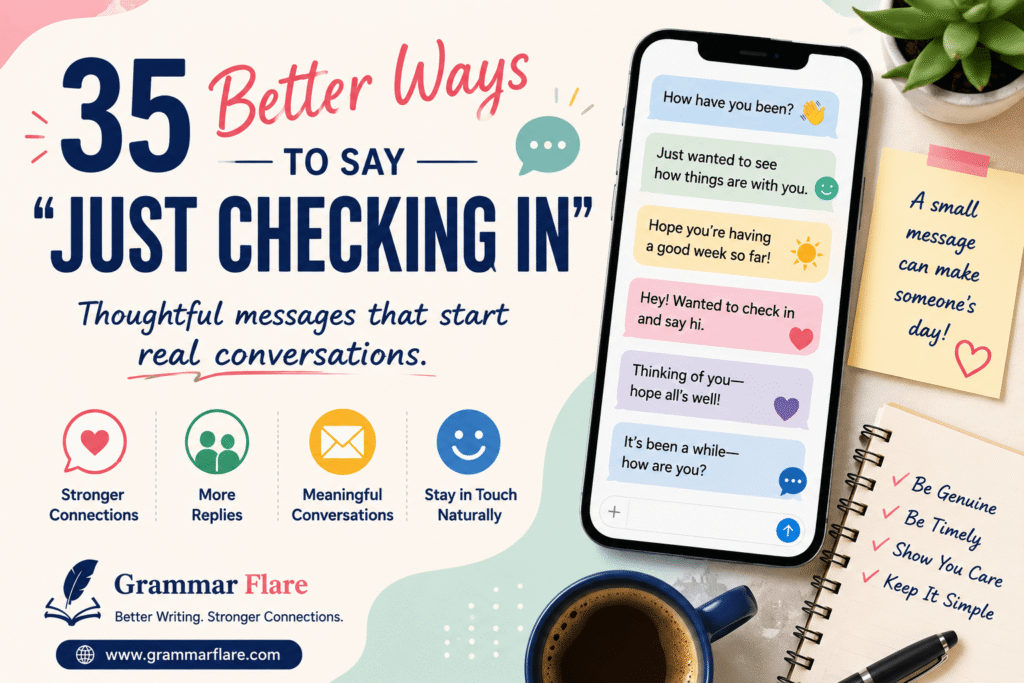
35 Better Ways to Say “Just Checking In”
When you need a status update
1. Following up on [specific thing].
The plainest fix. Naming the thing removes the reconstruction work.
Following up on the contract I sent Tuesday.
2. Where did we land on [X]?
Best after a conversation where something was left open. It assumes progress rather than asking whether any happened.
Where did we land on the pricing tiers?
3. Any movement on [X]?
Informal and low-pressure. Works well internally, less so with clients.
Any movement on the vendor quote?
4. Has there been any update on [X]?
More formal than any movement, and useful when you genuinely do not know whether the delay is on their side.
Has there been any update on the compliance review?
5. How is [X] looking on your end?
Puts the question in their terms rather than yours, which makes it easier to answer honestly.
How is the migration looking on your end?
6. Is this still a priority on your end?
Direct without being sharp. It also invites the honest answer, which is more useful than continued silence.
Is this still a priority on your end? Happy either way. I’d just rather know.
7. What’s the current thinking on [X]?
Softer than asking for a decision. Useful when the delay may be indecision rather than inaction.
What’s the current thinking on the vendor shortlist?
When you want to give something instead of asking
These are the highest-response-rate follow-ups, because they invert the transaction. You are not asking for effort; you are supplying something.
8. I came across [X] and thought of you.
Send an article, a report, a tool, or a contact. The follow-up rides along as context rather than being the point.
I came across a retention benchmarking report and thought of your team. Also still happy to talk whenever the timing works.
9. I’ve attached [X] in case it’s useful.
Give them the thing they would otherwise have to ask for.
I’ve attached a one-page summary in case it’s easier to circulate internally than the full proposal.
10. I made a change that might help.
Shows you have kept working rather than waiting.
I’ve reworked the pricing into two options rather than three, which should make the internal conversation simpler.
11. Circling back with an update, not a request.
Explicitly removes the obligation to act. Counterintuitively, this often gets a faster reply.
Circling back with an update rather than a request. The Q3 figures came in and they support the case we discussed.
12. Thought this might be relevant to what you mentioned about [X].
Proves you were listening in the original conversation.
Thought this might be relevant to what you mentioned about onboarding drop-off.
13. No reply needed, but [X].
Genuinely means it. Use only when true, and do not follow it with a question.
No reply needed, but the revised deck is in the shared folder whenever you want it.
14. Do you need anything from me to move this forward?
Reframes the follow-up as an offer of help, and occasionally reveals that you were the blocker.
Do you need anything from me to move this forward? Happy to send the technical spec if that’s what’s holding it up.
When it’s a second or third follow-up
The tone should change as the sequence progresses. Repeating the same message with increasing frequency is the most common mistake in follow-up sequences.
15. I wanted to make sure this didn’t get buried.
Generous framing. It attributes the silence to inbox volume rather than disinterest, which is usually true and always diplomatic.
I wanted to make sure this didn’t get buried. No rush at all.
16. Bringing this back to the top of your inbox.
Neutral and honest about what you are doing. Better than pretending it is a new message.
Bringing this back to the top of your inbox in case it slipped.
17. Still interested, whenever the timing works.
Removes urgency entirely and keeps the door open. Good for opportunities rather than deadlines.
Still interested in the collaboration whenever the timing works on your side.
18. If this has dropped down the list, just say so.
Explicitly permits the honest answer. This gets more replies than any amount of politeness, because silence is usually about discomfort rather than disinterest.
If this has dropped down the list, just say so and I’ll stop filling your inbox.
19. I’ll stop after this one.
Honest and slightly disarming. It also commits you, so mean it.
I’ll stop after this one. If the answer is no, no hard feelings at all.
20. Should I keep this on my list or close it out?
Binary and easy to answer. Very effective as a final follow-up.
Should I keep this on my list or close it out for now?
21. Last note from me on this.
Signals the end of the sequence clearly, which often prompts a reply on its own.
Last note from me on this. The offer stands if things change.
When you need a decision or a deadline
22. Are we still on track for [date]?
Puts the deadline back at the centre. The most useful phrasing when a date is genuinely at risk.
Are we still on track for the 14th, or should I move it?
23. Is [date] still realistic?
Slightly softer than the above, and gives them room to renegotiate rather than confess.
Is the 30th still realistic from your side?
24. I need to lock this in by [date].
States your constraint rather than making a demand of them.
I need to lock the venue in by Friday, so any steer before then would help.
25. I’ll assume [X] unless I hear otherwise.
Forces a decision by making silence itself a decision. Powerful, and to be used carefully, since it only works when the default is genuinely acceptable to you.
I’ll assume we’re proceeding with option B unless I hear otherwise by Thursday.
26. Would it help if I [specific action]?
Offers to remove an obstacle rather than pressing on the deadline.
Would it help if I drafted the internal summary for you to circulate?
27. What would need to happen for this to move?
Useful when something is stuck and you do not know why. It asks for diagnosis rather than a decision.
What would need to happen for this to move? Happy to work around whatever the constraint is.
Casual and internal
28. Quick nudge on [X].
Short and low-stakes. Right for colleagues, wrong for clients.
Quick nudge on the invoice. No urgency.
29. Any joy with [X]?
Informal and light. Common in British workplaces, and it may read as unusual in American ones.
Any joy with the vendor quote?
30. Poking this one.
Very informal, best in chat or with close teammates.
Poking this one. Did the deploy go through?
31. Where are we on [X]?
Blunt but neutral. Fine internally, too abrupt for external contacts.
Where are we on the analytics dashboard?
When you’re ready to close the loop
32. Closing the loop on [X].
Tidy and professional. Signals you are wrapping up rather than pressing.
Closing the loop on the audit request. We’ve gone ahead with the internal option.
33. Taking this off my list for now.
Honest about where things stand and leaves the door open without demanding anything.
Taking this off my list for now. Do come back to me if it resurfaces.
34. The offer stands if things change.
A graceful ending that does not burn the relationship.
Understood, and thank you for the clarity. The offer stands if things change.
35. Happy to park this until [timeframe].
Proposes a specific future point rather than an open-ended maybe.
Happy to park this until after your busy season. Shall I come back in September?
Which Alternative to Use, by Situation
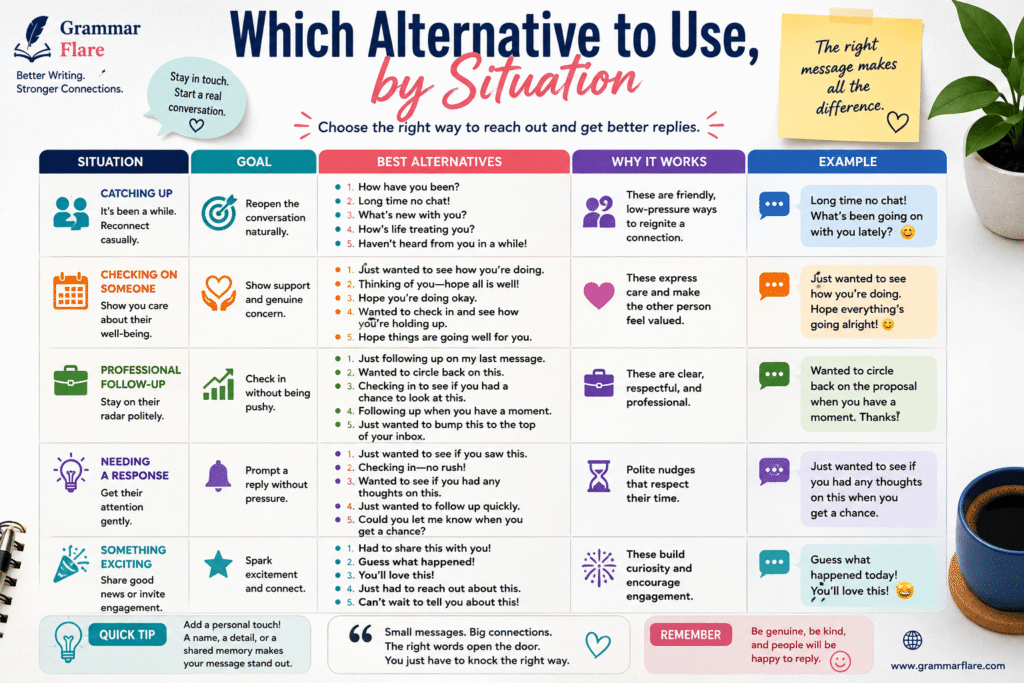
Formality matters less than circumstance. This is the section that decides which phrase is right.
First follow-up after no reply
Wait three to five working days. Reference the original message and its date, restate the single thing you need, and keep it under four lines.
Following up on the proposal I sent on 12 March. The main thing I need is a yes or no on the timeline. Everything else can wait.
Second follow-up
Change something. Do not resend the same message with a new opener. Add information, simplify the ask, or offer to remove an obstacle.
I wanted to make sure this didn’t get buried. I’ve reworked the pricing into two options rather than three, which should make the internal conversation simpler.
Third and final follow-up
Make it easy to close. A clean binary question gets replies that gentle persistence does not.
Last note from me on this. Should I keep it on my list, or close it out for now? Either answer is completely fine.
Chasing an overdue invoice
Be factual rather than apologetic. Reference the invoice number and date, state the amount, and ask a specific question. Softening the language here tends to delay payment rather than preserve goodwill.
Invoice 2041, issued 3 June, is now 30 days past due. Could you confirm whether it’s been scheduled for payment, or let me know who I should be speaking to?
After a job interview
Once, roughly a week after the stated decision date. Do not chase repeatedly, since it is read as a signal about how you would behave in the role.
Thank you again for the conversation on the 8th. I’m still very interested in the role, and I wanted to check whether there’s an updated timeline for the decision.
Following up with your manager or a senior colleague
Frame it around unblocking rather than reminding. Senior people respond better to being asked what they need than to being asked what happened.
Do you need anything from me before you can sign off on the budget? Happy to pull the figures into whatever format is easiest.
Following up on something a colleague owes you
Attach the consequence to the delay rather than to the person.
Quick nudge on the copy for the landing page. I need it by Wednesday to keep the Friday launch, otherwise we should move the date.
When you genuinely have nothing new to add
Then do not send anything. A follow-up with no new information is what “just checking in” actually is, and it is why the phrase acquired its reputation. Wait until you have something to add: a change, a deadline, a resource. Or accept the silence as an answer.
Checking in on someone personally
Different situation entirely, and the professional advice above does not apply. If someone is ill, bereaved, or going through something difficult, warmth matters more than efficiency, and the message should ask nothing of them.
Thinking of you this week. No need to reply. I just wanted you to know.
How Long to Wait Before Following Up
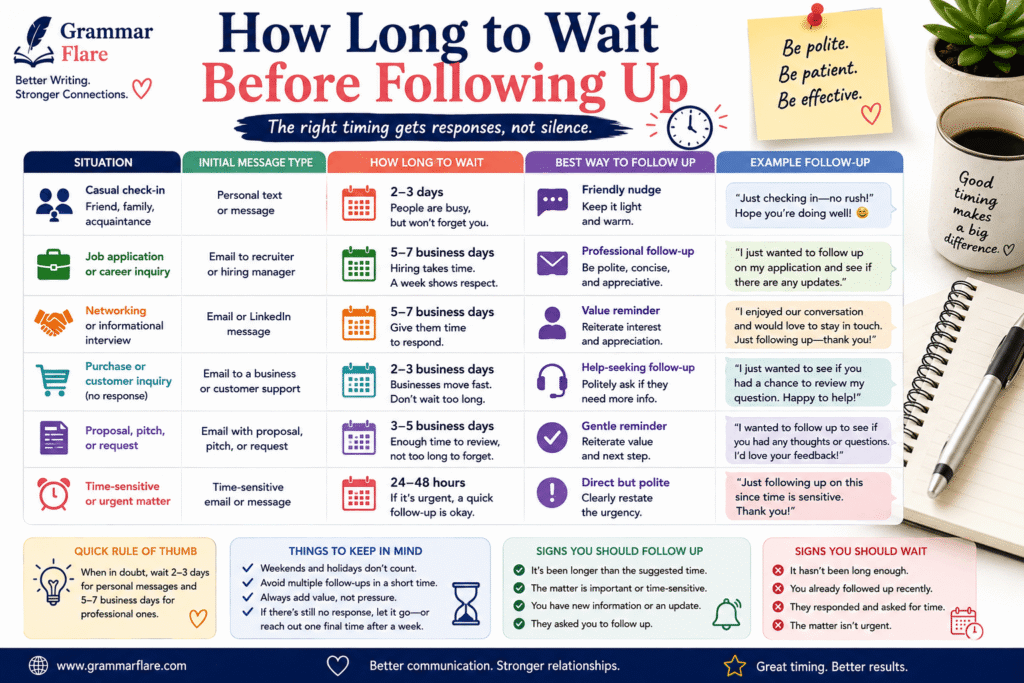
There is no universal rule, but these are reasonable defaults in professional contexts:
| Situation | Wait before following up |
|---|---|
| Internal request, non-urgent | 2 to 3 working days |
| Client proposal or quote | 3 to 5 working days |
| Cold outreach | 5 to 7 working days |
| After an interview | Until a week past the stated decision date |
| Overdue invoice | The day after the due date, then weekly |
| Sensitive or personal matters | Longer, and with no expectation of a reply |
Two things matter more than the interval: change the message each time, and decide in advance how many follow-ups you will send. Three is a common ceiling in professional contexts, and stating that you are on the last one usually improves the response rate.
Phrases to Avoid
“Per my last email.” Widely read as passive-aggressive, regardless of intent. It points at the reader’s failure rather than at the thing you need. Our guide to another way to say “as per my last email” covers 30 replacements sorted by what you are actually asking for.
“Just circling back.” Circling back is fine on its own. Just circling back has the same emptiness problem as just checking in and is now equally worn.
“Gentle reminder.” The word gentle announces that a reminder is being softened, which draws attention to the reminder. Say what you need instead.
“Did you see my last email?” Either they did not, in which case the question is pointless, or they did and chose not to reply, in which case it is pointed.
“Sorry to bother you again.” Apologising for a legitimate follow-up frames your own work as an imposition. If it is worth chasing, chase it without apology.
“Bumping this.” Fine in an internal chat, too curt for external email.
“Just wanted to touch base.” Same structural problem as just checking in, with an added layer of jargon.
One Test Before You Send
Read your follow-up and ask: could the reader answer this in under ten seconds?
If the answer requires them to scroll back through the thread, work out what you want, or compose a paragraph explaining a delay, the email is too much work and will be postponed. Rewrite it so the reply could be a single sentence, ideally yes or no.
FAQ
What can I say instead of “just checking in”?
Say what you need and when: Following up on the proposal. Are we still on track for Friday? If you have nothing specific to ask, either add something useful or wait until you do.
Is “just checking in” unprofessional?
No. It is polite and common, and nobody will be offended by it. It is simply ineffective, because it asks for effort without giving the reader anything to respond to.
Why does “just” make it weaker?
Just functions as a hedge. It signals that you consider your own message a minor imposition, which makes it easier for the reader to treat it as one. Removing it usually strengthens the sentence with no loss of politeness. Compare just checking in with checking in.
How many times should I follow up?
Three is a reasonable ceiling in most professional contexts, with the message changing each time. Saying explicitly that a message is your last one often prompts a reply on its own.
What’s the best follow-up email opener?
Following up on [specific thing] from [date] is the strongest general-purpose opener, because it removes the reader’s need to reconstruct the context. For a second or third attempt, I wanted to make sure this didn’t get buried works well.
Is “circling back” better than “just checking in”?
Marginally, and only when you have something new to report. Circling back with an update is useful. Just circling back has the same problem as the phrase it replaces.
How do I follow up without sounding pushy?
Give the reader an easy exit. If this has dropped down the list, just say so is not pushy, and it gets more replies than a softer message, because silence usually reflects awkwardness rather than disinterest.
What should I say if they never reply at all?
Close it cleanly and leave the door open: Taking this off my list for now. Do come back to me if it resurfaces. This preserves the relationship and often produces the reply that three follow-ups did not.
Is it rude to follow up the next day?
It depends on urgency. If a genuine deadline is at risk, say so explicitly and the timing justifies itself. Following up the next day on something with no deadline reads as impatient.
What’s a good subject line for a follow-up email?
Reply within the existing thread where possible, so the context travels with it. If you need a new subject line, use the specific item and a date: Proposal: decision needed by Friday.
How do I follow up on an invoice without damaging the relationship?
Keep it factual and administrative rather than emotional. Reference the invoice number, date, and amount, and ask a process question, such as who to contact or whether payment has been scheduled. Framing it as admin rather than as a complaint is what preserves the relationship.
Should I use “just checking in” when messaging a friend going through something?
In personal contexts the phrase works better than it does professionally, because there warmth is the point and no task is being requested. Even so, something more specific usually lands better: Thinking of you this week. No need to reply.
Short Answers for Quick Reference
- Best all-purpose alternative: Following up on [specific thing] from [date].
- Best when a deadline is at risk: Are we still on track for [date]?
- Best second follow-up: I wanted to make sure this didn’t get buried.
- Best final follow-up: Should I keep this on my list or close it out?
- Best when you have nothing new to say: Don’t send it yet.
- The rule underneath all of it: A follow-up should give the reader something to do, or something to say no to.
More Reading at GrammarFlare
- Another Way to Say “As Per My Last Email”
- Another Way to Say “Sorry for the Late Reply”
- Another Way to Say “I Hope You Are Doing Well”
- Professional Ways to Say “Please Let Me Know”
- Better Ways to Say “Thank You for Your Patience”
- The Importance of Tone in Conversation
Sources

Ahmad Waheed has spent five years editing academic and professional writing for universities, publishers, and software companies. He founded Grammar Flare after noticing the same handful of mistakes in almost every draft that crossed his desk, and that most grammar guides explained the rule without explaining when it actually matters.
Ahmad writes every guide on this site, checking usage questions against Merriam-Webster, the Chicago Manual of Style, and the AP Stylebook, and noting where those sources disagree rather than quietly picking a side.