
To decline a meeting politely, say no clearly, give one short reason, and offer another route to the same outcome: I can’t make Thursday, but send me the agenda and I’ll comment in the doc by Friday. The mistake most people make is explaining at length, which turns a decision into a negotiation.
This guide gives you 25 scripts sorted by situation, a way to decide whether to decline at all, and a note on how much reason each kind of recipient actually needs.
Quick Answer
A good decline has three parts and takes one line each:
- Decline clearly. I won’t be able to join Thursday.
- Give one reason, without justifying it. I’m heads-down on the audit that week.
- Offer a route to the outcome. Send the agenda and I’ll comment in writing before you meet.
The third part is what makes a decline read as helpful rather than dismissive. You are turning down the meeting, not the goal of the meeting, and saying so protects the relationship.
The Three-Part Structure
Almost every effective decline follows the same shape, regardless of who it goes to.
Part one: the decline itself. Short and unambiguous. I can’t make it, I won’t be able to join, I’m going to pass on this one. A vague answer is worse than a no, because the organizer has to chase you to find out what you meant.
Part two: one reason, stated once. A single clause is enough. The purpose is to show the decline is not arbitrary, not to build a case. Long explanations invite the organizer to solve your problem: if you say you are busy Thursday, you get offered Friday.
Part three: a route to the outcome. This is the part most people skip, and it does most of the work. The organizer wanted something, and the meeting was only their method. Offer written comments, a shorter call, a colleague who can attend, or a decision in advance.
Compare:
Too much: Sorry, I’m really slammed this week and Thursday is completely packed, plus I’ve got the audit and two deadlines. Maybe next week?
Better: I can’t make Thursday. I’m on the audit all week. Send me the agenda and I’ll comment in the doc by Friday morning so you’re not blocked.
The second is shorter, gives less to argue with, and leaves the organizer better off.
Should You Decline at All?
Worth a moment’s thought before you write anything, because the wrong decline costs more than an unnecessary hour.
| Signal | What it suggests |
|---|---|
| No agenda circulated the day before | Ask for one, or decline |
| You are listed as optional | Decline, and say you have read the notes |
| You would contribute nothing to the discussion | Decline and offer written input |
| The meeting is a status update you could read | Propose an asynchronous alternative |
| A decision needs your specific input | Attend |
| Someone junior needs your visible backing | Attend, even if the content does not need you |
| The relationship is new or fragile | Attend, or decline with unusual care |
| You are the decision-maker and the group is blocked | Attend, or delegate the decision explicitly |
| You have declined this organizer twice already | Attend, or offer a substantial alternative |
The last row matters more than people expect. Declines are read cumulatively. A third decline lands very differently from a first, however well written.
How Much Reason to Give
The amount of explanation should track the relationship, not the strength of your excuse.
| Who you’re declining | How much to say |
|---|---|
| A peer | Nothing, or a single clause |
| Your manager | One sentence, plus what you will do instead |
| A senior leader or skip-level | One sentence, no elaboration |
| A client | One sentence, plus a concrete alternative time |
| An external invitation | A clause, and a clear no rather than a maybe |
| Someone you have declined before | Less reason, more alternative |
The pattern underneath: as seniority or distance increases, give less explanation and more alternative. Long explanations read as anxiety, and anxiety reads as either guilt or unreliability.
25 Scripts for Declining a Meeting
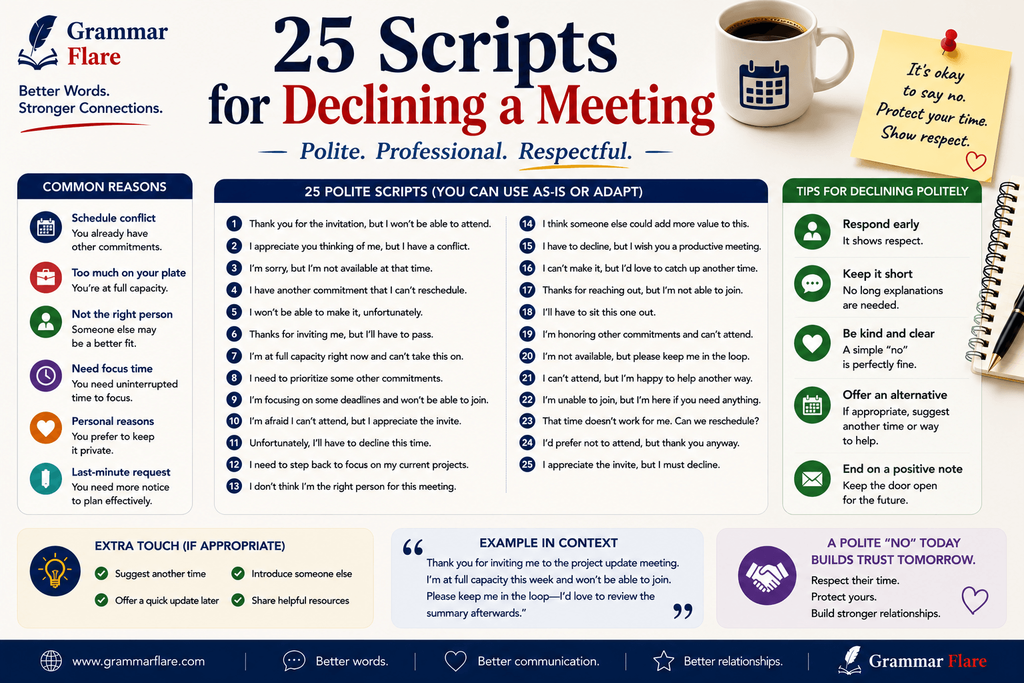
When you have a genuine conflict
1. The straightforward clash
I’m double-booked on Thursday at 2. Could we do Friday morning instead, or would written comments work?
2. The clash you would rather not reschedule
I can’t make that slot. If it’s a decision you need from me, I’m happy to give it now: I’d go with option B.
3. When you are traveling or away
I’m out that week. Rather than push it back, go ahead without me and send me the notes. I’ll flag anything I disagree with.
4. When the timing is genuinely bad
That week is the audit, so I’d be half-present at best. Could we hold it until the following Tuesday, when I can give it proper attention?
When the meeting has no clear agenda
Declining here is easier if you ask a question rather than refusing outright. It often produces an agenda, which was the real problem.
5. Asking for the agenda first
Happy to join, but could you send an agenda beforehand? If it turns out I’m not needed, I’d rather give you the time back.
6. When no agenda arrives
I haven’t seen an agenda, so I’ll step out of this one. Do send the notes, and pull me in if a decision needs me.
7. When the purpose is unclear
Before I block the hour, what decision are we trying to reach? If it’s a discussion rather than a decision, I might be more useful commenting in writing.
8. When it looks like a discussion that will not conclude
I’ll pass on this one. If it reaches a decision point and you need my input, put twenty minutes in for the two of us and I’ll make time.
When you are not the right person
9. Redirecting to someone better placed
I don’t think I’m the right person for this. Sara owns the reporting side and would be far more useful. Copying her here.
10. When you are listed but peripheral
I’m marked optional, so I’ll step out and read the notes. Shout if anything needs me directly.
11. When you would be attending out of habit
I’ve been on this invite for a while but I don’t think I’m adding much now the scope has narrowed. I’ll drop off and stay on the distribution list.
When it could be handled in writing
12. Offering written comments
I can’t make Thursday, but send the doc and I’ll comment by Friday morning so you’re not waiting on me.
13. Answering the question in advance
Rather than meet, here’s my answer to the question in the invite: yes to the phased rollout, no to moving the launch date. Happy to expand if that raises anything.
14. Suggesting a shorter call
An hour is more than this needs from me. Could we do fifteen minutes, or would a written summary work?
15. Proposing an asynchronous alternative
Could we run this as a thread instead? I’ll respond same day, and it saves five people an hour.
When it’s your manager
Declining upward needs one extra ingredient: what you are doing instead. Managers rarely object to a decline; they object to not knowing what it buys. The same principle applies to any pushback aimed upward, which our guide to disagreeing with your boss works through in more detail.
16. Declining with a trade-off named
I can make Thursday, but it would come out of the client deck. Which would you rather I prioritize?
This is often better than a flat no. It hands the decision back without refusing anything.
17. Declining a low-value recurring meeting
Would you mind if I dropped the Monday sync? I read the notes each week and I don’t think I’ve added much in a while. Happy to rejoin if that changes.
18. Declining when you are genuinely overloaded
I’m going to skip Thursday so I can finish the audit on time. If anything comes up that needs me, I’ll pick it up straight after.
When it’s a client or external
The rule here is different: never decline without offering a specific alternative. A bare no from a supplier reads as disinterest.
19. Declining with a concrete alternative
Thursday doesn’t work on my side, unfortunately. I have Friday at 10 or Monday at 2, both of which I’d hold for you.
20. Declining a meeting that isn’t necessary
Happy to meet if it’s useful, though I suspect I can answer this in writing faster. I’ve set out the three options below. If any of them needs discussion, I’ll clear time this week.
21. Declining an invitation to something optional
Thank you for thinking of me. I won’t be able to join this one, but I’d like to hear how it goes, and do keep me on the list for future sessions.
When you’re declining a recurring meeting
The hardest kind, because you are declining something that already has social weight.
22. Stepping off permanently
I’m going to step off the weekly sync. I’ve not been adding much since the scope narrowed, and you’d get more from the time than I would. I’ll keep reading the notes and I’m one message away if anything needs me.
23. Reducing your attendance
Could I move to attending every other week rather than weekly? I’ll take the alternate weeks from the notes and flag anything I disagree with.
24. Suggesting the meeting itself is reviewed
Before I drop off, is it worth asking whether the whole group still needs this weekly? I suspect a few of us are in the same position.
25. Declining a single instance of a recurring meeting
Skipping this week’s, nothing dramatic, just a clash. Carry on without me and I’ll catch up from the notes.
Regretfully or Regrettably?
Both turn up constantly in declines, and they are not interchangeable.
Regretfully means with regret, and it describes the feeling of the person doing the action. Regrettably means unfortunately, or it is to be regretted, and it describes the situation rather than the person.
I regretfully decline the invitation. (You feel regret.)
Regrettably, the meeting clashes with the audit. (The clash is unfortunate.)
The test: if you can substitute unfortunately and the sentence still works, you want regrettably. If you mean the person feels regret, you want regretfully.
In practice, both are more formal than most workplace email requires. Unfortunately is clearer than either, and I can’t make it is clearer still. Save regretfully for genuinely formal declines, such as a written response to an invitation.
One more pair worth separating: decline and reject. You decline an invitation, a meeting, or an offer. You reject a proposal, an argument, or an application. Declining is about your attendance; rejecting is about the merit of the thing. Using reject about a meeting invitation sounds harsher than almost anyone intends.
Declining Without Damaging the Relationship
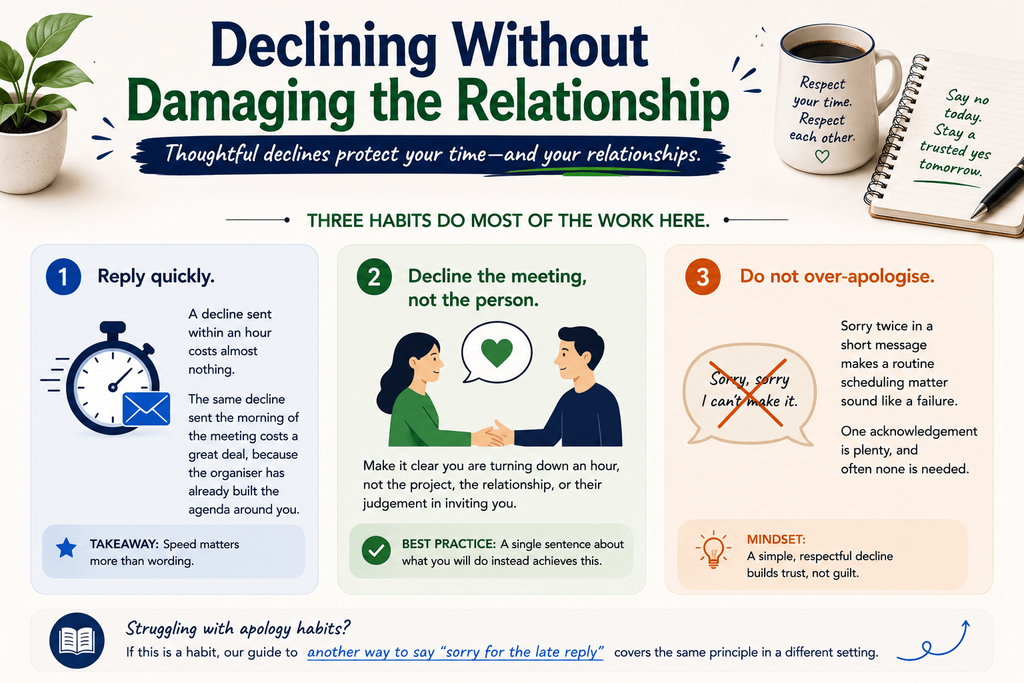
Three habits do most of the work here.
Reply quickly. A decline sent within an hour costs almost nothing. The same decline sent the morning of the meeting costs a great deal, because the organizer has already built the agenda around you. Speed matters more than wording.
Decline the meeting, not the person. Make it clear you are turning down an hour, not the project, the relationship, or their judgment in inviting you. A single sentence about what you will do instead achieves this.
Do not over-apologize. Sorry twice in a short message makes a routine scheduling matter sound like a failure. One acknowledgement is plenty, and often none is needed. If this is a habit, our guide to another way to say “sorry for the late reply” covers the same principle in a different setting.
Phrases to Avoid
“I’m too busy.” Implies your work outranks theirs. A specific reason lands better, and no reason at all is often better still.
“I don’t think this is a good use of my time.” It may be true. It reads as an insult to whoever scheduled it.
“I’ll try to make it.” A maybe is worse than a no, because the organizer now has to plan for both. Decide, and say which.
“Do I really need to be there?” Pushes the work back onto the organizer and carries an audible sigh. Ask what decision is being made instead.
“Can we just do this over email?” The word just makes a reasonable suggestion sound impatient. Remove it and the sentence improves.
“Sorry, I can’t.” Not wrong, but incomplete. Without a route to the outcome, it leaves the organizer exactly where they started.
“Something’s come up.” Vague enough to sound like an excuse, even when it is entirely true. One concrete clause is more credible than a euphemism.
One Test Before You Send
Read your decline and ask: has the organizer still got a way to get what they wanted?
If the answer is no, add one line. Written comments, a decision given in advance, a colleague who can attend, or a shorter slot. That single line is the difference between a decline that reads as unhelpful and one that reads as considerate, and it costs you about ten seconds.
FAQ
How do I politely decline a meeting?
Say no clearly, give one short reason, and offer another route to the outcome. I can’t make Thursday, I’m on the audit that week, but send the agenda and I’ll comment in writing by Friday.
Do I need to give a reason for declining a meeting?
Usually one clause is enough, and with peers often none is needed. Long explanations invite the organizer to solve your scheduling problem rather than accept your answer.
Is it rude to decline a meeting invitation?
No, provided you reply promptly and leave the organizer a way to reach their goal. Declining late, or declining without any alternative, is what causes friction.
How do I decline a meeting with my boss?
Name the trade-off rather than refusing outright: I can make Thursday, but it would come out of the client deck. Which would you rather I prioritize? This hands the decision back rather than pushing back.
What do I say when a meeting could have been an email?
Offer the written version instead of criticising the format: Could we run this as a thread? I’ll respond same day. Proposing an alternative is more persuasive than objecting to the meeting.
How do I decline a recurring meeting?
Explain what changed, not that you dislike it: I’ve not been adding much since the scope narrowed. Offer to keep reading the notes and to rejoin if circumstances change.
Is it “regretfully” or “regrettably”?
Regretfully means with regret and describes the person. Regrettably means unfortunately and describes the situation. If unfortunately fits, you want regrettably. In most workplace email, unfortunately is the better choice than either.
Should I decline in the calendar invite or send an email?
Decline in the calendar so the organizer’s system updates, then send a short message if you owe an explanation or an alternative. Declining silently in the calendar is what reads as rude, not the decline itself.
How do I decline a client meeting without damaging the relationship?
Always offer a specific alternative time or a written substitute. A bare no from a supplier reads as disinterest, whereas I have Friday at 10 or Monday at 2 reads as availability.
What if I’ve already declined this person once?
Give less explanation and more alternative. A second decline needs something substantial attached: written input, a colleague who can attend, or a firm slot you will protect.
Can I send someone else instead?
Often the best solution, provided you name the person and say why they are better placed. Sending a substitute without explanation can read as delegating something you consider unimportant.
How do I decline without sounding like I don’t care?
Show you understood the purpose. One sentence engaging with what the meeting was for, followed by how you will contribute anyway, does more for the relationship than any amount of apology.
Short Answers for Quick Reference
- The structure: decline clearly, one reason, one route to the outcome.
- Best all-purpose decline: I can’t make Thursday. Send the agenda and I’ll comment in writing by Friday.
- Declining your manager: name the trade-off and let them choose.
- Declining a client: never without a specific alternative time.
- Declining a recurring meeting: say what changed, and offer to rejoin.
- Regretfully or regrettably: if unfortunately fits, use regrettably.
- The rule underneath all of it: you are declining the meeting, not the outcome. Say so.
More Reading at GrammarFlare
- How to Disagree With Your Boss
- How to End a Conversation Politely
- The Importance of Tone in Conversation
- Another Way to Say “Sorry for the Late Reply”
- Professional Ways to Say “Please Let Me Know”
- Conversation Skills
Sources

Ahmad Waheed has spent five years editing academic and professional writing for universities, publishers, and software companies. He founded Grammar Flare after noticing the same handful of mistakes in almost every draft that crossed his desk, and that most grammar guides explained the rule without explaining when it actually matters.
Ahmad writes every guide on this site, checking usage questions against Merriam-Webster, the Chicago Manual of Style, and the AP Stylebook, and noting where those sources disagree rather than quietly picking a side.