
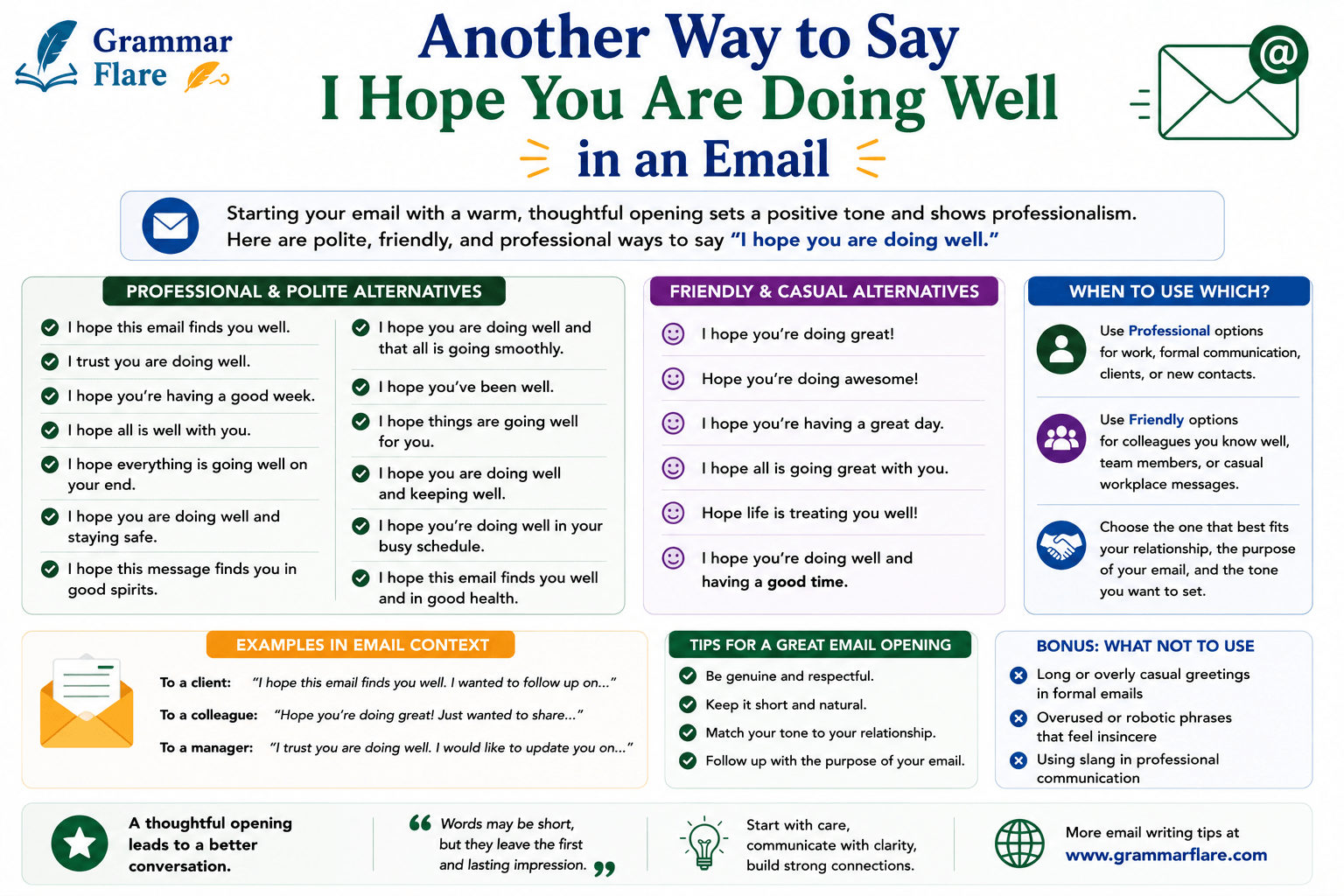
Instead of “I hope you are doing well,” open with something specific: I hope your week is off to a good start, Thanks again for your time yesterday, or I’m following up on the draft I sent Monday. The generic version is polite but carries no information, and after the fourth time in a week it reads as filler.
This guide gives you 35 alternatives sorted by formality and situation, plus the cases where skipping the opener entirely is the better call. If you want more phrasing help afterwards, the Better Ways to Say Things category is the next stop.
Quick Answer
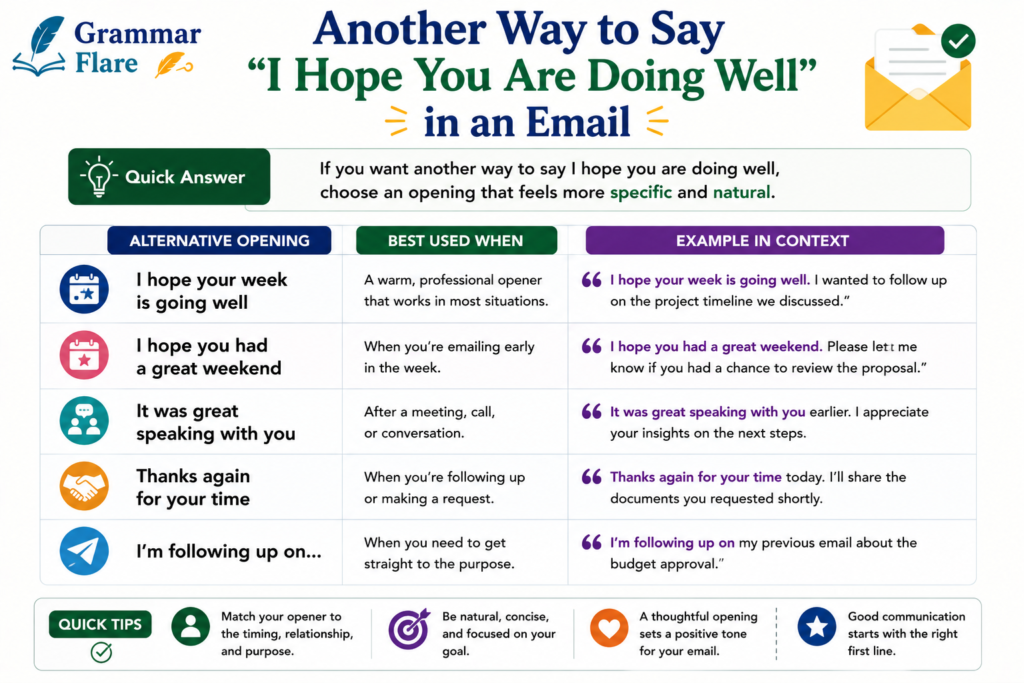
If you want another way to say I hope you are doing well, choose an opening that feels more specific and natural.
- Use I hope your week is going well for a warm professional opener.
- Use I hope you had a great weekend when the timing fits.
- Use It was great speaking with you after a meeting or call.
- Use Thanks again for your time when you are following up.
- Use I’m following up on… when a greeting is less useful than a clear purpose.
The strongest option is usually the one that sounds personal enough to feel human, but clear enough to get to the point quickly.
Best Alternatives in One Table
| Alternative | Best use | Tone | Example |
|---|---|---|---|
| I hope your week is going well. | weekday emails | warm, professional | I hope your week is going well. I’m reaching out about the revised draft. |
| I hope you had a great weekend. | Monday follow-ups | friendly | I hope you had a great weekend. I wanted to share the updated timeline. |
| I hope your day is going smoothly. | same-day outreach | warm, neutral | I hope your day is going smoothly. Could you review the attached file? |
| I hope all is well on your end. | professional general use | slightly formal | I hope all is well on your end. I’m following up on the invoice. |
| I trust you’re doing well. | formal business tone | polished | I trust you’re doing well. I’m writing regarding next week’s meeting. |
| It was great speaking with you. | after a call or meeting | natural, specific | It was great speaking with you today. I wanted to send the resources we discussed. |
| Thanks again for your time. | post-meeting follow-up | direct, professional | Thanks again for your time yesterday. I’m sending the proposal we reviewed. |
| I enjoyed meeting you. | networking follow-up | warm | I enjoyed meeting you at the workshop. I’d love to stay in touch. |
| I’m following up on… | direct follow-up | concise | I’m following up on the content brief we discussed last week. |
| I’m reaching out regarding… | formal purpose-led opener | neutral | I’m reaching out regarding the approved budget changes. |
| I wanted to check in about… | friendly follow-up | warm, direct | I wanted to check in about the final review timeline. |
| I hope the project is going smoothly. | ongoing work | specific | I hope the project is going smoothly. Please let me know if you need the updated assets. |
| I hope things have been going well for you. | broader personal-professional use | warm | I hope things have been going well for you. I’m writing with a quick update. |
| I hope you’re settling in well. | new role or new team | thoughtful | I hope you’re settling in well in your new position. |
| I hope this message reaches you at a good time. | sensitive or unexpected requests | considerate, formal | I hope this message reaches you at a good time. I wanted to raise a scheduling conflict early. |
| I hope your quarter is off to a strong start. | business contacts, early in a quarter | polished | I hope your quarter is off to a strong start. I wanted to share the pilot results. |
| I Hope your week is off to a good start. | Monday and Tuesday, colleagues | friendly | I hope your week is off to a good start. Quick update on the budget review. |
| Thanks for getting back to me. | replying after a wait | warm, direct | Thanks for getting back to me. I know it’s been a busy stretch. |
| Quick question about [X]. | single-question emails | efficient | Quick question about the invoice dates — should these run to the 30th or the 31st? |
| [Name] suggested I reach out. | warm cold outreach | direct, credible | Ayesha Rahman suggested I reach out about your localisation work. |
The Best Alternative Is Usually More Specific
The biggest problem with I hope you are doing well is not that it is wrong. It is that it does not tell the reader anything new.
A stronger opening usually does one of these things:
- matches the time of week
- refers to a recent interaction
- mentions the project or topic
- moves directly into the reason for the email
That makes the message sound more natural and less like a template.
35 Better Ways to Say “I Hope You Are Doing Well”
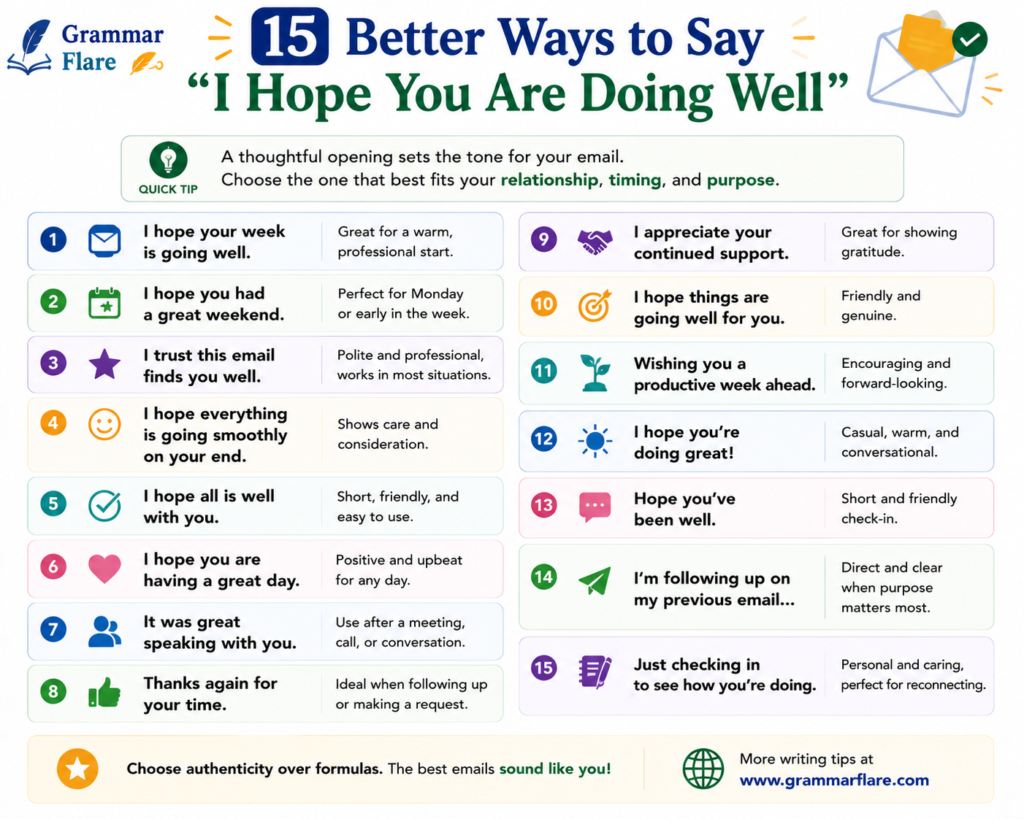
Warm professional greetings
1. I hope your week is going well.
This is one of the safest replacements because it sounds warm without sounding too personal.
Example: I hope your week is going well. I wanted to share the updated outline before Friday.
2. I hope you had a great weekend.
Use this on Monday or early in the week. It feels more timely than a generic wellness line.
Example: I hope you had a great weekend. I’m following up with the revised schedule.
3. I hope your day is going smoothly.
This works well for shorter emails and quick check-ins.
Example: I hope your day is going smoothly. Could you confirm that the attachment came through?
4. I hope all is well on your end.
This is slightly more polished than I hope you are doing well, but still broad enough for general professional use.
Example: I hope all is well on your end. I’m checking in about the next review round.
5. I trust you’re doing well.
This is more formal. It works best in client communication, external business emails, or professional follow-ups where you want a polished tone.
Example: I trust you’re doing well. I’m writing to confirm Thursday’s meeting time.
More specific relationship-based openings
6. It was great speaking with you.
If you recently talked, this is stronger than a generic greeting because it points to a real interaction.
Example: It was great speaking with you earlier. I’m sending the examples I mentioned on the call.
7. Thanks again for your time.
This is one of the best options after a meeting, interview, or call. It is polite and immediately relevant.
Example: Thanks again for your time yesterday. I’ve attached the updated proposal for your review.
8. I enjoyed meeting you.
This works well after an introduction, event, or networking conversation.
Example: I enjoyed meeting you at the webinar. I wanted to follow up and share my contact details.
9. I hope you’re settling in well.
Use this when someone recently started a new job, moved into a new role, or joined a new team.
Example: I hope you’re settling in well. I wanted to introduce myself and share the onboarding notes.
Purpose-led email openings
10. I’m following up on…
Sometimes the best alternative is not another greeting at all. If the purpose matters more than the small talk, start with the purpose.
Example: I’m following up on the draft I sent last Thursday.
11. I’m reaching out regarding…
This is a clean, professional opener when you want to sound direct without sounding abrupt.
Example: I’m reaching out regarding the final copy for the landing page.
12. I wanted to check in about…
This sounds softer and warmer than I’m following up on…
Example: I wanted to check in about the training materials for next week’s session.
Tailored alternatives for ongoing work
13. I hope the project is going smoothly.
This works especially well with clients, coworkers, or collaborators when you are already involved in a shared task.
Example: I hope the project is going smoothly. I had one quick question about the deadline.
14. I hope things have been going well for you.
This is broader and more conversational. Use it when you want warmth without sounding too formal.
Example: I hope things have been going well for you. I’m writing with a quick update on our side.
15. I hope everything is going smoothly with [specific thing].
This is often the best option because it sounds human and tailored instead of copied.
Example: I hope everything is going smoothly with the launch. I wanted to confirm the final image sizes.
More formal options for clients and executives
16. I hope this message reaches you at a good time.
Useful when you are about to raise something inconvenient. It acknowledges that you may be interrupting, which softens what follows without apologising for writing at all.
Example: I hope this message reaches you at a good time. I wanted to flag a scheduling conflict before it becomes urgent.
17. I trust you have been keeping well.
More traditional than I trust you’re doing well, and best reserved for correspondence that is already formal — legal, academic, or senior client contact. It sounds out of place in a quick internal note.
Example: I trust you have been keeping well since our exchange in March.
18. I hope your quarter is off to a strong start.
Works in the first few weeks of a quarter with business contacts. It signals you understand their calendar, which a generic wellness line does not.
Example: I hope your quarter is off to a strong start. I wanted to share the results from the pilot.
19. I hope you had a restful break.
Use after a known holiday period — Eid, Christmas, New Year, a company shutdown. Name the occasion if you know it.
Example: I hope you had a restful Eid. Picking up the thread from before the break.
20. Congratulations on [specific achievement].
The strongest opener available when there is genuine news: a funding round, a promotion, a launch, an award. It proves you have been paying attention.
Example: Congratulations on the Series B. That’s a significant milestone for the team.
21. I hope the [launch/event/presentation] went smoothly.
A tailored version of I hope the project is going smoothly, pointed at a specific moment rather than an ongoing state.
Example: I hope the Meridian launch went smoothly. I saw the announcement on Monday.
Friendlier options for colleagues you know
22. I Hope your week is off to a good start.
Slightly warmer and less formal than I hope your week is going well, because dropping the “I” makes it sound spoken rather than written. Best Monday or Tuesday.
Example: I Hope your week is off to a good start. Quick update on the budget review.
23. Good to hear from you.
Only use this when replying. It acknowledges their message rather than opening a new topic, which makes the exchange feel like a conversation.
Example: Good to hear from you. Yes, Thursday afternoon works on our side.
24. Thanks for getting back to me.
The right opener when someone has replied after a delay. It thanks them without drawing attention to how long it took.
Example: Thanks for getting back to me. I know it’s been a busy stretch.
25. Hope the [meeting/presentation] went well.
Use when you know something specific was on their calendar. The specificity is what makes it land.
Example: Hope the board presentation went well. I’ve been curious how they took the proposal.
26. Great to see [company news].
Similar to a congratulations, but lighter — suitable when the news is notable rather than momentous.
Example: Great to see the new office announcement. Congratulations to everyone involved.
Casual options for close contacts
These work internally and with people you correspond with regularly. They are too informal for clients or first contact.
27. Hey, hope things are good.
Short and unfussy. Right for quick internal notes where a full greeting would feel heavy.
Example: Hey, hope things are good. Can you look at the pull request when you get a chance?
28. Long time no talk.
For reconnecting after a real gap. It acknowledges the silence lightly instead of ignoring it, which is what makes it work.
Example: Long time no talk. I came across something I thought you’d find useful.
29. How’s it going over there?
This one genuinely asks a question, so only use it if you want a reply. Pairing it with a request makes the question look rhetorical.
Example: How’s it going over there? Curious whether the new process has settled in.
30. Hope you survived [busy period].
Requires shared knowledge of a crunch; audit season, a launch, exam marking. It signals you understand their working life.
Example: Hope you survived audit season. Now things have calmed down, can we revisit the timeline?
Openers that skip the pleasantry
Often the strongest choice. Busy readers appreciate an email that starts with its point, and for follow-ups a wellness line actively delays the information they need.
31. Quick question about [X].
Sets expectations immediately: this is short, and there is one thing to answer.
Example: Quick question about the invoice dates. Should these run to the 30th or the 31st?
32. I’ll keep this brief.
Signals respect for their time. Only use it if the email really is brief, or it reads as a false promise.
Example: I’ll keep this brief. We need a decision on the venue by Friday.
33. Two things, both quick.
Useful when you have multiple small items. Numbering them afterwards makes the email easy to reply to in one pass.
Example: Two things, both quick. First, the deck is approved. Second, we’ve moved the review to Wednesday.
34. [Name] suggested I reach out.
The best possible opener for cold email. A mutual contact does more work than any wellness line, because it answers the reader’s first question: why am I hearing from you?
Example: Ayesha Rahman suggested I reach out about your localisation work.
35. I owe you an update on [X].
For overdue progress reports. Taking responsibility in the first clause is more effective than apologising at length.
Example: I owe you an update on the audit. Here’s where things stand.
When “I Hope You Are Doing Well” Still Works
You do not need to delete this phrase from your vocabulary. It is still polite and completely acceptable.
It works well when:
- you do not know the person very well
- you need a safe, neutral opener
- the email is short
- there is no obvious recent detail to mention
Example:
I hope you are doing well. I am writing to ask whether the report is ready for review.
That sentence is fine. The issue is repetition, not correctness.
When It Is Better to Skip the Greeting
In many professional emails, a direct opening works better than any version of I hope you are doing well.
That is especially true when:
- you are following up on a deadline
- the email is transactional
- the reader is busy
- your purpose is already clear
Instead of this:
I hope you are doing well. I wanted to check in about the contract.
Try this:
I’m following up on the contract and wanted to confirm whether the revised version is approved.
This sounds clearer and usually feels more useful to the reader.
How to Choose the Right Alternative
Match the timing
Use timing when it helps:
- I hope you had a great weekend on Monday
- I hope your week is going well on Tuesday through Thursday
- I hope your day is going smoothly for same-day emails
Match the relationship
Choose a warmer phrase for familiar contacts and a more neutral phrase for formal outreach.
- Thanks again for your time feels natural after a real conversation.
- I trust you’re doing well feels more formal and distant.
- I wanted to check in about… feels softer and more collaborative.
Match the purpose
If your reason for writing is the important part, say it early.
- follow-up: I’m following up on…
- clarification: I wanted to check in about…
- formal topic: I’m reaching out regarding…
The clearest opener is often the best one.
Example Swaps You Can Use Right Away
| Original | Better option | Why it works |
|---|---|---|
| I hope you are doing well. I wanted to ask about the timeline. | I’m following up on the timeline for the next review round. | gets to the point faster |
| I hope you are doing well. Attached is the revised file. | I hope your week is going well. I’ve attached the revised file. | sounds warmer and more natural |
| I hope you are doing well after our meeting. | Thanks again for your time today. | more specific to the interaction |
| I hope you are doing well in your new role. | I hope you’re settling in well in your new role. | feels more personal and relevant |
| I hope you are doing well. I wanted to follow up. | I wanted to check in about the draft I sent on Monday. | clearer and more useful |
| I hope you are doing well. I’m reaching out about a role. | Ayesha Rahman suggested I reach out about the localisation role. | answers “why am I hearing from you” immediately |
| I hope you are doing well. Sorry for the delay. | I owe you an update on the audit. Here’s where things stand. | takes responsibility without a long apology |
| I hope you are doing well. I have a few things to run past you. | Two things, both quick. | sets expectations and makes it easy to reply |
| I hope you are doing well after everything. | I imagine it’s been a difficult few weeks. | acknowledges reality instead of talking past it |
Which opener to use, by situation
First contact with someone who doesn’t know you
Skip the pleasantry. A wellness wish from a stranger reads as a template, because it usually is one. Open with why you are writing and how you found them.
Ayesha Rahman suggested I reach out. I’m working on a similar localisation problem and wanted to ask about your approach.
Following up when they haven’t replied
Don’t repeat your original opener, and don’t apologise for following up. Reference the previous message and make it easy to say no.
Following up on my note from 12 March about the vendor contract. If this has moved down the priority list, just let me know and I’ll check back next month.
After a meeting or call
Reference the conversation. This is the easiest situation to get right and the one where a generic opener is most obviously lazy.
Thanks again for your time this afternoon. I’ve attached the notes and next steps we discussed.
After a long gap in contact
Acknowledge the gap briefly, then give a concrete reason for writing. Vague reconnections rarely get replies.
It’s been a while since we worked together on the Hassan account. I came across a report on retention benchmarking and thought of your team.
Networking follow-up
Name the event and something specific from the conversation, or the email is indistinguishable from every other one they received that week.
I enjoyed meeting you at the localisation workshop. Your point about translation memory stayed with me. I wanted to share the resource I mentioned.
When you’re delivering bad news
Don’t open warmly and then pivot. The contrast makes the news land harder and can read as insincere. Open neutrally and get to the point.
I’m writing with an update on the delivery date, and it isn’t the one we hoped for.
When you’re asking for a favour
A specific, genuine opener earns goodwill here in a way a generic one cannot. If you have nothing specific to reference, be direct about the ask instead.
Congratulations on the Series B — I saw the announcement Monday. I’m writing because I have a favour to ask, and I’ll understand entirely if the timing is wrong.
During a difficult period
If there has been a layoff, a bereavement, a crisis, or a public setback, “I hope you are doing well” is tone-deaf. Acknowledge it or say nothing.
I imagine it’s been a difficult few weeks. No reply needed on this — just wanted the file in your inbox for when you’re ready.
Short internal message
Keep it light and get to the request. A formal opener between teammates reads as stiff.
I wanted to check in about the updated spreadsheet. Do you want me to make those changes today or tomorrow?
Common Mistakes to Avoid
Using the same opener in every email
Even a good phrase starts to sound automatic if you repeat it constantly.
Choosing a greeting that sounds too personal
Warm is good. Overfamiliar is not. Match the tone to the relationship.
Writing a long greeting before the real point
If the message is short and practical, get to the reason quickly.
Using a specific phrase when the timing does not fit
Do not write I hope you had a great weekend on Thursday. Time-based greetings only work when they sound natural.
Phrases to Avoid
“I hope this email finds you well.” The most overused opener in professional English, and slightly odder than the standard version. It casts the email as the thing doing the finding. Same zero information, extra layer of cliché.
“I hope you don’t mind me reaching out.” Opens by apologising for existing, which weakens everything after it. If the email is worth sending, send it without the apology.
“Hope you’re crushing it!” Assumes an energy the reader may not have, and reads as performative rather than warm.
“I hope all is well in these challenging times.” Dated, and it was worn out even when it was current.
“Hope all is well.” Not wrong, just the same generic wish with fewer words. If you are going to use a generic opener, at least pick one that hasn’t been in continuous service for forty years.
Best Options by Situation
For quick scanning, these are the strongest choices:
- Best all-purpose option: I hope your week is going well.
- Best post-meeting option: Thanks again for your time.
- Best direct follow-up option: I’m following up on…
- Best softer follow-up option: I wanted to check in about…
- Best tailored option: I hope everything is going smoothly with [specific thing].
One test before you send
Read your opening line and ask: could this sentence appear in an email to literally anyone?
If yes, it is doing no work. Either replace it with something only this recipient would receive, or delete it and start with your actual point. Both are improvements.
FAQ
What can I say instead of “I hope you are doing well” in an email?
You can say I hope your week is going well, I hope you had a great weekend, Thanks again for your time, I’m following up on…, or I wanted to check in about… depending on the situation.
Is “I hope you are doing well” too formal?
No. It is polite and normal. It only starts to feel weak when it becomes repetitive or generic in emails that would benefit from a more specific opening.
What is the best professional alternative?
One of the best professional alternatives is I hope your week is going well because it sounds warm, natural, and not overly personal. For follow-ups, I’m following up on… is often even better.
Is “I hope this email finds you well” better?
Not always. It can sound more formal, but it can also feel old-fashioned or overly scripted. In many cases, a more specific sentence sounds better.
Should I skip the greeting entirely?
Sometimes, yes. If the email is mainly about a deadline, a follow-up, or a clear request, starting with the purpose can be more effective than using a greeting.
Is “I hope you are doing well” unprofessional?
No. It is polite and inoffensive, and it will never cost you a deal. It is simply generic, which means it adds nothing. Forgettable is the accurate word, not unprofessional.
Is “I hope this email finds you well” grammatically correct?
Yes. “Finds” is being used in the sense of encountering someone in a particular state, which is a legitimate if old-fashioned construction. The objection to the phrase is stylistic, not grammatical.
What should I say instead in a cold email?
Skip the wellness wish. Lead with a mutual contact, something they published, or a specific problem you can help with. Generic openers in cold email are the fastest route to being filed as a template.
Is it rude to skip the greeting entirely?
Not in most professional settings, particularly for follow-ups and internal messages.Keep the salutation, as in Hi Sara, and drop only the wellness line. Removing the salutation as well reads as abrupt in most workplaces.
What can I say when I know the person is going through something difficult?
Acknowledge it plainly or say nothing. I imagine it has been a difficult few weeks is honest. A generic wellness wish in that context suggests you haven’t been paying attention.
How often is too often to use the same opener?
If the same person receives it twice in a fortnight, they have noticed. Rotating between three or four openers is usually enough to stop it registering as automatic.
Does “I hope you are doing well” work in British English?
Yes, though I hope you’re well and Hope all’s well are more common in British usage. The advice is the same on both sides: specific beats generic.
Short Answer Blocks for Quick Overviews
- Best formal alternative: I hope your week is going well.
- Best friendly alternative: I hope your week is off to a good start.
- Best after a meeting: Thanks again for your time.
- Best for a follow-up: Following up on [specific thing] from [date].
- Best for cold outreach: Skip the opener and lead with your reason for writing.
- The rule underneath all of it: If your opener could be sent to anyone, it isn’t worth sending to this person.
More Reading at GrammarFlare
- Another Way to Say “Just Checking In”
- Another Way to Say “As Per My Last Email”
- Professional Ways to Say “Please Let Me Know”
- Another Way to Say “Have a Good Day”
- The Importance of Tone in Conversation
- Better Ways to Say Things
Sources
- Digital.gov: Plain language guide series
- Purdue OWL: Email Etiquette
- Harvard Business Review on email tone and brevity

Ahmad Waheed has spent five years editing academic and professional writing for universities, publishers, and software companies. He founded Grammar Flare after noticing the same handful of mistakes in almost every draft that crossed his desk, and that most grammar guides explained the rule without explaining when it actually matters.
Ahmad writes every guide on this site, checking usage questions against Merriam-Webster, the Chicago Manual of Style, and the AP Stylebook, and noting where those sources disagree rather than quietly picking a side.