
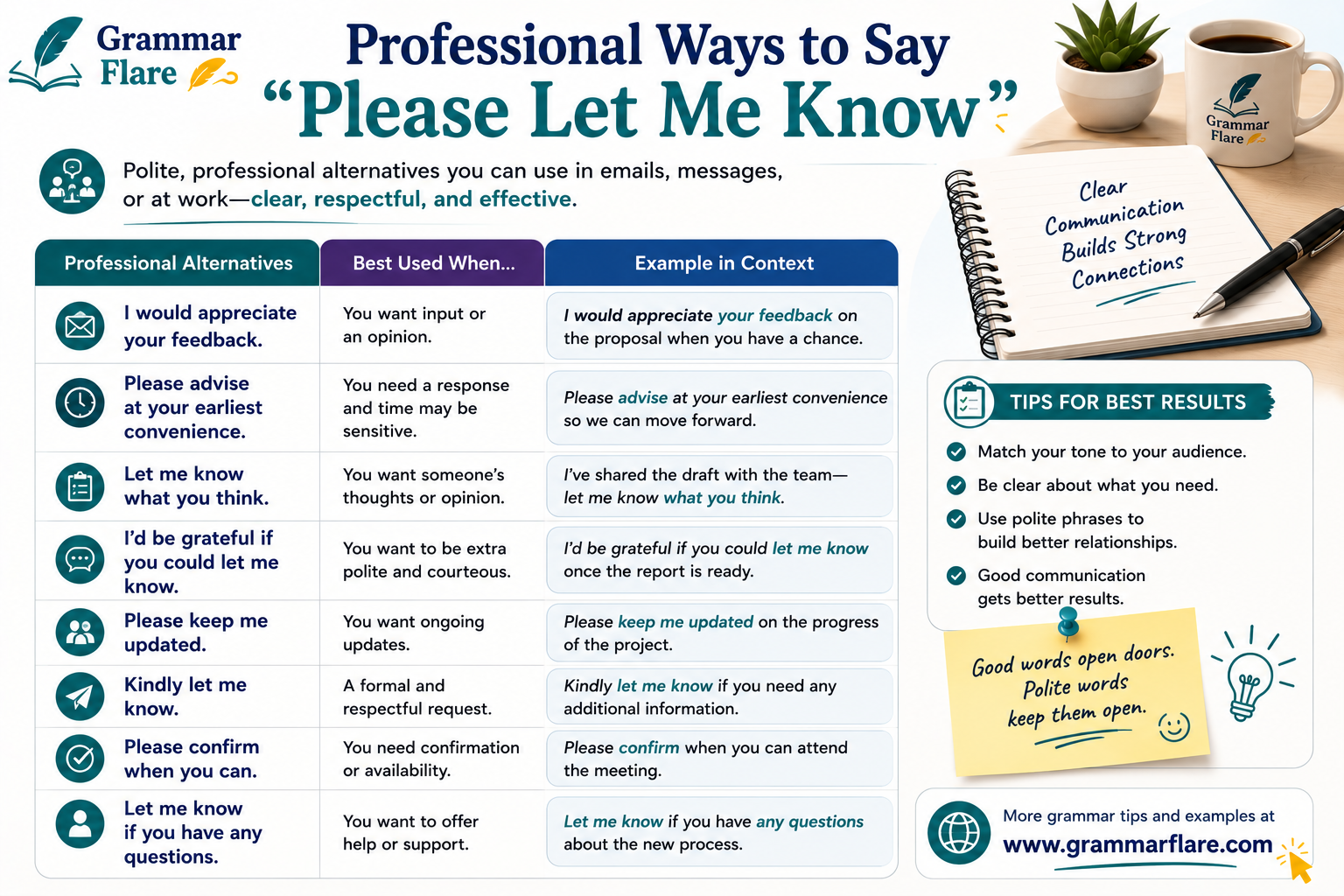
If you write emails often, you have probably used please let me know more times than you can count. It is polite, clear, and completely acceptable. The trouble is that it starts to feel repetitive, particularly in client communication and follow-ups.
The better choice is not always to replace it with something fancier. The best alternative depends on what you actually want from the reader: an update, a decision, confirmation, feedback, or a question. This guide gives you the strongest options by situation, with plain-English examples you can use right away. If you like practical phrase guides, our Better Ways to Say Things collection covers the phrases people reach for most.
Quick Answer
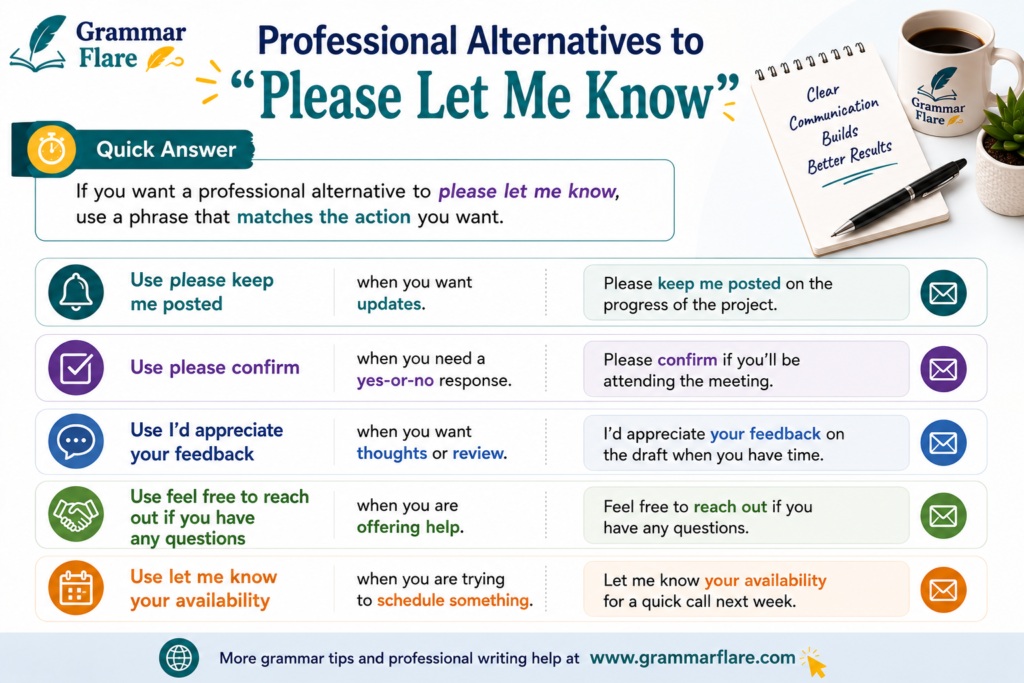
If you want a professional alternative to please let me know, use a phrase that matches the action you want.
- Use please keep me posted when you want updates.
- Use please confirm when you need a yes-or-no response.
- Use I’d appreciate your feedback when you want thoughts or review.
- Use feel free to reach out if you have any questions when you are offering help.
- Use let me know your availability when you are trying to schedule something.
The original phrase is still fine. It just works best when the request is general.
All 15 Alternatives in One Table
| Alternative | Best use | Tone | Example |
|---|---|---|---|
| Please keep me posted. | updates | professional, direct | Please keep me posted on the client response. |
| Please share any updates. | status changes | neutral | Please share any updates after the meeting. |
| I’d appreciate an update when you have one. | polite follow-up | warm, professional | I’d appreciate an update when you have one. |
| Please tell me if anything changes. | changing plans | practical | Please tell me if anything changes with the timeline. |
| Please confirm. | confirmation | concise, formal | Please confirm by Thursday. |
| Please let me know what you decide. | decisions | neutral | Please let me know what you decide after you review the options. |
| Let me know your availability. | scheduling | direct | Let me know your availability for next week. |
| Please reply when convenient. | low-pressure response | polite | Please reply when convenient so we can finalize the draft. |
| I’d appreciate your feedback. | review or comments | professional | I’d appreciate your feedback on the attached outline. |
| I’d love to hear your thoughts. | softer feedback request | warm | I’d love to hear your thoughts on the new homepage copy. |
| Feel free to reach out if you have any questions. | offering support | helpful | Feel free to reach out if you have any questions. |
| Let me know if anything is unclear. | clarifying instructions | friendly, direct | Let me know if anything is unclear in the brief. |
| I’m happy to help if needed. | support follow-up | warm | I’m happy to help if needed as you revise the document. |
| Just let me know. | casual internal messages | relaxed | Just let me know if you want me to update the file. |
| Keep me in the loop. | ongoing involvement | conversational | Keep me in the loop as the project moves forward. |
The Best Alternative Depends on What You Need
The biggest mistake writers make is choosing a phrase based only on tone. A better approach is to choose a phrase based on the response you want.
- If you want an update, ask for an update.
- If you want a decision, ask for a decision.
- If you want feedback, ask for feedback.
- If you want questions, invite questions.
That is clearer for the reader and usually sounds more natural.
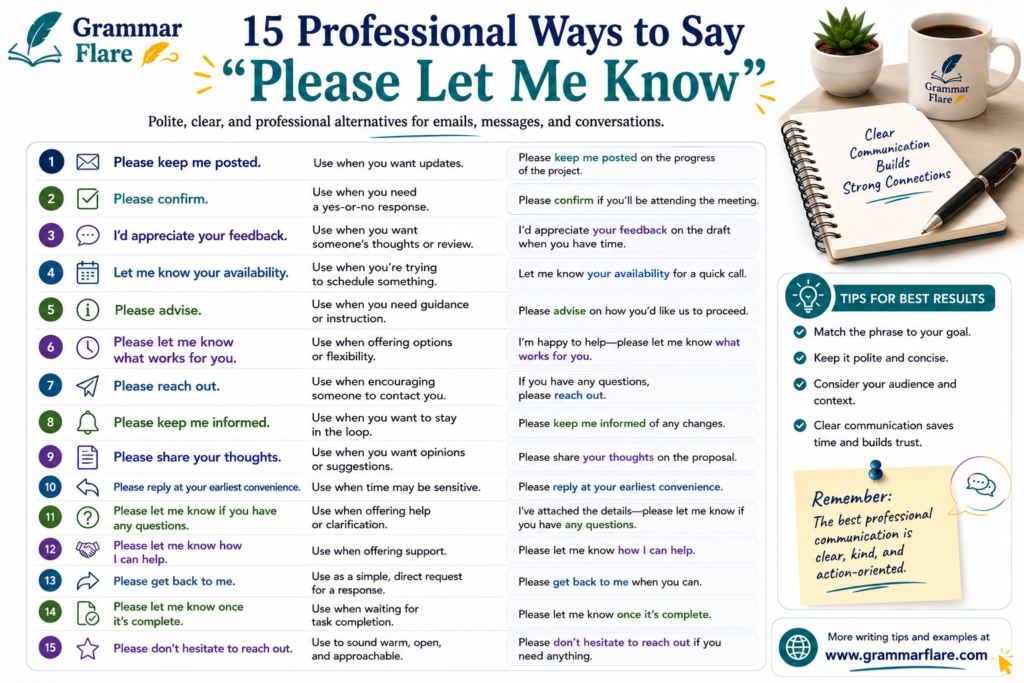
15 Professional Ways to Say “Please Let Me Know”
For updates and progress
1. Please keep me posted.
Use this when something is still moving and you want to hear about new developments.
Example: Please keep me posted on any changes to the launch date.
2. Please share any updates.
This is a little more neutral and works well in team communication.
Example: Please share any updates after your call with the vendor.
3. I’d appreciate an update when you have one.
Use this when you want to sound polite without sounding urgent or demanding.
Example: I’d appreciate an update when you have one so I can plan the next step.
4. Please tell me if anything changes.
This works best when a plan already exists, but details may shift.
Example: Please tell me if anything changes with Friday’s meeting.
For confirmation and decisions
5. Please confirm.
This is the cleanest option when you need a simple confirmation.
Example: Please confirm that you received the revised contract.
6. Please let me know what you decide.
Use this when the other person needs time to choose between options.
Example: Please let me know what you decide after reviewing both proposals.
7. Let me know your availability.
This is better than a vague follow-up when the real goal is scheduling.
Example: Let me know your availability for a 20-minute call next week.
8. Please reply when convenient.
Use this when you want a response but do not want to create pressure.
Example: Please reply when convenient so we can lock in the final version.
For feedback and review
9. I’d appreciate your feedback.
This is one of the best replacements when you want comments on a draft, plan, or idea.
Example: I’d appreciate your feedback on the new onboarding email.
10. I’d love to hear your thoughts.
This sounds warmer and slightly more conversational than I’d appreciate your feedback.
Example: I’d love to hear your thoughts on the proposed headline options.
For questions and support
11. Feel free to reach out if you have any questions.
Use this when you are offering help after giving instructions or sharing information.
Example: Feel free to reach out if you have any questions about the next steps.
12. Let me know if anything is unclear.
This is especially useful in instructions, training, and project briefs.
Example: Let me know if anything is unclear in the content calendar.
13. I’m happy to help if needed.
This phrase adds warmth and support without sounding overly casual.
Example: I’m happy to help if needed as you prepare the slides.
For warm or conversational workplace messages
14. Just let me know.
This works well in internal messages, quick follow-ups, and familiar professional relationships.
Example: Just let me know if you want me to rewrite that paragraph.
15. Keep me in the loop.
Use this when you want to stay informed or included as something develops.
Example: Keep me in the loop as the edits come in from the client.
When “Please Let Me Know” Still Works
You do not need to avoid please let me know completely. It is still clear, polite, and natural in many situations.
It works well when:
- your request is broad
- you do not need a very specific kind of response
- you want to keep the message simple
- you are writing to someone you do not know well
Example:
Please let me know if you have any questions.
That sentence is still good English. Replace it only if a more specific phrase would help the reader respond better.
How to Choose the Right Professional Alternative to Please Let Me Know
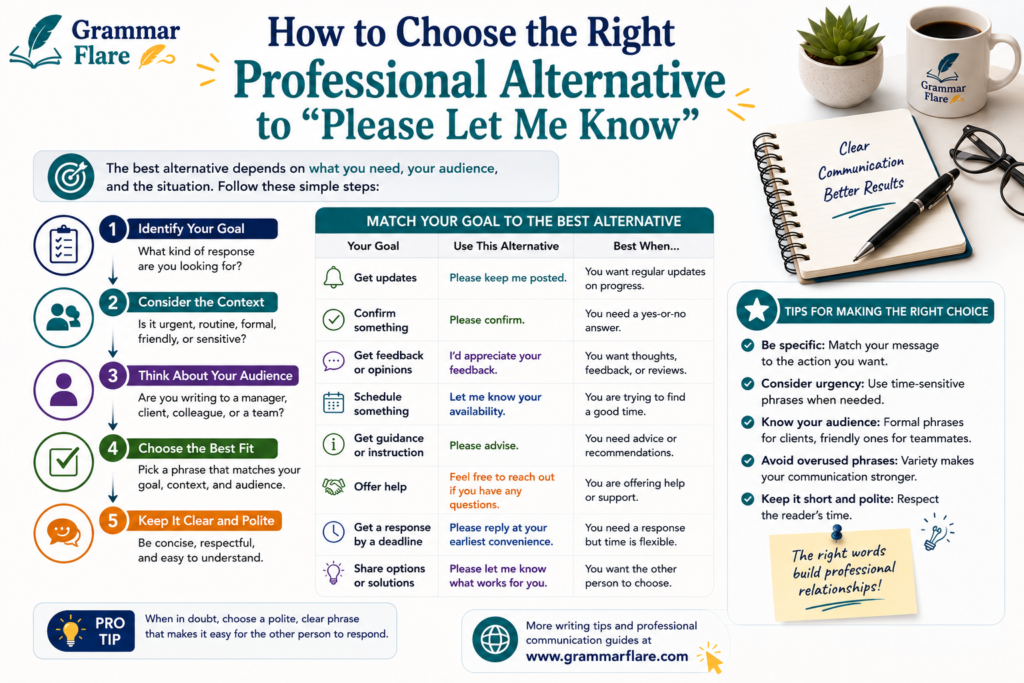
Match the phrase to the action
Ask yourself what you really want:
- an update
- confirmation
- availability
- feedback
- questions
The more precise your request is, the easier it is for the other person to answer.
Match the tone to the relationship
Some phrases are better for clients and managers. Others are better for teammates or ongoing conversations.
- Please confirm sounds more formal.
- Just let me know sounds more relaxed.
- I’d appreciate your feedback sounds respectful and collaborative.
Asking for a decision and questioning one are different requests, and the second needs more care. Our guide to disagreeing with your boss sets out how to make it without damaging the relationship.
Prefer clarity over corporate wording
Not every professional sentence needs to sound extra polished. In fact, overly stiff language can make writing feel less natural.
Clear, simple wording usually works better than vague or overly formal phrasing. That is one reason plain-language guidance remains useful for email and workplace writing.
Example Swaps You Can Use Right Away
Here are practical rewrites you can copy or adapt.
| Original | Better option | Why it works |
|---|---|---|
| Please let me know about any changes. | Please tell me if anything changes. | more direct |
| Please let me know your schedule. | Let me know your availability. | more natural scheduling language |
| Please let me know what you think. | I’d appreciate your feedback. | more professional for review |
| Please let me know if you need help. | I’m happy to help if needed. | warmer offer of support |
| Please let me know after the call. | Please share any updates after the call. | clearer action |
Email and Message Examples
Client follow-up
Please keep me posted on any feedback from your team.
Manager update request
I’d appreciate an update when you have one so I can adjust the timeline.
Scheduling message
Let me know your availability for a quick review on Thursday or Friday.
Instructions or onboarding note
Let me know if anything is unclear, and I’m happy to help if needed.
Common Mistakes to Avoid
Using a vague phrase for a specific task
If you need confirmation, say please confirm instead of using a general phrase.
Sounding too stiff
Phrases like please advise can work in some formal contexts, but they often sound rigid or old-fashioned in everyday business writing.
If it is a phrase you reach for often, there are 30 alternatives sorted by what you are actually asking for.
Replacing a clear phrase with a weaker one
Do not swap please let me know for something less clear just to sound different. The best wording is the one that helps the reader respond easily.
Best Options by Situation
For quick scanning, these are the strongest choices by use case:
- For updates: Please keep me posted.
- For feedback: I’d appreciate your feedback.
- For confirmation: Please confirm.
- For scheduling: Let me know your availability.
- For support: Feel free to reach out if you have any questions.
FAQ
What is a professional way to say “please let me know”?
A professional way to say please let me know depends on the situation. Good options include please keep me posted, please confirm, I’d appreciate your feedback, and let me know your availability.
Is “please let me know” not professional?
No. Please let me know is polite and professional. It only becomes repetitive when you use it too often or when a more specific phrase would work better.
What can I say instead of “please let me know” in an email?
You can say please keep me posted, please reply when convenient, I’d appreciate an update, or feel free to reach out if you have any questions, depending on the message.
What is better than “please let me know” for feedback?
For feedback, I’d appreciate your feedback or I’d love to hear your thoughts is usually better because it tells the reader exactly what kind of response you want.
Is “please advise” the same as “please let me know”?
Not exactly. Please advise often sounds more formal and can feel stiff in everyday workplace writing. In many cases, a more specific phrase sounds clearer and friendlier.
We cover the phrase in full, including whether it is grammatically correct, in our guide to another way to say “please advise”.
Short Answers for Quick Reference
- Best quick alternative: Use please keep me posted for updates, please confirm for confirmation, and I’d appreciate your feedback for review.
- Fast rule: Replace please let me know with a phrase that names the exact response you want.
- Clarity tip: The most professional choice is usually the clearest one, not the fanciest one.
Further Reading
- The Importance of Tone in Conversation: How to Be Heard
- Another Way to Say “Please Advise”
- Another Way to Say “Just Checking In”
- Another Way to Say “As Per My Last Email”
- Another Way to Say “Sorry for the Late Reply”
Sources

Ahmad Waheed has spent five years editing academic and professional writing for universities, publishers, and software companies. He founded Grammar Flare after noticing the same handful of mistakes in almost every draft that crossed his desk, and that most grammar guides explained the rule without explaining when it actually matters.
Ahmad writes every guide on this site, checking usage questions against Merriam-Webster, the Chicago Manual of Style, and the AP Stylebook, and noting where those sources disagree rather than quietly picking a side.