
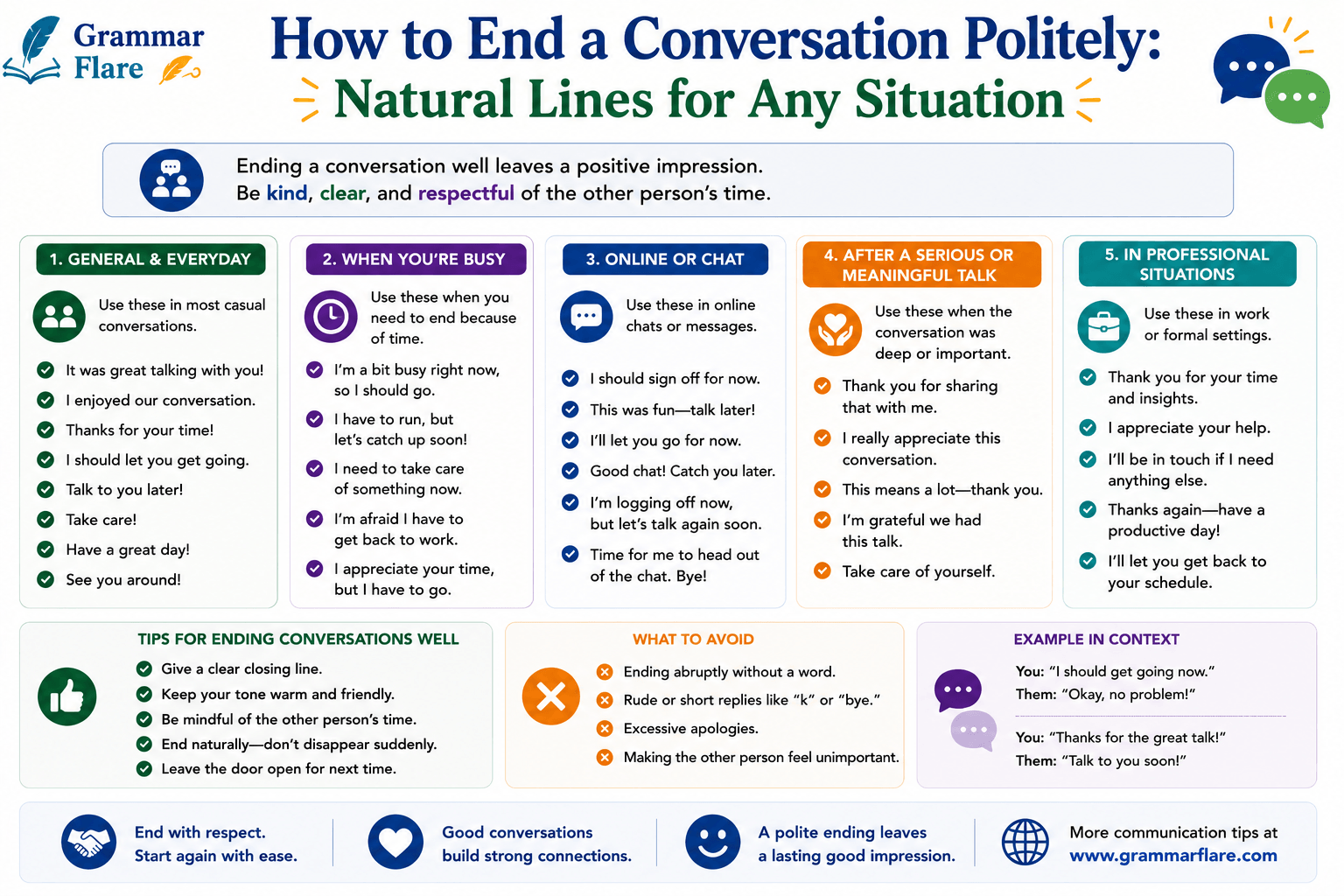
Ending a conversation politely is harder than most people expect. Starting one feels active. Ending one feels risky. Starting feels active. Ending feels risky. Many people worry that if they leave too early, they will sound rude, fake, or dismissive.
The good news is that polite endings usually follow a simple pattern. You do not need a perfect line. You need a warm signal, a clear reason, and a natural exit. If you want more practical communication help, our Conversation Skills guides cover greetings, difficult conversations, and keeping a conversation going.
Quick Answer
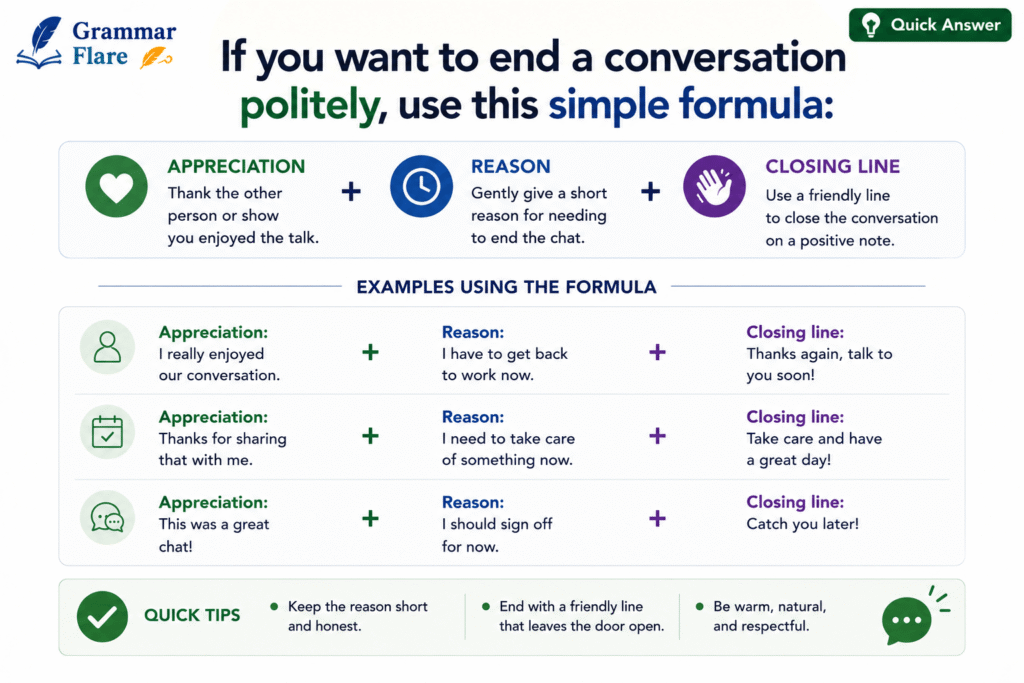
If you want to end a conversation politely, use this simple formula:
appreciation + reason + closing line
For example:
It was great talking with you, but I need to get back to work. Let’s catch up later.
That works because it does three things at once:
- shows warmth
- explains why you are leaving
- closes the interaction clearly
Best Short Answer Lines
If you need a fast option, these are safe and natural:
- It was great talking with you. I need to get going, but let’s talk again soon.
- I’ve got to run, but I really enjoyed this.
- I’ll let you get back to it. Thanks for chatting.
- I should jump off now, but this was helpful.
- I need to head out, but take care.
Why Ending a Conversation Feels Awkward
Most people are not bad at conversation. They are bad at transitions.
The awkwardness usually comes from one of these problems:
- you try to leave too suddenly
- you do not give any reason at all
- you over-explain and make the exit heavy
- you keep reopening the conversation after trying to close it
A clean ending is better than a long, apologetic one.
The Formula That Makes Exits Sound Natural
Use this pattern:
warmth -> reason -> close
1. Warmth
Show that you value the interaction.
Examples:
- It was nice talking with you.
- I’m glad we got to catch up.
- Thanks for the update.
2. Reason
Give a simple, believable reason for leaving. It does not need to be dramatic.
Examples:
- I need to get back to work.
- I have to head out now.
- I need to make another call.
3. Close
Signal that the conversation is ending.
Examples:
- Let’s talk later.
- Take care.
- Enjoy the rest of your day.
Put together, it sounds like this:
I’m glad we got to talk. I need to head into a meeting now. Take care.
25 Polite Ways to End a Conversation
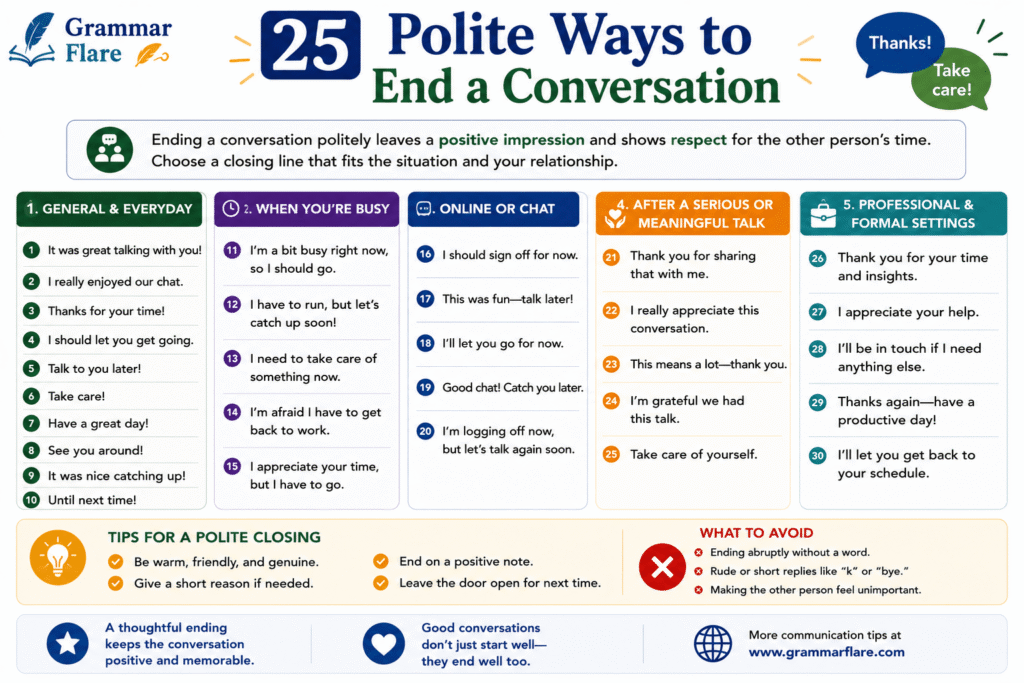
Everyday exits with friends or casual contacts
| Line | Best use | Tone |
|---|---|---|
| It was great catching up. I need to get going now. | general everyday exit | warm |
| I’ve got to run, but this was really nice. | quick friendly exit | easygoing |
| I’ll let you get back to your day. Talk soon. | when you do not want to overstay | considerate |
| I should head out, but I’m glad we talked. | in-person social exit | natural |
| I do not want to keep you, so I’ll let you go. | when the other person seems busy | thoughtful |
| Let’s pick this up another time. | when the topic could continue later | open, friendly |
Professional lines for work conversations
| Line | Best use | Tone |
|---|---|---|
| Thanks for the update. I need to get back to a deadline, but this was helpful. | work chat | professional |
| I appreciate your time. I’ll let you get back to it. | manager, coworker, client | respectful |
| I have to jump to another meeting, but thank you for walking me through that. | office or remote meeting | polished |
| This was useful. I’ll follow up by email. | when you want a clean next step | clear |
| I should get back to work, but I’m glad we connected. | short coworker conversation | warm-professional |
| I’ll let you go so you can get back to your afternoon. | hallway or desk chat | considerate |
| I need to hop off now, but thank you again. | remote call or chat | efficient |
Event, phone, or in-person networking exits
| Line | Best use | Tone |
|---|---|---|
| It was really nice meeting you. I’m going to say hello to a few other people before I leave. | networking event | graceful |
| I’ve enjoyed talking with you. I’m going to grab a drink before the next session starts. | conference or social event | natural |
| I do not want to monopolize your time, but this was great. | when the other person is in demand | polished |
| I’m going to make my way out, but I’m glad we got to talk. | event ending | friendly |
| Thanks for the call. I’ll let you go and follow up on my end. | phone conversation | clear |
| I should let you get on with your evening. Take care. | evening or personal call | warm |
Text and online conversation exits
| Line | Best use | Tone |
|---|---|---|
| I need to step away for a bit, but let’s talk later. | casual text | warm |
| I’ve got to get back to something, but I liked this conversation. | friendly text exit | natural |
| I’m logging off for now. Talk soon. | online chat or DM | direct |
| I need to run, but send me an update later. | practical text close | easygoing |
| I’m heading into something now, so I’ll reply later. | setting response expectations | useful |
| I have to go for now, but thanks for messaging me. | short clean exit | polite |
How to End a Conversation Without Sounding Rude
This is where tone matters most.
Be kind before you are brief
Short is fine. Cold is the problem.
Too abrupt: Okay, bye.
Better: It was nice talking with you. I need to go, but take care.
Give a real reason, not a dramatic excuse
You do not need to invent an emergency. A normal reason sounds more natural.
Good examples:
- I need to get back to work.
- I have to head out now.
- I need to make another call.
Do not apologize too much
One light apology is enough if you need it.
Fine: Sorry, I need to run.
Too much: I’m so sorry, I feel terrible, I really hate to leave, I wish I could stay…
Over-apologizing makes the exit feel heavier than it needs to be.
Use a future bridge when appropriate
If you genuinely want to continue later, say so.
Examples:
- Let’s talk again soon.
- Send me an update later.
- We should finish this conversation another time.
Mini Examples by Situation
At work
Thanks for explaining that. I need to get back to a deadline, but this helped a lot.
With a friend
I’ve got to head out, but I really liked catching up with you.
On the phone
Thanks for the call. I’ll let you go and email you the details.
At a networking event
It was great meeting you. I’m going to say hello to a few other people before the session starts.
Over text
I’m stepping away now, but message me later and we’ll keep talking.
What Not to Say
Some exits technically end the conversation, but they leave the wrong impression.
Avoid lines like these:
- Anyway…
- I am bored.
- I have better things to do.
- Okay, I am done talking.
- You talk too much.
The problem is not just the words. It is the social signal. These lines make the other person feel dismissed instead of simply concluded.
When It Is Better to End Quickly
Not every conversation needs a soft landing.
Sometimes a direct ending is better, especially when:
- you are late
- the exchange is becoming unproductive
- the other person is ignoring boundaries
- the conversation is happening in a work setting where time matters
You can still stay polite:
I need to stop here and get back to my priority right now. Thanks for understanding.
That is firm without being hostile.
The opposite problem has its own guide. If conversations tend to run out before you want them to, our guide to how to keep a conversation going covers the follow-up questions that keep one moving.
How to End a Conversation if Someone Keeps Talking
This is where many people get stuck. They try to close, but the other person restarts the conversation.
Use a firmer version of the same formula:
- acknowledge
- restate the need to leave
- close clearly
Example:
I hear you, and I appreciate the update. I really do need to go now, so I’ll catch you later.
If they continue, do not invent new reasons. Repeat the exit calmly.
I need to head out now. Take care.
Clarity works better than endless softening.
Ending a conversation and declining an invitation are the same skill in different settings: say the thing clearly, keep it short, and leave the other person a way forward. If it is a meeting rather than a conversation you need to step out of, our guide to how to politely decline a meeting covers the wording.
Quick Table: Weak Exit vs Better Exit
| Weak exit | Better exit | Why it works better |
|---|---|---|
| Okay, bye. | It was nice talking with you. I need to go, but take care. | adds warmth and closure |
| I have to leave. | I need to head out now, but I’m glad we talked. | sounds less abrupt |
| Anyway… | I’ll let you get back to your day. Thanks for chatting. | ends without sounding dismissive |
| I am busy. | I need to get back to a deadline, so I’ll catch up with you later. | gives context politely |
| Talk later maybe. | Let’s pick this up another time. | sounds clearer and more intentional |
How to Practice This Without Overthinking It
You do not need to memorize twenty-five lines. Learn the structure, then keep a few versions ready.
Start with these three:
- It was great talking with you, but I need to get going.
- Thanks for the update. I’ll let you get back to it.
- I’m heading out now, but let’s talk again soon.
Once those feel natural, adjust them to the situation.
Our Better Ways to Say Things guides cover the phrases that come before the exit.
FAQ
How do you end a conversation politely?
End a conversation politely by showing warmth, giving a simple reason for leaving, and closing clearly. For example: It was great talking with you, but I need to get back to work. Take care.
What can I say instead of just saying bye?
You can say It was nice talking with you, I need to get going now, I’ll let you get back to it, or Let’s talk again soon depending on the situation.
How do I end a conversation without sounding rude?
Avoid abrupt lines and add a short friendly signal before you leave. A warm sentence plus a simple reason usually sounds polite and natural.
How do I end a work conversation professionally?
Use a line like Thanks for the update. I need to get back to a deadline, but this was helpful. It sounds respectful and keeps the interaction efficient.
How do I end a text conversation politely?
Say that you need to step away, log off, or reply later. For example: I’m heading into something now, so I’ll reply later.
What if the other person keeps talking?
Repeat your exit calmly and clearly. Do not keep inventing new excuses. A firm polite line works best.
Short Answers for Quick Overviews
- Best quick answer: End a conversation politely by showing warmth, giving a simple reason for leaving, and closing clearly.
- Fast formula: Use warmth -> reason -> close.
- Best professional line: Thanks for the update. I need to get back to a deadline, but this was helpful.
- Biggest mistake to avoid: Do not end with a cold one-word exit when a short warm sentence would work better.
More Reading at GrammarFlare
- How to Keep a Conversation Going
- How to Politely Decline a Meeting
- The Importance of Tone in Conversation
- Things to Talk About With Friends
- Creative Ways to Say Hello
- Conversation Skills
Sources
- Harvard Business Review: The Surprising Power of Questions
- Harvard Business Review: What Great Listeners Actually Do
- Digital.gov: Plain language guide series

Ahmad Waheed has spent five years editing academic and professional writing for universities, publishers, and software companies. He founded Grammar Flare after noticing the same handful of mistakes in almost every draft that crossed his desk, and that most grammar guides explained the rule without explaining when it actually matters.
Ahmad writes every guide on this site, checking usage questions against Merriam-Webster, the Chicago Manual of Style, and the AP Stylebook, and noting where those sources disagree rather than quietly picking a side.