
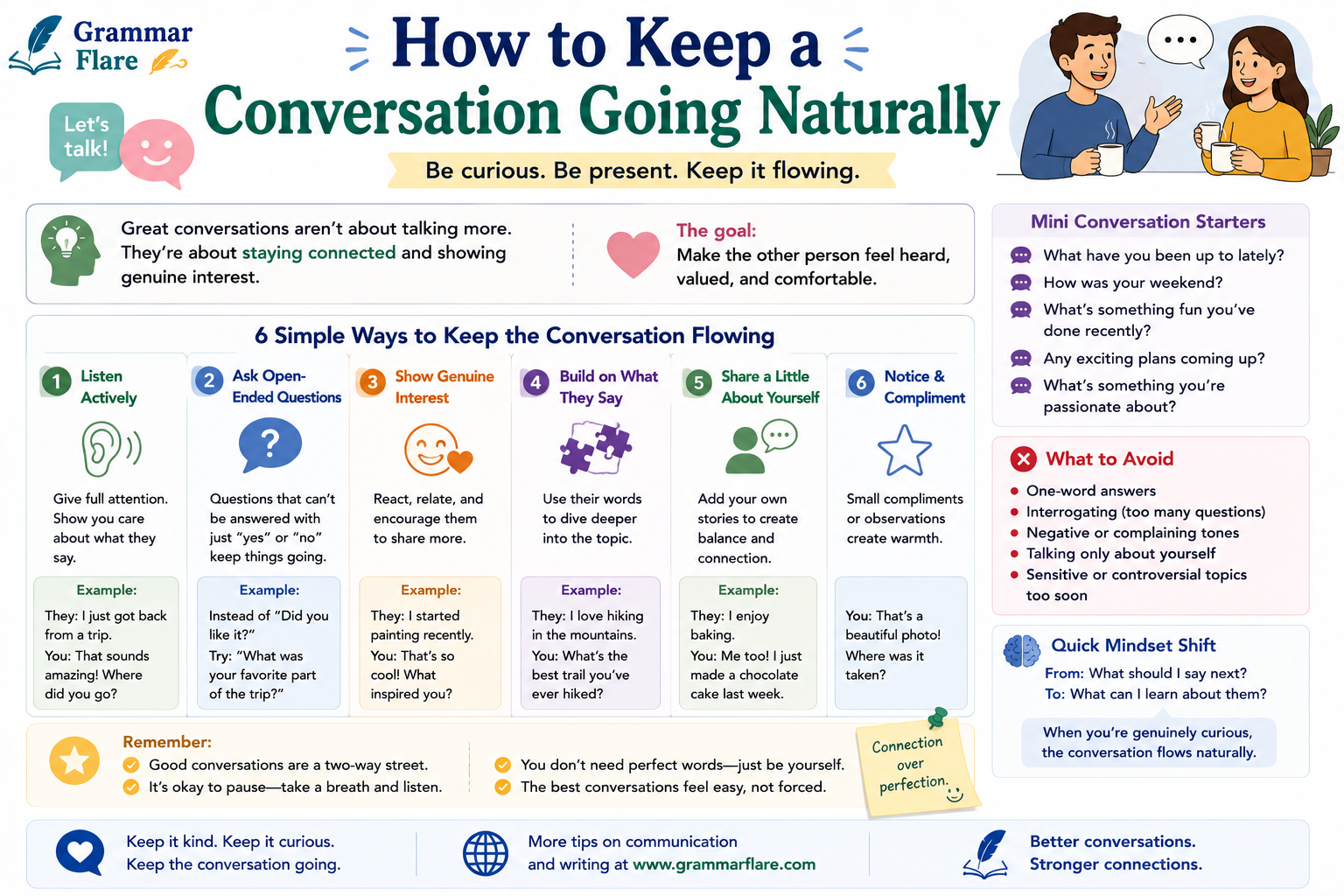
If you have ever felt a conversation slowing down and thought, What do I say now?, you are not the only one. Many people do not struggle because they have “nothing to say.” They struggle because they put too much pressure on themselves to be clever, fast, or endlessly interesting.
The good news is that strong conversation usually does not come from having perfect lines ready. It comes from doing a few simple things well: noticing what the other person already said, asking a natural follow-up, and adding a little of your own perspective.
If you want more practical people-skills content, our Conversation Skills guides cover greetings, exits, and difficult conversations.
Quick Answer
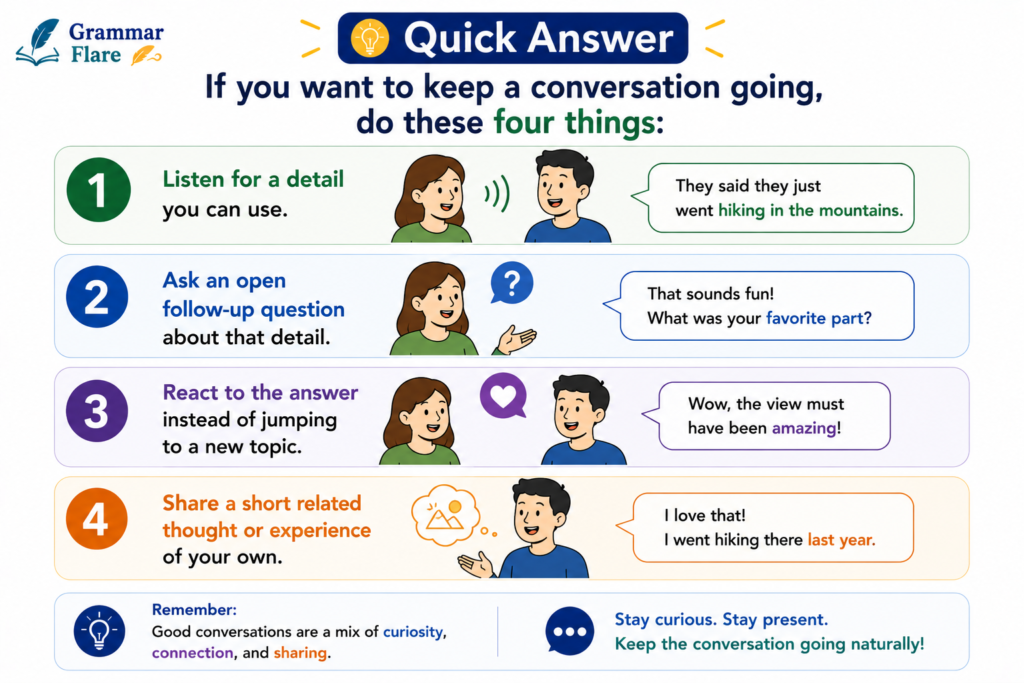
If you want to keep a conversation going, do these four things:
- Listen for a detail you can use.
- Ask an open follow-up question about that detail.
- React to the answer instead of jumping to a new topic.
- Share a short related thought or experience of your own.
That is the core pattern. Good conversation is usually less about “performing” and more about showing steady interest.
The Simple Formula That Keeps Conversations Moving
Here is the easiest version to remember:
Notice -> Ask -> React -> Add
1. Notice
Listen for a specific word, feeling, place, event, or opinion.
Example: I just got back from Chicago.
Useful details you could notice
- Chicago
- just got back
- travel
- timing
2. Ask
Ask a question that opens the topic instead of closing it.
Better question: How was the trip?
Even better: What was the best part of the trip?
3. React
Do not treat the answer like a box you needed to check. Respond to it.
Example: That sounds fun. No wonder you liked it. That makes sense.
4. Add
Share a short related comment so the conversation feels balanced.
Example: I have never been to Chicago, but I keep hearing the food is great.
That gives the other person something new to respond to without forcing the conversation in a random direction.
Why Conversations Usually Stall
Most awkward silences do not happen because people are boring. They happen because the structure breaks down.
Asking closed questions only
If you keep asking questions that invite one-word answers, the conversation will shrink fast.
Closed question: Did you like it?
More open version: What did you like most about it?
Moving on too quickly
People often switch topics too early because they are afraid of silence. But if you leave a topic after one answer, you lose the easiest follow-up material.
Turning the conversation into an interview
If you only ask question after question without reacting or sharing anything, the exchange can feel mechanical.
Overthinking every line
Trying to sound impressive usually makes you sound tense. Natural conversation is usually simpler than people expect.
The Best Types of Follow-Up Questions
The easiest way to keep talking is to ask the right kind of follow-up question.
Ask for details
This works when the person already mentioned something specific.
Examples
- What was that like?
- How did that happen?
- What did you think of it?
Ask about preference or opinion
This works well because people usually have a view, even on a small topic.
Examples
- Which part did you enjoy most?
- Do you usually prefer that kind of thing?
- What made you choose that option?
Ask about the story behind it
People often enjoy explaining how something started.
Examples
- How did you get into that?
- What made you start doing it?
- How long have you been interested in it?
Ask about what happens next
Future-focused questions help the conversation keep moving.
Examples
- What are you doing next with it?
- Are you planning to keep going?
- What happens after that?
Use soft opinion-sharing questions
These feel more conversational than formal.
Examples
- Does it actually live up to the hype?
- Would you recommend it?
- Was it easier than you expected or harder?
Conversation Examples You Can Reuse
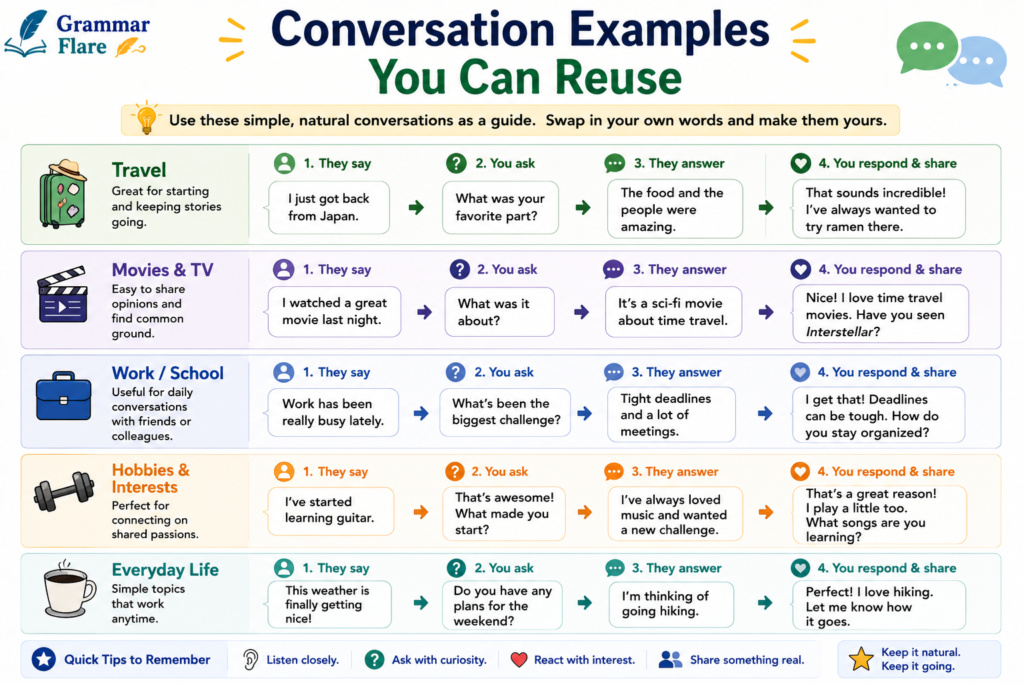
If someone mentions work
Instead of: Oh, nice.
Try
- What kind of work do you do there?
- What do you like most about it?
- How did you end up in that field?
Work conversations carry their own rules once they move into email. Our guide to professional ways to say “please let me know” covers the written version of the same problem.
If someone mentions a hobby
Instead of: That is cool.
Try
- How did you get into that?
- What do you enjoy about it most?
- Do you do it often?
If someone mentions travel
Instead of: I have always wanted to go there.
Try
- What stood out most to you?
- Would you go back?
- Was there anything that surprised you?
If someone mentions a movie, book, or show
Try
- What did you think of the ending?
- Would you recommend it?
- What made it interesting to you?
If you are talking over text
Text conversations often die when replies get too flat.
Weak: lol nice
Better: That sounds fun. How did that happen?
Weak: cool
Better: That actually sounds interesting. Was it your first time doing that?
How to Keep a Conversation Going Without Sounding Forced
This is usually what people really mean when they ask how to keep a conversation going. They do not just want more words. They want the conversation to feel easy.
React before you ask another question
A short reaction makes you sound present.
Examples
- That is interesting.
- That makes sense.
- That sounds stressful.
- I can see why you liked that.
Then ask the next question.
Do not stack too many questions in a row
This feels intense: Where did you go? Who were you with? How long were you there? Did you like it?
A better rhythm: Where did you go? Oh, that sounds fun. What was the highlight?
Share a little of yourself too
Good conversation is not one person extracting information from the other. It should feel balanced.
Example: I have not tried that yet, but now I kind of want to.
Stay with the current topic longer
Many people give up on a topic too early. If someone says something interesting, you often have two or three natural follow-ups available already.
Use specific words from the other person
If they say: The event was chaotic but fun.
You can ask: What made it chaotic?
Using their own language makes the question feel natural instead of scripted.
What to Say When the Conversation Starts Dying
If the energy drops, you do not need a magical line. You usually just need a clean reset.
Try one of these:
- How did you get into that in the first place?
- What have you been into lately?
- What has been the highlight of your week so far?
- What are you looking forward to right now?
- What have you been working on recently?
These work because they are open enough to invite a real answer, but focused enough that the other person is not left guessing what to say.
When Not to Keep It Going
Sometimes a conversation is winding down because it has finished, not because you failed at it. Forcing it past that point is what actually creates the awkwardness people are trying to avoid.
Signs it has run its natural course:
- Both of you are giving shorter answers, not just one of you
- The other person has glanced at the door, their phone, or the clock more than once
- You have already reset the topic twice
- You are asking questions you are not actually curious about
- One of you is clearly somewhere they need to leave
Ending a conversation cleanly is a skill in its own right, and doing it well leaves a better impression than stretching one out. A short, warm exit is usually remembered more fondly than an extra ten minutes of effort. Our guide to ending a conversation politely covers the lines that work.
The goal was never to talk for as long as possible. It was to have a conversation worth having.
Good Conversation Is Usually Good Listening
People often think conversation skill means talking more. In practice, it often means listening better.
If you pay attention well, you will hear:
- a place you can ask about
- a feeling you can respond to
- a story you can invite
- an opinion you can explore
That is why active listening matters so much. If you are only thinking about your next line, you will miss the best material the other person is already giving you.
Listening well also changes how you sound, not just what you notice. Our guide to tone in conversation covers why the same words land differently depending on delivery.
Quick Table: Awkward Line vs Better Line
| If you want to say this | Say this instead | Why it works better |
|---|---|---|
| Cool. | That sounds fun. What was the best part? | adds interest + invites detail |
| Nice. | How did that happen? | opens a story |
| Oh wow. | What was that like for you? | invites reflection |
| Same. | I have felt that too. What happened after that? | connects + continues |
| I do not know what to say. | That is interesting. Tell me more about that part. | keeps the focus moving |
How to Practice This in Everyday Life
You do not need a big social event to improve. Practice in low-pressure situations:
- short chats with coworkers
- casual conversations with friends
- text conversations
- checkout or cafe small talk
- family conversations where you usually go quiet
Pick one habit to practice at a time:
- ask one better follow-up question
- react before changing the topic
- stay on one topic for thirty seconds longer
- repeat one keyword from the other person in your next question
Small improvements add up quickly.
Common Mistakes to Avoid
Trying to sound too interesting
Curiosity usually works better than performance.
Asking generic questions only
Questions like How are you? are fine, but they rarely carry a conversation by themselves.
Interrupting with your own story too soon
If you switch the focus back to yourself too quickly, the conversation can feel competitive instead of connected.
Panicking about silence
A short pause is normal. You do not need to fill every second immediately.
Best Conversation-Keeping Questions by Situation
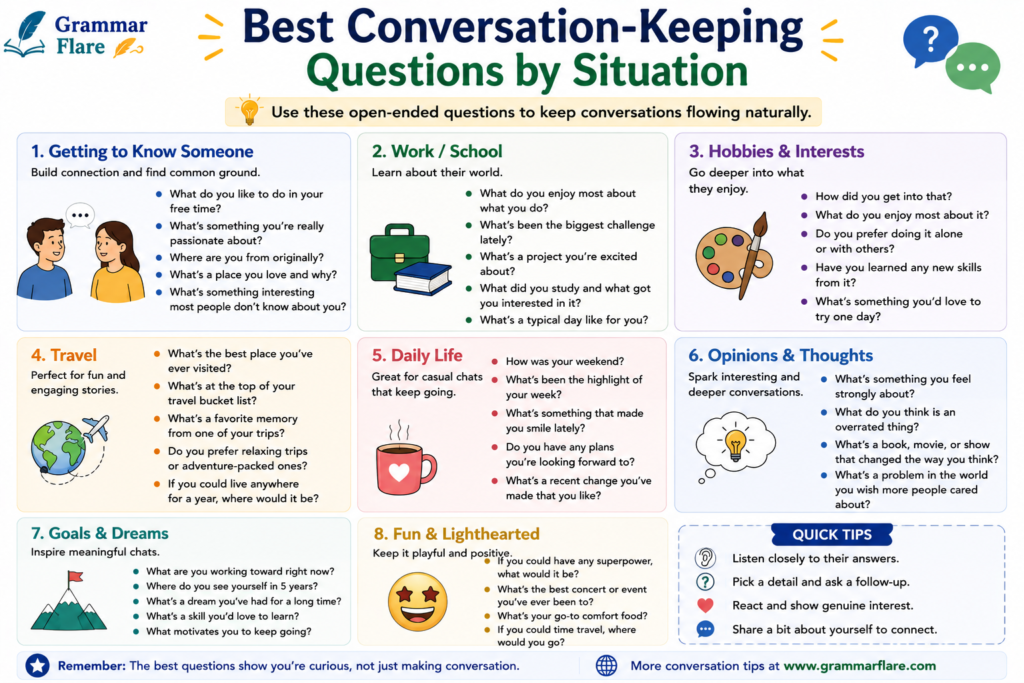
A New Person
- What have you been into lately?
- How do you know everyone here?
- What kind of work do you do?
A Friend
- What was the best part of your week?
- What happened after that?
- How are you feeling about it now?
Work
- What are you focused on right now?
- What has been the biggest challenge so far?
- What would help move it forward?
For text
- Wait, how did that happen?
- What did you say after that?
- Are you going to do it again?
FAQ
How do you keep a conversation going naturally?
Keep a conversation going naturally by listening for a detail, asking an open follow-up question, reacting to the answer, and sharing a short related thought of your own.
What should I say when a conversation gets awkward?
When a conversation gets awkward, ask a simple open question like What have you been into lately? or How did that happen? A calm reset usually works better than trying to force a clever line.
How do I stop sounding like I am interviewing someone?
React to what the person says before asking the next question, and share a little of your own experience too. That makes the exchange feel more balanced.
How do I keep a text conversation going?
Use replies that add a reaction and a follow-up. Instead of cool or nice, say something like That sounds fun. What happened next?
Is it normal to run out of things to say?
Yes. That happens to almost everyone. Better conversation usually comes from better follow-up questions, not from having endless topics prepared in advance.
Short Answer for Quick Overviews
- Best quick answer: Keep a conversation going by listening closely, asking open follow-up questions, reacting naturally, and adding a short related thought of your own.
- Fast rule: Use the pattern Notice -> Ask -> React -> Add.
- Biggest mistake to avoid: Do not ask one-word-answer questions and jump topics too fast.
More Reading at GrammarFlare
- How to End a Conversation Politely
- Things to Talk About With Friends
- The Importance of Tone in Conversation
- Creative Ways to Say Hello
- How to Politely Decline a Meeting
- Conversation Skills
Sources
- Harvard Business Review: The Surprising Power of Questions
- Harvard Business Review: What Great Listeners Actually Do
- Digital.gov: Plain Language

Ahmad Waheed has spent five years editing academic and professional writing for universities, publishers, and software companies. He founded Grammar Flare after noticing the same handful of mistakes in almost every draft that crossed his desk, and that most grammar guides explained the rule without explaining when it actually matters.
Ahmad writes every guide on this site, checking usage questions against Merriam-Webster, the Chicago Manual of Style, and the AP Stylebook, and noting where those sources disagree rather than quietly picking a side.