
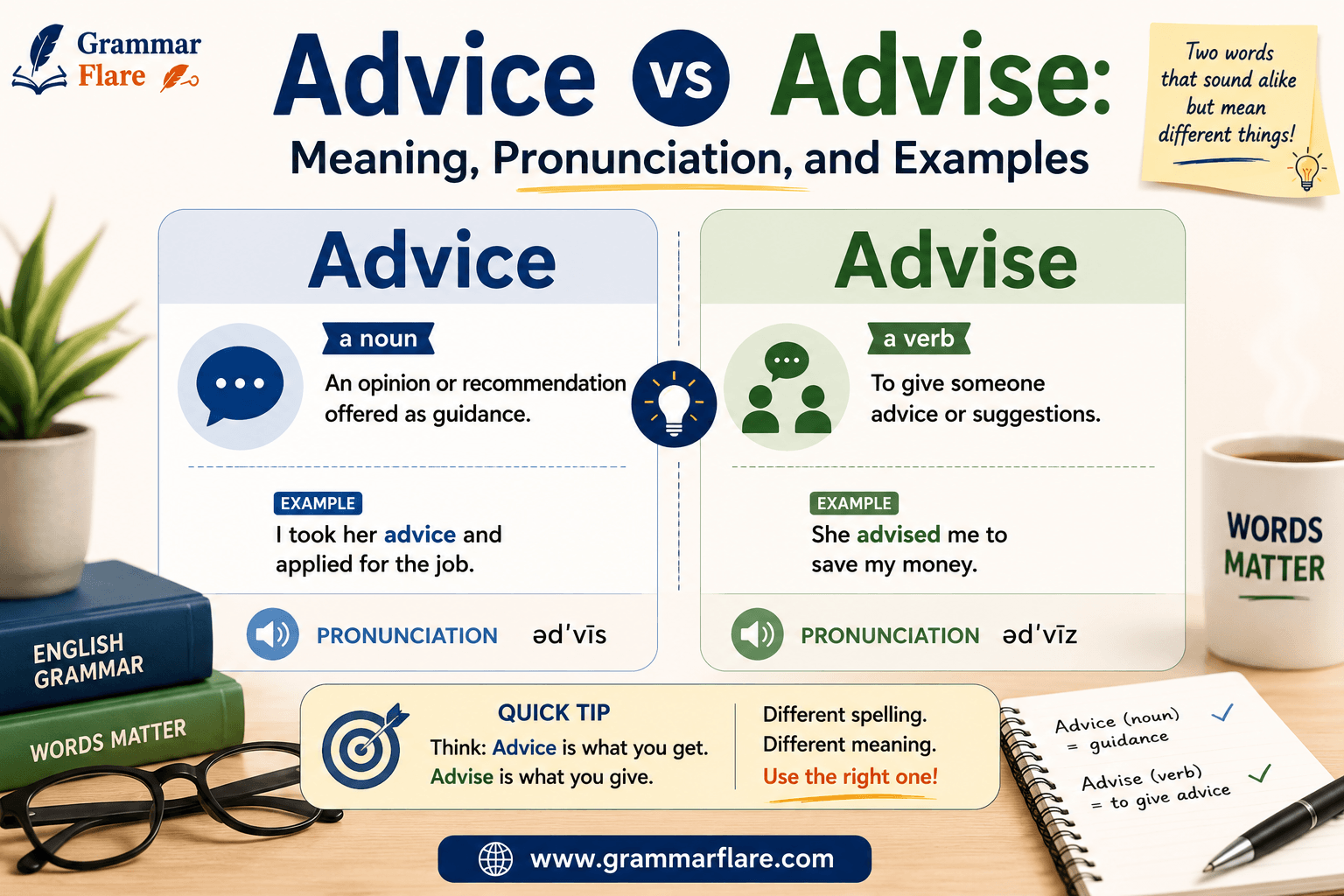
The difference between advice vs advise is simple once you identify the word’s job. Advice, spelled with a c, is a noun meaning a recommendation or guidance. Advise, spelled with an s, is a verb meaning to give a recommendation, guidance, or information.
Compare these sentences
- My teacher gave me useful advice.
- My teacher advised me to revise the essay.
In the first sentence, advice is the thing the teacher gave. In the second, advised describes what the teacher did.
Quick answer: Use advice as a noun and advise as a verb. You give or receive advice, but you advise someone. Advice ends with an /s/ sound, while advise ends with a /z/ sound.
Advice vs Advise at a Glance
| Word | Part of speech | Meaning | Pronunciation ending | Example |
|---|---|---|---|---|
| advice | noun | a recommendation, suggestion, or guidance | /s/ sound | She gave me good advice. |
| advise | verb | to recommend, guide, or inform | /z/ sound | She advised me to wait. |
The easiest pattern is
You advise someone by giving them advice.
Cambridge Dictionary identifies advice as an uncountable noun and advise as a verb meaning to give someone advice or official information. Merriam-Webster makes the same noun–verb distinction.
The Rule in One Sentence
Advice is the recommendation; advise is the action of giving it.
That single rule answers most advice vs advise questions.
What Does Advice Mean?
Advice is a noun. It refers to an opinion, recommendation, suggestion, or guidance about what someone should do.
Examples
- helpful advice
- legal advice
- medical advice
- career advice
- financial advice
- practical advice
- professional advice
- friendly advice
Advice in sentences
- My teacher gave me useful advice.
- I need your advice about this decision.
- Her advice helped me avoid a mistake.
- He asked his manager for advice.
- The article provides practical advice for new writers.
- You should seek professional advice before signing the contract.
- That was the best advice I received all year.
- She ignored everyone’s advice and continued with the plan.
- Can I give you some advice?
- We appreciate your advice on this matter.
In each sentence, advice names a thing, idea, or type of guidance. That makes it a noun.
What Does Advise Mean?
Advise is a verb. It means to recommend an action, offer guidance, counsel someone, or formally provide information.
Advise in sentences
- I advise you to read the instructions.
- The doctor advised her to rest.
- My teacher advised me to revise the conclusion.
- We strongly advise customers to keep their receipts.
- The lawyer will advise the company.
- Please advise us of any changes.
- They advised against traveling during the storm.
- She advises students on career choices.
- I would advise waiting until tomorrow.
- The notice advised residents to remain indoors.
The form changes according to tense and subject
| Form | Example |
|---|---|
| advise | I advise you to wait. |
| advises | She advises new students. |
| advised | They advised us to leave. |
| advising | He is advising the committee. |
Because advise is a verb, it can change form. Advice does not change this way.
Advice vs Advise: The Noun-and-Verb Test
When choosing between advice vs advise, ask whether you need a thing or an action.
Use advice for the thing
- I need some advice.
- Her advice was helpful.
- We followed your advice.
- That is excellent advice.
Use advise for the action
- Please advise me.
- She advised us.
- The doctor will advise the patient.
- They are advising the committee.
A useful comparison is
| Thing | Action |
|---|---|
| advice | advise |
| choice | choose |
| breath | breathe |
| belief | believe |
The noun is the concept or object. The verb describes what someone does.
How to Pronounce Advice and Advise
The spellings differ by only one letter, but the final sounds are different.
Advice
Advice ends with an unvoiced /s/ sound, like the ending of:
- ice
- rice
- nice
- price
It sounds roughly like:
ad-VICE
Advise
Advise ends with a voiced /z/ sound, like the ending of
- rise
- size
- prize
- realize
It sounds roughly like
ad-VIZE
This pronunciation difference offers a useful memory trick:
Advice rhymes with ice. Advise rhymes with eyes.
Although accents vary, the final sound distinction is standard in both major American and British pronunciations.
Is Advice Countable or Uncountable?
In standard English, advice is an uncountable noun.
That means you normally do not write
- an advice
- two advices
- several advices
Instead, use
- some advice
- a little advice
- a lot of advice
- a piece of advice
- two pieces of advice
- several helpful suggestions
Cambridge specifically notes that advice is uncountable and recommends a piece of advice when you need a countable expression.
Correct examples
- Can I give you some advice?
- She offered me a useful piece of advice.
- I received three helpful pieces of advice.
- He gave us a lot of advice.
- We need more advice before making a decision.
Incorrect examples
- Can I give you an advice?
- She offered me two advices.
- I received many advices.
- He gave us a helpful advice.
Corrected versions
- Can I give you some advice?
- She offered me two pieces of advice.
- I received many helpful suggestions.
- He gave us a helpful piece of advice.
This uncountable-noun rule is especially important for English learners whose first language treats the equivalent word as countable.
Advice vs Advise in Different Tenses
Because advise is a verb, it changes to show time.
Present tense
- I advise students to proofread carefully.
- We advise customers to arrive early.
- She advises new employees.
- The guide advises caution.
Past tense
- The doctor advised me to rest.
- My teacher advised me to add examples.
- They advised us against taking that route.
- The notice advised residents to stay inside.
Present progressive
- She is advising the team.
- We are advising clients about the change.
- He is advising me on the application.
Present perfect
- The lawyer has advised the company.
- My supervisor has advised me to revise the methods section.
- Officials have advised drivers to avoid the road.
Advice never takes these verb endings
- Incorrect: She advices students.
- Correct: She advises students.
- Incorrect: He is advicing me.
- Correct: He is advising me.
- Incorrect: They adviced us.
- Correct: They advised us.
Common Sentence Patterns With Advice
Learning common combinations makes advice vs advise easier.
Give advice
- She gave me good advice.
- Can I give you some advice?
- He often gives unsolicited advice.
Get or receive advice
- I got advice from my teacher.
- We received legal advice.
- She received helpful advice from a colleague.
Ask for advice
- I asked my manager for advice.
- He called to ask for advice.
- Where can I ask for professional advice?
Follow advice
- You should follow your doctor’s advice.
- I followed her advice and applied early.
- He rarely follows anyone’s advice.
Take advice
In American English, follow someone’s advice is often more natural, but take someone’s advice is also correct.
- I took your advice and changed the title.
- You should take your lawyer’s advice.
- She refused to take my advice.
Offer advice
- The counselor offered practical advice.
- May I offer a piece of advice?
- The guide offers advice for first-time writers.
Seek advice
- Seek professional advice before investing.
- She sought advice from her supervisor.
- You may need to seek medical advice.
Common Sentence Patterns With Advise
Advising someone to do something
advise + person + to-infinitive
- I advised him to wait.
- The doctor advised me to rest.
- She advised the students to check their work.
- We advise customers to keep their receipts.
Advise doing something
advise + gerund
- I advise waiting until tomorrow.
- The guide advises checking every reference.
- Experts advise avoiding unnecessary risks.
- We advise contacting the office first.
Advising someone against something
- The lawyer advised us against signing immediately.
- I advised her against taking that route.
- The doctor advised him against strenuous exercise.
- They advised travelers against visiting the area.
Advise that something should happen
- The committee advised that the policy should be revised.
- The doctor advised that he remain at home.
- We advised that the meeting be postponed.
Advising someone of something
This formal pattern means to inform someone.
- Please advise us of any changes.
- The company advised customers of the delay.
- We will advise you of the final decision.
- Residents were advised of the road closure.
“Please Advise” in Emails
Please advise is grammatically correct, but it can sound formal, vague, or abrupt.
Example
Please advise.
The writer probably means
- Please tell me what to do.
- Please let me know your decision.
- Please confirm the next step.
- Please share your recommendation.
A more specific request often sounds warmer and produces a better response.
Instead of “Please advise”
Use
- Please let me know how you would like to proceed.
- Could you recommend the best next step?
- Please confirm whether I should submit the revised version.
- Could you let me know which option you prefer?
- Please tell me whether any further changes are required.
- I would appreciate your guidance on this issue.
Those are the fastest substitutions. For 30 alternatives sorted by what you are actually asking for, along with whether “please advise” is even grammatically correct, see our full guide to another way to say “please advise”.
When “please advise” works
It can be suitable in formal business communication when the context is already clear:
The supplier cannot meet the original deadline. Please advise whether we should accept the revised delivery date.
The problem is not grammar. It is clarity and tone.
Advice vs Advise in American and British English
The basic advice vs advise distinction is the same in American and British English:
- advice is a noun
- advise is a verb
The spelling does not change between the two varieties.
This differs from some other noun–verb pairs that may vary by regional spelling, but advice and advise remain stable.
Examples in both American and British English:
- She gave me useful advice.
- She advised me to wait.
- I need professional advice.
- The doctor advised rest.
Adviser or Advisor?
A person who advises others may be called an adviser or advisor.
Both spellings are accepted.
- academic adviser
- academic advisor
- financial adviser
- financial advisor
- legal adviser
- policy advisor
Organizations often choose one spelling and use it consistently.
The connection is:
- advise: the verb
- adviser/advisor: the person
- advice: the guidance
Example
My financial advisor advised me to seek independent tax advice.
All three forms appear in one sentence, and each performs a different role.
Advice vs Advise Examples Side by Side
| Advice | Advise |
|---|---|
| Thank you for your advice. | Thank you for advising me. |
| I need some advice. | I need you to advise me. |
| Her advice was useful. | She advised us carefully. |
| We followed their advice. | They advised us to wait. |
| Can I ask for advice? | Can you advise me? |
| He ignored my advice. | I advised him against it. |
| The article offers advice. | The article advises caution. |
| She sought legal advice. | Her lawyer advised her. |
| This is practical advice. | I advise taking notes. |
| His advice changed my mind. | He advised me to reconsider. |
Advice vs Advise in Everyday Situations
School
- My teacher gave me useful advice about the essay.
- My teacher advised me to improve the conclusion.
- I asked my supervisor for advice.
- My supervisor advised me to review the sources.
Work
- The manager offered practical advice.
- The manager advised us to document every change.
- We need legal advice before signing.
- The lawyer advised the company to wait.
Healthcare
- Follow your doctor’s advice.
- The doctor advised me to rest.
- Seek medical advice if the symptoms continue.
- The nurse advised him to contact a specialist.
Relationships
- She asked her friend for advice.
- Her friend advised her to communicate honestly.
- That was thoughtful advice.
- I would advise giving the situation more time.
Travel
- The website provides safety advice.
- Officials advise travelers to check local conditions.
- We followed the guide’s advice.
- The airline advised passengers to arrive early.
Emails
- Thank you for your advice.
- Could you advise me on the next step?
- I would appreciate your advice.
- Please advise whether the document is ready.
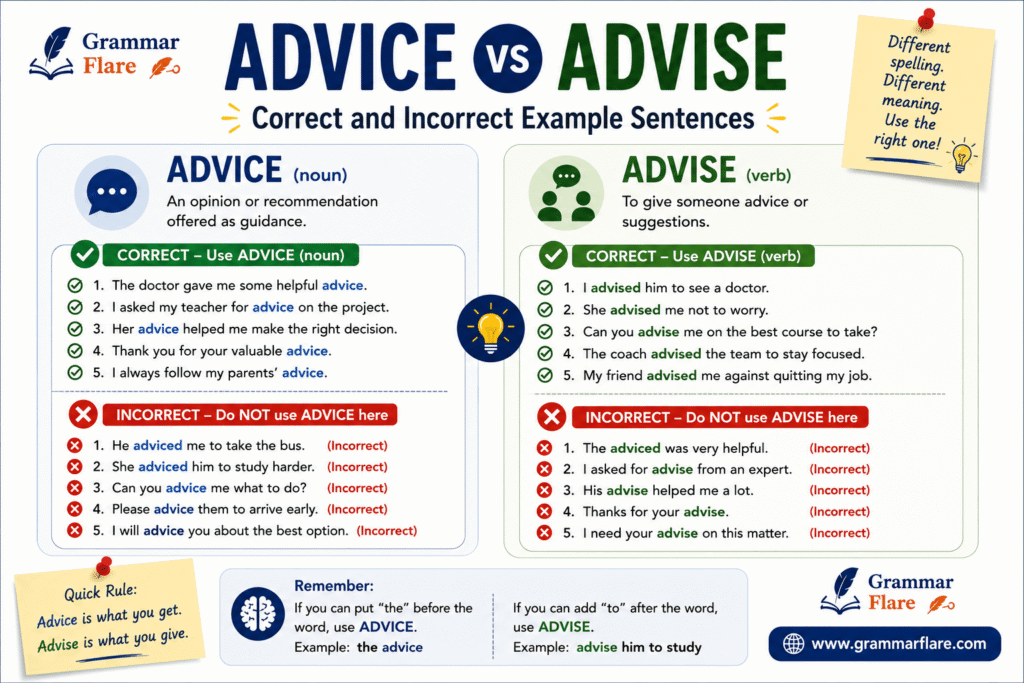
Common Advice vs Advise Mistakes
Mistake 1: Using advice as a verb
Incorrect
I advice you to wait.
Correct
I advise you to wait.
The sentence needs a verb, so use advise.
Mistake 2: Using advise as a noun
Incorrect
Thank you for your advise.
Correct
Thank you for your advice.
The word follows the possessive determiner your and names the guidance, so use the noun.
Mistake 3: Writing an advice
Incorrect
She gave me an advice.
Correct
She gave me some advice.
Also correct
She gave me a piece of advice.
Mistake 4: Making advice plural
Incorrect
He gave me several advices.
Correct
He gave me several pieces of advice.
Also correct
He gave me several suggestions.
Mistake 5: Misspelling advised
Incorrect
She adviced me to wait.
Correct
She advised me to wait.
The base verb is advise, so its past form is advised.
Mistake 6: Misspelling advising
Incorrect
He is advicing the committee.
Correct
He is advising the committee.
The final silent e is removed before adding -ing:
advise → advising
Mistake 7: Using “please advice”
Incorrect
Please advice me on the next step.
Correct
Please advise me on the next step.
You need the verb because you are asking someone to perform an action.
Mistake 8: Using vague “please advise”
Grammatically correct but vague
The file is attached. Please advise.
Clearer
The revised file is attached. Please let me know whether it is ready for submission.
The vagueness is the real problem rather than the grammar, which our guide to replacing “please advise” works through in detail.
Before-and-After Corrections
| Incorrect | Correct |
|---|---|
| Can you advice me? | Can you advise me? |
| Thank you for your advise. | Thank you for your advice. |
| She gave me an advice. | She gave me some advice. |
| He offered several advices. | He offered several pieces of advice. |
| My teacher adviced me to revise it. | My teacher advised me to revise it. |
| The lawyer is advicing the company. | The lawyer is advising the company. |
| I need you to give me an advise. | I need you to give me some advice. |
| Please advice whether this is correct. | Please advise whether this is correct. |
| Her advise was useful. | Her advice was useful. |
| I advice checking the document. | I advise checking the document. |
A Fast Advice vs Advise Test
When you are unsure, try one of these tests.
Test 1: Replace it with guidance
If guidance fits, use advice.
I need your guidance.
Therefore
I need your advice.
Test 2: Replace it with recommend
If recommend fits, use advise.
I recommend waiting.
Therefore
I advise waiting.
Test 3: Look for verb endings
If the word needs -s, -d, or -ing, use advise:
- advises
- advised
- advising
You cannot form these verbs from the noun advice.
Test 4: Check the words before it
These patterns usually require the noun advice:
- some advice
- good advice
- useful advice
- your advice
- professional advice
- a piece of advice
These patterns usually require the verb advise:
- I advise
- she advises
- they advised
- please advise
- would advise
- is advising

Easy Memory Tricks
Ice and eyes
Advice rhymes with ice.
Advise rhymes with eyes.
The c in advice has an /s/ sound. The s in advise has a /z/ sound.
Noun and verb
Think
The advice is the thing. To advise is the action.
The hidden verb test
Place to before the word
- to advise: correct
- to advice: incorrect
Because to can introduce an infinitive verb, this test helps identify advise.
The “give and do” trick
- You give advice.
- You advise someone.
If give is already the verb, use the noun advice. If the target word performs the action, use advise.
Advice vs Advise for English Learners
The pair can be difficult because the spelling difference is small and some languages use one form for both meanings.
Use this sentence frame
Person + advises + person + to do something.
Example
The teacher advised the student to study.
Then use this noun frame
Person + gives + person + advice.
Example
The teacher gave the student advice.
Both sentences express a similar idea, but their grammar differs.
Verb structure
The doctor advised me to rest.
Subject: the doctor
Verb: advised
Object: me
Infinitive phrase: to rest
Noun structure
The doctor gave me advice.
Subject: the doctor
Verb: gave
Indirect object: me
Direct object: advice
Seeing the structure makes the difference clearer than memorizing spelling alone.
Formal Meanings of Advise
In business and official communication, advise can mean inform, not only recommend.
Examples:
- We will advise you of the outcome.
- Please advise us of your new address.
- Customers were advised of the delay.
- The committee will advise the minister.
- I am writing to advise you that your application was successful.
In the last example, the writer is not necessarily offering a recommendation. The writer is formally communicating information.
Cambridge includes this formal informational meaning in its definition of advise.
Advice vs Recommendation
Advice and recommendation overlap, but they are not identical. Advice often refers broadly to guidance about what someone should do.
My teacher gave me advice about improving my writing.
A recommendation may identify a particular choice, product, action, or course:
My teacher recommended adding a stronger conclusion.
Compare
- Can you give me some advice about laptops?
- Which laptop do you recommend?
The first asks for broad guidance. The second asks for a specific choice.
Advice vs Suggestion
A suggestion is usually one possible idea. Advice may feel more personal, authoritative, or action-oriented.
- Suggestion: You could try moving the paragraph.
- Advice: I think you should revise the entire section.
However, the distinction depends on tone and context. Both words can introduce helpful ideas.
Because suggestion is countable, you can write:
- a suggestion
- two suggestions
- several suggestions
Because advice is uncountable, write:
- some advice
- a piece of advice
- several pieces of advice
Mini Quiz: Advice or Advise?
Choose the correct word.
1
My teacher gave me useful ___.
A. advice
B. advise
2
I would ___ you to check the deadline.
A. advice
B. advise
3
Can you give me a piece of ___?
A. advice
B. advise
4
The doctor ___ her to rest.
A. adviced
B. advised
5
Please ___ us of any changes.
A. advice
B. advise
6
He ignored my ___.
A. advice
B. advise
7
The counselor is ___ new students.
A. advicing
B. advising
8
She offered three helpful ___.
A. advices
B. pieces of advice
9
I ___ against signing the document immediately.
A. advice
B. advise
10
Thank you for your ___.
A. advice
B. advise
11
The notice ___ residents to remain indoors.
A. advised
B. adviced
12
Could you ___ me on the next step?
A. advice
B. advise
Quiz Answers
- A: advice — The sentence needs a noun.
- B: advise — The sentence needs a verb after would.
- A: advice — A piece of advice is the correct countable expression.
- B: advised — The past form of advise is advised.
- B: advise — The formal phrase means inform us.
- A: advice — The possessive determiner my is followed by a noun.
- B: advising — Drop the final e before adding -ing.
- B: pieces of advice — Advice is uncountable.
- B: advise — The sentence needs a verb.
- A: advice — You thank someone for the guidance you received.
- A: advised — Adviced is not a standard form.
- B: advise — The sentence asks someone to perform an action.
Frequently Asked Questions About Advice vs Advise
What is the difference between advice and advise?
Advice is a noun referring to guidance or a recommendation. Advise is a verb meaning to give guidance, make a recommendation, or formally inform someone.
Is it “please advice” or “please advise”?
Write please advise because the sentence needs a verb.
Correct
Please advise me on the next step.
Incorrect
Please advice me on the next step.
Is advice a noun or a verb?
Advice is a noun.
Her advice was helpful.
The related verb is advise
She advised me to wait.
Is advise a noun or a verb?
Advise is a verb.
I advise checking the instructions.
Use advice when you need a noun
That is good advice.
Can I say “an advice”?
Not in standard English. Advice is uncountable.
Use
- some advice
- a piece of advice
- a helpful suggestion
Can advice be plural?
Advice does not normally have a plural form. Use pieces of advice, recommendations, or suggestions when you need to count separate points.
How do Americans pronounce advice and advise?
Advice ends with an /s/ sound, while advise ends with a /z/ sound.
- advice: ad-VICE
- advise: ad-VIZE
What is the past tense of advise?
The past tense is advised.
She advised me to apply early.
Do not write adviced.
What is the -ing form of advise?
The correct form is advising.
He is advising the committee.
Drop the final e before adding -ing.
Is “please advise” rude?
It is not inherently rude, but it can sound abrupt or vague. A more specific request often sounds warmer:
Could you let me know which option you prefer?
Our guide to another way to say “please advise” covers why it reads as cold and what to write instead.
Is it “your advice” or “your advise”?
Use your advice because the possessive determiner your normally introduces a noun.
Thank you for your advice.
Is adviser or advisor correct?
Both spellings are accepted. Choose the form preferred by your organization and use it consistently.
Helpful References
The noun–verb distinction and uncountable status of advice can be verified through Cambridge Dictionary’s advice-or-advise guide. Merriam-Webster also explains that advise is the verb and advice is the noun in its usage guide.
Related Grammar Flare Guides
- Another Way to Say “Please Advise”
- Loaned or Lent
- Affect vs Effect
- Apostrophe Rules
- Commonly Confused Words
Final Takeaway
The advice vs advise distinction depends on grammar, not preference.
Use advice when you need a noun:
She gave me useful advice.
Use advise when you need a verb:
She advised me to wait.
Remember these three shortcuts:
- Advice is the guidance.
- Advise is the action.
- Advice rhymes with ice, while advise rhymes with eyes.
Also remember that advice is uncountable. Say some advice or a piece of advice, not an advice or advices.
The simplest sentence to memorize is:
When you advise someone, you give them advice.

Ahmad Waheed has spent five years editing academic and professional writing for universities, publishers, and software companies. He founded Grammar Flare after noticing the same handful of mistakes in almost every draft that crossed his desk, and that most grammar guides explained the rule without explaining when it actually matters.
Ahmad writes every guide on this site, checking usage questions against Merriam-Webster, the Chicago Manual of Style, and the AP Stylebook, and noting where those sources disagree rather than quietly picking a side.