
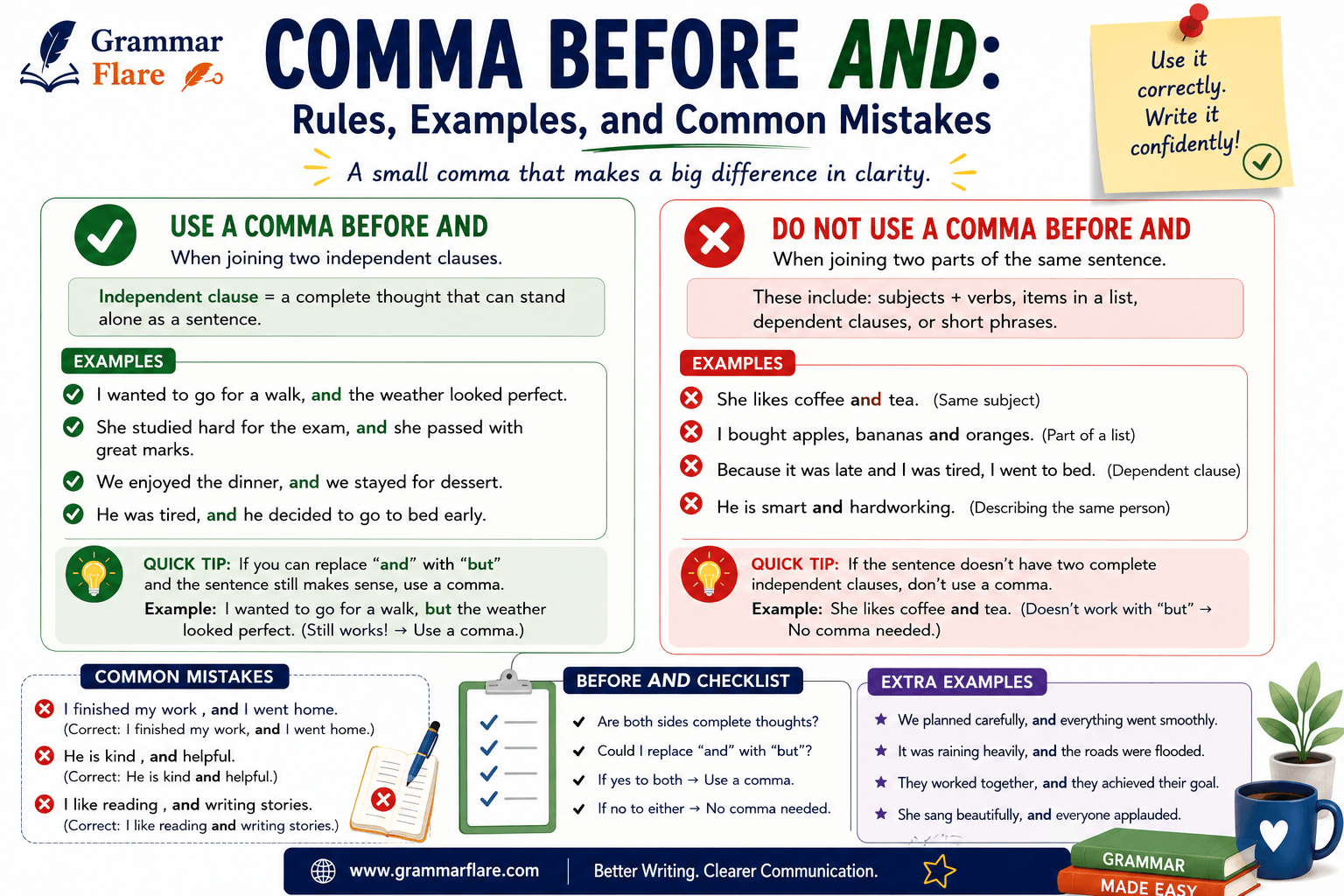
The comma before and is correct in some sentences but unnecessary in others. You usually need it when and joins two complete sentences or when it introduces the final item in a list under a style that uses the Oxford comma. You usually leave it out when and connects only words, short phrases, or two verbs that share the same subject.
That sounds manageable, but one word can completely change the punctuation.
Compare these examples
- I opened the document and checked the title.
- I opened the document, and Maya checked the title.
The first sentence has one subject performing two actions. The second has two complete thoughts, so it needs a comma.
Quick answer: Use a comma before and when it joins two independent clauses. You may also use one before the final item in a list of three or more items. Do not usually use one when and joins two words, phrases, or verbs that share the same subject.
Comma Before And at a Glance
| Situation | Use a comma? | Example |
|---|---|---|
| Two complete sentences | Yes | I finished the draft, and Maya reviewed it. |
| Two verbs with one subject | No | I finished the draft and sent it. |
| Two nouns | No | We bought pens and notebooks. |
| Two adjectives | No | The lesson was clear and useful. |
| Final item in a list | Depends on style | We bought pens, notebooks, and folders. |
| Repeated independent clauses | Usually yes | The rain stopped, and the wind weakened, and the clouds cleared. |
| Very short independent clauses | Sometimes optional in informal style | I called and she answered. |
| Contrast or possible confusion | Often helpful | She photographed the teacher, and the student. |
The Rule in One Sentence
Use a comma before and when it joins two complete sentences; leave it out when it joins smaller parts of one sentence.
This rule solves most questions about the comma before and.
Purdue OWL recommends using a comma when a coordinating conjunction, including and, joins two independent clauses. An independent clause contains a complete thought that can stand alone as a sentence.
When to Use a Comma Before And
You need a comma before and when and connects two independent clauses.
An independent clause normally contains
- a subject
- a verb
- a complete thought
Consider this sentence
I finished the article, and my editor checked the examples.
Both sides can stand alone
I finished the article.
My editor checked the examples.
Because each side is a complete sentence, place a comma before and.
More correct examples
- The sun disappeared, and the temperature dropped.
- I checked the spelling, and Maya reviewed the punctuation.
- The lesson was short, and the examples were easy to follow.
- We wanted to leave early, and our friends agreed.
- The teacher explained the rule, and the students practiced it.
- The website loaded slowly, and several images failed to appear.
- He completed the form, and she submitted the application.
- The baby fell asleep, and the room became quiet.
- I saved the document, and the computer restarted.
- The store was closing, and we still had several items to buy.
Each example contains two complete thoughts.
The same pattern appears in compound sentences. Grammar Flare’s guide to compound sentences explains how coordinating conjunctions connect independent clauses..
The Complete-Sentence Test
The easiest way to decide whether you need a comma before and is to split the sentence at and.
Start with
Ava reviewed the first draft, and Noah corrected the references.
Now test each side
- Ava reviewed the first draft.
- Noah corrected the references.
Both parts work independently. Use the comma.
Now test this sentence
Ava reviewed the first draft and corrected the references.
Split it
- Ava reviewed the first draft.
- Corrected the references.
The second part is incomplete because it has no stated subject. Do not use the comma.
This test is more reliable than listening for a pause. People pause for emphasis, breathing, or rhythm, but punctuation depends mainly on sentence structure.
The same rule governs the other coordinating conjunctions. If you want the equivalent guide for the most common of them, see when you need a comma before “but”, including the compound predicate exception that catches most writers out.
When Not to Use a Comma Before And
Do not normally use a comma before and when the conjunction joins two smaller parts of one sentence.
Those parts may be
- nouns
- verbs
- adjectives
- adverbs
- phrases
- objects
- dependent elements
And joining two nouns
- We bought coffee and tea.
- Sarah and Noah arrived early.
- The guide covers grammar and punctuation.
- Students and teachers attended the event.
No comma is necessary because and joins two nouns or noun phrases.
And joining two adjectives
- The explanation was simple and clear.
- She sounded calm and confident.
- The room was quiet and comfortable.
- His answer was brief and accurate.
A comma between two adjectives may be appropriate in other structures, but it is not needed merely because and connects them.
And joining two verbs with the same subject
- I opened the email and read the attachment.
- She checked the title and corrected the excerpt.
- The dog ran outside and barked.
- We completed the quiz and reviewed our answers.
- He saved the document and closed the program.
The subject performs both actions.
In this example
She checked the title and corrected the excerpt.
The subject she applies to both verbs:
- she checked
- she corrected
The words after and do not form a separate independent clause, so no comma is needed.
And joining two phrases
- We worked in the morning and after lunch.
- The box was under the table and beside the chair.
- She spoke with patience and without anger.
- He completed the project on time and within budget.
Again, and is joining parts of one sentence rather than two complete sentences.
One Subject With Two Verbs vs. Two Complete Clauses
This distinction causes many errors with the comma before and.
One subject and two verbs
Maya opened the file and checked the figures.
Subject: Maya
Verb 1: opened
Verb 2: checked
No comma is needed.
Two complete clauses
Maya opened the file, and Daniel checked the figures.
Clause 1: Maya opened the file.
Clause 2: Daniel checked the figures.
Use a comma.
More comparisons
| No comma | Comma needed |
|---|---|
| She wrote the introduction and edited the conclusion. | She wrote the introduction, and I edited the conclusion. |
| The dog ran outside and chased the ball. | The dog ran outside, and the children chased the ball. |
| We checked the address and sent the package. | We checked the address, and the clerk sent the package. |
| He read the instructions and completed the form. | He read the instructions, and his assistant completed the form. |
| I opened the page and found the answer. | I opened the page, and the answer appeared immediately. |
Look for a new subject after and. A new subject often signals a new independent clause, although you should still check whether the words form a complete thought.
The Comma Before And in a List
A different rule applies when and introduces the last item in a list of three or more items.
Consider
We bought notebooks, pens, and folders.
The comma after pens is called the serial comma or Oxford comma.
Without it
We bought notebooks, pens and folders.
The two major American style guides disagree. Chicago requires the serial comma in all lists. AP omits it unless the sentence would be ambiguous without it, which is why you see it in books and not in news writing. Neither is wrong. Grammar Flare recommends using it consistently, because a fixed rule produces fewer errors than a judgement call on every list.
Grammar Flare recommendation
For general American English, Grammar Flare recommends using the Oxford comma consistently:
- red, white, and blue
- grammar, punctuation, and spelling
- students, teachers, and parents
- breakfast, lunch, and dinner
The Oxford comma can make lists easier to scan and can prevent confusion.
Example with possible ambiguity
Without the Oxford comma
I would like to thank my parents, Taylor Swift and Batman.
This sentence may jokingly suggest that Taylor Swift and Batman are the writer’s parents.
With the Oxford comma
I would like to thank my parents, Taylor Swift, and Batman.
Now the sentence clearly identifies three separate people or groups.
Not every list becomes confusing without the final comma, but using it consistently gives your writing a predictable pattern.
Comma Before And With Only Two Items
Do not use an Oxford comma in a list of only two items.
Correct
- We bought pens and paper.
- She studies English and history.
- I invited Mia and Noah.
- The design is clean and modern.
Incorrect
- We bought pens, and paper.
- She studies English, and history.
- I invited Mia, and Noah.
- The design is clean, and modern.
The serial-comma rule applies to a series of three or more items, not a pair.
Comma Before And in a List of Clauses
List items can be longer than individual words.
The manager asked us to check the figures, correct the headings, and update the final paragraph.
The list contains three verb phrases
- check the figures
- correct the headings
- update the final paragraph
The Oxford comma appears before and.
Another example
We need a writer who understands grammar, an editor who notices small errors, and a designer who can create clear graphics.
The comma helps separate three long noun phrases.
When list items already contain commas, semicolons may work better:
The speakers came from Austin, Texas; Denver, Colorado; and Portland, Oregon.
For more help with semicolons, see When to Use a Semicolon.
Can You Omit the Comma Between Two Short Clauses?
You may sometimes see a short sentence such as:
I called and she answered.
Both halves are technically independent clauses:
- I called.
- She answered.
Many formal guides recommend:
I called, and she answered.
However, some editors omit the comma when the clauses are extremely short, closely connected, and unlikely to confuse the reader.
Examples sometimes written without commas include:
- I came and I saw.
- He asked and she replied.
- The door opened and we entered.
For dependable academic, business, and instructional writing, use the comma when both sides are independent clauses:
- I called, and she answered.
- He asked, and she replied.
- The door opened, and we entered.
This choice creates consistency and follows the standard compound-sentence pattern described by Purdue OWL.
When a Comma Before And Adds Clarity
Sometimes a comma helps readers understand how the sentence is grouped.
Compare
She photographed the teacher and the student.
This means she photographed two people: the teacher and the student.
Now compare
She photographed the teacher, and the student edited the images.
The comma signals that the student is the subject of a new clause.
Another example
I asked Daniel and Maya answered.
This is awkward because the reader may initially treat Daniel and Maya as a pair.
Better
I asked Daniel, and Maya answered.
The comma shows where the first clause ends.
Comma Before And With an Introductory Phrase
A sentence may contain another comma before reaching and.
After the meeting, I revised the draft and emailed the client.
The comma after meeting belongs to the introductory phrase. You do not need another comma before and because one subject performs both actions:
- I revised
- I emailed
Compare
After the meeting, I revised the draft, and Maya emailed the client.
Now the comma before and is needed because Maya emailed the client is a separate independent clause.
The two commas perform different jobs:
- The first closes the introductory phrase.
- The second separates two independent clauses.
Comma Before And With a Dependent Clause
Do not automatically add a comma merely because the material after and is long.
I stayed home and because the weather was terrible watched the movie online.
This sentence is awkward and should be revised, but the phrase beginning with because is not an independent clause.
A clearer version is
Because the weather was terrible, I stayed home and watched the movie online.
Here, and joins two verbs with the same subject:
- I stayed
- I watched
No comma before and is required.
For more on independent and dependent clauses, read What Is a Complex Sentence?.
Comma Before And With Parenthetical Information
Commas may appear around extra information even when the basic sentence would not require a comma before and.
The guide explains commas, which many writers find difficult, and provides a short quiz.
The paired commas surround the nonessential clause
which many writers find difficult
The basic sentence is
The guide explains commas and provides a short quiz.
Do not assume that every comma near and exists because of the conjunction.
Starting a Sentence With And
You can start a sentence with And when it creates a natural connection with the previous sentence.
We thought the task was finished. And then the client requested another revision.
This structure is common in conversational, creative, and informal writing. In formal writing, you may prefer to combine the ideas
We thought the task was finished, but the client requested another revision.
Starting with And does not require a comma after it automatically.
Correct
- And then we left.
- And that was the end of the discussion.
- And I still disagree.
Use a comma only when another rule calls for one
And, after several delays, the train finally arrived.
The commas surround the interrupting phrase after several delays.
Common Mistakes With the Comma Before And
Mistake 1: Adding a comma before every and
Incorrect
I opened the article, and checked the title.
Correct
I opened the article and checked the title.
One subject performs two actions, so no comma is required.
Mistake 2: Omitting the comma between independent clauses
Incorrect
I opened the article and Maya checked the title.
Correct
I opened the article, and Maya checked the title.
Both sides are complete sentences.
Mistake 3: Adding a comma in a two-item list
Incorrect
We need paper, and ink.
Correct
We need paper and ink.
Two items do not form a series requiring a serial comma.
Mistake 4: Confusing the Oxford comma with the clause comma
In this sentence
I bought apples, oranges, and bananas.
The comma before and is a serial comma.
In this sentence
I bought apples, and Maya bought oranges.
The comma separates two independent clauses.
The punctuation looks the same, but the grammatical reason is different.
Mistake 5: Following a pause instead of sentence structure
Incorrect
The lesson was useful, and clear.
Correct
The lesson was useful and clear.
A spoken pause does not automatically justify a comma.
Mistake 6: Ignoring a missing subject
Incorrect
She opened the website, and clicked the first article.
Correct
She opened the website and clicked the first article.
The words clicked the first article do not contain a stated subject.
Mistake 7: Creating a run-on sentence
Incorrect
I completed the draft and my editor reviewed it and we published it that evening.
Better
I completed the draft, my editor reviewed it, and we published it that evening.
Also possible
I completed the draft, and my editor reviewed it. We published it that evening.
Breaking a long sentence into manageable units often improves clarity.
Before-and-After Corrections
| Incorrect or awkward | Corrected |
|---|---|
| I checked the grammar, and fixed the punctuation. | I checked the grammar and fixed the punctuation. |
| The article was helpful and I bookmarked it. | The article was helpful, and I bookmarked it. |
| We bought bread, and milk. | We bought bread and milk. |
| She likes grammar punctuation and spelling. | She likes grammar, punctuation, and spelling. |
| He opened the door and Maya walked inside. | He opened the door, and Maya walked inside. |
| The answer was short, and accurate. | The answer was short and accurate. |
| I finished the lesson and I took the quiz. | I finished the lesson, and I took the quiz. |
| We invited the teachers the students and the parents. | We invited the teachers, the students, and the parents. |
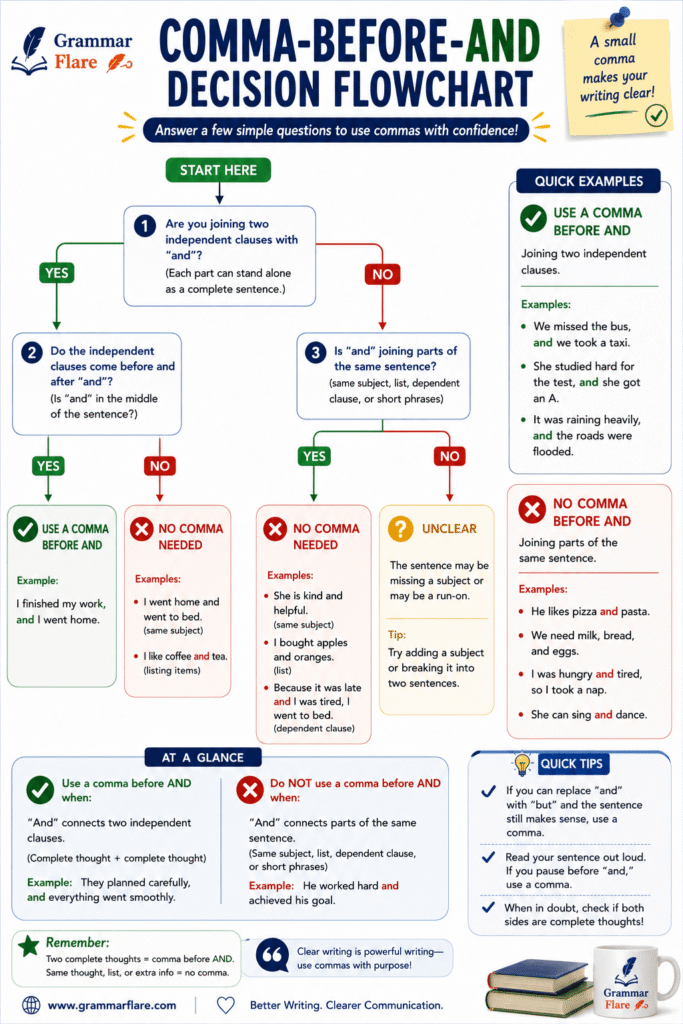
A Fast Comma Before And Checklist
Before adding the comma, ask:
- Does and join two complete sentences?
- Does each side have its own subject and verb?
- Could I replace and with a period and still have two grammatical sentences?
- Is and introducing the final item in a list of three or more?
- Am I adding the comma only because I hear a pause?
- Does the comma make the meaning clearer?
If both sides are complete sentences, use the comma.
If and joins only words, phrases, or shared verbs, leave it out.
An Easy Memory Trick
Remember this pattern:
Two complete thoughts need a comma; two connected parts do not.
Complete thoughts:
The rain stopped, and we went outside.
Connected parts:
We went outside and played soccer.
You can also remember:
Sentence + and + sentence = comma.
Word or phrase + and + word or phrase = no comma.
Comma Before And Examples by Situation
Workplace writing
- I completed the report, and my manager approved it.
- I completed the report and sent it to my manager.
- We discussed the budget, schedule, and staffing needs.
- The meeting was brief and productive.
- The client requested changes, and the design team responded quickly.
Academic writing
- The researchers collected the samples, and the laboratory analyzed them.
- The researchers collected and analyzed the samples.
- The study examined grammar, spelling, and punctuation.
- The evidence was limited but relevant.
- The first experiment failed, and the second produced clearer results.
Email writing
- I have attached the document, and Sarah will send the figures separately.
- I have attached the document and included my comments.
- Please review the title, abstract, and keywords.
- The file is complete and ready for submission.
- I checked the deadline, and we still have two days.
Everyday writing
- I made coffee, and my brother prepared breakfast.
- I made coffee and prepared breakfast.
- We bought eggs, bread, and cheese.
- The movie was long but entertaining.
- The rain stopped, and the children ran outside.
Mini Quiz: Do You Need a Comma Before And?
Choose the correctly punctuated sentence.
1
A. I opened the document, and checked the heading.
B. I opened the document and checked the heading.
2
A. I opened the document and Maya checked the heading.
B. I opened the document, and Maya checked the heading.
3
A. We bought paper, pens and folders.
B. We bought paper, pens, and folders.
C. Both may be correct depending on style.
4
A. The explanation was simple, and useful.
B. The explanation was simple and useful.
5
A. The rain stopped and we went outside.
B. The rain stopped, and we went outside.
6
A. She wrote the introduction and edited the conclusion.
B. She wrote the introduction, and edited the conclusion.
7
A. The teacher explained the rule, and the students practiced it.
B. The teacher explained the rule and the students practiced it.
8
A. We invited Mia, and Noah.
B. We invited Mia and Noah.
9
A. He saved the file, closed the program, and restarted the computer.
B. He saved the file, closed the program and restarted the computer.
C. Both may be accepted depending on style.
10
A. The room was small and comfortable.
B. The room was small, and comfortable.
Quiz Answers
- B. One subject performs both actions.
- B. Both sides are independent clauses.
- C. Both are accepted. Grammar Flare recommends the version with the serial comma.
- B. And joins two adjectives.
- B. Both sides are complete sentences.
- A. One subject performs two actions.
- A. The second part has its own subject and verb.
- B. The sentence contains only two objects.
- C. Both styles occur, although Grammar Flare recommends A.
- A. And joins two adjectives.
Frequently Asked Questions About the Comma Before And
Do you always put a comma before and?
No. Use a comma when and joins two independent clauses or, depending on style, before the final item in a list of three or more. Do not usually use one when and joins two words, phrases, adjectives, or verbs with a shared subject.
What is an example of a comma before and?
I completed the assignment, and my teacher reviewed it.
Both halves can stand alone as sentences, so the comma is correct.
Do you put a comma before and in a list?
In American English, many writers use a comma before and in a list of three or more items:
We bought apples, oranges, and bananas.
This punctuation mark is called the Oxford or serial comma. Some styles omit it unless clarity requires it.
Do you need a comma when one person performs two actions?
Usually not:
She opened the document and checked the spelling.
The subject she applies to both verbs.
Is there a comma before and when joining two sentences?
Yes. When and joins two independent clauses, place a comma before it:
I wanted to call, and she was waiting for my response.
Can I omit the comma when both clauses are short?
Some editors omit it when the clauses are extremely short and closely related. For consistent academic and professional writing, using the comma is the safer choice.
Is the comma before and the same as the Oxford comma?
Not always. A comma joining independent clauses and a comma before the final list item perform different jobs.
Clause comma:
I wrote the article, and Maya edited it.
Oxford comma:
We reviewed grammar, spelling, and punctuation.
Should I place a comma before and because the sentence is long?
Length alone does not determine the answer. Check whether and joins two complete sentences.
Is it wrong to begin a sentence with and?
No. Beginning a sentence with And can be grammatically acceptable, especially in conversational or creative writing. Use it deliberately rather than repeatedly.
Helpful References
The main clause rule in this guide follows Purdue OWL’s guidance on commas with coordinating conjunctions and its explanation of independent and dependent clauses. Purdue states that a comma is used when a coordinating conjunction joins two independent clauses.
Related Grammar Flare Guides
- Comma Before “But”: When You Need It and When You Don’t
- How to Fix a Comma Splice
- Semicolon Before “And”
- What Is an Independent Clause?
- Punctuation Rules
Final Takeaway
The comma before and becomes much easier when you stop listening for pauses and start checking sentence structure.
Use a comma when and joins two complete sentences:
I finished the article, and my editor reviewed it.
Leave the comma out when one subject performs two actions:
I finished the article and sent it.
You may also place a comma before and when it introduces the final item in a list of three or more:
We checked the grammar, spelling, and punctuation.
Remember the simplest test:
If both sides of and can stand alone as complete sentences, use the comma. If they cannot, you probably do not need it.

Ahmad Waheed has spent five years editing academic and professional writing for universities, publishers, and software companies. He founded Grammar Flare after noticing the same handful of mistakes in almost every draft that crossed his desk, and that most grammar guides explained the rule without explaining when it actually matters.
Ahmad writes every guide on this site, checking usage questions against Merriam-Webster, the Chicago Manual of Style, and the AP Stylebook, and noting where those sources disagree rather than quietly picking a side.