
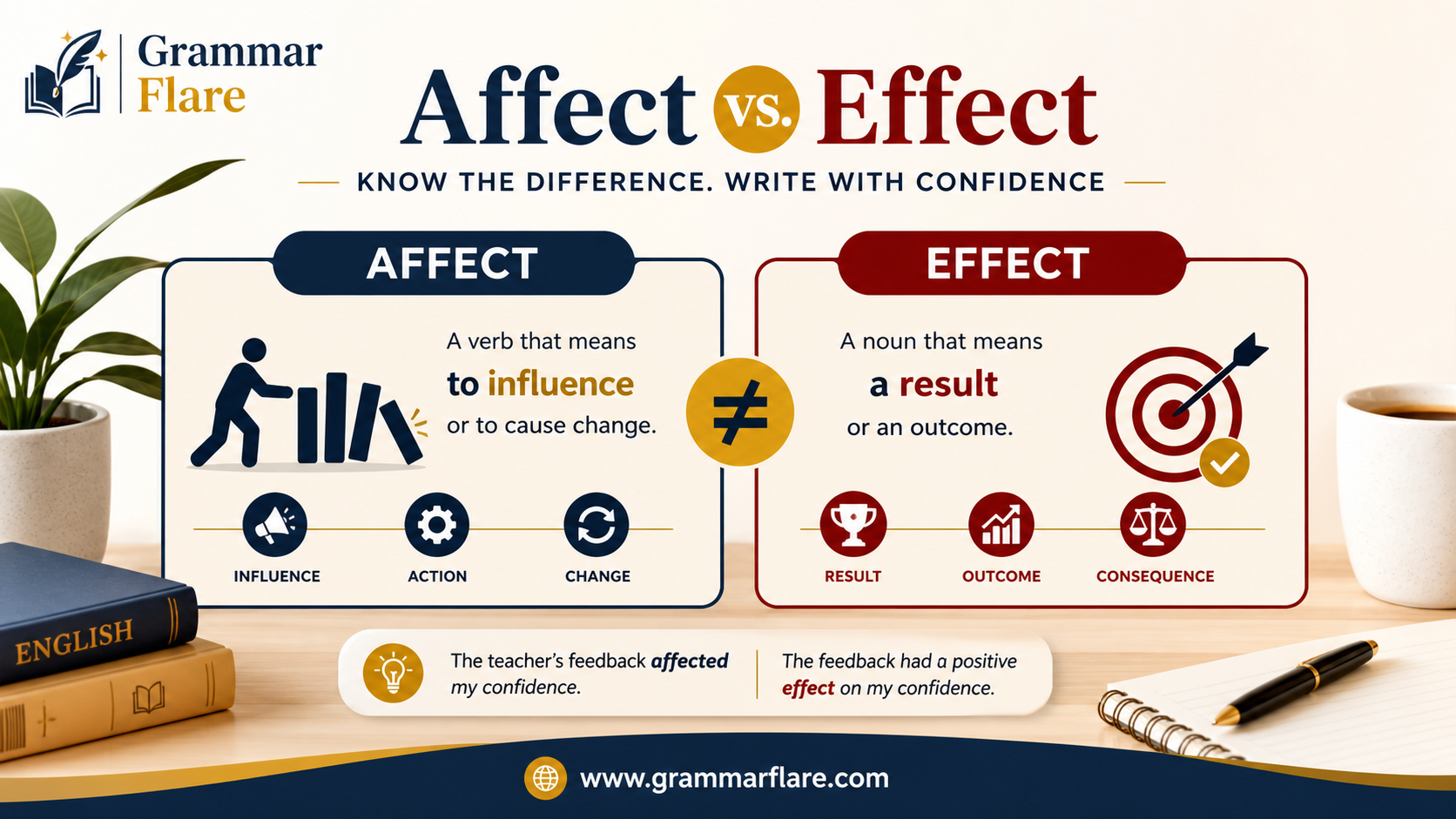
If you mix up affect vs. effect, you are not alone. These two words look similar, sound related, and often appear in the same kinds of sentences. The good news is that the difference is simple once you know the basic rule.
Quick Answer
Use affect as a verb when you mean “influence.” Use effect as a noun when you mean “result.”
Example: Lack of sleep can affect your focus. The effect is slower thinking the next day.
For most everyday writing, that one rule will give you the correct answer.
Affect vs. Effect in One Table
| Word | Usual part of speech | Usual meaning | Example |
|---|---|---|---|
| affect | Verb | to influence or change something | Stress can affect your mood. |
| effect | Noun | a result or outcome | One effect of stress is poor sleep. |
The Simple Rule in One Sentence
Affect is usually the action, and effect is usually the result.
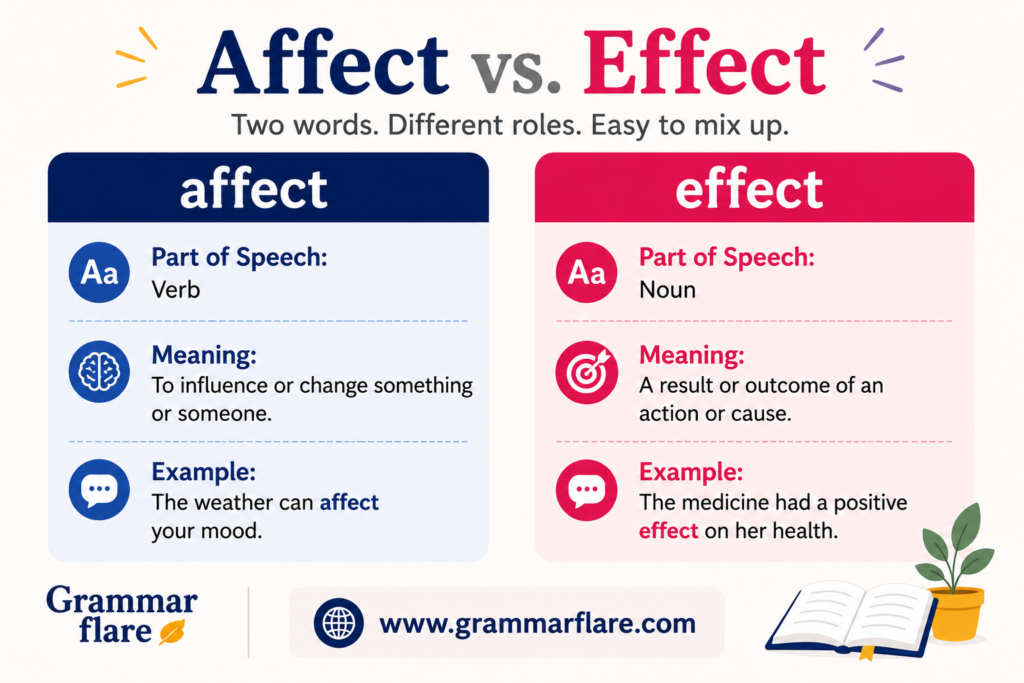
If something is changing or influencing something else, use affect. If you are naming the outcome of that change, use effect.
What Does Affect Mean?
In most grammar and writing situations, affect is a verb. It means to influence, change, or act on something.
Affect as a Verb
Use affect when one thing has an impact on another.
Examples:
- Bright light can affect your sleep schedule.
- The weather may affect our travel plans.
- Her tone of voice affected the whole conversation.
- A typo can affect how professional an email looks.
In each sentence, affect shows action. Something is influencing something else.
Rare Exception: Affect as a Noun
In psychology, affect can be a noun that refers to an observable emotional state.
Example:
- The patient showed a flat affect during the interview.
This is a real use, but it is uncommon in everyday writing. In everyday writing, affect is almost always a verb.
What Does Effect Mean?
In most cases, effect is a noun. It means a result, consequence, or outcome.
Effect as a Noun
Use effect when you are naming what happened because of something else.
Examples:
- One effect of regular practice is better writing.
- The new schedule had a positive effect on productivity.
- A short subject line can have a strong effect on email open rates.
- The medicine’s side effects were mild.
Rare Exception: Effect as a Verb
Sometimes effect is used as a verb meaning to bring about or to cause to happen.
Example:
- The board hopes to effect major changes this year.
This use is correct, but it sounds formal and is much less common than effect as a noun.
Affected, Effected, Affective, Effective
Both words change form, and the derived forms cause as much trouble as the originals.
| Form | What it is | Meaning | Example |
|---|---|---|---|
| affect | verb | to influence | Noise affects my focus. |
| effect | noun | a result | The effect was immediate. |
| affected | past tense verb | influenced | The delay affected sales. |
| effected | past tense verb | brought about | The board effected the merger. |
| effective | adjective | producing a result | An effective strategy. |
| affective | adjective | relating to emotion | An affective disorder. |
Affected or effected?
This is the trickiest pair on the page, because both are real verbs.
- The new policy affected morale. (it influenced morale, which already existed)
- The new policy effected a change in morale. (it brought the change into being)
The test: if you can substitute influenced, use affected. If you can substitute brought about, use effected. In ordinary writing you want affected almost every time.
Effective or affective?
Effective is the common one, meaning something works. Affective is a technical term in psychology and education meaning related to emotion, as in affective disorder or the affective domain of learning.
If you are not writing about psychology, you want effective.
Fixed phrases that always take “effect”
- in effect (currently operating: the rule is in effect)
- take effect (begin operating: the law takes effect in June)
- side effects
- special effects
- personal effects (belongings, an unrelated older sense)
- to that effect (with that meaning)
None of these takes affect, so if you recognise the phrase you do not need the test at all.
Affect vs. Effect Examples in Sentences
Here are side-by-side examples to make the difference easier to see.
| Meaning | Correct sentence |
|---|---|
| influence | Too much noise can affect concentration. |
| result | The effect of too much noise is lower concentration. |
| influence | Missing breakfast may affect your energy. |
| result | A common effect of missing breakfast is low energy. |
| influence | Word choice can affect how confident you sound. |
| result | The overall effect is a more professional message. |
Correct and Incorrect Examples
Correct
- Will this decision affect the budget?
- What effect will this decision have on the budget?
- Poor punctuation can affect clarity.
- The effect of poor punctuation is confusion.
Incorrect
- Will this decision effect the budget?
Use affect here because the meaning is “influence.” - What affect will this decision have?
Use effect here because the meaning is “result.”
When to Use Affect
Use affect when you can replace it with words like:
- influence
- change
- impact
- alter
Examples:
- Does music affect your focus?
- How will this rule affect students?
- The delay affected customer trust.
If the sentence needs an action word, affect is usually the right choice.
When to Use Effect
Use effect when you can replace it with words like:
- result
- outcome
- consequence
- impact as a noun
Examples:
- The long-term effect was positive.
- What was the effect of the delay?
- The policy had little effect on daily work.
If the sentence needs a thing you can name, measure, or describe, effect is usually correct.
Common Mistakes With Affect and Effect
One common mistake is choosing a word based only on how it sounds. Because affect and effect are related in meaning, writers sometimes use them interchangeably. They are not interchangeable in most sentences.
Another common mistake is forgetting to check the part of speech. Ask yourself:
- Do I need a verb here?
- Or do I need a noun here?
If you need a verb, the answer is usually affect.
If you need a noun, the answer is usually effect.
Memory Trick for Affect vs. Effect
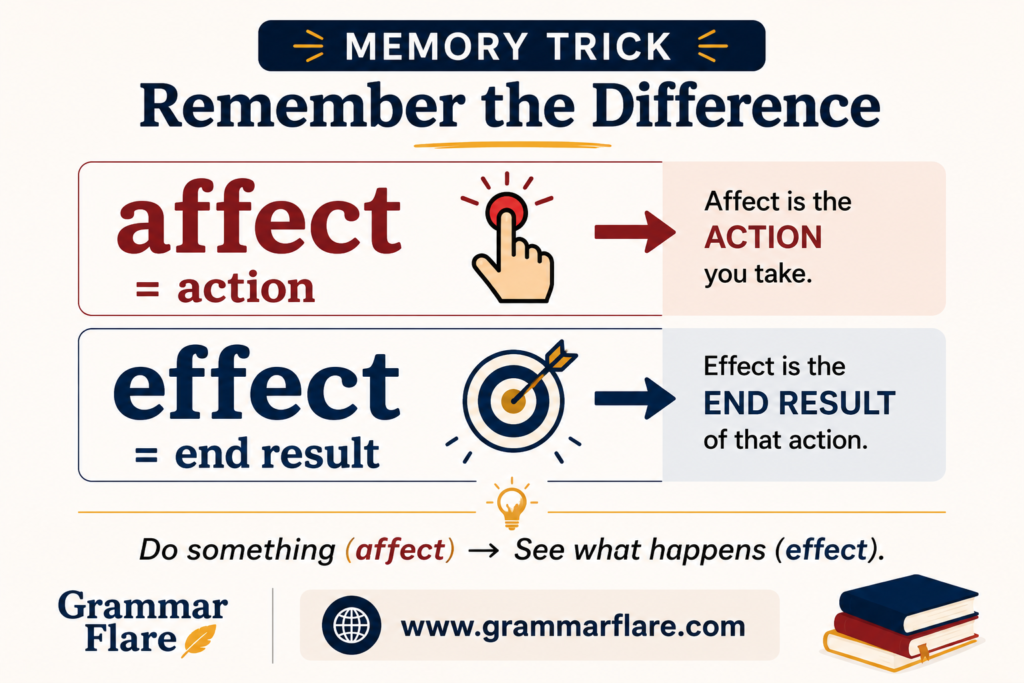
Here is the easiest memory trick:
- Affect starts with A, and so does action.
- Effect starts with E, and so does end result.
So:
- affect = action
- effect = end result
That shortcut works for most everyday grammar questions.
A 10-Second Test
If you are unsure which word to use, try this quick test.
Use Affect If:
- the word is doing the action
- you could replace it with influence
- the sentence asks what changed something
Use Effect If:
- the word names the result
- you could replace it with result or outcome
- the sentence asks what happened because of something
Affect vs. Effect in Real-Life Writing
This difference matters in more than school grammar exercises. You may need it in:
- emails
- essays
- business reports
- captions
- resumes
- cover letters
- social posts
If you write often for work, the same care applies to the words around this pair. Our guides to passed versus past and lose versus loose cover two more that spell-check will not catch.
Examples:
- Your subject line can affect whether people open your email.
- The effect of a clear subject line is a better response rate.
- The manager’s feedback affected the final draft.
- The overall effect was a stronger proposal.
American English Style Note
In standard American English, the usual rule is still:
- affect = verb
- effect = noun
Major dictionaries and usage references recognize the rare exceptions, but for everyday writing, the simple version is the one worth learning first.
For standard usage, compare Merriam-Webster’s entry for affect with Merriam-Webster’s entry for effect. If you want the psychology-specific noun meaning of affect, see the APA Dictionary of Psychology entry.
Mini Quiz: Affect or Effect?
Choose the correct word in each sentence.
- How will this change ___ the team?
- What was the main ___ of the new policy?
- Lack of sleep can ___ your memory.
- The medicine had an immediate ___.
- Did the weather ___ your plans?
Mini Quiz Answers
- affect
- effect
- affect
- effect
- affect
FAQ
Is it affect or effect most of the time?
Most of the time, affect is a verb and effect is a noun.
How do I remember affect vs. effect?
Use this memory trick: affect = action and effect = end result.
Can effect be a verb?
Yes. In formal writing, effect can mean “bring about.” Example: The new director wants to effect change. This use is correct but less common.
Can affect be a noun?
Yes. In psychology, affect can be a noun that refers to an emotional expression or state. This use is uncommon in everyday writing.
What is the easiest way to choose between affect and effect?
Check the job the word is doing in the sentence. If you need an action word, use affect. If you need a result, use effect.
Which is correct: affect change or effect change?
Both can be correct, but they mean different things. Affect change means to influence change. Effect change means to make change happen.
Is it “affected” or “effected”?
Usually affected, meaning influenced. Effected means brought about and is much rarer: the board effected a merger.
Is it “effective” or “affective”?
Effective means it works. Affective means related to emotion and appears mainly in psychology, as in affective disorder.
Sources
More Reading at GrammarFlare

Ahmad Waheed has spent five years editing academic and professional writing for universities, publishers, and software companies. He founded Grammar Flare after noticing the same handful of mistakes in almost every draft that crossed his desk, and that most grammar guides explained the rule without explaining when it actually matters.
Ahmad writes every guide on this site, checking usage questions against Merriam-Webster, the Chicago Manual of Style, and the AP Stylebook, and noting where those sources disagree rather than quietly picking a side.