

Instead of “as per my last email,” repeat the information itself: To recap, the deadline is the 14th and I need the signed copy before then. The phrase has a reputation because it points at the reader’s failure to read rather than at the thing you actually need, and it does this while sounding neutral, which is what makes it land as a rebuke.
This guide gives you 30 alternatives sorted by what you are actually trying to do, along with a note on whether “as per” is even correct English.
Quick Answer
The best replacement for as per my last email depends on your goal:
- Just need them to have the information? Repeat it. To recap, the deadline is the 14th.
- Need to point back without blame? Date it. As I mentioned on 12 March.
- Need a written record? Say so plainly. For the record, I sent the contract on 3 June.
- Genuinely escalating? Escalate openly. This is now blocking the launch.
The phrase reads as passive-aggressive because it does none of these directly. It gestures at a previous message and leaves the reader to work out both what you need and how annoyed you are.
Best Alternatives in One Table
| Alternative | Best use | Tone | Example |
|---|---|---|---|
| To recap, | repeating information | neutral | To recap, the deadline is the 14th. |
| As I mentioned on [date], | pointing back politely | factual | As I mentioned on 12 March, the quote expires at month end. |
| Repeating the key detail here: | saving them a scroll | helpful | Repeating the key detail here: the invoice number is 2041. |
| Following up on my note from [date], | first chase | neutral | Following up on my note from Tuesday. |
| Copying the relevant part below: | long threads | practical | Copying the relevant part below so it’s easier to find. |
| You may have already seen this, but | generous framing | soft | You may have already seen this, but the schedule changed. |
| For the record, I sent [X] on [date]. | building a paper trail | formal | For the record, I sent the signed copy on 3 June. |
| To summarise where things stand: | messy threads | organised | To summarise where things stand: two items are outstanding. |
| I want to flag that this is now blocking [X]. | genuine escalation | direct | I want to flag that this is now blocking the launch. |
| I need a response by [date] to keep [X] on track. | deadline at risk | clear | I need a response by Thursday to keep the launch on track. |
| Adding [name] for visibility. | widening the thread | procedural | Adding Sara for visibility on the timeline. |
| Bumping this one back up. | informal internal | light | Bumping this one back up before it disappears. |
| I don’t think I explained this clearly. Trying again: | your fault | accountable | I don’t think I explained this clearly. Trying again: I need two signatures, not one. |
| Short version: | your original was long | efficient | Short version: yes to the date, no to the venue. |
| Going back to my earlier email, | neutral reference | mild | Going back to my earlier email, the second option is still open. |
Why “As Per My Last Email” Reads as Passive-Aggressive
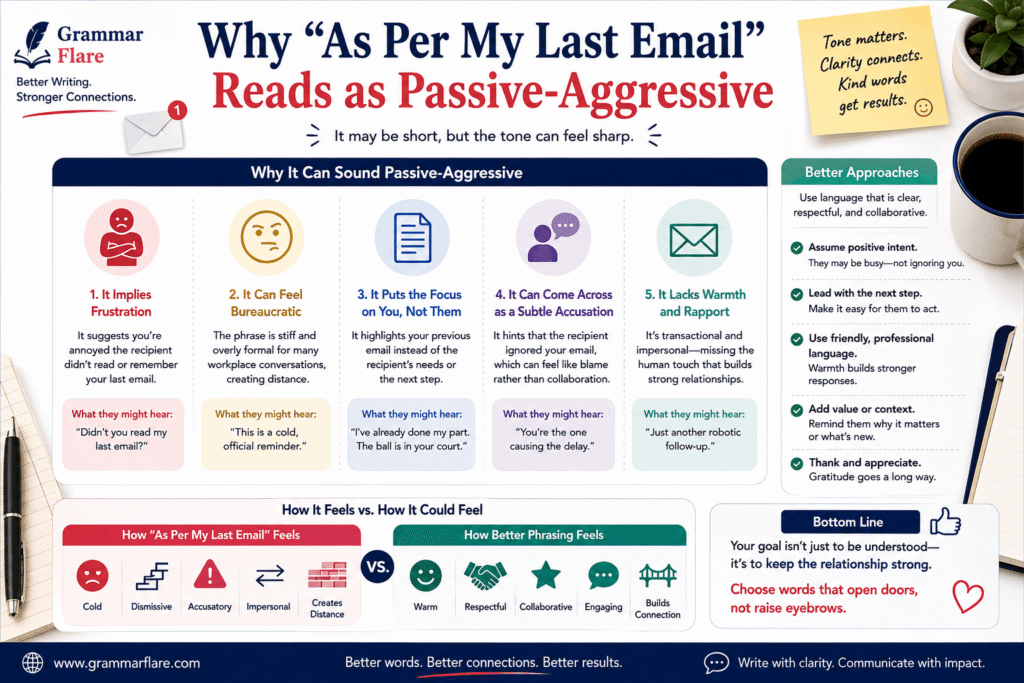
The phrase is not rude on its face. Every word in it is neutral. The problem is what it does structurally.
It points at a failure rather than a need. The subject of the sentence is your previous email, not the thing you want. That framing puts the reader’s conduct at the centre of the message before you have asked for anything.
It says “you didn’t read this” without saying it. Because the criticism is implied rather than stated, the reader cannot respond to it directly. They can only absorb it. Implied criticism is harder to answer than direct criticism, which is precisely why it registers as passive-aggressive.
It makes the reader do the work twice. They have to find the old email, read it again, and work out which part you meant. If you simply repeated the information, they would be answering you instead of searching their inbox.
The formality does the damage. As per is stiffer than anything else in a normal email. That sudden shift in register signals displeasure more clearly than the words do. It is the written equivalent of someone using your full name.
Every alternative below fixes at least one of these. The principle underneath all of them: say the thing, not that you already said the thing.
Is “As Per” Even Correct?
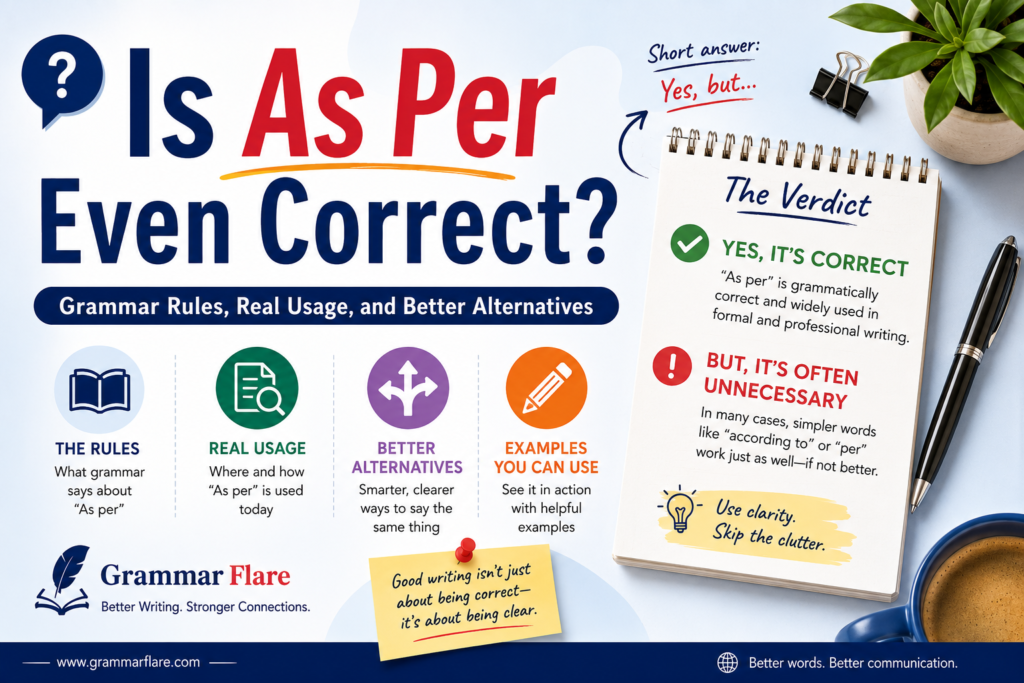
Worth answering, because it is a separate question from whether the phrase is tactful.
Per comes from Latin, meaning “through” or “by means of,” and has been used in English commercial writing for centuries: per annum, per capita, as per usual. As per has been in use since at least the nineteenth century and appears in ordinary business correspondence throughout that period, so it is not a recent corruption.
Usage authorities split on it. Dictionaries such as Merriam-Webster record as per as established in commercial English without labelling it an error. Style and usage guides aimed at working writers, including Garner’s Modern English Usage, treat it as tired business jargon and recommend cutting as or replacing the phrase entirely, on the grounds that as adds nothing that per has not already supplied.
Where that leaves you:
- It is not a grammatical mistake. Nobody can correct you for writing it.
- It is widely disliked stylistically, and in most contexts per alone or according to is cleaner.
- In email specifically, the tone problem outweighs the usage question. Even the tidiest version, per my last email, carries the same implication.
If you want the shortest defensible form, use per. If you want your reader to stay on side, use one of the alternatives below instead.
30 Better Ways to Say “As Per My Last Email”
When you just need them to have the information
The most effective fix in most cases. Skip the reference and supply the content.
1. To recap,
Signals a summary without assigning blame for why one is needed.
To recap, the deadline is the 14th and I need the signed copy before then.
2. Repeating the key detail here for convenience:
The phrase “for convenience” frames the repetition as a service rather than a correction.
Repeating the key detail here for convenience: the invoice number is 2041.
3. Sharing this again in case it got lost in the thread.
Attributes the gap to the thread rather than the reader, which is usually accurate and always diplomatic.
Sharing this again in case it got lost in the thread. The venue needs confirming by Friday.
4. Copying the relevant part below:
Useful in long threads. Quote the two or three lines that matter and nothing else.
Copying the relevant part below so you don’t have to hunt for it.
5. Here it is again for easy reference:
Plain and functional. Works in almost any register.
Here it is again for easy reference: two signatures, both on page four.
6. Pulling this up so it’s easier to find:
Slightly warmer than the previous option and useful with senior recipients.
Pulling this up so it’s easier to find. The figures are in the second attachment.
7. Short version:
Best when your original email was long and the ask was buried. It quietly acknowledges that as the reason.
Short version: yes to the date, no to the venue.
When you want to point back without blame
Sometimes the reference genuinely matters, usually because a date or a sequence is relevant. Anchor it to a date rather than to their reading.
8. As I mentioned on [date],
The date does the work that as per my last email was trying to do, without the implied reproach.
As I mentioned on 12 March, the quote expires at the end of the month.
9. Following up on my note from [date],
Standard, neutral, and appropriate for a first chase.
Following up on my note from Tuesday about the vendor contract.
10. Going back to my earlier email,
Slightly softer than naming a date, and useful when the exact date is not the point.
Going back to my earlier email, the second option is still open if it helps.
11. Referring to the message I sent on [date],
More formal. Suitable for client correspondence and anything semi-official.
Referring to the message I sent on 3 June, the terms have not changed.
12. In my earlier email I mentioned [X].
States the fact and moves on. The lack of any framing around it is what keeps it neutral.
In my earlier email I mentioned that the licence renews automatically.
13. You may have already seen this, but
Assumes good faith explicitly. Costs you nothing and removes the sting entirely.
You may have already seen this, but the schedule changed on Monday.
When you need a written record
A legitimate reason people reach for the phrase. If the real goal is a documented timeline, document it openly rather than implying it.
14. For the record, I sent [X] on [date].
Says what you are doing. Clearer than an implication, and easier to defend later.
For the record, I sent the signed copy on 3 June.
15. Confirming in writing that [X] was sent on [date].
Formal and unambiguous. Appropriate where a contract or payment is involved.
Confirming in writing that the invoice was issued on 3 June and is now past due.
16. Documenting the timeline here:
Useful when several dates matter and you want them in one place.
Documenting the timeline here: quote sent 3 June, approved 10 June, no response since.
17. To summarise where things stand:
Neutral framing for a status recap. It reads as organisation rather than accusation.
To summarise where things stand: two items are outstanding and both sit with your team.
18. For clarity on the sequence of events:
More formal again. Reserve it for disputes and escalations, where the sequence genuinely is the issue.
For clarity on the sequence of events: the change was requested after the design was signed off.
When you are genuinely escalating
If you are annoyed and the situation warrants it, escalate openly. A clear escalation is easier to respond to than a passive one, and it damages the relationship less.
19. I want to flag that this is now blocking [X].
States the consequence rather than the grievance. Consequences get answered.
I want to flag that this is now blocking the launch.
20. This is the third time I’ve raised this, so I want to make sure it’s on your radar.
Factual about the repetition without editorialising on it.
This is the third time I’ve raised this, so I want to make sure it’s on your radar.
21. I need a response by [date] to keep [X] on track.
Attaches the request to a deadline and a consequence, which is what makes it actionable.
I need a response by Thursday to keep the launch on track.
22. I’m going to [action] if I don’t hear back by [date].
Only use this if you will actually do it. An unfulfilled threat costs more than it gains.
I’m going to proceed with the original spec if I don’t hear back by Friday.
23. This has now missed its deadline. Here’s where we are:
Plain statement of fact followed by a summary. Difficult to argue with.
This has now missed its deadline. Here’s where we are: the design is complete, the copy is not.
24. Adding [name] to this thread for visibility.
A real escalation. Say you are doing it rather than adding someone silently, which is read as going over their head.
Adding Sara to this thread for visibility on the timeline.
If you are on a second or third attempt and not yet escalating, the tone should shift gradually rather than jumping. Our guide to another way to say “just checking in” covers how each stage of a follow-up sequence should differ.
Casual and internal
25. Reposting this so it doesn’t get lost.
Light and unbothered. Right for chat and internal threads.
Reposting this so it doesn’t get lost in the standup notes.
26. Bumping this one back up.
Short, informal, and carries no edge.
Bumping this one back up before it disappears again.
27. Copying the ask here so it’s easier to find.
Practical framing that quietly acknowledges long threads are hard to navigate.
Copying the ask here so it’s easier to find: I need the copy by Wednesday.
When you were unclear the first time
Worth considering before sending any of the above. If the first email was long, buried the ask, or mixed three requests together, the silence may be yours to fix.
28. I don’t think I explained this clearly. Trying again:
Takes the blame and resets the conversation. Costs nothing and usually gets a fast reply.
I don’t think I explained this clearly. Trying again: I need two signatures, not one.
29. My earlier email buried the ask. Here it is plainly:
Specific about what went wrong, which makes it read as honest rather than performatively humble.
My earlier email buried the ask. Here it is plainly: can we move the review to Wednesday?
30. That was probably too long. Short version:
Light, self-aware, and effective with busy recipients.
That was probably too long. Short version: approve the budget or tell me what to cut.
Which Alternative to Use, by Situation
They missed one detail in a long email
Do not reference the email at all. Supply the detail.
Quick one: the deadline is the 14th, not the 24th. Everything else is unchanged.
They appear not to have read the email at all
Assume the thread, not the reader. Then repeat the ask in a single sentence.
Sharing this again in case it got lost in the thread. The one thing I need is a yes or no on the venue by Friday.
Third time asking
Stop softening. Name the number and attach a consequence, which gives them something concrete to respond to.
This is the third time I’ve raised this, so I want to make sure it’s on your radar. I need a decision by Thursday or we lose the booking.
Writing to a client
Never use the original phrase with a client. Anchor to a date and keep the tone administrative.
As I mentioned on 12 March, the quote expires at the end of the month. Happy to extend it if that helps.
Writing to your manager
Frame it as unblocking rather than reminding. Senior recipients respond better to being asked what they need.
Do you need anything from me before you can sign this off? Happy to pull the figures into another format.
Writing to a colleague at your level
Keep it light. Internal threads can absorb informality that client email cannot.
Bumping this one back up. Did you get a chance to look at the copy?
You need a paper trail for a dispute
Say so openly. Implied documentation is weaker than stated documentation, and it reads worse.
For clarity on the sequence of events: the change was requested on 14 June, after the design was signed off on 10 June.
You are annoyed
Wait. Almost every genuinely passive-aggressive email is a message that should have been sent an hour later. If you cannot wait, write the version you want to send, delete it, and send the factual one.
This has now missed its deadline. Here’s where we are, and here’s what I need to move it forward.
It was actually your fault
Say so. It resets the exchange faster than anything else on this page.
I don’t think I explained this clearly. Trying again: I need two signatures, not one, and both on page four.
Phrases to Avoid
“Per my last email.” The shortened form has the same problem. Trimming as fixes the usage objection, not the tone.
“As I already said.” Already makes the criticism explicit, which is worse rather than more honest.
“Just to reiterate.” Reiterate means to say again, so the word itself points at the repetition. To recap does the same job without the edge.
“As previously discussed.” Fine in a contract, cold in an email. It reads as though you are preparing evidence.
“I’ll say it again.” Openly exasperated. If you feel this way, escalate properly instead.
“Kindly refer to my previous email.” Formal, distant, and it asks the reader to go and do homework.
“See below.” Not hostile, but it makes the reader hunt. Quote the relevant lines instead.
One Test Before You Send
Read your message and ask: would this sentence survive being forwarded?
Passive-aggressive email is dangerous because it is deniable in the moment and damning in a thread. If the line would look bad quoted back to you, or shown to your recipient’s manager, rewrite it as a plain statement of what you need and by when. That version is almost always shorter, and it gets answered faster.
FAQ
What can I say instead of “as per my last email”?
Repeat the information rather than the reference: To recap, the deadline is the 14th. If the date genuinely matters, anchor to it instead: As I mentioned on 12 March.
Is “as per my last email” rude?
Not literally, and most people who use it do not intend rudeness. It reads as rude because it centres the reader’s failure to read rather than the thing you need, and because the sudden formality signals displeasure.
Is “as per” grammatically correct?
Yes. It has been used in commercial English since at least the nineteenth century and dictionaries record it as established. Many usage guides consider it redundant and recommend per or according to, but that is a stylistic objection rather than a grammatical one.
What is the difference between “per” and “as per”?
Per means “by” or “through” and is sufficient on its own. As per adds a comparative word that most usage guides consider unnecessary. Both are understood identically, so the choice is stylistic.
Is it ever fine to use “as per my last email”?
In a formal record, a contract dispute, or a message intended to document a timeline, it is defensible. Even then, for the record, I sent X on [date] is clearer and less loaded.
How do I chase someone without sounding annoyed?
Give them something concrete: the information itself, a deadline, or an easy way to say no. Annoyance is usually read in the vagueness rather than the words, because a vague chase asks the reader to guess what you want.
What if they genuinely never replied?
Escalate openly rather than hinting. This is the third time I’ve raised this, and I need a decision by Thursday is direct and easier to respond to than another polite nudge.
Should I use “as per our conversation”?
The same objection applies, though less strongly, because a conversation is a shared event rather than something the reader failed to read. Following up on our call on Tuesday is cleaner.
How do I write it if I need a record for legal or contractual reasons?
State plainly what was sent and when: Confirming in writing that the invoice was issued on 3 June and is now past due. Documentation should be explicit, not implied.
Is “as per my last email” a British or American phrase?
It appears in both, and it is common in Indian, Pakistani, and Australian business English as well. The tone problem travels across all of them.
What should I do if someone sends it to me?
Answer the substance and ignore the tone. Responding to the implication rather than the request escalates a thread that is usually salvageable.
What if my email really was too long to read?
Then that is the thing to fix. That was probably too long. Short version: takes the blame and gets a faster reply than any amount of chasing.
Short Answers for Quick Reference
- Best all-purpose alternative: To recap, followed by the information itself.
- Best when the date matters: As I mentioned on [date],
- Best for a written record: For the record, I sent [X] on [date].
- Best when escalating: I want to flag that this is now blocking [X].
- Best when it was your fault: I don’t think I explained this clearly. Trying again:
- Is “as per” correct? Yes, though most usage guides prefer per or according to.
- The rule underneath all of it: Say the thing, not that you already said the thing.
More Reading at GrammarFlare
- Another Way to Say “Just Checking In”
- Another Way to Say “Sorry for the Late Reply”
- Another Way to Say “Please Advise”
- Another Way to Say “I Hope You Are Doing Well”
- Professional Ways to Say “Please Let Me Know”
- The Importance of Tone in Conversation
Sources

Ahmad Waheed has spent five years editing academic and professional writing for universities, publishers, and software companies. He founded Grammar Flare after noticing the same handful of mistakes in almost every draft that crossed his desk, and that most grammar guides explained the rule without explaining when it actually matters.
Ahmad writes every guide on this site, checking usage questions against Merriam-Webster, the Chicago Manual of Style, and the AP Stylebook, and noting where those sources disagree rather than quietly picking a side.