

To disagree with your boss well, first work out whether you have information they don’t or simply a different judgment on the same facts. Those need opposite approaches, and confusing them is why most pushback fails. If you have information, supply it and let it do the work. If you have a different judgment, you are asking someone to change their mind, which is a much larger request and needs to be made carefully.
This guide gives you 25 scripts sorted by situation, plus how grammar itself does most of the softening.
Quick Answer
Before you say anything, answer one question: do I know something they don’t, or do I just see it differently?
- You have information they lack. Supply it neutrally and let the facts argue. There’s a figure in the Q3 report that might change this.
- You have the same information, different judgment. Ask for permission to make the case. Can I offer a different read on this?
- You are disagreeing in front of others. Frame it as stress-testing, not opposition. Can I push on that a little?
- The decision is already made. Register the concern once, then commit. I still think we should have gone the other way, but it’s your call and I’ll make it work.
The most common mistake is using judgment language when you actually have information, which makes a fact sound like an opinion and invites an argument you did not need to have.
The Distinction That Changes Everything
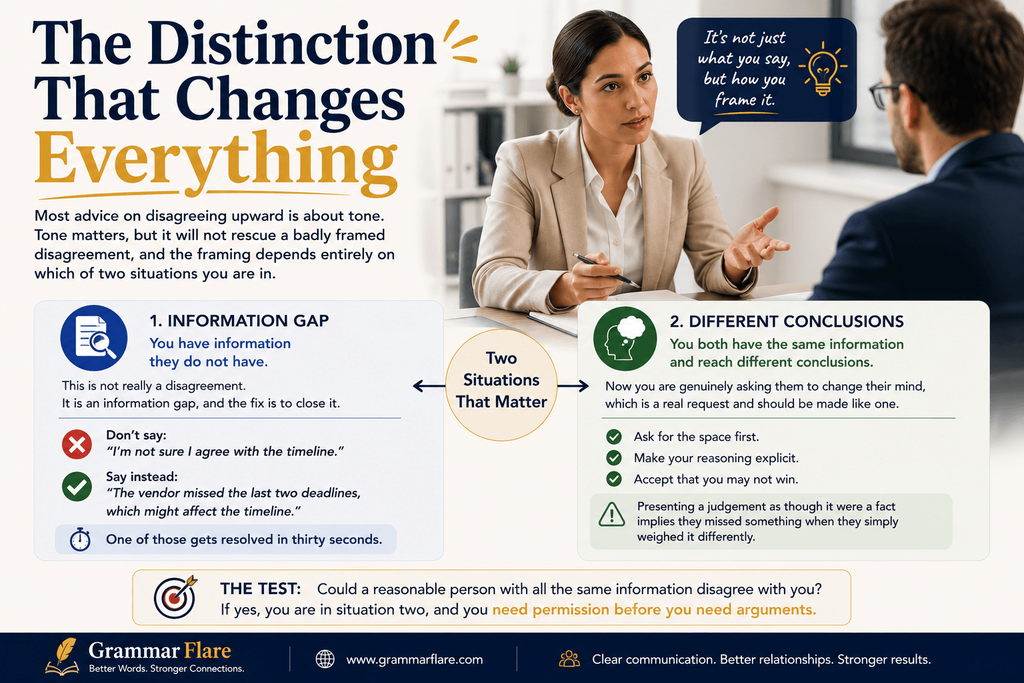
Most advice on disagreeing upward is about tone. Tone matters, but it will not rescue a badly framed disagreement, and the framing depends entirely on which of two situations you are in.
Situation one: you have information they do not have. You saw a client email they were not copied on. You know the vendor missed the last two deadlines. You ran the numbers and they came out differently.
This is not really a disagreement. It is an information gap, and the fix is to close it. The mistake is dressing it up as an opinion, because I’m not sure I agree with the timeline invites a debate, whereas the vendor missed the last two deadlines, which might affect the timeline invites a recalculation. One of those gets resolved in thirty seconds.
Situation two: you both have the same information and reach different conclusions. They have seen the numbers. They have read the emails. They have weighed it and come out somewhere you would not.
Now you are genuinely asking them to change their mind, which is a real request and should be made like one. Ask for the space first, make the reasoning explicit, and accept that you may not win. Presenting a judgment as though it were a fact is what makes this go wrong, because it implies they missed something when they simply weighed it differently.
The test: could a reasonable person with all the same information disagree with you? If yes, you are in situation two, and you need permission before you need arguments.
Four Questions Before You Disagree
Worth thirty seconds, and they change what you say.
| Question | Why it matters |
|---|---|
| Is this decision reversible? | Reversible decisions rarely justify a fight. Save your capital. |
| Have I disagreed with this person recently? | Disagreements are read cumulatively, like declines. |
| Am I the right person to raise this? | If someone closer to the work agrees, they may carry it better. |
| What do I want to happen? | A decision reversed, a concern recorded, or a risk shared. These need different conversations. |
That last one is the most useful. A great deal of workplace pushback is really a request to have a concern noted, not a request to change course, and saying which you want makes the conversation shorter and less tense.
25 Scripts for Disagreeing With Your Boss
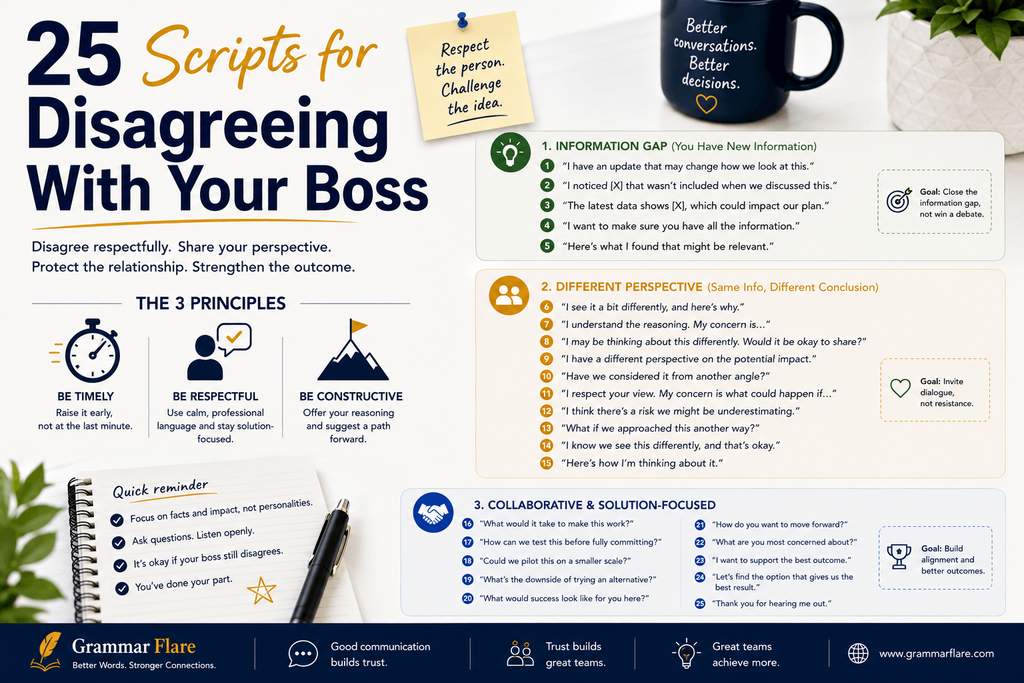
When you have information they don’t
Keep these neutral. The facts are doing the work, and any editorial framing weakens them.
1. Flagging something they may not have seen
There’s something you may not have seen before this gets locked in. The client raised the same concern in an email on Tuesday.
2. Offering a data point rather than an argument
One number before we commit: the last two vendor deliveries ran nine and eleven days late. That may change how we phase this.
3. When you think the numbers say something different
I may have this wrong, but when I ran it the margin came out at eleven percent rather than eighteen. Could we check which of us has the right figures?
4. When new information has arrived since the decision
This may not change anything, but the situation shifted this morning and I wanted you to have it before the meeting.
When you have the same information and a different view
Ask for the space before you use it. A request to disagree is much easier to grant than a disagreement is to receive.
5. Asking permission to make the case
Can I offer a different read on this? I might be wrong, but I’d rather say it now than after we’ve committed.
6. Naming the trade-off you would weigh differently
I’d weigh that trade-off the other way, mainly because I think the reputational cost outlasts the saving. Happy to be talked out of it.
7. Disagreeing without claiming certainty
I’m not sure I agree, though I may be missing context. My concern is that the timeline assumes nothing slips, and something usually does.
8. Asking for their reasoning first
What’s the thinking behind starting with the larger region? My instinct was the opposite, so I suspect I’m missing something.
This is often the most effective script on the page, because it frequently resolves without any disagreement at all.
9. Disagreeing with the process rather than the decision
I’m fine with where we landed. I’d like us to have heard from the support team before we finalize, since they’ll carry most of it.
When you’re disagreeing in front of other people
The rules change here. Public disagreement carries a status cost that private disagreement does not, so frame it as testing rather than opposing.
10. Framing it as stress-testing
Can I push on that a little? Not because I disagree with where we’re heading, but I want to make sure it survives contact.
11. Taking the other side explicitly
Let me argue the other side for a minute, just so we’ve heard it.
Naming it as an exercise gives everyone, including your boss, a way to engage without anyone losing face.
12. Raising a risk without blocking the room
I’ve got one concern I don’t want to derail this with. Could I put it in writing after and we pick it up separately?
13. Deferring to a private conversation
I think I see this differently, but it’s probably not a group conversation. Can I grab ten minutes with you after?
Almost always the right move if the disagreement is substantial. Serious pushback lands better in private, and offering to take it offline is itself a signal of good judgment.
When you’re disagreeing in writing
Written disagreement is permanent, forwardable, and read without your tone. Be shorter and plainer than you would be in person.
14. Leading with the concern
One concern before this goes out: the schedule assumes the legal review takes three days, and it has taken eight on the last two projects.
15. Separating agreement from disagreement
Agreed on the first two points. On the third I have a different view, which I’ve set out below.
Explicitly conceding what you agree with makes the disagreement narrower and much easier to accept.
16. Offering to move it off email
I’ve got a different read on the second point. Probably faster to talk it through than to write it out. Do you have ten minutes tomorrow?
17. Making the reasoning visible
Two things I’d change, and my reasoning for each, so you can tell me where the reasoning breaks down.
When the decision has already been made
18. Disagreeing and committing
Understood. I’m not fully convinced, but the call is yours and I’ll get properly behind it.
Saying you are not convinced and committing anyway is more credible than pretending to be persuaded, and it costs nothing.
19. Putting a concern on record without relitigating
Can I put one concern on record and then drop it? I want it written down, not reopened.
20. Asking what would change the decision
Is there anything that would cause us to revisit this? I’d rather know what to watch for than raise it again for no reason.
Turns a lost argument into a monitoring arrangement, which is often what you actually wanted.
21. Accepting it cleanly
That’s fair. I’d have gone the other way, but I can see the case. Let’s go.
When the stakes are genuinely high
Reserve these. Their force comes from being rare.
22. Signaling seriousness before you start
I want to raise something serious, and I’d rather do it now than after. Do you have fifteen minutes today?
23. Naming an unpriced risk
I think this carries a risk we haven’t priced in, and I’d rather be wrong in a meeting than right in three months.
24. Quantifying what being right would cost
If I’m right about this, it costs us the Q4 renewal. That seems worth ten minutes.
25. Saying it plainly
I need to say this clearly, because I don’t want to be ambiguous: I don’t think we should do this. Here’s why, and then I’ll leave it with you.
Directness at this level works precisely because everything else on this page is softer. If every disagreement sounds like this, none of them do.
The Grammar of Disagreement
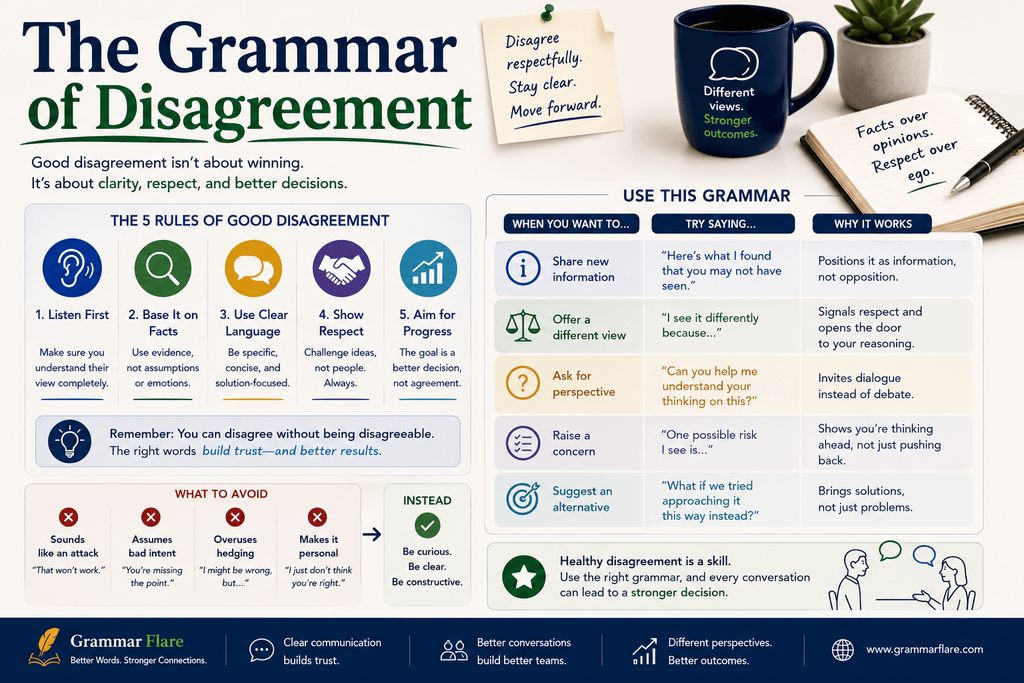
Most of the softening in these scripts is done by grammar rather than by vocabulary. Knowing which structures do the work lets you adjust the strength of a sentence deliberately instead of by feel.
Modal verbs set the temperature. Might, could, and may leave room for you to be wrong. Will, must, and won’t close that room.
This won’t work.
This might not work.
Same objection, entirely different reception. The second invites a reply. The first invites a defence.
Hedges buy you room, but only one at a time. I think, it seems, as far as I can tell, and I may be wrong all signal that you hold the view provisionally. Used once, this is confidence. Used repeatedly, it collapses.
I might be wrong, but I sort of think that maybe this could possibly be a problem.
I may be wrong, but I think this is a problem.
One hedge protects you. Four make you sound like you do not believe your own point, and a listener will believe you rather than argue.
Conditionals describe a scenario instead of making an accusation. Framing your objection as a hypothetical lets the other person examine it without defending themselves.
The timeline is too tight.
If legal takes as long as last time, we’d be a week over.
The second is harder to dismiss, because it is a description of a possible world rather than a verdict on their plan.
The passive voice can remove the accused, which is occasionally useful upward.
You’ve underestimated the review time.
The review time may have been underestimated.
The second removes the person from the sentence entirely. Use it sparingly. Overused, the passive voice reads as evasive, and a boss who notices you are avoiding the subject of the sentence will wonder why.
“But” deletes the sentence before it. Anything preceding but is heard as throat-clearing.
I think the strategy is right, but the timeline is impossible.
I think the strategy is right. My concern is the timeline.
Splitting the sentence lets the agreement survive.
“I don’t agree” is slightly softer than “I disagree.” Negating agreement is marginally less confrontational than asserting opposition, since it describes your position rather than declaring a conflict. The difference is small, but in a tense room small differences are what you have.
In Writing or In Person?
| Situation | Better channel | Why |
|---|---|---|
| You have information they lack | Writing | Facts survive being forwarded; no tone to misread |
| You have a different judgment | In person | Judgment needs back-and-forth to land |
| The disagreement is minor | Writing | Not worth a meeting |
| The disagreement is serious | In person, then confirm in writing | Nuance first, record second |
| You are disagreeing in a group setting | Defer to private | Public pushback carries a status cost |
| You have already disagreed once | In person | A second written objection reads as a campaign |
| You want it on record | Writing | That is the entire point of the channel |
The pattern: use writing for facts and records, use conversation for judgment. Most damaged relationships in this area come from making a judgment-based disagreement in an email that then gets forwarded.
Phrases to Avoid
“With all due respect.” Universally understood to precede the opposite. It signals an attack, and the listener braces before you have said anything.
“Actually,” at the start of a sentence. It frames what follows as a correction of them rather than a contribution to the problem.
“I don’t think you understand.” Even when true, this is a statement about their comprehension rather than about the issue, and nobody receives it well.
“That’s not going to work.” A verdict with no reasoning attached. Give the reason and let them reach the verdict.
“No offense, but.” Same function as with all due respect, one register lower.
“Just my two cents.” Undercuts your own point before you have made it. If it is worth saying, say it without the discount.
“As I said before.” Points at their memory rather than at the issue. Repeat the point instead of the fact that you are repeating it.
“I’m just saying.” Retreats from a position you already took, which leaves you having caused the friction without gaining anything from it.
One Test Before You Speak
Read what you are about to say and ask: am I asking them to look at something, or telling them they were wrong?
The first is almost always available, and it is almost always more effective. There’s a figure here that might change this and you got the numbers wrong can be the same objection, but only one of them gets checked rather than defended. If your sentence has you as the subject and a failure as the verb, rewrite it around the thing rather than the person.
FAQ
How do I disagree with my boss without sounding difficult?
Work out first whether you have information they lack or a different judgment. Information can be supplied neutrally. A different judgment needs permission first: Can I offer a different read on this?
Is it ever a bad idea to disagree with your manager?
Rarely on substance, often on timing and setting. Public disagreement, repeated disagreement, and disagreement over reversible decisions all cost more than they usually return.
How do I disagree in a meeting in front of other people?
Frame it as testing rather than opposing: Can I push on that a little? If the disagreement is substantial, offer to take it offline instead, which is itself a signal of judgment.
What if my boss doesn’t take disagreement well?
Shift to written information and questions rather than positions. What’s the thinking behind X? is much easier to receive than a stated objection, and it often surfaces the reasoning without any confrontation.
Should I disagree in writing or in person?
Writing for facts, records, and minor points. In person for judgment calls and anything serious. Written disagreement is permanent and forwardable, and it arrives without your tone.
What does “disagree and commit” mean?
You state your objection once, the decision goes the other way, and you then support it fully rather than half-heartedly. Saying openly that you are not convinced but will get behind it is more credible than pretending to have been persuaded.
How do I push back on an unrealistic deadline?
Use a conditional and a comparison: If legal takes as long as last time, we’d be a week over. Then offer the trade-off: what would have to come out to make the date.
Is “I disagree” too blunt?
It is direct rather than rude, and in most workplaces it is fine. I don’t agree is fractionally softer, and I see it differently softer again. Match the phrasing to how much room you want to leave.
How do I disagree with my boss over email without it escalating?
Concede what you agree with first, keep the disagreement to one paragraph, and offer to talk. Long written objections read as building a case, which invites one in return.
What if I’ve already disagreed with them recently?
Give it more weight and less frequency. Disagreements accumulate, so make the second one either genuinely important or in a completely different area, and say what you want to happen with it.
How do I raise a concern without asking them to change the decision?
Say exactly that: Can I put one concern on record and then drop it? Separating “I want this noted” from “I want this reversed” makes the conversation shorter and considerably less tense.
What if I’m proved right later?
Say nothing about having been right. The value of having raised it is already banked, and collecting on it publicly costs more than it pays.
Short Answers for Quick Reference
- The first question: do I have information they lack, or a different judgment on the same facts?
- If information: supply it neutrally and let the facts argue.
- If judgment: ask permission first. Can I offer a different read on this?
- In a group: frame it as stress-testing, or take it offline.
- After the decision: register once, then commit properly.
- The grammar: modal verbs and conditionals soften; one hedge helps, four destroy your credibility.
- The rule underneath all of it: ask them to look at something rather than telling them they were wrong.
More Reading at GrammarFlare
- How to Politely Decline a Meeting
- The Importance of Tone in Conversation
- Another Way to Say “Please Advise”
- Professional Ways to Say “Please Let Me Know”
- Another Way to Say “As Per My Last Email”
Sources

Ahmad Waheed has spent five years editing academic and professional writing for universities, publishers, and software companies. He founded Grammar Flare after noticing the same handful of mistakes in almost every draft that crossed his desk, and that most grammar guides explained the rule without explaining when it actually matters.
Ahmad writes every guide on this site, checking usage questions against Merriam-Webster, the Chicago Manual of Style, and the AP Stylebook, and noting where those sources disagree rather than quietly picking a side.