

If you mix up who’s vs whose, you are not alone. These two words sound the same, but they do very different jobs in a sentence. That makes them a common grammar mistake in emails, school writing, captions, and everyday questions.
The good news is that the difference is simple once you know what to test.
Quick Answer
Use who’s when you mean who is or who has. Use whose to ask or say who something belongs to.
Examples:
- Who’s coming to the meeting?
- Whose jacket is on the chair?
- Who’s finished the assignment?
If you can replace the word with who is or who has, use who’s. If the sentence asks about ownership, connection, or belonging, use whose.
Quick visual: use who’s for who is or who has, and use whose for belonging or ownership.
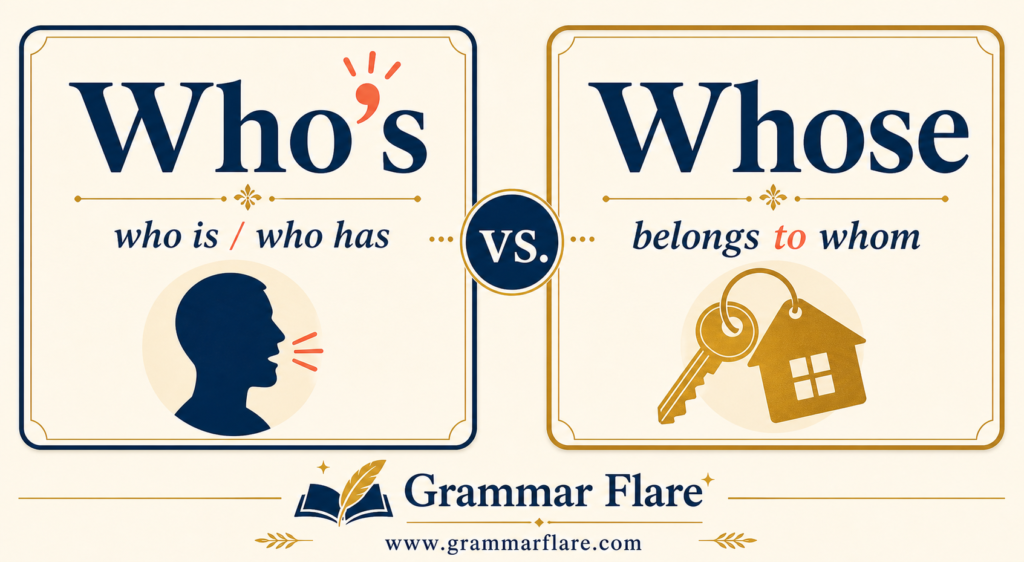
Who’s vs Whose in One Table
| Word | What it means | Grammar role | Example |
|---|---|---|---|
| who’s | who is / who has | contraction | Who’s ready to start? |
| whose | belonging to whom | possessive determiner or pronoun | Whose keys are these? |
The Simple Rule in One Sentence
Who’s is a contraction. Whose shows possession.
That is the core difference.
What Does Who’s Mean?
Who’s is a contraction. It can mean:
Merriam-Webster records who’s as a contraction of both who is and who has..
- who is
- who has
Examples:
- Who’s at the front door?
This means Who is at the front door? - Who’s been using my laptop?
This means Who has been using my laptop? - Who’s responsible for this section?
This means Who is responsible for this section?
If the sentence still works after expanding the word to who is or who has, who’s is correct.
What Does Whose Mean?
Whose is a possessive word. It asks or tells who something belongs to or who something is connected with.
For dictionary support, see Merriam-Webster’s entry for whose and Cambridge Dictionary’s entry for whose.
Examples:
- Whose bag is under the desk?
- Do you know whose phone keeps ringing?
- She is the writer whose article went viral.
- We visited the teacher whose class won the contest.
In each example, whose shows ownership, relationship, or connection.
Can Who’s Mean “Who Has”?
Yes. Many learners only remember who’s = who is, but who’s can also mean who has.
Examples:
- Who’s already eaten lunch?
= Who has already eaten lunch? - Who’s seen this movie before?
= Who has seen this movie before?
This matters because some sentences sound wrong if you test only for who is. If who has fits, who’s may still be correct.
Why People Mix Up Who’s and Whose
These words are easy to confuse because they are homophones. They sound the same, but they have different spellings and grammar jobs.
Another reason is that writers often expect possession to use an apostrophe. But possessive words like whose, your, its, and their usually do not use apostrophes. The same logic explains its versus it’s and your versus you’re. In every case the apostrophe marks a missing letter, never possession.
That is why these mistakes are common:
- Who’s shoes are by the door?
Incorrect, because the sentence asks about ownership. - Whose going with you?
Incorrect, because the sentence means who is going with you?
Quick Test: Should You Use Who’s or Whose?
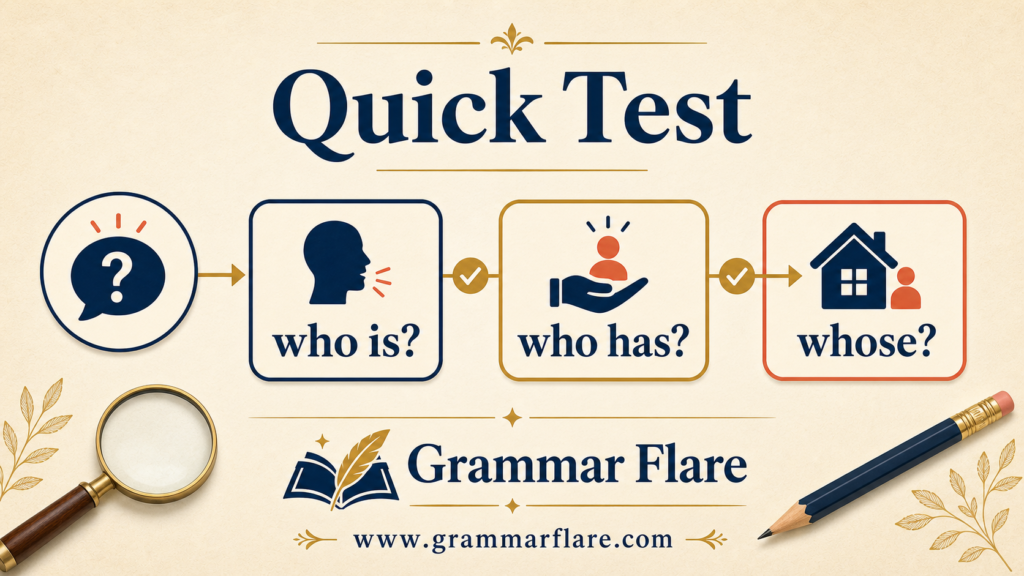
Use this 10-second test:
- Replace the word with who is.
- If that does not work, try who has.
- If either version makes sense, use who’s.
- If the sentence asks who something belongs to or describes a person connected to something, use whose.
Examples:
- Who’s in charge today?
Who is in charge today? works, so who’s is correct. - Whose notebook is this?
Who is notebook is this? does not work, so whose is correct. - Who’s finished the report?
Who has finished the report? works, so who’s is correct.
Use the quick test in order: try who is, then who has. If neither works, you probably need whose.
Who’s vs Whose Examples in Sentences
Here are clear side-by-side examples:
| Meaning | Correct sentence |
|---|---|
| who is | Who’s the new editor? |
| possession | Whose draft needs revision? |
| who has | Who’s already replied to the email? |
| possession | Whose turn is it to present? |
| who is | Who’s calling this late? |
| connection | The student whose essay won smiled. |
Correct and Incorrect Examples
Correct
- Who’s ready for the quiz?
- Whose coffee mug is on the counter?
- Do you know who’s been updating the document?
- I met the neighbor whose dog barks every morning.
Incorrect
- Whose coming with us?
Incorrect because the sentence means who is coming with us? - Who’s backpack is on the sofa?
Incorrect because the backpack belongs to someone. - The manager who’s team won gave a short speech.
Incorrect because the team belongs to the manager, so whose is needed.
When to Use Who’s
Use who’s when:
- you mean who is
- you mean who has
- the word combines a pronoun and a verb
Examples:
- Who’s available for a quick call?
- Who’s handled this client before?
- Who’s the best person to ask?
If the sentence can expand to who is or who has, who’s is correct.
When to Use Whose
Use whose when:
- you are asking who something belongs to
- you are showing ownership or connection
- you are describing a person, group, or thing linked to something else
Examples:
- Whose charger is plugged in over here?
- Whose idea was it to shorten the introduction?
- We hired a coach whose feedback was direct and useful.
If the sentence answers a question like belonging to whom?, whose is right.
What About “Who Else’s”?
This one catches even confident writers. When you add else, the possessive attaches to else, not to who:
- Correct: Who else’s car is blocking the driveway?
- Incorrect: Whose else car is blocking the driveway?
- Incorrect: Who’s else car is blocking the driveway?
The same pattern applies to other pronouns: someone else’s, anyone else’s, nobody else’s. In each case the apostrophe goes on else because the two words function as a single unit.
This is one of the few places where a possessive built on a pronoun does take an apostrophe, which is exactly why it looks wrong at first.
Can Whose Refer to People and Things?
Yes. In everyday modern English, whose can refer to both people and things.
Examples with people:
- The teacher whose lesson was clearest got strong feedback.
- The player whose shot won the game looked stunned.
Examples with things or organizations:
- We joined a company whose training materials were easy to follow.
- This is a book whose ending surprises most readers.
Some very formal writers may prefer of which in a few cases, but whose is standard, natural, and common in modern English.
Common Mistakes With Who’s and Whose
One common mistake is adding an apostrophe because the sentence feels possessive. Another is assuming that any question starting with that sound needs whose. Plenty of them need who’s: Who’s coming? Who’s finished? Who’s in charge?
A better approach is to check the grammar job of the word:
- Does the sentence mean who is or who has?
- Or does it ask who something belongs to?
If it means who is or who has, use who’s.
If it shows ownership or connection, use whose.
Memory Trick for Who’s vs Whose
The easiest memory trick is this:
- who’s has an apostrophe because it is missing letters from who is or who has
- whose has no apostrophe because it is showing possession
Another shortcut:
- who’s = who is / who has
- whose = whose book, whose seat, whose idea
If you remember the expansion test, you usually will not need any other trick.
Memory shortcut: who’s signals a contraction, while whose points to ownership or connection.
A Fast Proofreading Method
If who’s vs whose is a mistake you make often, try this proofreading habit:
- Search your draft for every use of who’s and whose.
- Read each sentence slowly.
- Replace who’s with who is and then who has.
- If neither version works, switch to whose.
This works especially well for:
- emails
- assignments
- captions
- FAQ pages
- blog posts
- customer messages
Who’s vs Whose in Real-Life Writing
This difference matters because readers notice it quickly, especially in questions and headlines. Even a small mistake can make polished writing look rushed.
You are likely to see or need this distinction in:
- school assignments
- interview questions
- business emails
- social posts
- website copy
- customer support replies
If you want to sound careful and credible, this is a useful grammar fix to learn.
American English Style Note
The core rule is the same in American English and British English:
- who’s = who is or who has
- whose = possession or connection
There is no meaningful regional difference in the basic rule. In modern American English, using whose for both people and things is normal and readable.
Mini Quiz: Who’s or Whose?
Try these before checking the answers.
- ___ going to lead the discussion today?
- ___ notebook was left in the classroom?
- Do you know ___ already submitted the form?
- She is the designer ___ logo we approved.
- ___ been answering the support emails this week?
Answers
- Who’s
- Whose
- who’s
- whose
- Who’s
FAQ
What is the difference between who’s vs whose?
Who’s is a contraction of who is or who has. Whose is a possessive word that asks or shows who something belongs to.
How do I know whether to use who’s or whose?
Replace the word with who is or who has. If the sentence still works, use who’s. If the sentence asks about ownership or connection, use whose.
Is “who’s book” correct?
No. The correct form is whose book because the sentence asks who the book belongs to.
Can whose refer to things, not just people?
Yes. In modern English, whose can naturally refer to things, groups, and organizations as well as people.
Can who’s ever mean who has?
Yes. In sentences like Who’s finished?, who’s means who has.
Is it “who else’s” or “whose else”?
Who else’s is correct. When else follows a pronoun, the possessive attaches to else, as in someone else’s and anyone else’s.
More Reading at GrammarFlare
- It’s vs Its
- Your vs You’re
- There vs Their vs They’re
- Apostrophe Rules
- Than vs Then
- Commonly Confused Words
Sources
Final Takeaway
If you remember one rule, make it this:
Who’s means who is or who has. Whose shows possession.
When in doubt, expand who’s. If who is or who has fits, keep it. If not, and the sentence asks about belonging or connection, use whose.

Ahmad Waheed has spent five years editing academic and professional writing for universities, publishers, and software companies. He founded Grammar Flare after noticing the same handful of mistakes in almost every draft that crossed his desk, and that most grammar guides explained the rule without explaining when it actually matters.
Ahmad writes every guide on this site, checking usage questions against Merriam-Webster, the Chicago Manual of Style, and the AP Stylebook, and noting where those sources disagree rather than quietly picking a side.