
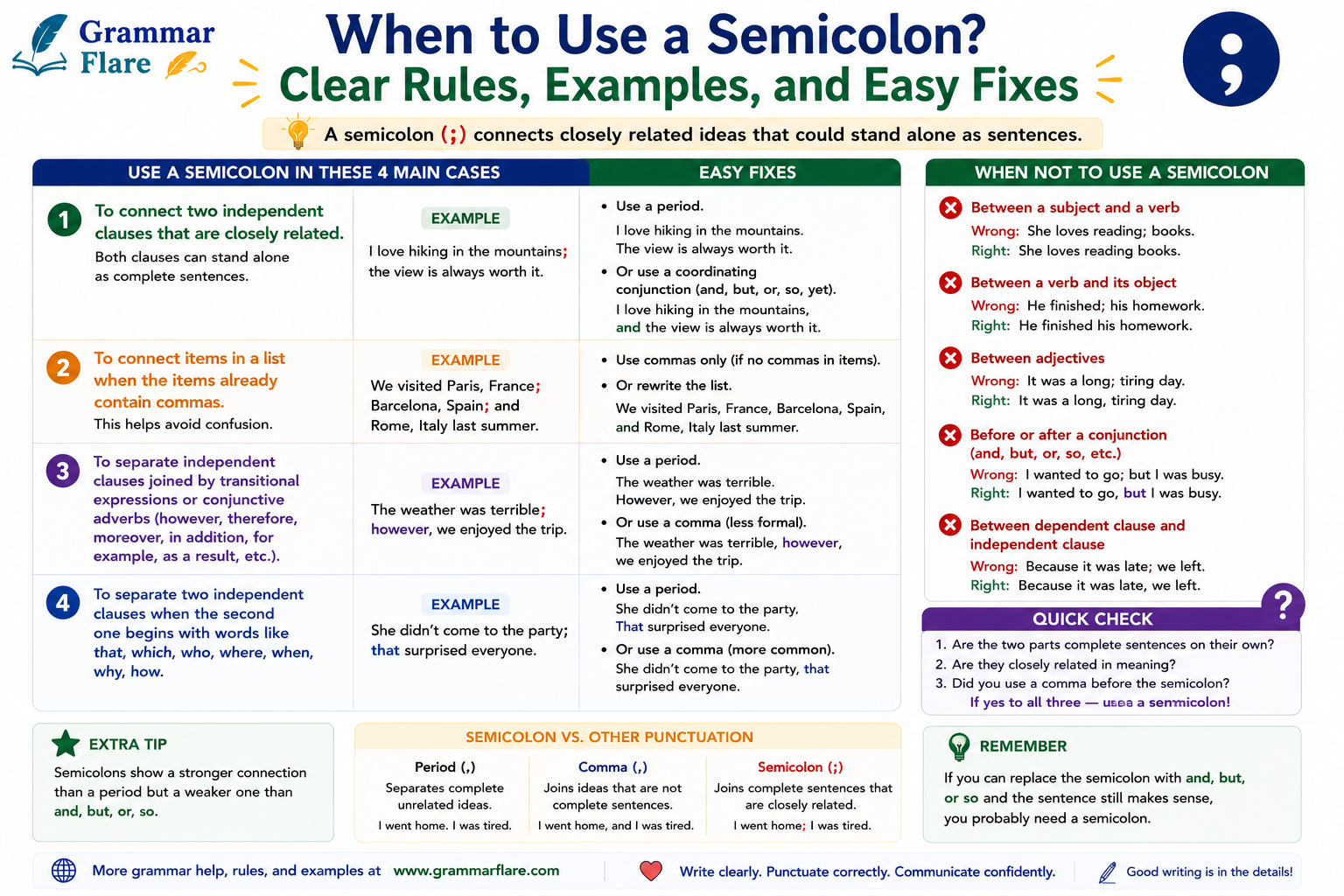
Many writers avoid semicolons because they seem formal or confusing. The truth is simpler: a semicolon has a few clear jobs, and once you know those jobs, it becomes much easier to use correctly.
Most of the time, you will use a semicolon in one of three ways: to join two closely related complete sentences, to connect a sentence with a transition like however, or to separate complex list items that already contain commas. If you want more punctuation help after this article, GrammarFlare’s Punctuation Rules archive is the best next category to browse.
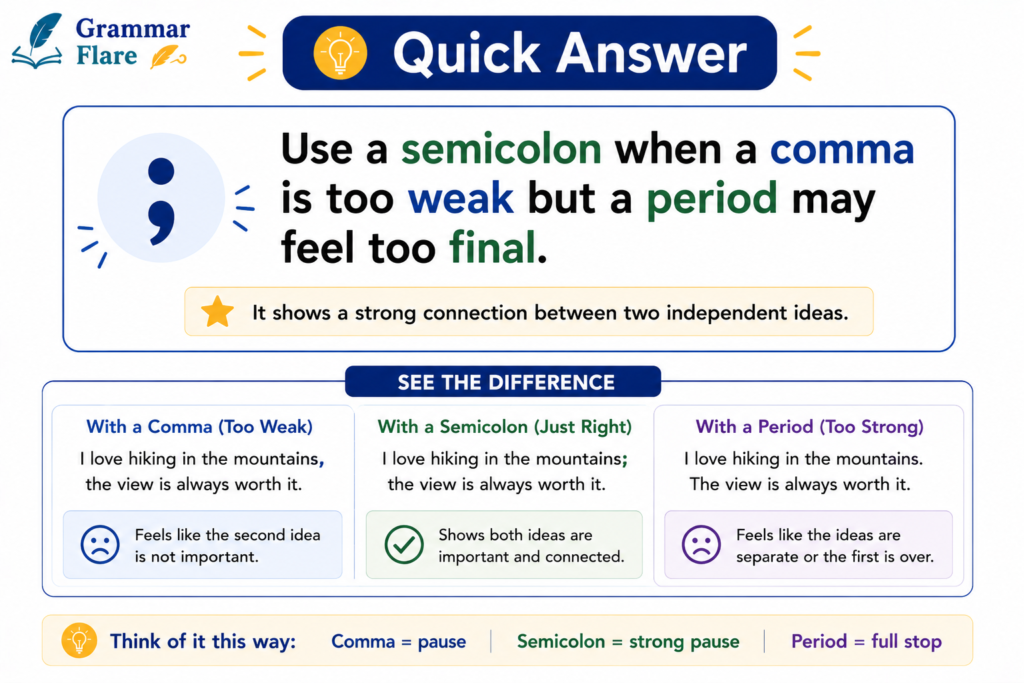
Quick Answer
Use a semicolon when a comma is too weak but a period may feel too final.
The three main uses are:
- between two closely related complete sentences
- before transition words like however, therefore, or for example when both sides are complete sentences
- between list items that already contain commas
Examples:
- The meeting ran late; we moved the lunch break.
- I wanted to call earlier; however, my phone battery died.
- We visited Austin, Texas; Santa Fe, New Mexico; and Boise, Idaho.
The Rule in One Sentence
A semicolon usually connects equal sentence parts or separates complex list items.
That means it should not be used randomly just to make a sentence look more polished.
What Is a Semicolon?
A semicolon (;) is a punctuation mark that sits between a comma and a period in strength.
- A comma often signals a lighter pause.
- A period ends a complete sentence.
- A semicolon links sentence parts that could stand alone but still belong closely together.
If you can replace the semicolon with a period and still have two correct sentences, that is often a good sign that the semicolon may work.
The Three Main Times to Use a Semicolon
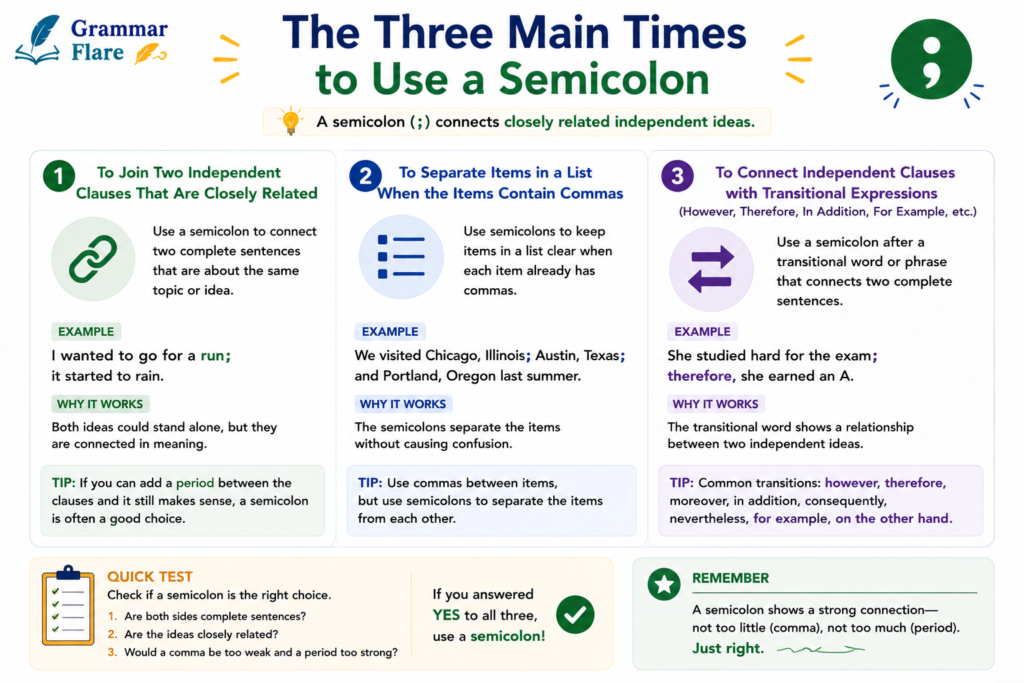
1. Between two closely related complete sentences
This is the use most people think of first.
Use a semicolon when:
- the first part is a complete sentence
- the second part is a complete sentence
- the two ideas are closely connected
- you do not want to use a coordinating conjunction like and or but
Examples:
- The draft was strong; the headline still needed work.
- She studied the rule carefully; the quiz felt easier after that.
- The storm ended early; the roads stayed wet for hours.
Why it works:
Each side can stand alone as its own sentence. The semicolon shows that the ideas belong together more tightly than two separate sentences might suggest.
2. Before transition words when both sides are complete sentences
Use a semicolon before transition words such as:
- however
- therefore
- instead
- meanwhile
- for example
- in fact
- nevertheless
This pattern is common:
complete sentence; transition word, complete sentence
Examples:
- The instructions looked simple; however, the final step confused everyone.
- The team wanted a shorter intro; therefore, we cut the first paragraph.
- He did not ignore the comment; instead, he rewrote the section completely.
- The sentence was technically correct; in fact, it sounded more natural after the edit.
Important note: If the second part is not a complete sentence, do not use a semicolon.
Correct: The plan seemed solid; however, the budget changed.
Incorrect: The plan seemed solid; however not cheap.
3. Between complex list items that already contain commas
This use is extremely practical.
Use semicolons in a list when each item already includes commas. That keeps the list readable.
Example:
- The workshop included Phoenix, Arizona; Tulsa, Oklahoma; and Tampa, Florida.
More examples:
- The panel featured a teacher from Miami, Florida; a copy editor from Portland, Oregon; and a recruiter from Denver, Colorado.
- Our priorities were better headlines, subheads, and summaries; cleaner formatting, spacing, and image placement; and more useful examples for beginners.
Without semicolons, readers can lose track of where one item ends and the next begins.
Semicolon Examples in One Table
| Use case | Correct example | Why it works |
|---|---|---|
| Related complete sentences | I finished the outline; the editor approved it that afternoon. | both sides are full sentences |
| Transition word | The idea sounded simple; however, the execution took longer. | semicolon joins two complete thoughts |
| Complex list | We shipped to Albany, New York; Richmond, Virginia; and Columbus, Ohio. | list items already contain commas |
How to Tell Whether a Semicolon Is Correct
If you are unsure, ask these questions:
1. Are both sides complete sentences?
Test the sentence by replacing the semicolon with a period.
Example: The room was quiet; everyone was waiting.
This becomes: The room was quiet. Everyone was waiting.
That works, so the semicolon is possible.
2. Are the ideas closely related?
If the second sentence feels unrelated, use a period instead.
Better: The room was quiet. My favorite color is green.
Those ideas do not need a semicolon because they are not connected.
3. Are you separating list items that already have commas?
If yes, a semicolon may be the clearest choice.
When Not to Use a Semicolon
Semicolons are helpful, but they are often misused. Here are the most common problems.
Do not use a semicolon between a sentence and a sentence fragment
Incorrect: Because the train was late; we missed the opening remarks.
Correct: Because the train was late, we missed the opening remarks.
Why: Because the train was late is not a complete sentence by itself.
Do not use a semicolon in a simple list
Incorrect: I bought apples; oranges; and bananas.
Correct: I bought apples, oranges, and bananas.
Why: Simple lists need commas, not semicolons.
Do not use a semicolon right before and, but, or or in ordinary cases
Incorrect: The article was clear; but the examples were too short.
Correct: The article was clear, but the examples were too short.
Why: If you are using a coordinating conjunction like but, a comma is usually the better mark.
Do not use a semicolon just to sound formal
If a period, comma, or colon does the job better, use it.
Semicolon vs. Colon
These two marks are often confused, but they do different things.
Use a semicolon to link or separate equal units
Examples:
- The speaker was nervous; the audience did not notice.
- We compared Dallas, Texas; Reno, Nevada; and Boise, Idaho.
Use a colon to introduce something
A colon often introduces:
- a list
- an explanation
- a quotation
- an example
Examples:
- She brought three things: notes, a pen, and a timer.
- There was one clear problem: the deadline was unrealistic.
Quick difference:
- Semicolon = link or separate equal parts
- Colon = point forward to what comes next
Do You Use a Semicolon Before However?
Often, yes.
Use a semicolon before however when:
- the first part is a complete sentence
- the second part is also a complete sentence
Examples:
- I wanted a shorter title; however, the keyword needed to stay near the front.
- The instructions were accurate; however, they were not easy to skim.
Do not use the semicolon if however is not connecting two complete sentences.
Common Semicolon Mistakes
| Incorrect | Correct | Why |
|---|---|---|
| Because the file was missing; we delayed the review. | Because the file was missing, we delayed the review. | first part is not a full sentence |
| The message was polite; but too vague. | The message was polite but too vague. | no semicolon before a fragment |
| She wanted a quick answer; however she got none. | She wanted a quick answer; however, she got none. | comma belongs after however |
| We packed shirts; socks; and shoes. | We packed shirts, socks, and shoes. | simple list needs commas |
| There was one issue; the date was wrong. | There was one issue: the date was wrong. | colon is stronger for direct explanation |
A Quick Proofreading Test
If you are checking a sentence quickly, use this three-step test:
1. Replace the semicolon with a period
If you do not get two correct sentences, the semicolon may be wrong.
2. Check whether the ideas belong together
If the connection is weak, a period is usually better.
3. Look for a hidden list problem
If you are in a list and the items already contain commas, semicolons may be the clearest fix.
Why Semicolons Matter in Writing
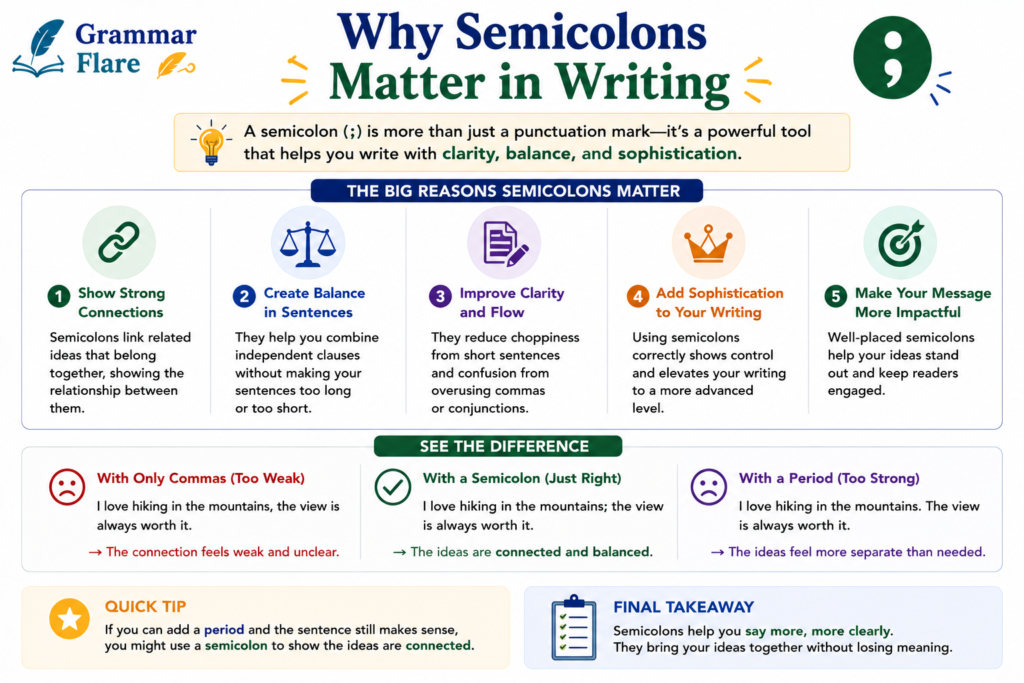
Semicolons are not just decorative punctuation. Used well, they improve clarity.
They can help you:
- show a close relationship between ideas
- avoid run-on sentences
- make complex lists easier to read
- create smoother rhythm in formal or polished writing
That said, you do not need to force them into every paragraph. Clear writing matters more than fancy punctuation. After you fix punctuation, many writers also want smoother phrasing and better sentence flow. GrammarFlare’s Better Ways to Say Things and Commonly Confused Words categories are useful next steps if you want both correctness and clarity.
Short Practice Set
Choose the correct option in each sentence:
- The slides were finished ( ; / , ) the speaker still wanted one more example.
- We traveled to Salem, Oregon ( ; / , ) Helena, Montana ( ; / , ) and Tulsa, Oklahoma.
- The note sounded polite ( ; however, / , however, ) it was not specific enough.
- Because the printer jammed ( ; / , ) we sent the file later.
- There was one obvious problem ( ; / : ) the link was broken.
Answers:
- ;
- ; and ;
- ; however,
- ,
- :
FAQ
When do you use a semicolon instead of a comma?
Use a semicolon instead of a comma when you are joining two closely related complete sentences without a coordinating conjunction, or when you need to separate complex list items that already contain commas.
A semicolon replaces the conjunction rather than accompanying it, which is why it rained; but we went anyway is not standard. If a conjunction is what you want, see when to use a comma before “but”.
Can a semicolon replace a period?
Sometimes. If both sides are complete sentences and the ideas are closely related, a semicolon can replace a period.
Do you capitalize the word after a semicolon?
Usually no. The word after a semicolon normally stays lowercase unless it is a proper noun or something that would already be capitalized.
Do you use a semicolon before however?
Yes, if however joins two complete sentences. The usual pattern is complete sentence; however, complete sentence.
Can semicolons be used in lists?
Yes. They are especially useful in lists where each item already contains commas.
Short Answers for Quick Reference
- Best quick answer: Use a semicolon to join two closely related complete sentences, to connect a sentence with a transition like however, or to separate complex list items that already contain commas.
- Fast rule: If a comma feels too weak and a period feels too final, a semicolon may be right.
- Biggest mistake to avoid: Do not use a semicolon between a complete sentence and a fragment.
Read more at GrammarFlare
- Comma Before “And”
- Comma Before “But”
- Semicolon before “And”
- How to Fix a Comma Splice
- How to use a Colon
- What Is an Independent Clause?
Sources

Ahmad Waheed has spent five years editing academic and professional writing for universities, publishers, and software companies. He founded Grammar Flare after noticing the same handful of mistakes in almost every draft that crossed his desk, and that most grammar guides explained the rule without explaining when it actually matters.
Ahmad writes every guide on this site, checking usage questions against Merriam-Webster, the Chicago Manual of Style, and the AP Stylebook, and noting where those sources disagree rather than quietly picking a side.