
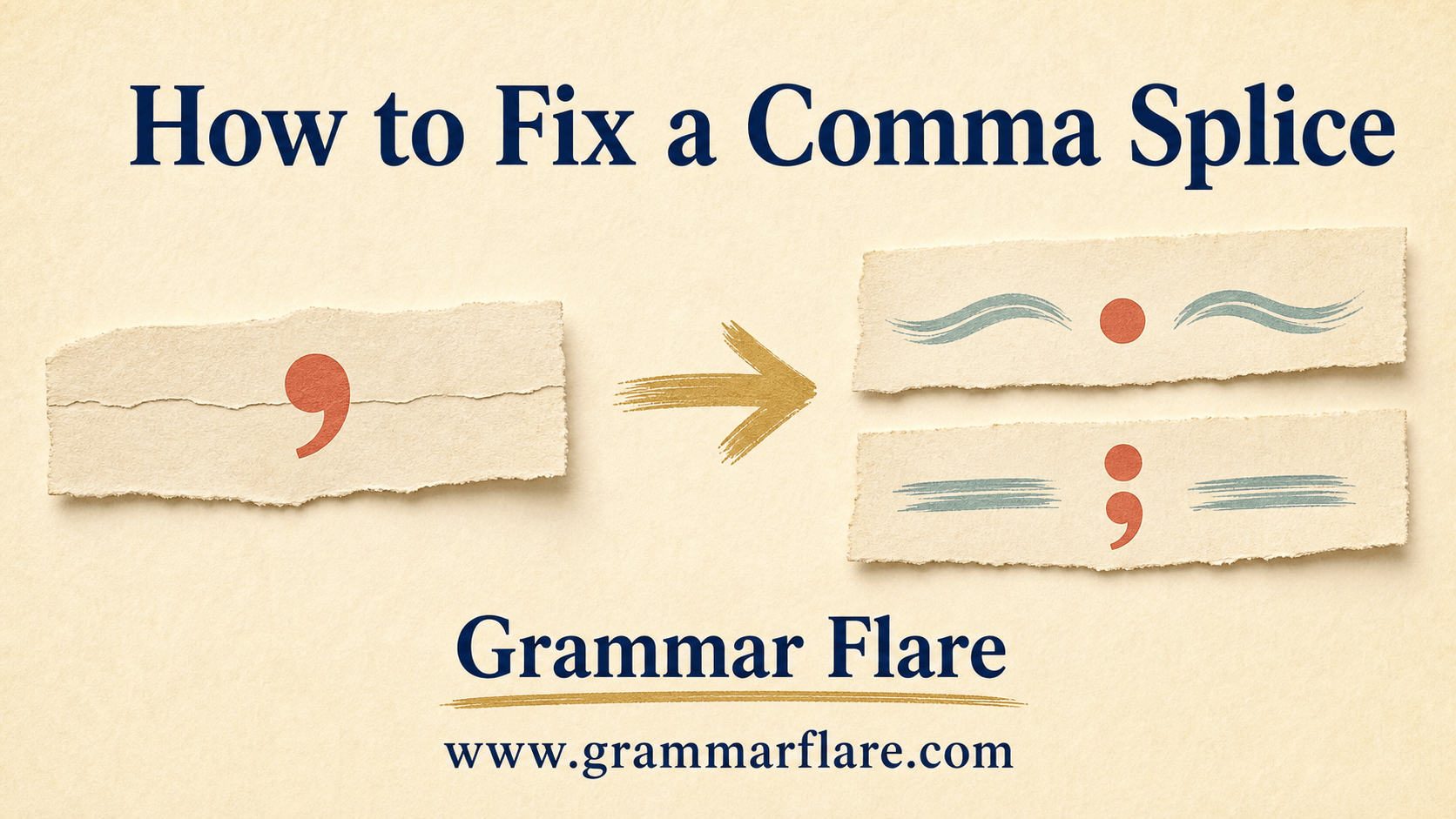
A comma splice happens when two complete sentences are joined with only a comma. Most writers make this mistake because the sentence sounds fine read aloud, where the pause does the work the punctuation should be doing.
That is the whole problem in one line. Many writers make this mistake because the sentence sounds fine in their head, but on the page, the comma is not strong enough to hold the two ideas together by itself.
If you want more punctuation help after this guide, check Punctuation Rules.
Quick Answer
To fix a comma splice, choose one of these four corrections:
- replace the comma with a period
- add a comma plus a coordinating conjunction such as and, but, or so
- replace the comma with a semicolon
- make one clause dependent
Example of a comma splice: I finished the report, I sent it to the client.
Correct versions
- I finished the report. I sent it to the client.
- I finished the report, and I sent it to the client.
- I finished the report; I sent it to the client.
- After I finished the report, I sent it to the client.
The Rule in One Sentence
Do not join two independent clauses with only a comma.
What Is a Comma Splice?
A comma splice is a sentence error that happens when a writer joins two independent clauses with a comma and nothing else.
An independent clause is a group of words that can stand alone as a complete sentence.
Example:
- The meeting ended.
- Everyone left quickly.
Each part can stand alone. That means each part is an independent clause.
If you join them like this, you get a comma splice:
The meeting ended, everyone left quickly.
The comma creates too weak a connection. The sentence needs a different fix.
If you want a broader refresher on clause structure after this article, check Grammar Basics.
Why Comma Splices Happen
Comma splices usually happen for one of three reasons:
- the writer hears only one smooth pause and assumes a comma is enough
- the writer knows the ideas are related but does not know which connector to use
- the writer tries to avoid short sentences and ends up joining complete thoughts the wrong way
The problem is not sentence length. A short sentence can contain a comma splice, and a long sentence can be perfectly correct.
Four Easy Ways to Fix a Comma Splice
1. Use a period
This is the simplest fix.
Comma splice: The store was closing, we had to hurry.
Correct: The store was closing. We had to hurry.
Use this fix when you want the two ideas to feel separate and direct.
2. Use a comma and a coordinating conjunction
The most common coordinating conjunctions are:
- for
- and
- nor
- but
- or
- yet
- so
Comma splice: The store was closing, we had to hurry.
Correct: The store was closing, so we had to hurry.
Use this fix when you want to show a clear relationship between the ideas.
Adding a conjunction only works if the comma is placed correctly, and but has its own rules about when the comma belongs there. Our guide to the comma before “but” covers both cases.
3. Use a semicolon
A semicolon can join two closely related independent clauses.
Comma splice: The store was closing, we had to hurry.
Correct: The store was closing; we had to hurry.
Use this fix when the ideas are strongly connected and you do not need a conjunction.
4. Make one clause dependent
You can also turn one clause into a dependent clause.
Comma splice: The store was closing, we had to hurry.
Correct
- Because the store was closing, we had to hurry.
- We had to hurry because the store was closing.
Use this fix when one idea explains the other.
Comma Splice Examples and Corrections
| Comma splice | Better correction | Why it works |
|---|---|---|
| I was tired, I went to bed early. | I was tired, so I went to bed early. | The conjunction shows cause and result. |
| The file was missing, we checked the backup. | The file was missing. We checked the backup. | A period cleanly separates the ideas. |
| She practiced every day, she improved quickly. | She practiced every day; she improved quickly. | The semicolon links related full sentences. |
| The teacher explained the rule, the students still looked confused. | Although the teacher explained the rule, the students still looked confused. | One clause becomes dependent. |
| We arrived early, the doors were still locked. | We arrived early, but the doors were still locked. | The conjunction shows contrast. |
Comma Splice vs. Run-On Sentence
A comma splice is usually treated as a type of run-on sentence.
Comma splice
A comma splice joins two independent clauses with only a comma.
Example: She called me, I did not answer.
Fused sentence
A fused sentence joins two independent clauses with no punctuation at all.
Example: She called me I did not answer.
The bigger category
Both problems fall under the larger idea of a run-on sentence because two complete thoughts are joined incorrectly.
How to Tell If a Sentence Has a Comma Splice
Use this quick check:
- Find the comma.
- Look at the words on the left side.
- Look at the words on the right side.
- Ask whether both sides can stand alone as full sentences.
If both sides are complete sentences and the comma is the only connection, you have a comma splice.
Quick test
Sentence: My phone was almost dead, I could not call you.
Now split it: My phone was almost dead.
- I could not call you.
Both parts work alone. That tells you the original sentence is a comma splice.
Common Mistakes to Avoid
Adding only a transition word after the comma
This is still wrong if the two sides are full sentences.
Incorrect: I wanted to go, however, I was too tired.
Better
- I wanted to go; however, I was too tired.
- I wanted to go, but I was too tired.
Using a semicolon when one side is not complete
Incorrect: The package arrived late; because the address was wrong.
Better
- The package arrived late because the address was wrong.
- The package arrived late; the address was wrong.
Overusing conjunctions in every fix
Conjunctions are useful, but not every sentence needs and or but. Sometimes a period or semicolon is cleaner.
Assuming every comma between clauses is wrong
Some commas are correct. For example, a comma is fine before a coordinating conjunction when both sides are full sentences:
The package arrived late, but the client was still patient.
A Fast Proofreading Check
Before you keep or remove a comma, ask:
- Does the left side stand alone?
- Does the right side stand alone?
- Is the comma the only connector?
- Would a period, conjunction, semicolon, or dependent clause fix the sentence more clearly?
If the answer to the first three questions is yes, the sentence probably has a comma splice.
Why Comma Splices Matter in Clear Writing
Comma splices make writing look rushed and less polished. They can also confuse readers because the sentence structure feels unstable.
Fixing comma splices helps in:
- school writing
- professional email
- blog posts
- reports
- proofreading
FAQ
What is a comma splice?
A comma splice happens when two independent clauses are joined with only a comma.
How do you fix a comma splice?
You can fix a comma splice by using a period, adding a coordinating conjunction, using a semicolon, or making one clause dependent.
Is a comma splice the same as a run-on sentence?
A comma splice is usually treated as a type of run-on sentence. A fused sentence is another type of run-on sentence.
Can you ever join two sentences with a comma?
Yes, but only if you also use a coordinating conjunction such as and, but, or so, or if the second part is not an independent clause.
Is a semicolon always the best fix?
No. A semicolon is only one option. In many everyday cases, a period or a comma with a conjunction is clearer.
Why is however tricky?
Because writers often treat however like a coordinating conjunction. It is not one. If it joins two complete sentences, you usually need a semicolon or a period before it.
Short Answers For Quick Overviews
- Best quick answer: A comma splice happens when two complete sentences are joined with only a comma.
- Fast fix rule: Use a period, a comma plus a coordinating conjunction, a semicolon, or a dependent clause.
- Common confusion: A comma splice is a kind of run-on sentence, but not every run-on sentence is a comma splice.
- Best proofreading test: If both sides of the comma can stand alone as full sentences, the comma alone is probably not enough.
Explore More on GrammarFlare
- Comma Before “But”
- Comma Before “And”
- When to Use a Semicolon
- What Is an Independent Clause?
- What Is a Compound Sentence?
Sources

Ahmad Waheed has spent five years editing academic and professional writing for universities, publishers, and software companies. He founded Grammar Flare after noticing the same handful of mistakes in almost every draft that crossed his desk, and that most grammar guides explained the rule without explaining when it actually matters.
Ahmad writes every guide on this site, checking usage questions against Merriam-Webster, the Chicago Manual of Style, and the AP Stylebook, and noting where those sources disagree rather than quietly picking a side.