
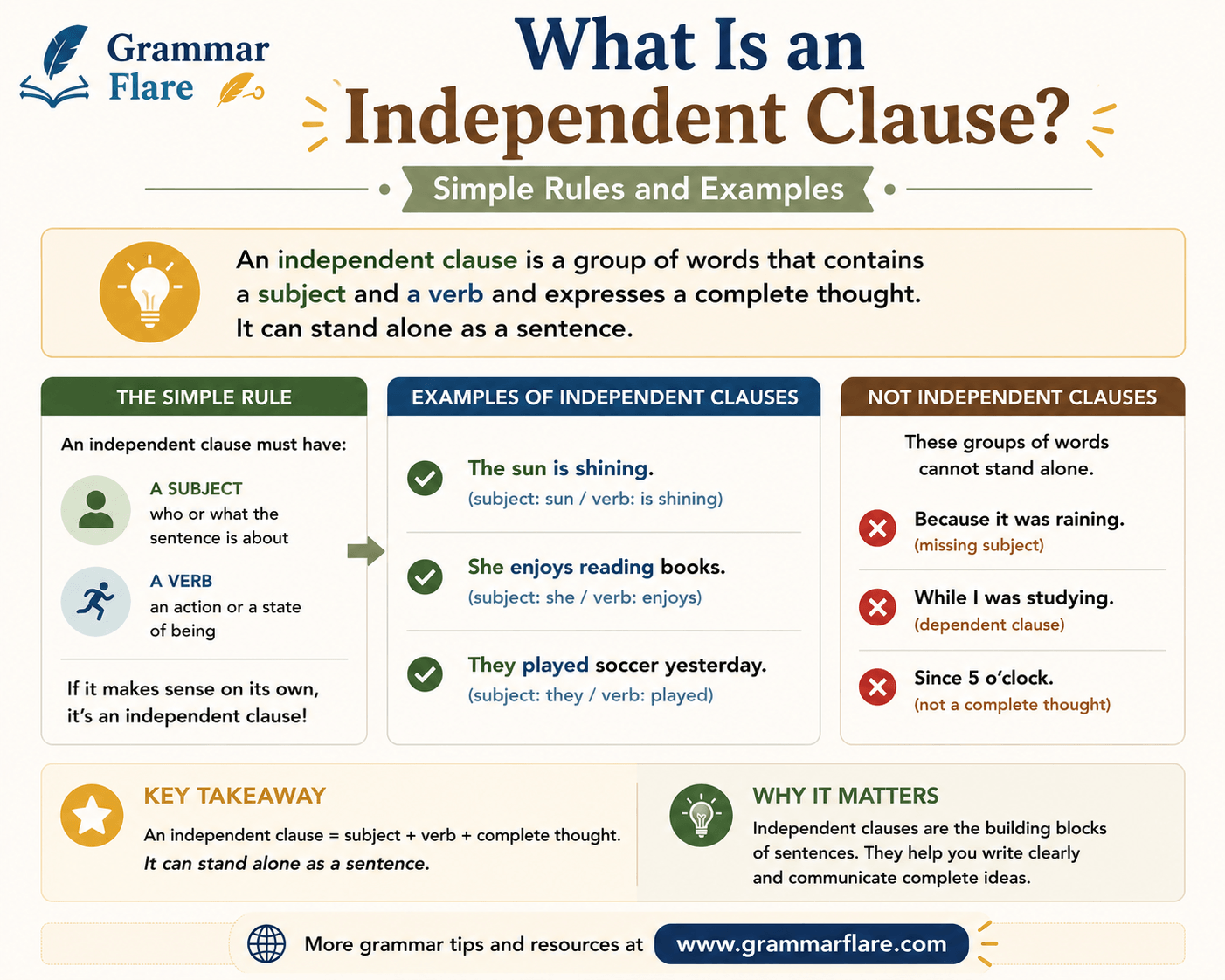
An independent clause is one of the most important building blocks in English grammar.
Once you understand independent clauses, sentence structure becomes much easier. You can identify simple sentences, compound sentences, complex sentences, comma splices, fragments, and run-ons with more confidence.
The good news is that the rule is simple.
An independent clause is a group of words that has a subject, a verb, and a complete thought.
Examples:
- She smiled.
- The dog barked.
- I finished the lesson.
- The students opened their books.
- My brother plays football after school.
Each example can stand alone as a complete sentence. That is why it is called independent. It does not depend on another clause to make sense.
Quick Answer: What Is an Independent Clause?
Here is the quick answer:
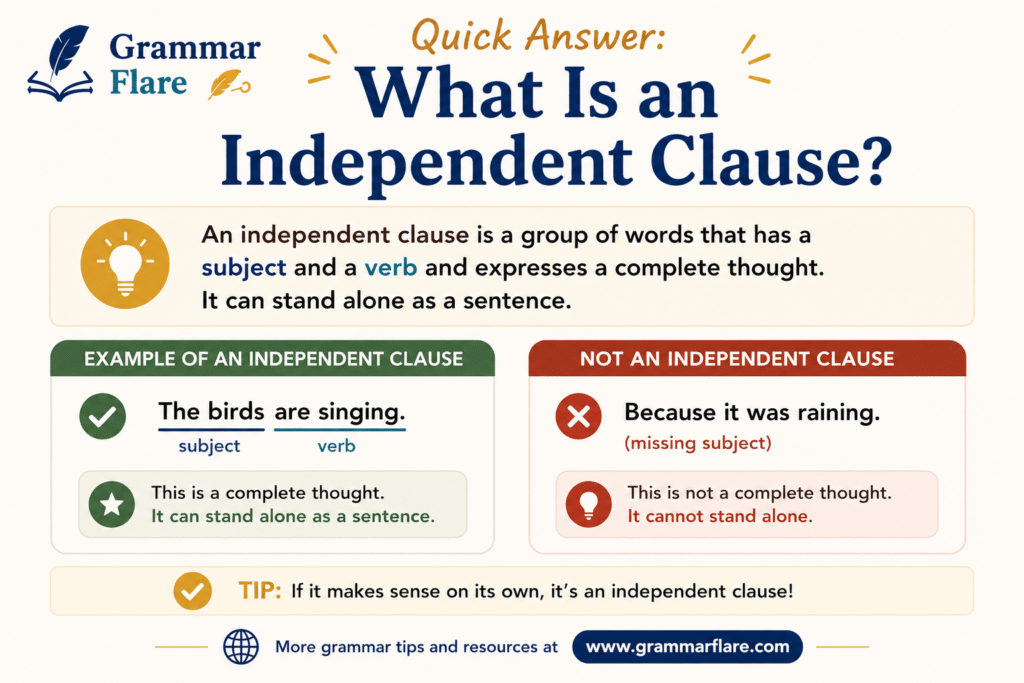
An independent clause is a clause that can stand alone as a complete sentence because it has a subject, a verb, and a complete idea.
If you like clear GrammarFlare guides such as Simple Sentence: Meaning, Rules, and Examples, What Is a Compound Sentence? Simple Rules and Examples, and What Is a Complex Sentence? Simple Rules and Examples, this guide follows the same practical format.
An independent clause is a complete thought with a subject and a verb.
It can stand alone as a sentence.
Examples:
- I laughed.
- She closed the door.
- The teacher explained the rule.
- We waited outside the classroom.
- The article answered the question clearly.
Each sentence has three things:
- a subject
- a verb
- a complete thought
In the sentence She closed the door, the subject is she, and the verb is closed. The sentence also makes complete sense.
That makes it an independent clause.
Cambridge Dictionary defines an independent clause as a clause that would form a complete sentence by itself. Merriam-Webster gives a similar definition, describing it as a clause that can be used by itself as a simple sentence.
Independent Clause in One Table
| Clause | Subject | Verb | Complete thought? | Independent clause? |
|---|---|---|---|---|
| She smiled. | She | smiled | Yes | Yes |
| The dog barked. | The dog | barked | Yes | Yes |
| Because she smiled | she | smiled | No | No |
| When the dog barked | the dog | barked | No | No |
| I finished the report. | I | finished | Yes | Yes |
The key point is this:
A clause can have a subject and verb but still not be independent. It must also express a complete thought.
The Simple Rule
Use this formula:
Subject + verb + complete thought = independent clause
Examples:
- Birds fly.
- I waited.
- She reads novels.
- The phone rang loudly.
- My friend called after dinner.
These are independent clauses because each one can stand alone.
Now compare these:
- because birds fly
- when I waited
- although she reads novels
- after the phone rang
- while my friend called
These groups of words have subjects and verbs, but they do not express complete thoughts. They leave the reader waiting for more information.
That means they are not independent clauses.
What Is a Clause?
Before you fully understand an independent clause, it helps to understand the word clause.
A clause is a group of words that contains a subject and a verb.
Examples:
- she smiled
- the dog barked
- we waited
- because he was late
- when the rain stopped
All of these are clauses because each one has a subject and a verb.
But not all clauses are complete sentences.
There are two main types:
- independent clauses
- dependent clauses
An independent clause can stand alone.
A dependent clause cannot stand alone.
Independent Clause Examples
Here are clear examples of independent clauses:
- I opened the window.
- She finished her homework.
- The baby slept peacefully.
- My father repaired the car.
- We studied grammar after lunch.
- The students answered the question.
- The movie started at seven o’clock.
- The red bus stopped near the school.
- Your explanation helped me understand the rule.
- The website loaded quickly on my phone.
Each example has a complete idea.
You can put a period after each one, and the sentence feels finished.
That is the easiest test.
Independent Clause Does Not Mean Short Clause
An independent clause can be short.
Example: I laughed.
It can also be long.
Example: The tired students in the back row answered the difficult grammar question after a short discussion.
That is still one independent clause.
The main structure is: The students answered the question.
Everything else adds detail.
So, sentence length does not decide whether a clause is independent. Completeness does.
Three Parts of an Independent Clause
An independent clause needs three main things.
A subject
The subject tells who or what the clause is about.
Examples:
- I
- she
- the teacher
- my brother
- the old clock
A verb
The verb tells what the subject does or what happens.
Examples:
- laughed
- writes
- opened
- explained
- stopped
A complete thought
A complete thought means the clause makes sense by itself.
Example: The teacher explained the rule.
This has a subject, a verb, and a full idea.
Now look at this: Because the teacher explained the rule.
This has a subject and verb, but it does not feel complete. The word because makes the reader expect more.
That is why it is dependent, not independent.
Independent Clause vs Dependent Clause
An independent clause can stand alone.
A dependent clause cannot.
Independent clause: I stayed home.
Dependent clause: Because I stayed home
The dependent clause leaves a question in the reader’s mind:
What happened because you stayed home?
Complete sentence: Because I stayed home, I finished my homework.
Here are more comparisons:
| Independent clause | Dependent clause |
|---|---|
| She was tired. | Because she was tired |
| We left early. | After we left early |
| He passed the test. | Although he passed the test |
| The rain stopped. | When the rain stopped |
| I need help. | If I need help |
A dependent clause often starts with a word like because, although, when, if, while, before, or after.
These words make the clause depend on another idea.
Common Words That Create Dependent Clauses
A complete sentence can become dependent when you add certain words at the beginning.
Common dependent-clause starters include:
- after
- although
- as
- because
- before
- even though
- if
- since
- though
- unless
- until
- when
- whenever
- where
- wherever
- while
Compare
Independent: I was tired.
Dependent: Because I was tired
Independent: The class ended.
Dependent: When the class ended
Independent: She studied hard.
Dependent: Although she studied hard
The subject and verb are still there, but the thought is no longer complete.
Independent Clauses in Simple Sentences
A simple sentence is made of one independent clause.
Examples:
- The cat slept.
- I wrote an email.
- She opened the notebook.
- The teacher answered the question.
- My cousin arrived after midnight.
Each sentence has one complete idea.
That is why every simple sentence is an independent clause.
However, an independent clause can also be part of a larger sentence.
Example: I wrote an email, and she replied quickly.
This sentence has two independent clauses:
- I wrote an email.
- she replied quickly.
That makes it a compound sentence.
For the full explanation, read Simple Sentence: Meaning, Rules, and Examples.
Independent Clauses in Compound Sentences
A compound sentence has two or more independent clauses.
Example: I finished the article, and I uploaded it.
Independent clause 1: I finished the article.
Independent clause 2: I uploaded it.
The word and joins the two clauses.
More examples:
- She wanted tea, but the kitchen was closed.
- I saved the file, and my editor reviewed it.
- The rain stopped, so we went outside.
- You can read the guide, or you can take the quiz.
- The rule is simple; the examples make it clearer.
A compound sentence connects complete thoughts.
For more help, read What Is a Compound Sentence? Simple Rules and Examples.
Independent Clauses in Complex Sentences
A complex sentence has one independent clause and at least one dependent clause.
Example: Because I was tired, I went to bed early.
Dependent clause: Because I was tired
Independent clause: I went to bed early.
The dependent clause gives the reason. The independent clause gives the complete main idea.
More examples: When the bell rang, the students left the room.
- Although the test was hard, she passed.
- I stayed inside because it was raining.
- We called the office after the meeting ended.
- If you practice daily, your writing will improve.
In each sentence, the independent clause can stand alone.
For the full guide, read What Is a Complex Sentence? Simple Rules and Examples.
How to Identify an Independent Clause
Use this quick test.
Ask three questions:
- Does the group of words have a subject?
- Does it have a verb?
- Does it express a complete thought?
If the answer is yes to all three, it is an independent clause.
Example: The girl opened the door.
Subject: The girl
Verb: opened
Complete thought?
Yes.
So it is an independent clause.
Now try this: When the girl opened the door
Subject: the girl
Verb: opened
Complete thought?
No.
The word when makes the idea unfinished.
So it is a dependent clause.
Independent Clause Examples by Pattern
Independent clauses can follow different sentence patterns.
Subject + verb
- Birds fly.
- I waited.
- She smiled.
- The baby cried.
- We listened.
Subject + verb + object
- I read the book.
- She cleaned the room.
- He fixed the bike.
- They watched the movie.
- We finished the project.
Subject + linking verb + complement
- The soup is hot.
- She seems happy.
- The answer was correct.
- The children are excited.
- The sky looks cloudy.
Subject + verb + extra phrase
- I waited at the station.
- She sat near the window.
- We walked through the park.
- He works after school.
- The keys are in my bag.
All of these are independent clauses because they can stand alone.
Independent Clause With a Compound Subject
An independent clause can have a compound subject.
Examples:
- Sarah and Mina laughed.
- The teacher and the students waited.
- Coffee and tea are available.
- My brother and sister play tennis.
- Rain and wind damaged the roof.
Each sentence has one complete thought.
A compound subject does not automatically make a sentence compound. It can still be one independent clause.
Independent Clause With a Compound Verb
An independent clause can also have a compound verb.
Examples:
- Sarah laughed and waved.
- I packed my bag and left.
- The teacher opened the book and explained the rule.
- The children ran, jumped, and shouted.
- He cooked dinner and washed the dishes.
These are independent clauses because they express complete thoughts.
Do not confuse this with a compound sentence.
Independent clause with compound verb:
She opened the door and smiled.
Compound sentence: She opened the door, and her brother smiled.
The second sentence has two independent clauses.
Independent Clause vs Sentence
An independent clause can be a complete sentence.
Example: She smiled.
This is both an independent clause and a sentence.
But an independent clause can also be part of a longer sentence.
Example: She smiled, and her brother waved.
Independent clauses:
- She smiled.
- her brother waved.
The whole sentence is compound, but each clause is independent.
So, an independent clause can stand alone, but it does not always appear alone.
Independent Clause vs Phrase
A phrase is a group of words without both a subject and a verb.
Examples of phrases:
- under the table
- after dinner
- the red notebook
- running through the park
- with my best friend
These are not clauses because they do not have a full subject-verb structure.
Compare
Phrase: under the table
Independent clause: The cat slept under the table.
Phrase: after dinner
Independent clause: We talked after dinner.
Phrase: with my best friend
Independent clause: I went to the library with my best friend.
Phrases can add detail, but they cannot stand alone as complete sentences.
Independent Clause vs Fragment
A sentence fragment is an incomplete sentence.
Many fragments are dependent clauses or phrases.
Fragment: Because I was tired.
Independent clause: I was tired.
Complete sentence: Because I was tired, I went to bed early.
Fragment: After the meeting.
Independent clause: The meeting ended.
Complete sentence: We talked after the meeting.
Fragment: The boy with the red bag.
Independent clause:
The boy with the red bag smiled.
Fragments often happen when writers punctuate dependent clauses or phrases as full sentences.
Independent Clauses and Commas
Independent clauses are closely connected to comma rules.
When two independent clauses are joined by a coordinating conjunction, use a comma before the conjunction. For example:
I finished the work, and I went home.
She wanted to leave, but the meeting continued.
The road was closed, so we took another route.
The coordinating conjunctions are:
- for
- and
- nor
- but
- or
- yet
- so
You may know them as FANBOYS.
This rule is important because it helps you avoid comma splices and run-on sentences.
For related punctuation help, read Comma Before But: Simple Rule and Examples.
Independent Clauses and Semicolons
A semicolon can join two closely related independent clauses.
Correct: The rain stopped; the streets were still wet.
Independent clause 1: The rain stopped.
Independent clause 2: The streets were still wet.
The semicolon shows a close relationship between the ideas.
More examples:
- I finished the article; my editor reviewed it.
- She studied every night; her confidence improved.
- The lesson was short; the examples were clear.
- He missed the bus; he arrived late.
- The rule is simple; the quiz will test it.
Do not use a semicolon before a dependent clause or phrase.
Incorrect: I finished the article; after lunch.
Correct: I finished the article after lunch.
For more help, read Semicolon Before And: When It’s Correct and When It Isn’t.
Common Mistakes With Independent Clauses
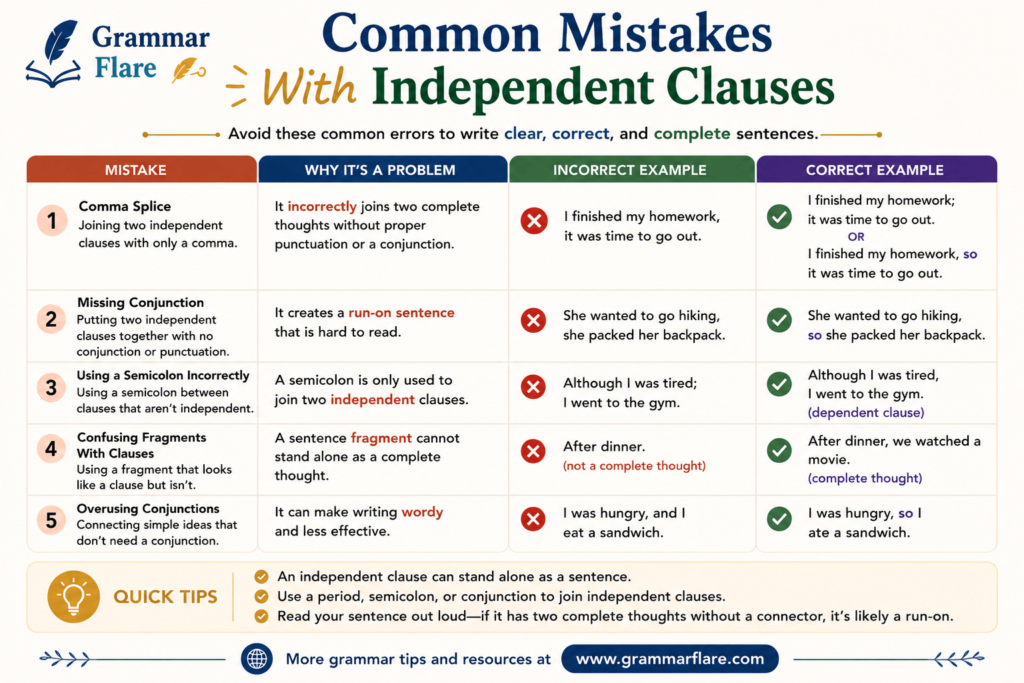
Mistake 1: Joining two independent clauses with only a comma
Incorrect: I finished the lesson, I took the quiz.
Correct: I finished the lesson, and I took the quiz.
Also correct: I finished the lesson; I took the quiz.
Also correct: I finished the lesson. I took the quiz.
Mistake 2: Writing a dependent clause as a sentence
Incorrect: Because I finished the lesson.
Correct: Because I finished the lesson, I took the quiz.
Also correct: I finished the lesson.
Mistake 3: Confusing phrases with independent clauses
Incorrect: After the long meeting.
Correct: We talked after the long meeting.
Mistake 4: Thinking every long sentence has more than one independent clause
Long but still one independent clause: The tired student with the blue notebook answered the difficult question after class.
This has one main subject and one main verb: student answered
So it is one independent clause.
Mistake 5: Adding a comma before every “and”
No comma needed: She opened the file and checked the title.
Comma needed: She opened the file, and her editor checked the title.
The first sentence has one subject doing two actions. The second sentence has two independent clauses.
How to Fix a Comma Splice
A comma splice happens when two independent clauses are joined with only a comma.
Incorrect: The rule is simple, the examples are helpful.
You can fix it in four main ways.
Fix 1: Add a coordinating conjunction
The rule is simple, and the examples are helpful.
Fix 2: Use a semicolon
The rule is simple; the examples are helpful.
Fix 3: Use a period
The rule is simple. The examples are helpful.
Fix 4: Make one clause dependent
Because the rule is simple, the examples are helpful.
Each option is correct. Choose the one that fits your meaning and style.
Independent Clauses in Everyday Writing
Emails
- I attached the file.
- Please review the document.
- The meeting starts at noon.
- I will send the update tomorrow.
- We can discuss the changes on Friday.
School writing
- The author uses strong imagery.
- The character changes throughout the story.
- The evidence supports the argument.
- The experiment produced clear results.
- The conclusion answers the research question.
Blog writing
- The rule is simple.
- Examples make the rule clearer.
- This mistake is common.
- A comma can change the sentence.
- The quiz will help you practice.
Conversation
- I’m tired.
- She called me.
- We ordered pizza.
- The movie ended.
- He forgot his keys.
Independent clauses are everywhere because they are the core of complete sentences.
Independent Clauses for Better SEO Writing
For SEO writing, the main answer should often be an independent clause.
Good: An independent clause can stand alone as a complete sentence.
Weak: When a clause has the ability to stand alone as a complete sentence.
The second version is not a complete sentence. It leaves the reader waiting.
Clear independent clauses are especially useful in:
- quick answers
- definitions
- headings
- FAQ answers
- meta descriptions
- image text
- examples
- summaries
For example:
Good FAQ answer: An independent clause has a subject, a verb, and a complete thought.
That is clear, direct, and easy to extract.
How to Teach Independent Clauses
Here is a simple classroom-friendly method.
Step 1: Start with a short sentence
Example:
She smiled.
Ask: Who is the sentence about?
She.
What did she do?
Smiled.
Does it make sense?
Yes.
Step 2: Add details
She smiled at her friend.
Still independent.
She smiled at her friend after class.
Still independent.
Step 3: Add a dependent word
Because she smiled at her friend after class
Now it is not complete.
Ask: What happened because she smiled?
The reader needs more information.
Step 4: Complete the sentence
Because she smiled at her friend after class, he felt welcome.
Now the sentence has a dependent clause and an independent clause.
Easy Memory Trick
Use this memory trick:
Independent means it can stand alone.
An independent clause does not need help to be a complete sentence.
Examples:
- I waited.
- She laughed.
- The teacher explained the rule.
- We finished the project.
Each one stands alone.
A dependent clause depends on something else.
Examples:
- because I waited
- when she laughed
- after the teacher explained the rule
- although we finished the project
These need another clause to complete the meaning.
Quick Test: Is It an Independent Clause?
Ask:
Can I put a period after it?
If yes, it is probably an independent clause.
Example:
The students finished the quiz.
Yes. You can put a period after it.
Now try:
Because the students finished the quiz.
No. It feels unfinished.
That is not an independent clause.
This test works most of the time.
Mini Quiz: Independent Clause or Not?
Identify each group of words as an independent clause or not an independent clause.
- The dog barked loudly.
- Because the dog barked loudly.
- She opened the window.
- When she opened the window.
- My brother plays football.
- After my brother plays football.
- The teacher explained the rule.
- Although the teacher explained the rule.
- We waited outside.
- While we waited outside.
Answers
- Independent clause
- Not an independent clause
- Independent clause
- Not an independent clause
- Independent clause
- Not an independent clause
- Independent clause
- Not an independent clause
- Independent clause
- Not an independent clause
Practice: Fix the Fragments
Turn each fragment into a complete sentence with an independent clause.
- Because I was late.
- After the class ended.
- When the rain stopped.
- Although she was nervous.
- Before we left home.
Possible answers:
- Because I was late, I took a taxi.
- After the class ended, we talked to the teacher.
- When the rain stopped, we went outside.
- Although she was nervous, she gave a great speech.
- Before we left home, we checked the doors.
Each corrected sentence includes an independent clause.
FAQ
What is an independent clause?
An independent clause is a group of words with a subject, a verb, and a complete thought. It can stand alone as a sentence.
What is an example of an independent clause?
Here is an example: She smiled. It has a subject, a verb, and a complete thought.
How do you identify an independent clause?
Ask whether the words have a subject, a verb, and a complete thought. If the group of words can stand alone as a sentence, it is an independent clause.
What is the difference between an independent clause and a dependent clause?
An independent clause can stand alone. A dependent clause cannot stand alone because it does not express a complete thought.
Can an independent clause be one word?
Usually, no. Most independent clauses need at least a subject and verb. However, commands like Stop! can be complete sentences because the subject you is understood.
Is every sentence an independent clause?
Every complete simple sentence is an independent clause. However, longer sentences can contain more than one clause, including dependent clauses.
Can a sentence have two independent clauses?
Yes. A sentence with two independent clauses is often a compound sentence. Example: I studied the rule, and I passed the quiz.
Do independent clauses need commas?
A single independent clause does not need a comma just because it is independent. But when two independent clauses are joined by a coordinating conjunction, use a comma before the conjunction.
What is a comma splice?
A comma splice happens when two independent clauses are joined with only a comma. Example: I was tired, I went home. Fix it with a conjunction, semicolon, or period.
Related GrammarFlare Reading
If this guide helped, read these next:
- What Is a Compound Sentence? Simple Rules and Examples
- What Is a Complex Sentence? Simple Rules and Examples
- Simple Sentence: Meaning, Rules, and Examples
- How to Fix a Comma Splice
- Comma Before “But”
Sources
- Purdue OWL: Identifying Independent and Dependent Clauses
- Purdue OWL: Sentence Punctuation Patterns
- Purdue OWL: Run-ons, Comma Splices, and Fused Sentences
- Cambridge Dictionary: Independent Clause
- Merriam-Webster: Independent Clause
Final Takeaway
An independent clause is a complete grammatical idea.
Remember this simple formula:
Subject + verb + complete thought = independent clause
Examples:
- She smiled.
- I finished the lesson.
- The teacher explained the rule.
- We waited outside the classroom.
- The article answered the question clearly.
An independent clause can stand alone as a sentence. It can also join with another independent clause to form a compound sentence or combine with a dependent clause to form a complex sentence.
Once you understand independent clauses, many grammar rules become easier, including comma rules, semicolon rules, fragments, run-ons, simple sentences, compound sentences, and complex sentences.

Ahmad Waheed has spent five years editing academic and professional writing for universities, publishers, and software companies. He founded Grammar Flare after noticing the same handful of mistakes in almost every draft that crossed his desk, and that most grammar guides explained the rule without explaining when it actually matters.
Ahmad writes every guide on this site, checking usage questions against Merriam-Webster, the Chicago Manual of Style, and the AP Stylebook, and noting where those sources disagree rather than quietly picking a side.