
If you are not sure when to use a colon, start with one simple rule: use a colon after a complete sentence to introduce something that explains, lists, shows, or emphasizes what comes next.
That means a colon often appears before a list, an explanation, an example, or a quotation. It does not belong after a sentence fragment. If you want more punctuation help, our Punctuation Rules guides cover commas, semicolons, and apostrophes.
Quick Answer
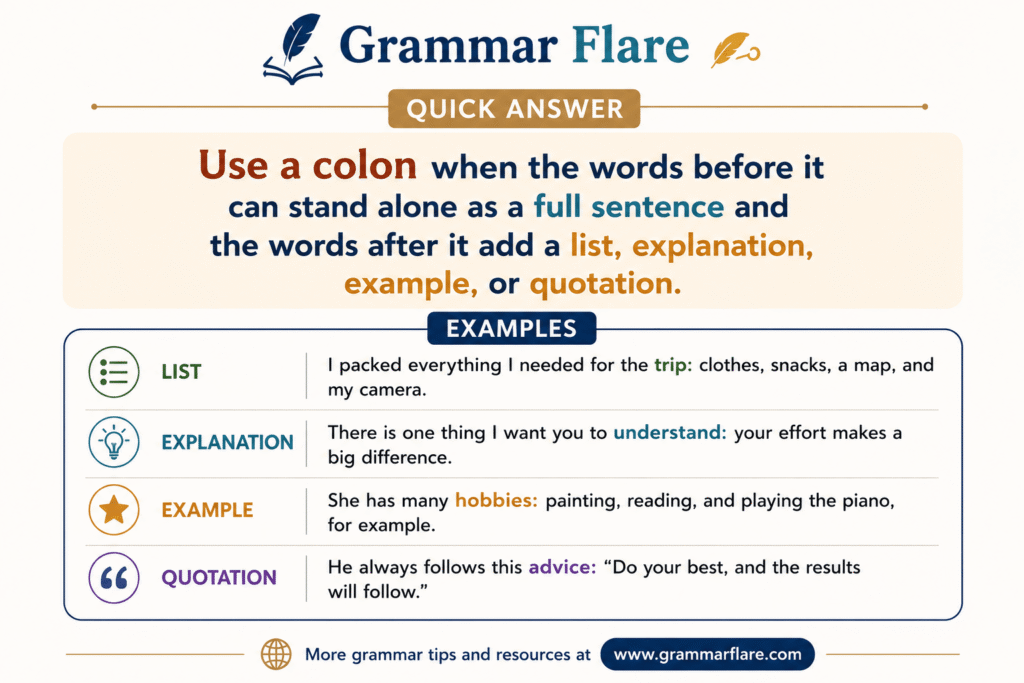
Use a colon when the words before it can stand alone as a full sentence and the words after it add a list, explanation, example, or quotation.
- Correct: I brought three things: a notebook, a pen, and a charger.
- Correct: There was only one problem: the file was missing.
- Not correct: My favorite snacks are: chips and fruit.
The easiest test is this: if the words before the colon are not a complete sentence, do not use a colon.
Colon Rule in One Sentence
A colon should come after an independent clause and before material that explains or completes that clause.
What Is a Colon?
A colon is the punctuation mark with two dots: :
In everyday writing, it usually signals that something important is coming next. It tells the reader to pause and expect:
- a list
- an explanation
- an example
- a quotation
- a formal label, title, or time expression
When to Use a Colon in a Sentence
Use a colon before a list
Use a colon before a list when the part before the colon is already a complete sentence.
Correct examples:
- We need three supplies: paper, tape, and scissors.
- She packed everything for the trip: shoes, a jacket, snacks, and a map.
- The class covered four topics: nouns, verbs, adjectives, and adverbs.
Why it works:
- We need three supplies is a full sentence.
- The list after the colon finishes the idea.
Use a colon before an explanation or result
A colon is also useful when the second part explains the first part.
Correct examples:
- He had one goal: to finish the report before lunch.
- The room felt different: everyone had gone quiet.
- I knew what caused the delay: the attachment never uploaded.
In these cases, the colon acts like a sign that says, “Here is the explanation.”
Use a colon before an example
You can use a colon to introduce an example when the first part is a complete sentence.
Correct examples:
- One sentence changed the whole tone: “I appreciate your patience.”
- She had a simple strategy: ask first, answer clearly, and stay calm.
Use a colon before a quotation
Colons can introduce quotations, especially in more formal writing.
Correct examples:
- The teacher gave one instruction: “Revise for clarity, not just length.”
- The note ended with a reminder: “Please submit your draft by Friday.”
A colon works before a quotation only when the words before it form a complete sentence. After a speech verb like said, use a comma instead: The coach said, “Stay focused.”
Use a colon in common fixed formats
A colon also appears in standard formats such as:
- time:
10:30 a.m. - ratios:
2:1 - titles and subtitles: Writing Clearly: A Practical Guide
Colons in Letter and Email Greetings
This is the one colon convention that changes depending on which side of the Atlantic you are writing on.
| Context | Convention | Example |
|---|---|---|
| American formal business letter | Colon | Dear Hiring Manager: |
| American business email, formal | Colon | Dear Ms. Rahman: |
| American email, ordinary | Comma | Dear Sarah, |
| British letter or email | Comma | Dear Ms Rahman, |
| Informal, either variety | Comma | Hi Sarah, |
In American English, the colon signals formality. It is standard in cover letters, formal complaints, and correspondence with someone you have not met.
In British English the colon is not used in greetings at all, and a comma appears in both formal and informal contexts.
In practice, email has softened this. A colon after a greeting reads as noticeably formal even in American business email, and many writers now use a comma throughout except in genuinely formal letters. If you are unsure, the comma is the safer default and will not look wrong to either audience.
One related difference worth knowing: American English writes Mr., Ms., and Dr. with a full stop; British English usually omits it, writing Mr, Ms, and Dr. If you are matching a house style, these two conventions usually travel together.
If the opening of your emails is something you think about often, our guides to professional ways to say “please let me know” and another way to say “I hope you are doing well” cover what comes after the greeting.
When Not to Use a Colon
Knowing when not to use a colon is just as important.
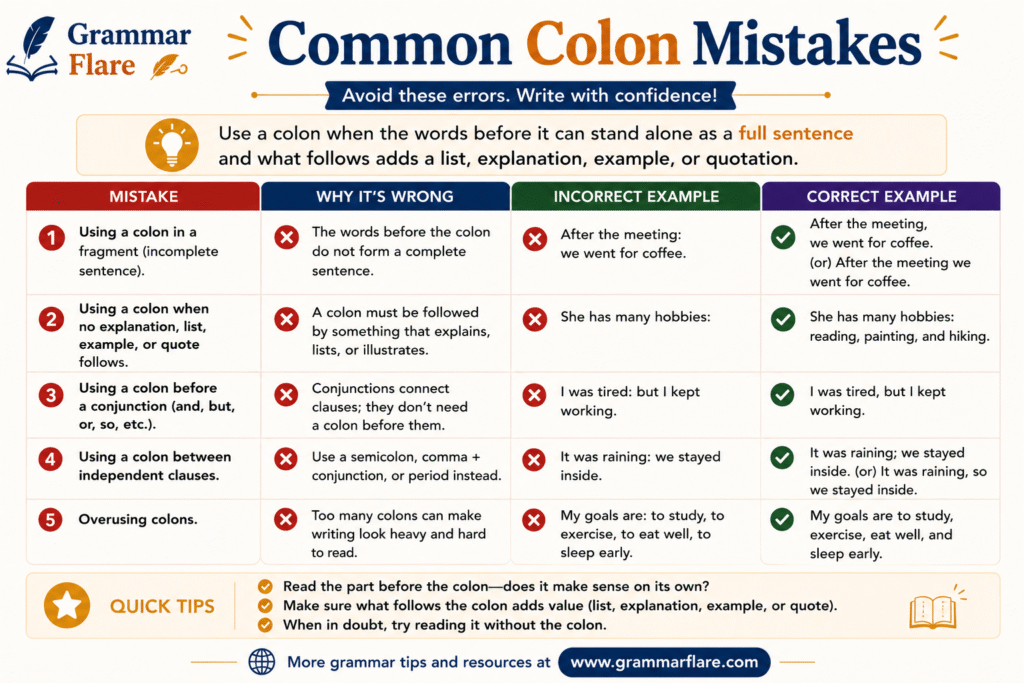
Do not use a colon after a fragment
Wrong:
- My favorite desserts are: cake and ice cream.
Right:
- My favorite desserts are cake and ice cream.
- I have two favorite desserts: cake and ice cream.
Why the first version is wrong:
- My favorite desserts are is not the kind of complete lead-in that needs a colon there. The sentence flows directly into the list.
The same principle decides most punctuation questions: check whether each part could stand alone. It is the test behind knowing when you need a comma before “but” as well.
Do not use a colon right after a verb or preposition
Wrong:
- The box contains: old letters, photos, and receipts.
- We talked about: deadlines, pricing, and next steps.
Right:
- The box contains old letters, photos, and receipts.
- We talked about deadlines, pricing, and next steps.
- We discussed three issues: deadlines, pricing, and next steps.
Do not use a colon just to sound formal
Some writers add colons because they look serious or polished. That usually makes the sentence worse.
Use a colon only when it helps the structure and makes the next part clearer.
Colon Examples in One Table
| Use | Example |
|---|---|
| List | Bring these items: your ID, your ticket, and a notebook. |
| Explanation | She looked worried: the email had gone to the wrong client. |
| Example | One phrase sounded warmer: “Thanks for the update.” |
| Time | The meeting starts at 9:15. |
| Title | Grammar Basics: Clear Rules for Everyday Writing |
Colons in Lists: In-Line and Bulleted
Lists that run inside a sentence
The basic rule applies: the words before the colon must form a complete sentence.
We shortlisted three candidates: Amina, Daniel, and Priya.
When the list items already contain commas
If any item in your list contains a comma, separate the items with semicolons instead. The colon still introduces the list; the semicolons keep the items apart.
Three cities made the shortlist: Austin, Texas; Portland, Oregon; and Raleigh, North Carolina.
Without the semicolons that sentence appears to list six things rather than three.
The same applies when items are long or contain internal punctuation of any kind:
The report covered three areas: staffing, which had improved since March; budget, which had not; and retention, which nobody had measured.
Bulleted and numbered lists
Use a colon before a vertical list when the lead-in is a complete sentence.
Bring the following:
- your ID
- your ticket
- a notebook
When the lead-in is not a complete sentence and the bullets finish it grammatically, no colon is needed.
Before the meeting, please
- read the agenda
- review the budget
- send any questions
Punctuation at the end of list items
Two workable conventions, and consistency matters more than the choice:
- Fragments: no punctuation at the end of each item, no full stop on the last one
- Complete sentences: capitalise each item and end each with a full stop
Do not mix the two within one list.
The “including” and “such as” trap
Words like including, such as, and for example already introduce a list, so a colon after them is redundant.
- Wrong: Bring snacks such as: fruit, crackers, and cheese.
- Right: Bring snacks such as fruit, crackers, and cheese.
- Right: Bring these snacks: fruit, crackers, and cheese.
Colon vs. Semicolon

A colon and an em dash can often introduce the same material. The difference is tone and structure rather than correctness.
A colon is structural. It tells the reader that what follows completes or explains what came before, and it does so neutrally.
An em dash is conversational. It suggests an interruption, an aside, or a deliberate pause for effect.
Compare:
- There was one problem: the file had not saved.
- There was one problem — the file had not saved.
Both are correct. The first reads as measured and formal. The second reads as though someone is telling you in conversation.
When to choose the colon
- Formal writing, reports, and documentation
- Introducing a list
- When the second part genuinely explains the first
- When you want the sentence to feel controlled
When to choose the dash
- Informal or conversational writing
- An afterthought or an aside
- When you want emphasis or surprise
- When the material interrupts rather than completes
The one thing a colon cannot do
An em dash can work in pairs to enclose material in the middle of a sentence. A colon cannot.
The revised plan — which nobody had read — went ahead anyway.
There is no colon equivalent of that construction. For enclosing material mid-sentence your options are paired dashes, commas, or parentheses.
A note on spacing
Style guides differ here too. Chicago sets the em dash closed up against the surrounding words, with no spaces. AP puts a space on each side.
- Chicago: There was one problem—the file had not saved.
- AP: There was one problem — the file had not saved.
Pick one and be consistent. Mixing them within a document is the only genuine error.
A word of caution
Dashes are easy to overuse. A paragraph with three of them reads as breathless, and the emphasis stops landing because everything is emphasised. If you find several in a row, convert some to colons, commas, or full stops.
Use a colon when the second part explains or introduces
Example:
- There was one reason we stayed late: the final file was corrupted.
Use a semicolon when you connect two closely related full sentences
Example:
- The final file was corrupted; we had to rebuild it from the backup.
Simple difference:
- Colon = “here comes the explanation or list”
- Semicolon = “these two full sentences are closely connected”
If you are unsure whether your two halves really are full sentences, our guide to when to use a semicolon works through the test, and what an independent clause is covers how to spot one.
Do You Capitalize After a Colon?
In most everyday American English, no. The first word after a colon stays lowercase.
- She needed one thing: patience.
- There was only one city we could choose: Chicago. (capitalised because it is a proper noun)
- He gave one answer: “No.” (capitalised because it starts a quotation)
Beyond those two automatic cases, the major style guides disagree, and the disagreement is worth knowing because it explains why you will see the rule applied both ways in published writing.
| Style guide | What it says | Example |
|---|---|---|
| Chicago Manual of Style | Lowercase, unless what follows is two or more complete sentences, a direct quotation, or a formal rule or principle | She had one worry: the deadline was Friday. |
| AP Stylebook | Capitalise whenever what follows the colon is a complete sentence | She had one worry: The deadline was Friday. |
So the same sentence is correct either way, depending on which guide you follow. Neither version is an error.
What to do if you have no house style: pick lowercase and stay consistent. It is the more common choice in general writing, and it never looks wrong. What does look wrong is switching between the two in the same document.
One case where both agree: when two or more complete sentences follow the colon, capitalise the first.
The plan had two parts: First, we would rewrite the introduction. Second, we would cut the third section entirely.
A Quick Colon Test
If you are unsure whether a colon belongs in your sentence, use this three-step test.
1. Is the part before the colon a complete sentence?
If no, do not use a colon.
2. Does the part after the colon explain, list, show, or quote something?
If yes, a colon may be the right choice.
3. Would the sentence still make sense without a dramatic pause?
If the sentence flows naturally without the colon, you may not need it.
Quick Practice
Choose whether each sentence needs a colon.
- We visited three cities _ Boston, Philadelphia, and Chicago.
- There was only one answer _ try again.
- The package included _ a cable, a charger, and a manual.
- The coach said _ “Stay focused.”
Answers
- Needs a colon -> We visited three cities: Boston, Philadelphia, and Chicago.
- Needs a colon -> There was only one answer: try again.
- Does not need a colon -> The package included a cable, a charger, and a manual.
- Does not needs a colon -> The coach said, “Stay focused.”
Common Colon Mistakes
Mistake 1: Using a colon after “such as” or “including”
Wrong:
- Bring snacks such as: fruit, crackers, and cheese.
Right:
- Bring snacks such as fruit, crackers, and cheese.
- Bring these snacks: fruit, crackers, and cheese.
Mistake 2: Using a colon where a comma works better
Not every pause needs a colon. If the sentence is simple and direct, a comma or no punctuation may be better.
Mistake 3: Mixing up colon and semicolon
If the second part is not explaining or introducing something, you may need a semicolon instead.
Joining two full sentences with only a comma creates a different error, which our guide to fixing a comma splice explains with four ways to correct it.
Mistake 4: Capitalizing every word after a colon
Only capitalize after a colon when normal capitalization rules or your style guide call for it.
Chicago keeps the first word lowercase unless what follows is two or more complete sentences, a direct quotation, or a formal rule. AP capitalises the first word whenever what follows is a complete sentence. So She had one worry: the deadline was Friday is lowercase under Chicago and capitalised under AP. Neither is wrong; pick one and stay consistent.
Why Colons Matter in Clear Writing
A well-placed colon makes writing easier to scan. It helps readers see a list quickly, notice an explanation faster, and understand the structure of your sentence with less effort.
That matters in:
- emails
- essays
- blog posts
- instructions
- professional writing
FAQ
Can you use a colon before a list?
Yes, but only when the words before the colon form a complete sentence.
Correct:
- I bought three things: bread, eggs, and coffee.
Not correct:
- I bought: bread, eggs, and coffee.
Can you use a colon after “including” or “such as”?
Usually no. Words like including and such as already introduce examples or a list, so a colon is usually unnecessary.
What is the difference between a colon and a dash?
A colon feels more formal and structural. A dash feels more conversational or dramatic. Both can introduce extra information, but a colon usually gives a clearer grammar signal.
Can you use a colon in an email?
Yes. Colons are common in formal email greetings, labels, and lists.
Examples:
- Dear Team:
- Next steps: review the file, leave comments, and confirm the deadline.
Do you capitalize after a colon?
Usually not in American English. Chicago keeps the first word lowercase unless what follows is two or more complete sentences, a quotation, or a formal rule. AP capitalises whenever a complete sentence follows. Both are accepted; consistency is what matters.
What is the difference between a colon and a semicolon?
A colon introduces something that explains or completes the first part. A semicolon joins two closely related complete sentences without a conjunction. If the second part explains the first, use a colon. If it simply continues the thought, use a semicolon.
Should I use a colon or a dash?
Both can introduce the same material. A colon is more formal and structural, a dash more conversational. Only the dash can work in pairs to enclose material in the middle of a sentence.
How do I punctuate a list where the items contain commas?
Introduce it with a colon and separate the items with semicolons: Three cities made the shortlist: Austin, Texas; Portland, Oregon; and Raleigh, North Carolina.
Do you use a colon or comma after “Dear”?
American formal letters use a colon: Dear Hiring Manager:. British letters use a comma. In ordinary email a comma is standard in both varieties, and a colon reads as noticeably formal.
Can you use a colon after “said”?
No. Said is a verb, and a colon needs a complete sentence before it. Use a comma: The coach said, “Stay focused.” A colon works before a quotation only when the lead-in is a full clause, as in The teacher gave one instruction: “Revise for clarity.”
Final Takeaway
If you remember just one rule, remember this: use a colon only after a complete sentence, and only when what follows explains, lists, shows, or emphasizes something important.
That one test will help you avoid most colon mistakes.
Explore More on GrammarFlare
If this guide helped, read these next:
- When to Use a Semicolon
- Comma Before “But”
- How to Fix a Comma Splice
- Apostrophe Rules
- Punctuation Rules
Sources
- The Chicago Manual of Style: capitalisation after a colon
- Merriam-Webster: colon
- Cambridge Dictionary: colon
- Purdue OWL: sentence punctuation patterns

Ahmad Waheed has spent five years editing academic and professional writing for universities, publishers, and software companies. He founded Grammar Flare after noticing the same handful of mistakes in almost every draft that crossed his desk, and that most grammar guides explained the rule without explaining when it actually matters.
Ahmad writes every guide on this site, checking usage questions against Merriam-Webster, the Chicago Manual of Style, and the AP Stylebook, and noting where those sources disagree rather than quietly picking a side.