

Instead of “please advise,” name the decision you need: Could you confirm whether we’re going with option A or option B? The problem with “please advise” is that it asks for something without saying what, which leaves the reader to work out both the question and the answer.
This guide gives you 30 alternatives sorted by what you actually need, plus a note on whether “please advise” is correct English in the first place.
Quick Answer
The best replacement for please advise depends on what you are asking for:
- A decision: Let me know how you’d like to proceed.
- Information: Could you let me know the correct invoice number?
- A choice between options: Option A or option B?
- Action by a date: Could you confirm by Thursday so we can keep the launch on track?
- Their opinion: What’s your read on this?
The phrase fails because it does none of these specifically. A vague request is easy to postpone, and postponed requests are the ones that never get answered.
Best Alternatives in One Table
| Alternative | Best use | Tone | Example |
|---|---|---|---|
| Let me know how you’d like to proceed. | you need a decision | neutral | Let me know how you’d like to proceed and I’ll set it up. |
| Could you confirm [specific thing]? | you need certainty | clear | Could you confirm the delivery address before I book the courier? |
| Which of these should I go ahead with? | two or more options | direct | Which of these should I go ahead with, the June or July slot? |
| Are you happy for me to proceed with [X]? | you have a default | efficient | Are you happy for me to proceed with the original spec? |
| I need a yes or no on [X]. | binary decision | firm | I need a yes or no on the venue by Friday. |
| Could you let me know [specific thing]? | missing information | polite | Could you let me know the correct purchase order number? |
| Can you point me to the right person? | wrong contact | practical | Can you point me to the right person for procurement questions? |
| Option A or option B? | genuine binary | very short | Option A or option B? Either works on my side. |
| My recommendation is [X], but happy to go the other way. | you have a view | collaborative | My recommendation is the phased rollout, but happy to go the other way. |
| Could you confirm by [date]? | deadline attached | clear | Could you confirm by Thursday so we can keep the launch on track? |
| If I don’t hear back by [date], I’ll proceed with [X]. | you can default | decisive | If I don’t hear back by Friday, I’ll proceed with the original quote. |
| What’s your read on this? | you want a view | open | What’s your read on this? I can see arguments both ways. |
| Does this look right to you? | checking work | light | Does this look right to you before I send it on? |
| Am I missing anything here? | inviting scrutiny | humble | Am I missing anything here before we commit? |
| Let me know either way. | any answer helps | easy | Let me know either way and I’ll plan around it. |
Why “Please Advise” Doesn’t Get a Straight Answer
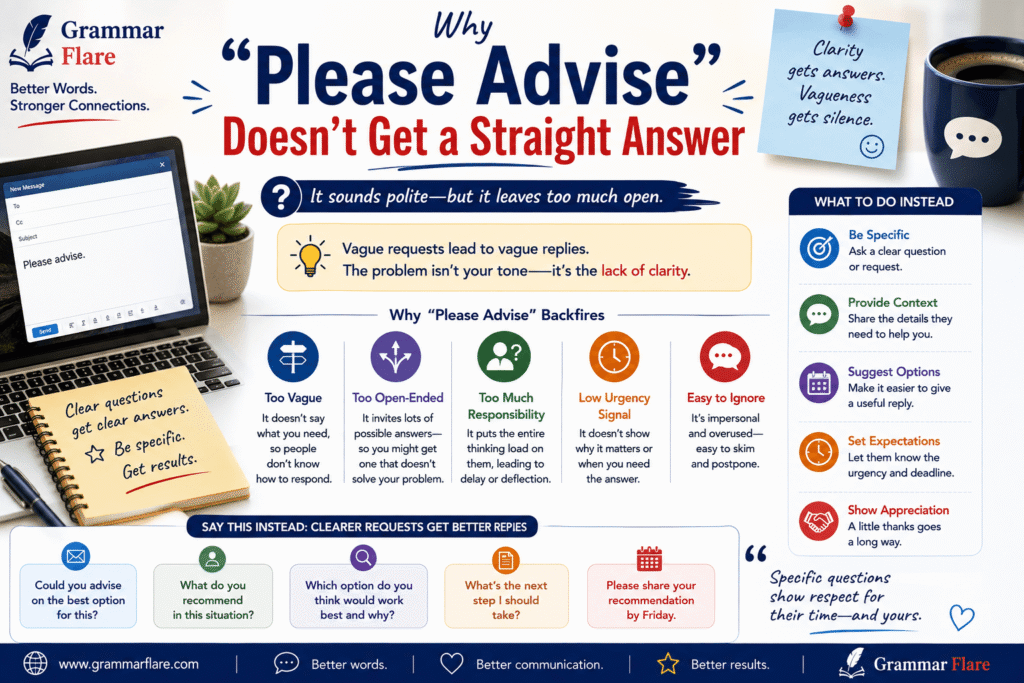
The phrase is polite, common, and grammatically defensible. It still fails, for reasons that have nothing to do with courtesy.
It names no decision. Advise on what? The reader has to reread your email, work out which part needed a response, and decide what kind of answer you were hoping for. That is three steps before they have written anything.
It carries no deadline. Without a date, nothing distinguishes this email from the forty others in the inbox, and it gets postponed by default.
It is an instruction, not a question. Please advise is grammatically an imperative. Softened by please, it still tells rather than asks, which is part of why it can read as curt or faintly impatient, particularly at the end of an email listing problems.
It hides the real ask. Writers often reach for it precisely when they are uncomfortable making a direct request. The vagueness is doing emotional work for the sender and creating work for the reader.
Every alternative below fixes at least one of these. The principle underneath all of them: name the decision, the options, or the date. Ideally all three.
Is “Please Advise” Correct English?
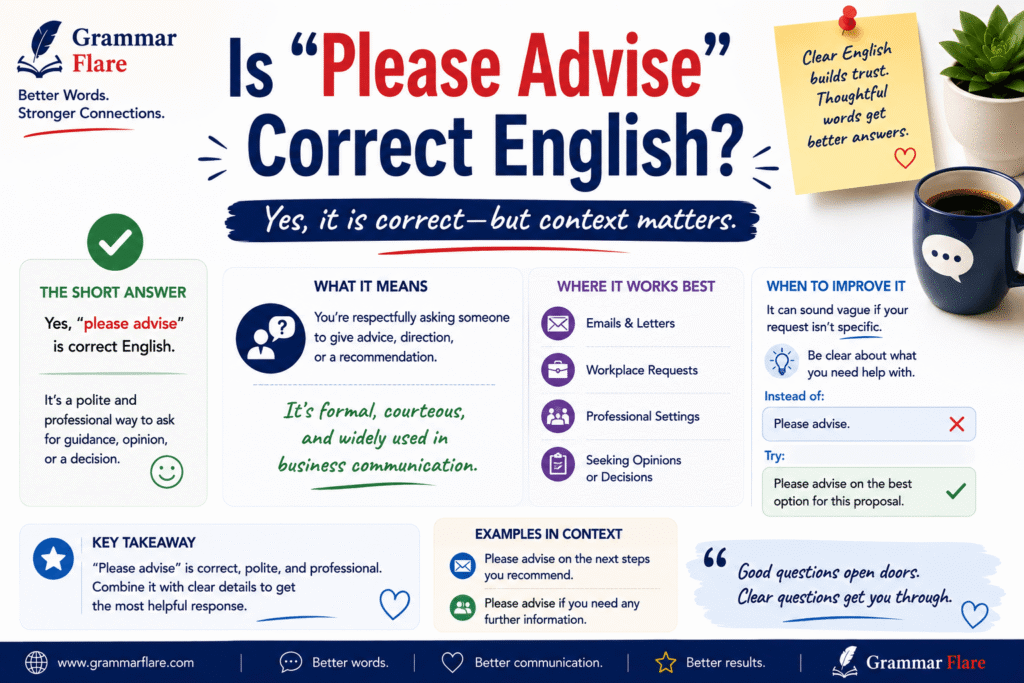
Worth separating from whether it is effective, since these are different questions.
The spelling is right, and this is where most errors happen. Advise is the verb and advice is the noun. Please advise uses the verb, which is correct. Please advice is an error, and a common one. If that distinction is the reason you are here, our guide to advice vs advise covers it in full.
One spelling detail worth knowing. Unlike organise and organize, the spelling of advise does not shift between British and American English. The s here belongs to the root of the word rather than to the -ise and -ize suffix that varies by region, so advize is not correct in any variety of English.
The grammar is elliptical rather than wrong. Advise normally takes an object: you advise someone, or you advise someone of something. Please advise drops both, which is why the phrase feels clipped. This kind of compression is characteristic of commercial English and is commonly traced to telegraphic business correspondence, where every word carried a cost and phrases such as please confirm and please find attached were shortened for the same reason.
So it is not an error, but it is a fossil. The register it belongs to is formal, impersonal, and about a century old. In modern email that register reads as either stiff or slightly cold, depending on what surrounds it.
Where that leaves you: nobody can correct your grammar for writing please advise, but almost any of the alternatives below will get you a faster and more useful reply.
30 Better Ways to Say “Please Advise”
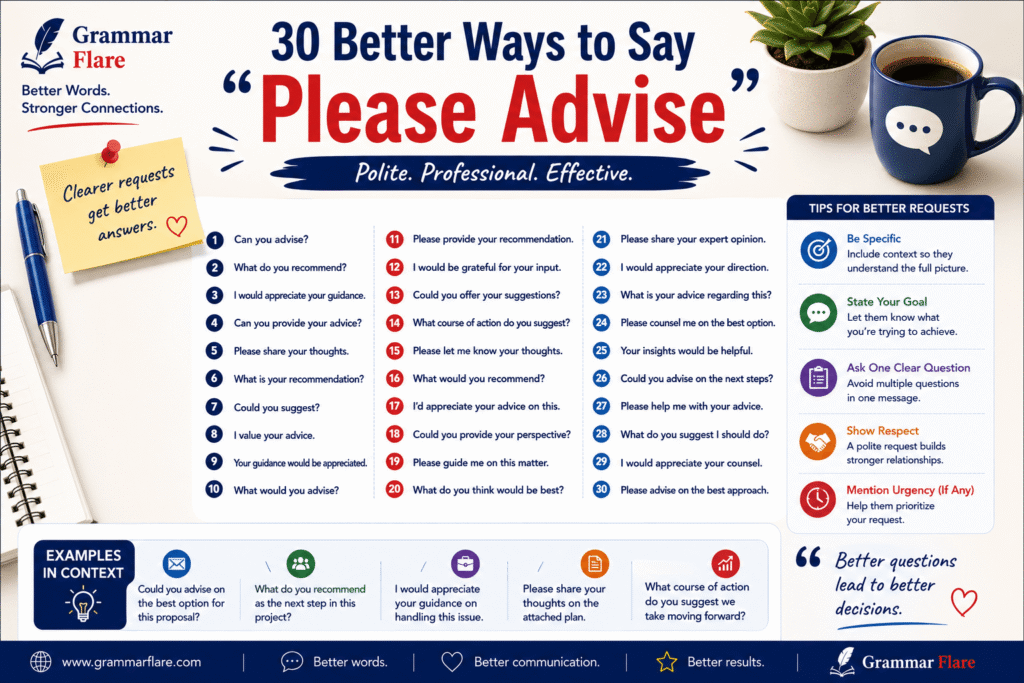
When you need a decision
1. Let me know how you’d like to proceed.
The closest direct substitution. It signals that a decision is required without prescribing which one.
Let me know how you’d like to proceed and I’ll set it up this week.
2. Could you confirm which option you’d like?
Assumes the options are already laid out above, which they should be.
Could you confirm which option you’d like, the June slot or the July one?
3. Which of these should I go ahead with?
Slightly more direct, and it makes clear that you are ready to act.
Which of these should I go ahead with? Either is fine from my side.
4. Are you happy for me to proceed with [X]?
Best when you have a sensible default. It converts an open question into a yes or no, which is far easier to answer.
Are you happy for me to proceed with the original spec?
5. I need a yes or no on [X].
Firm and unambiguous. Appropriate when previous soft requests have gone unanswered.
I need a yes or no on the venue by Friday.
6. Can you approve this, or tell me what to change?
Gives two exits, both of which move the work forward.
Can you approve this, or tell me what to change? Either gets us unstuck.
When you need information
7. Could you let me know [specific thing]?
Naming the specific thing is the entire difference between this and please advise.
Could you let me know the correct purchase order number?
8. What’s the correct [figure, date, or contact] for this?
Frames it as filling a gap rather than making a request, which lowers the effort involved.
What’s the correct billing address for the September invoice?
9. Do you know who owns this on your side?
Useful when you are not sure the person you are writing to is the right one.
Do you know who owns this on your side? Happy to take it to them directly.
10. Could you fill in the gap on [X]?
Light and specific. Works well internally.
Could you fill in the gap on the Q3 figures? Everything else is ready.
11. I’m missing [X]. Where can I find it?
States the blocker plainly and asks a question they can answer in five words.
I’m missing the signed NDA. Where can I find it?
12. Can you point me to the right person?
Asks for a redirection rather than an answer, which is often the fastest thing they can give you.
Can you point me to the right person for procurement questions?
When you need them to choose between options
Presenting a choice is one of the most effective things you can do, because it converts an open-ended task into a two-second decision.
13. Option A or option B?
Extremely short. Only use it when both options are set out clearly above.
Option A or option B? Either works on my side.
14. Here are two ways forward. Which do you prefer?
Slightly more formal, and appropriate for clients.
Here are two ways forward. Which do you prefer?
15. I’ve narrowed it to two. Your call.
Signals that you have done the work of eliminating the rest, which makes the ask feel smaller.
I’ve narrowed it to two. Your call on which we run with.
16. My recommendation is [X], but happy to go the other way.
Gives them a default and permission to override it. Often the highest response rate of anything on this page.
My recommendation is the phased rollout, but happy to go the other way if you’d rather move faster.
17. Which would you rather I prioritise?
Useful when the real question is sequencing rather than substance.
Which would you rather I prioritise, the report or the client deck?
When you need action by a deadline
18. Could you confirm by [date] so we can keep [X] on track?
Attaches a reason to the date, which makes it a constraint rather than a demand.
Could you confirm by Thursday so we can keep the launch on track?
19. I need this back by [date] to make the deadline.
States your constraint plainly. Most people respond well to being told the actual reason.
I need this back by Wednesday to make the print deadline.
20. If I don’t hear back by [date], I’ll proceed with [X].
Makes silence into a decision. Use only when the default is genuinely acceptable to you.
If I don’t hear back by Friday, I’ll proceed with the original quote.
21. What’s a realistic date for this on your side?
Hands them the timeline rather than imposing one, which works better with people who outrank you.
What’s a realistic date for this on your side? I can plan around most things with notice.
22. Can you get me an answer before [date]?
Direct and appropriate when a deadline is genuinely at risk.
Can you get me an answer before the 14th? After that the pricing changes.
When you genuinely want their opinion
Sometimes please advise is used correctly, in the sense of asking someone to advise you. These are the alternatives for that case.
23. What’s your read on this?
Invites judgement rather than instruction, which suits senior colleagues and people whose experience you are drawing on.
What’s your read on this? I can see arguments both ways.
24. How would you handle it?
Asks for their approach rather than their approval. Useful when you want to learn rather than get permission.
How would you handle it? I’ve not run into this before.
25. Does this look right to you?
Light-touch review request. Low effort to answer, which is why it usually gets answered.
Does this look right to you before I send it on to the client?
26. Am I missing anything here?
Invites scrutiny explicitly, which tends to surface the objection someone was going to raise later anyway.
Am I missing anything here before we commit to the date?
Casual and internal
27. Thoughts?
Minimal and effective in internal threads, though too abrupt for clients.
Draft’s attached. Thoughts?
28. Let me know either way.
Signals that any answer is useful, which removes the pressure to have a good one.
Let me know either way and I’ll plan around it.
29. Shout if you’d rather do it differently.
Very informal, and it sets a default while leaving the door open.
I’ll book the Tuesday slot. Shout if you’d rather do it differently.
30. Happy to go either way, just say which.
Removes any suggestion that you are pushing for one outcome.
Happy to go either way, just say which and I’ll sort it.
Which Alternative to Use, by Situation
Writing to a client
Never end a client email with please advise. Give them a recommendation and a default, which is what they are usually paying you for.
My recommendation is the phased rollout, mainly because it keeps the January date safe. Happy to go the other way if you’d prefer. Could you confirm by Thursday?
Naming a trade-off rather than refusing outright works the same way when you are turning down a meeting, which our guide to declining a meeting politely covers in more detail.
Writing to your manager
Ask for a decision, not for guidance, and make the decision small. Senior people answer binary questions faster than open ones.
Two ways forward on the budget line. My preference is B. Are you happy for me to proceed, or would you rather we talk it through?
If what you are really doing is questioning the decision rather than asking about it, that is a different conversation, and our guide to disagreeing with your boss covers how to open it.
Writing to someone more senior than you outside your company
Ask for their view rather than their instruction. The distinction matters, because instructing implies an obligation they have not agreed to.
What’s your read on this? I’d value the perspective before we commit.
Writing to a colleague
Be short. Internal threads rarely need the formality, and brevity gets faster replies.
Draft’s attached. Thoughts, or shall I send it?
When you have already asked once
Stop being open-ended. Convert the request into a yes or no with a date attached.
Coming back to this one. I need a yes or no on the venue by Friday, otherwise we lose the hold.
When nobody has replied and you can proceed anyway
Make silence into a decision. This is the single most effective technique for unblocking a stalled thread.
If I don’t hear back by Friday, I’ll proceed with the original quote and we can adjust later if needed.
When you genuinely do not know what to do
Say so plainly. Pretending to have a recommendation you do not have wastes everyone’s time.
I don’t have a strong view here and I’d rather not guess. How would you handle it?
When you are asking about a mistake or a problem
Separate the problem from the ask. Describe what happened, then state clearly what you need from them.
The invoice went out with last quarter’s rates. I’ve flagged it with billing. What I need from you is whether we absorb the difference or reissue.
When the answer needs to come from someone else
Do not ask your recipient to advise. Ask them for a name.
Can you point me to the right person for procurement questions? Happy to take it from there.
Phrases to Avoid
“Please advice.” The most common error associated with this phrase. Advice is a noun, so it cannot follow please as an instruction. The verb is advise.
“Please advise ASAP.” Combines a vague request with an urgent tone, which reads as pressure without direction. Give a date instead.
“Please advise accordingly.” Accordingly adds nothing, since it points back at a request that was never specified.
“Kindly advise.” Kindly used as a softener before an instruction reads as formal to the point of coldness in most modern contexts.
“Please advise on the below.” The below is not idiomatic in careful writing, and the phrase still fails to say what kind of response you need.
“Awaiting your advice.” Positions you as waiting on them, which can read as pointed. State the deadline instead.
“Please advise at your earliest convenience.” A deadline that is not a deadline. If a date matters, name it.
One Test Before You Send
Read your closing line and ask: could the reader answer this in one sentence without rereading the email?
If they would have to scroll up to work out what you are asking, the request is not specific enough. Put the decision, the options, or the date directly into the final line. A question that can be answered in five words gets answered today.
FAQ
What can I say instead of “please advise”?
Name what you need. Let me know how you’d like to proceed for a decision, could you confirm [specific thing] for information, or option A or option B? when the answer is binary.
Is “please advise” rude?
Not intentionally, and most people who write it mean nothing by it. It can read as curt because it is grammatically an imperative and because its vagueness places the work of interpretation on the reader, which is particularly noticeable at the end of an email describing a problem.
Is “please advise” correct English?
Yes. Advise is the verb form and the usage is grammatically defensible, though elliptical, since advise normally takes an object. It belongs to a compressed commercial register that now reads as dated in ordinary email.
Is it “please advise” or “please advice”?
Please advise. Advise is the verb, advice is the noun, and only a verb can follow please in an instruction. Our full guide to advice vs advise covers the distinction with more examples.
Is “advise” ever spelled with a z?
No. Unlike organise and organize, the s in advise is part of the root rather than a regional suffix, so advize is incorrect in British, American, and every other variety of English.
What is a more polite way to say “please advise”?
Politeness is rarely the issue. Specificity is. Could you confirm which option you’d prefer? is both warmer and clearer, because it tells the reader exactly what a helpful reply would contain.
How do I ask for a decision without sounding demanding?
Offer a default and permission to override it: My recommendation is X, but happy to go the other way. This gives the reader control while removing the effort of starting from scratch.
Should I use “please advise” with a client?
Better not to. Clients generally want a recommendation rather than an open question. Give your view, give them an easy way to disagree, and attach a date.
What can I say instead of “please advise” in a formal letter?
I would be grateful if you could confirm [specific thing] by [date] keeps the formality while adding the specificity the original lacks.
Why do people use “please advise” so often?
Because it is a safe default when you are unsure how directly to ask for something. The vagueness feels polite to write and unhelpful to receive, which is the core of the problem.
Is “please advise” American or British?
It appears in both, and it is common in Indian, Pakistani, and Middle Eastern business English as well, often in more formal registers than are typical in the United States or Britain.
What should I do if someone sends me “please advise” and I don’t know what they want?
Ask a specific question back rather than guessing: Happy to help. Are you asking whether we should proceed, or which option to use? Guessing wrong costs another round of email.
Is “please let me know” better than “please advise”?
Slightly, because it is warmer and less imperative, but it has the same vagueness problem if you do not say what you want to be told. See our guide to professional ways to say please let me know.
Short Answers for Quick Reference
- Best all-purpose alternative: Let me know how you’d like to proceed.
- Best when you need a decision fast: I need a yes or no on [X] by [date].
- Best with a client: My recommendation is [X], but happy to go the other way.
- Best when nobody is replying: If I don’t hear back by [date], I’ll proceed with [X].
- Best when you want their opinion: What’s your read on this?
- Advise or advice? Advise is the verb, advice is the noun. Please advise is correct.
- The rule underneath all of it: Name the decision, the options, or the date.
More Reading at GrammarFlare
- Professional Ways to Say “Please Let Me Know”
- Advice vs Advise
- Another Way to Say “As Per My Last Email”
- Another Way to Say “Just Checking In”
Sources

Ahmad Waheed has spent five years editing academic and professional writing for universities, publishers, and software companies. He founded Grammar Flare after noticing the same handful of mistakes in almost every draft that crossed his desk, and that most grammar guides explained the rule without explaining when it actually matters.
Ahmad writes every guide on this site, checking usage questions against Merriam-Webster, the Chicago Manual of Style, and the AP Stylebook, and noting where those sources disagree rather than quietly picking a side.