

You need a comma before but when what follows it could stand alone as its own sentence. I wanted to go, but I was too tired. You do not need one when the second part has no subject of its own: I wanted to go but couldn’t.
That single test settles almost every case. This guide covers the rule, the exception most writers get wrong, and the situations where the major style guides disagree.
Quick Answer
- Comma: when but joins two complete sentences. The report is finished, but I haven’t sent it yet.
- No comma: when the words after but have no subject. She tried but failed.
- No comma: when but joins two words or phrases rather than clauses. Small but strong.
- Optional: when both clauses are very short. I called but he didn’t answer.
The mistake to avoid is adding a comma out of habit whenever but appears. Whether it belongs depends entirely on what comes after it.
The One Test That Settles It
Cover everything before the word but. Read what is left. Can it stand alone as a complete sentence?
| Sentence | What follows “but” | Stands alone? | Comma? |
|---|---|---|---|
| I wanted to go, but I was too tired. | I was too tired | Yes | Yes |
| I wanted to go but couldn’t. | couldn’t | No | No |
| The soup was hot, but the bread was cold. | the bread was cold | Yes | Yes |
| The soup was hot but delicious. | delicious | No | No |
| She apologized, but he stayed angry. | he stayed angry | Yes | Yes |
| She apologized but meant none of it. | meant none of it | No | No |
The reason the test works is that a comma plus a conjunction is what English uses to join two independent clauses. If there is only one clause, there is nothing to join, so the comma has no job to do.
When You Need the Comma
Use a comma when but connects two independent clauses, meaning each side has its own subject and its own verb.
The deadline is Friday, but the client wants it Wednesday.
I sent the invoice last week, but nobody has replied.
We can take the earlier train, but we would have to leave now.
He knew the answer, but he said nothing.
In each of these, both halves could be written as separate sentences without changing anything. The comma marks the seam.
This is the same rule that governs the other coordinating conjunctions: for, and, nor, but, or, yet, so, often remembered as FANBOYS. The logic that applies to but applies equally to a comma before and.
When You Don’t Need the Comma
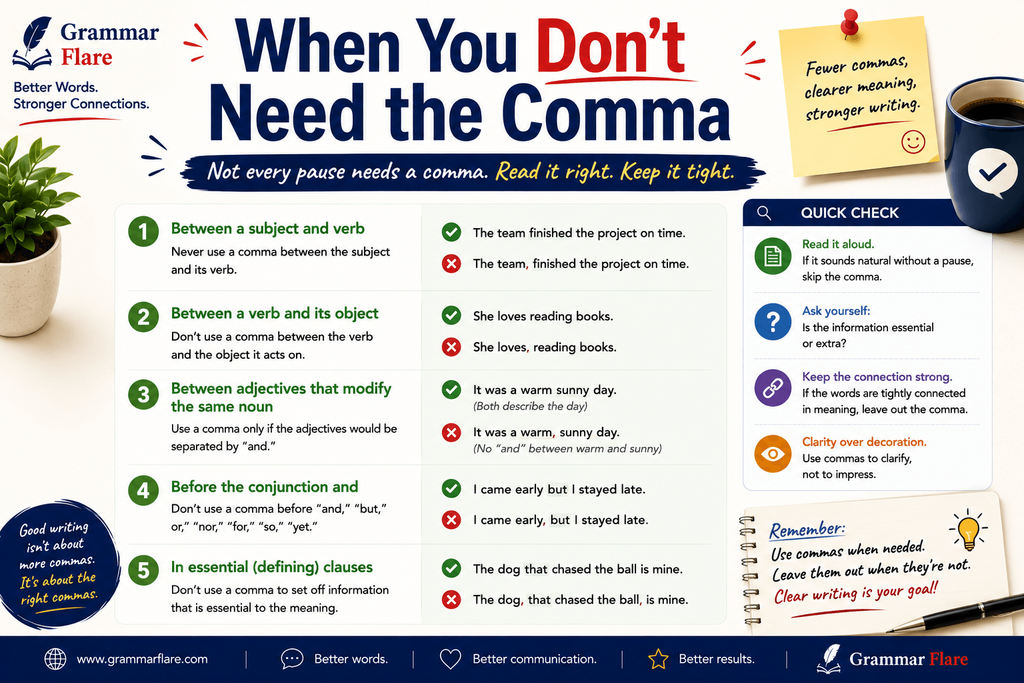
Compound predicates
This is the case most writers get wrong. When one subject performs two actions joined by but, there is no second clause and no comma.
She studied for weeks but failed the exam.
He apologized but did not explain.
The package arrived on time but had been opened.
In each, the subject appears once. Failed the exam has no subject of its own, so it cannot stand alone, so no comma.
Compare directly:
She studied for weeks but failed the exam. (one subject, no comma)
She studied for weeks, but the exam defeated her. (two subjects, comma)
When “but” joins words or phrases
If but connects two adjectives, nouns, or short phrases, no comma is needed.
A small but significant change.
Tired but happy.
Not the cost but the timing worried us.
In “not only… but also”
This construction usually takes no comma, because the two parts function as a single unit.
She is not only fluent in French but also conversational in Arabic.
A comma appears only if the second part is a full clause.
Not only did she finish early, but she also improved the design.
Where Style Guides Disagree
Two situations have no single correct answer, and knowing which is which matters more than picking a side.
Very short clauses
When both independent clauses are short and closely connected, the Chicago Manual of Style permits dropping the comma. The AP Stylebook is generally more consistent about keeping it before a coordinating conjunction joining independent clauses.
I called but he didn’t answer. (acceptable under Chicago)
I called, but he didn’t answer. (safer, and standard under AP)
If you write to a house style, follow it. If you have no house style, keeping the comma is the safer default, because it is never wrong.
A comma before a compound predicate, for emphasis
The general rule says no comma in a compound predicate. Chicago allows an exception where the comma prevents misreading or marks a deliberate contrast.
She promised to help, but never did.
Strictly, that sentence has one subject and needs no comma. In practice, many editors accept it because the pause carries the contrast. Use it sparingly and deliberately, not by accident.
Comma, Semicolon, or Period?
All three can separate the ideas that but joins. They are not interchangeable.
| Punctuation | Use when | Example |
|---|---|---|
| Comma + but | The contrast is part of one thought | It rained, but we went anyway. |
| Semicolon, no but | The clauses are closely linked and the contrast is obvious | It rained; we went anyway. |
| Period | You want the contrast to land harder | It rained. We went anyway. |
A semicolon replaces the conjunction rather than accompanying it, which is why it rained; but we went anyway is not standard. For the full rules on that mark, see when to use a semicolon.
What you cannot do is join the two clauses with a comma alone. It rained, we went anyway is a comma splice, and adding but is one of the four standard ways to fix it.
Can You Start a Sentence With “But”?
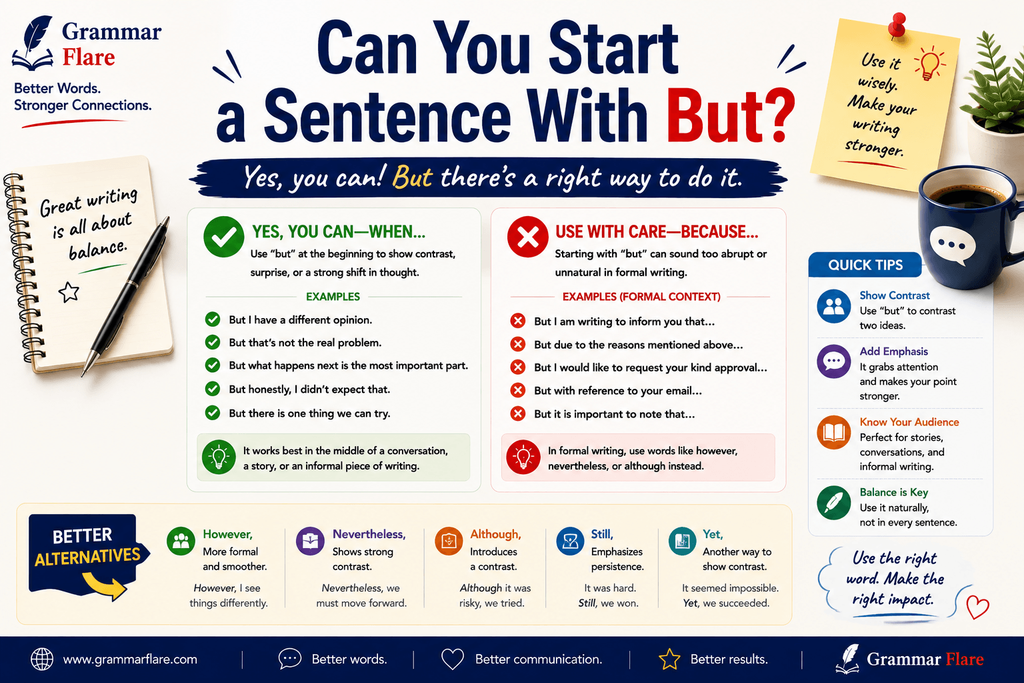
Yes. This is one of the most persistent myths in English usage, and it has no basis in any major style guide. Chicago, Merriam-Webster, and the AP Stylebook all accept it, and it has been standard in good writing for centuries.
The plan was sound. But the timing was wrong.
Starting with but is a stylistic choice that gives the contrast more weight than a comma would. Used occasionally it is effective. Used every paragraph it becomes a tic.
No comma follows the opening “but” unless a parenthetical phrase comes next.
But we ran out of time. (correct)
But, we ran out of time. (incorrect)
But, as I mentioned, we ran out of time. (correct, the commas belong to the parenthetical)
Do You Ever Put a Comma After “But”?
Only when something parenthetical follows and needs enclosing on both sides.
We agreed to the price, but, given the timeline, we asked for a deposit.
Remove the parenthetical and the commas go with it: we agreed to the price, but we asked for a deposit. The comma after but was never attached to but at all.
Common Mistakes
Adding a comma by reflex. The most frequent error. She tried, but failed has one subject and needs no comma.
Dropping the comma between two long clauses. The revised schedule arrived on Tuesday but nobody had time to review it before the meeting is hard to parse. Both halves are full clauses, so the comma helps.
Using a comma instead of a conjunction. It rained, we went anyway is a comma splice. Add but, or use a semicolon, or split the sentence.
Putting a comma after “but” at the start of a sentence. Unless a parenthetical follows, nothing goes there.
Writing “; but”. The semicolon already does the joining. Choose one.
Quick Reference
| Situation | Comma before “but”? |
|---|---|
| Two independent clauses | Yes |
| Compound predicate, no second subject | No |
| Joining adjectives or phrases | No |
| “Not only… but also” | Usually no |
| Two very short clauses | Optional |
| Deliberate contrast, shared subject | Optional, for emphasis |
| “But” starting a sentence | No comma after it |
FAQ
Do you always need a comma before “but”?
No. You need one when but joins two complete sentences. You do not when the words after but have no subject of their own, as in she tried but failed.
How do I know if I need the comma?
Cover everything before but and read what remains. If it works as a sentence on its own, use the comma. If it does not, leave it out.
Is it “I wanted to go but couldn’t” or “I wanted to go, but couldn’t”?
The first is standard, because couldn’t has no subject and cannot stand alone. The version with a comma is sometimes used for emphatic contrast, which Chicago permits, but it is not required.
What is a compound predicate?
Two verbs sharing one subject: she studied but failed. Because the subject appears only once, the second verb is not a separate clause, so no comma is needed.
Can you start a sentence with “but”?
Yes. Every major style guide accepts it, and the belief that it is forbidden is a schoolroom myth. Do not put a comma after it unless a parenthetical phrase follows.
Do you put a comma after “but”?
Only when a parenthetical phrase follows and needs commas on both sides, as in but, given the timeline, we asked for a deposit.
Do I need a comma before “but” in a short sentence?
Not necessarily. Chicago allows the comma to be dropped when both clauses are short and closely connected. AP is more consistent about keeping it. Keeping the comma is never wrong.
What about “not only… but also”?
Usually no comma, because the two parts work as a single unit. Add one only if the second part is a complete clause.
Should I use a comma or a semicolon before “but”?
A comma. A semicolon replaces the conjunction rather than accompanying it, so it rained; but we went anyway is not standard usage.
Is the rule different in British English?
No. Unlike the Oxford comma, this rule is essentially the same in British and American English. The disagreements are between style guides rather than between countries.
What happens if I leave the comma out when I need it?
Usually nothing serious, though long sentences become harder to read. It is not a comma splice, which is a different and more noticeable error.
Is there an easy way to remember this?
One question: does what follows but have its own subject? If yes, comma. If no, no comma. That single test covers almost every case you will meet.
Short Answers for Quick Reference
- The rule in one sentence: Use a comma before but when what follows could stand alone as a sentence.
- The test: Cover everything before but. Does the rest work on its own?
- The common mistake: Adding a comma in a compound predicate, as in she tried, but failed.
- Starting with “but”: Perfectly acceptable, and no comma follows it.
- Short clauses: The comma is optional under Chicago, standard under AP, and never wrong.
More Reading at GrammarFlare
- Comma Before “And”: When It’s Needed
- How to Fix a Comma Splice
- When to Use a Semicolon
- What Is an Independent Clause?
- What Is a Compound Sentence?
- Punctuation Rules
Sources

Ahmad Waheed has spent five years editing academic and professional writing for universities, publishers, and software companies. He founded Grammar Flare after noticing the same handful of mistakes in almost every draft that crossed his desk, and that most grammar guides explained the rule without explaining when it actually matters.
Ahmad writes every guide on this site, checking usage questions against Merriam-Webster, the Chicago Manual of Style, and the AP Stylebook, and noting where those sources disagree rather than quietly picking a side.