
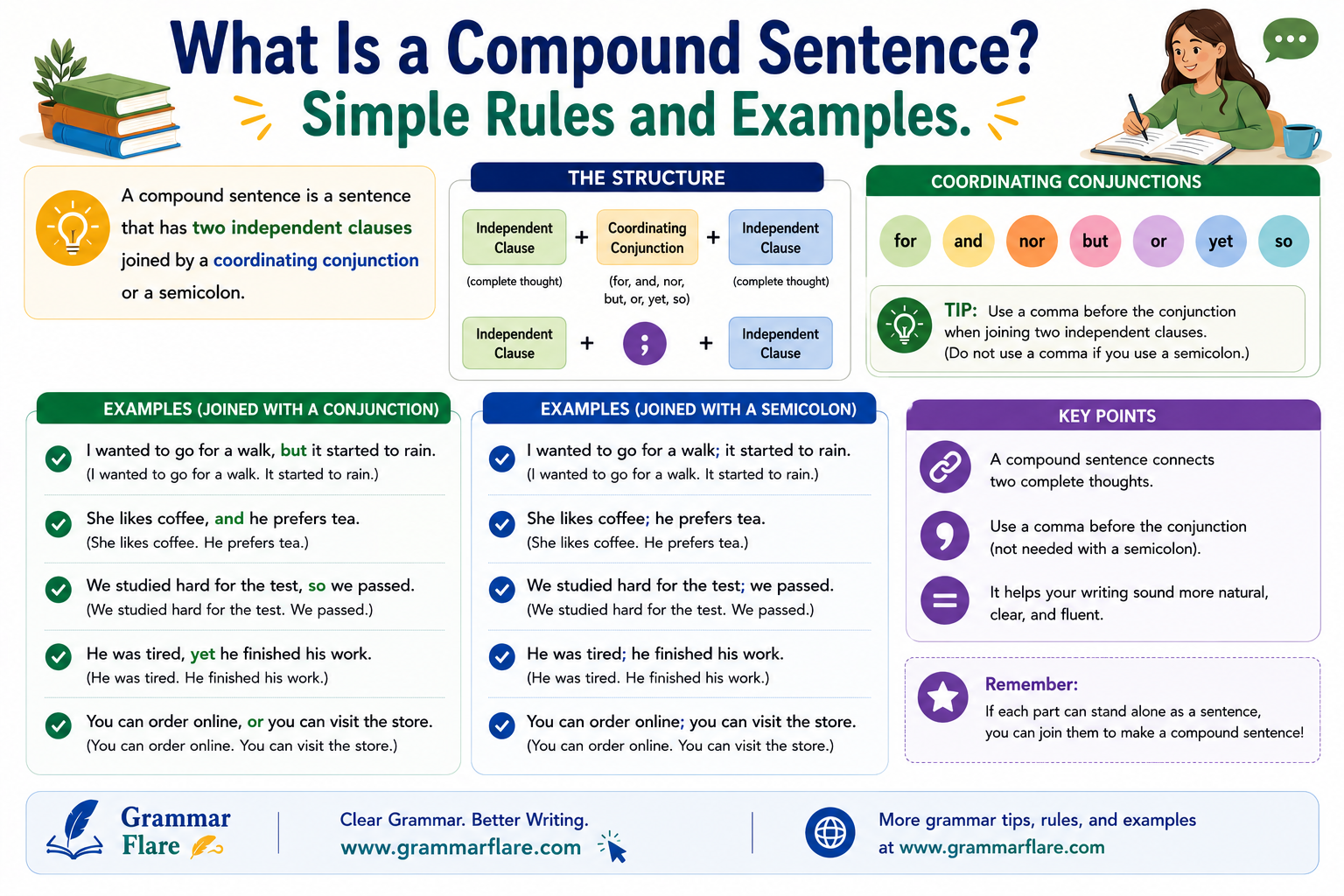
A compound sentence sounds technical, but the rule is simple.
A compound sentence joins two or more complete thoughts in one sentence.
Here is a quick example:
I finished the lesson, and I took the quiz.
This sentence has two complete ideas:
- I finished the lesson.
- I took the quiz.
Each part can stand alone as its own sentence. When you join them correctly, you create a compound sentence.
The quick answer is this: A compound sentence has two or more independent clauses joined by a coordinating conjunction, a semicolon, or another correct punctuation pattern.
Examples
- I wanted coffee, but the café was closed.
- She opened the file, and I checked the title.
- The rule looks simple; the examples make it clearer.
- You can study now, or you can review later.
- He was tired, so he went to bed early.
Compound sentences help you connect ideas that are equally important. Instead of writing several short sentences, you can combine related thoughts and make your writing smoother.
If you like simple GrammarFlare guides such as What Is a Complex Sentence? Simple Rules and Examples, Comma Before But: Simple Rule and Examples, and Semicolon Before And: When It’s Correct and When It Isn’t, this guide follows the same clear format.
Quick Answer: What Is a Compound Sentence?

A compound sentence is a sentence made of two or more independent clauses.
An independent clause is a complete thought. It can stand alone as a sentence.
Example: She studied grammar, and she passed the quiz.
Independent clause 1: She studied grammar.
Independent clause 2: She passed the quiz.
The word and joins the two complete thoughts.
That makes the sentence compound.
Here are more examples.
- I wanted to call, but my phone died.
- The sun was bright, so we wore sunglasses.
- You can stay here, or you can come with us.
- I saved the draft; the editor reviewed it.
- The class ended, and the students packed their bags.
In each example, both sides can stand alone as complete sentences.
Compound Sentence in One Table
| Sentence part | Can it stand alone? | Example |
|---|---|---|
| Independent clause | Yes | I finished the article. |
| Independent clause | Yes | I uploaded it. |
| Compound sentence | Yes | I finished the article, and I uploaded it. |
The key is simple: A compound sentence needs at least two independent clauses.
The Simple Rule
Here is the easiest way to remember a compound sentence:
Complete sentence + complete sentence = compound sentence
But you must join the two complete sentences correctly.
Correct: I finished the article, and I uploaded it.
Correct: I finished the article; I uploaded it.
Incorrect: I finished the article, I uploaded it.
The incorrect version is called a comma splice. It joins two complete sentences with only a comma, which is not strong enough.
A compound sentence needs a stronger connection.
You can use
- a comma plus a coordinating conjunction
- a semicolon
- a semicolon plus a transition word
- sometimes a colon or dash, depending on meaning and style
Most beginners should focus on the first two:
comma + conjunction
semicolon
What Is an Independent Clause?
An independent clause is a group of words that can stand alone as a complete sentence.
It usually has:
- a subject
- a verb
- a complete thought
Examples
- I opened the door.
- She finished the report.
- The teacher explained the rule.
- We walked to the store.
- The website loaded quickly.
Each example is complete.
You do not need another clause to understand the meaning.
Now look at these
- after the meeting
- because I was tired
- and closed the door
- while she was waiting
- although the rule was simple
These are not independent clauses. They cannot stand alone as complete sentences.
A compound sentence joins independent clauses, not fragments.
Correct: I opened the door, and she walked inside.
Incorrect: I opened the door, and walked inside.
The second example is not a compound sentence because walked inside does not have its own subject. It is part of the same simple sentence.
What Are Coordinating Conjunctions?
A coordinating conjunction connects words, phrases, or clauses that have equal grammatical value.
The seven coordinating conjunctions are often remembered with the acronym FANBOYS:
- For
- And
- Nor
- But
- Or
- Yet
- So
In compound sentences, these conjunctions join independent clauses.
Examples
- I was hungry, so I made a sandwich.
- She wanted to go, but she was too tired.
- You can call me, or you can send an email.
- He did not study, yet he passed the test.
- I enjoy grammar, and I like clear examples.
The conjunction shows the relationship between the two complete thoughts.
Compound Sentence Formula
The most common formula is
Independent clause + comma + coordinating conjunction + independent clause
Examples
- I wanted tea, but the kitchen was closed.
- She checked the spelling, and I reviewed the punctuation.
- The rain stopped, so we went outside.
- You can read the guide, or you can watch the video.
- He was nervous, yet he answered clearly.
The comma usually comes before the coordinating conjunction when the conjunction joins two independent clauses.
This is similar to the rule in Comma Before But: Simple Rule and Examples. If both sides can stand alone as complete sentences, the comma usually belongs before the conjunction.
Compound Sentence With “And”
Use and when the two ideas add to each other.
Examples
- I opened the document, and she checked the title.
- The class ended, and the students left quietly.
- He wrote the first draft, and I edited the final version.
- The dog barked, and the cat ran under the table.
- She packed her bag, and her brother called a taxi.
The two ideas are equal and connected.
You can also write two short sentences instead:
I opened the document. She checked the title.
That is correct, but the compound sentence sounds smoother when the ideas belong together.
Compound Sentence With “But”
Use but when the second idea contrasts with the first.
Examples
- I wanted to sleep, but the noise kept me awake.
- She studied hard, but the test was difficult.
- The rule looks simple, but the examples are important.
- He tried to call, but no one answered.
- The article was long, but it was easy to read.
The word but creates a turn in the sentence.
This is one of the most useful compound sentence patterns in English.
For a deeper explanation of this punctuation pattern, read Comma Before But: Simple Rule and Examples.
Compound Sentence With “Or”
Use or when the sentence gives a choice.
Examples
- You can stay here, or you can come with us.
- We can eat now, or we can wait until later.
- She can submit the form online, or she can mail it.
- I can explain the rule, or you can read the examples first.
- He can take the bus, or he can walk home.
Both clauses are complete.
You can test them by separating them: You can stay here. You can come with us.
Because both parts stand alone, the sentence is compound.
Compound Sentence With “So”
Use so when the second clause shows a result.
Examples
- It was raining, so we stayed inside.
- I forgot my password, so I reset it.
- The lesson was short, so the students finished early.
- She was hungry, so she made noodles.
- The website was slow, so I refreshed the page.
The first clause gives the reason. The second clause gives the result.
This is a very common pattern in everyday writing.
Compound Sentence With “Yet”
Use yet when the second idea is surprising or contrasting.
Examples
- He was tired, yet he kept working.
- The instructions were long, yet they were easy to follow.
- She was nervous, yet she spoke clearly.
- The phone was old, yet it still worked well.
- The test was difficult, yet many students passed.
The word yet is similar to but, but it often sounds a little more formal or dramatic.
Compound Sentence With “For” and “Nor”
For and nor are less common in everyday compound sentences.
Use for when the second clause gives a reason.
Example: She stayed home, for she was feeling sick.
This is grammatically correct, but it sounds formal or old-fashioned. In everyday writing, because often sounds more natural.
More natural: She stayed home because she was feeling sick.
Use nor when you continue a negative idea.
Example: He did not call, nor did he send a message.
This structure is correct, but it can feel formal. Many writers use a simpler version:
He did not call, and he did not send a message.
Still, nor is useful in formal writing when you want a clean negative pattern.
Compound Sentence With a Semicolon
A compound sentence does not always need a coordinating conjunction.
You can join two closely related independent clauses with a semicolon.
Examples
- I finished the article; I uploaded it.
- The rain stopped; the streets were still wet.
- She checked the spelling; I reviewed the punctuation.
- The meeting ended; everyone left the room.
- He practiced daily; his writing improved quickly.
A semicolon is stronger than a comma but softer than a period.
It tells the reader that the two ideas are closely connected.
Compare
I finished the article. I uploaded it.
and
I finished the article; I uploaded it.
Both are correct. The semicolon makes the connection feel closer.
If you want a full guide, read Semicolon Before And: When It’s Correct and When It Isn’t.
Compound Sentence With a Semicolon and Transition
You can also use a semicolon with transition words such as:
- however
- therefore
- moreover
- nevertheless
- meanwhile
- otherwise
- consequently
- for example
Examples
- I wanted to leave early; however, the meeting ran long.
- She studied every night; therefore, she felt prepared.
- The rule is simple; nevertheless, many writers forget it.
- He missed the bus; consequently, he arrived late.
- The first draft was messy; however, the final version was strong.
Notice the punctuation:
independent clause + semicolon + transition + comma + independent clause
Correct: I wanted to go; however, I was too tired.
Incorrect: I wanted to go, however, I was too tired.
The second sentence is a common comma splice problem. The semicolon is stronger and works better before a transition between two complete thoughts.
For the full set of rules on that mark, including lists and conjunctive adverbs, see when to use a semicolon.
Compound Sentence vs Simple Sentence
A simple sentence has one independent clause.
Examples
- I finished the lesson.
- She opened the window.
- The dog barked loudly.
- We studied grammar.
- The train arrived late.
A compound sentence has two or more independent clauses.
Examples
- I finished the lesson, and I took the quiz.
- She opened the window, but the room stayed hot.
- The dog barked loudly, so the baby woke up.
- We studied grammar, and the teacher gave examples.
- The train arrived late, yet everyone stayed calm.
A simple sentence gives one complete idea.
A compound sentence connects two or more complete ideas.
Compound Sentence vs Complex Sentence
This is a common point of confusion.
A compound sentence has two or more independent clauses.
Example: I was tired, so I went to bed.
Both parts can stand alone: I was tired. I went to bed.
A complex sentence has one independent clause and at least one dependent clause.
Example
Because I was tired, I went to bed.
The dependent clause is: Because I was tired
That part cannot stand alone.
Compare them
Compound: I was tired, so I went to bed.
Complex: Because I was tired, I went to bed.
Both sentences express a reason and result, but their structures are different.
For more help, read What Is a Complex Sentence? Simple Rules and Examples.
Compound Sentence vs Compound-Complex Sentence
A compound-complex sentence has:
- at least two independent clauses
- at least one dependent clause
Example
Because I was tired, I went to bed, and my brother turned off the lights.
Independent clauses
- I went to bed.
- My brother turned off the lights.
Dependent clause
- Because I was tired
A compound sentence has only independent clauses.
Compound: I went to bed, and my brother turned off the lights.
Compound-complex: Because I was tired, I went to bed, and my brother turned off the lights.
Compound-complex sentences can be useful, but they can also become long. Use them carefully.
Why Writers Use Compound Sentences
Compound sentences help writers connect related ideas.
They can show
- addition
- contrast
- choice
- result
- cause
- sequence
- equal importance
Without compound sentences, writing may sound choppy.
Choppy: I opened the file. She checked the title.
Smoother: I opened the file, and she checked the title.
Choppy: The rule was simple. The examples were confusing.
Smoother: The rule was simple, but the examples were confusing.
Choppy: It was raining. We stayed inside.
Smoother: It was raining, so we stayed inside.
Compound sentences make writing feel more connected.
Compound Sentences in Everyday Writing

Emails
- I reviewed the document, and I added my comments.
- The meeting ended early, so I sent the update.
- I tried to call, but your phone was off.
School Writing
- The character wants freedom, but society limits his choices.
- The poem uses simple language, yet its meaning is deep.
- The experiment failed, so the students repeated it.
Conversation
- I made tea, and she brought cookies.
- He wanted to come, but he was busy.
- It was late, so we went home.
You use compound sentences all the time, even if you do not think about the grammar label.
Common Mistakes With Compound Sentences

Mistake 1: Comma splice
Incorrect: I finished the work, I went home.
Correct: I finished the work, and I went home.
Also correct: I finished the work; I went home.
A comma alone cannot join two independent clauses.
Mistake 2: Fused sentence
Incorrect: I finished the work I went home.
Correct: I finished the work, and I went home.
Also correct: I finished the work; I went home.
A fused sentence joins two complete thoughts with no punctuation.
Mistake 3: Missing comma before the conjunction
Incorrect: I finished the work and I went home.
Correct: I finished the work, and I went home.
When and joins two independent clauses, use a comma before it.
Note: If the sentence is very short, some style guides allow the comma to be omitted. But for learners and most everyday writing, using the comma is the safer choice.
The same reasoning applies to the other conjunctions, and our guide to the comma before “but” covers the exception that catches most writers: a shared subject means no comma.
Mistake 4: Using a comma when the second part is not independent
Incorrect: She opened the file, and checked the title.
Correct: She opened the file and checked the title.
The words checked the title do not have their own subject. So this is not a compound sentence.
Mistake 5: Overusing compound sentences
Too many compound sentences can feel repetitive.
Repetitive: I opened the file, and she checked the title. I wrote the intro, and he edited the paragraph. We added the images, and the page looked better.
Better: I opened the file, and she checked the title. After that, I wrote the intro while he edited the paragraph. Once we added the images, the page looked better.
Good writing uses sentence variety.
How to Fix a Comma Splice
A comma splice happens when two complete sentences are joined only by a comma.
Incorrect: The lesson was short, the examples were clear.
You can fix it in four ways.
Fix 1: Add a coordinating conjunction
The lesson was short, and the examples were clear.
Fix 2: Use a semicolon
The lesson was short; the examples were clear.
Fix 3: Use a period
The lesson was short. The examples were clear.
Fix 4: Make one clause dependent
Because the lesson was short, the examples were easy to follow.
Each fix works. Choose the one that best fits your meaning.
Our dedicated guide to fixing a comma splice works through each fix with more examples and a test for spotting them in your own writing.
How to Write a Compound Sentence

Use this simple method.
Step 1: Write one complete sentence
Example: I studied the rule.
Step 2: Write another complete sentence
Example: I practiced the examples.
Step 3: Choose the relationship
Are you adding information?
Use and.
I studied the rule, and I practiced the examples.
Are you showing contrast?
Use but or yet.
I studied the rule, but I still made mistakes.
Are you showing result?
Use so.
I studied the rule, so I understood the examples.
Are you giving a choice?
Use or.
You can study the rule, or you can start with examples.
How to Identify a Compound Sentence
Ask these questions:
- Does the sentence have two or more complete thoughts?
- Can each main part stand alone as a sentence?
- Are the parts joined by a comma and conjunction, semicolon, or another correct pattern?
Example
The article was long, but it was helpful.
Part 1: The article was long.
Part 2: It was helpful.
Both can stand alone, so this is a compound sentence.
Now compare:
Although the article was long, it was helpful.
Part 1: Although the article was long.
This cannot stand alone.
So this sentence is complex, not compound.
Compound Sentence Examples With Corrections
Incorrect: I wanted coffee, the café was closed.
Correct: I wanted coffee, but the café was closed.
Incorrect: The teacher explained the rule and the students practiced.
Correct: The teacher explained the rule, and the students practiced.
Incorrect: She opened the file, and checked the title.
Correct: She opened the file and checked the title.
Incorrect: He was tired he went home.
Correct: He was tired, so he went home.
Incorrect: The rule is simple; and the examples are clear.
Correct: The rule is simple, and the examples are clear.
Also correct: The rule is simple; the examples are clear.
Mixing Sentence Types
Compound sentences are useful in writing because they help you connect ideas without making every sentence too short.
Choppy writing can feel robotic.
Example: This rule is simple. Many writers still make mistakes. Examples help.
Better: This rule is simple, but many writers still make mistakes, so examples help.
That version is smoother.
However, do not make every sentence compound. Too many joined clauses can make the article feel heavy.
Best style: Short sentence:
The rule is simple.
Compound sentence: The rule is simple, but examples make it easier.
Complex sentence: Because examples show the rule in action, readers remember it faster.
Mixing sentence types keeps your writing natural and easy to read.
Easy Memory Trick
Use this memory trick:
Compound means combined.
A compound sentence combines two complete thoughts.
Example
Complete thought 1: I studied.
Complete thought 2: I passed.
Compound sentence: I studied, and I passed.
If both sides can stand alone, you probably have a compound sentence.
Quick Test: Is It a Compound Sentence?
Ask yourself: Can I split the sentence into two complete sentences?
Example: She opened the window, and the room cooled down.
Split it: She opened the window.
The room cooled down.
Both are complete, so the original sentence is compound.
Now try this: She opened the window because the room was hot.
Split it: She opened the window.
Because the room was hot.
The second part is not complete, so the sentence is complex, not compound.
Mini Quiz: Compound Sentences
Identify each sentence as simple, compound, or complex.
- I finished the article.
- I finished the article, and I uploaded it.
- Because I finished the article, I uploaded it.
- The rule was simple, but the examples were difficult.
- When the rain stopped, we went outside.
- She opened the door and smiled.
- She opened the door, and her brother walked inside.
- The train was late; the passengers waited calmly.
- Although he was tired, he kept working.
- You can call me, or you can send an email.
Answers
- Simple
- Compound
- Complex
- Compound
- Complex
- Simple
- Compound
- Compound
- Complex
- Compound
Practice: Make These Sentences Compound
Combine each pair into one compound sentence.
- I was hungry. I made a sandwich.
- She wanted to go. She was too tired.
- The sun was bright. We wore sunglasses.
- You can study now. You can review later.
- He practiced daily. His writing improved.
Answers
- I was hungry, so I made a sandwich.
- She wanted to go, but she was too tired.
- The sun was bright, so we wore sunglasses.
- You can study now, or you can review later.
- He practiced daily, and his writing improved.
Your answers may differ, but each sentence should join two independent clauses correctly.
FAQ
What is a compound sentence?
A compound sentence has two or more independent clauses joined correctly. The clauses may be joined with a comma and coordinating conjunction, a semicolon, or another correct punctuation pattern.
What is an example of a compound sentence?
Here is an example: I finished the lesson, and I took the quiz. Both parts can stand alone as complete sentences.
How do you identify a compound sentence?
Look for two or more complete thoughts in one sentence. If each main part can stand alone and they are joined correctly, the sentence is compound.
What are the coordinating conjunctions?
The seven coordinating conjunctions are for, and, nor, but, or, yet, so. You can remember them with the acronym FANBOYS.
Does a compound sentence need a comma?
A compound sentence usually needs a comma before the coordinating conjunction when the conjunction joins two independent clauses.
Can a compound sentence use a semicolon?
Yes. A semicolon can join two closely related independent clauses: The rain stopped; the streets were still wet.
What is the difference between a compound sentence and a complex sentence?
A compound sentence has two or more independent clauses. A complex sentence has one independent clause and at least one dependent clause.
Is “She opened the door and smiled” a compound sentence?
No. It is a simple sentence with a compound predicate. The second verb, smiled, does not have its own subject.
What is a comma splice?
A comma splice happens when two complete sentences are joined with only a comma. Example: I was tired, I went home. Fix it with a conjunction, semicolon, or period.
Related GrammarFlare Reading
If this guide helped, read these next:
- What Is an Independent Clause?
- What Is a Complex Sentence?
- Simple Sentence: Meaning, Rules, Examples
- Comma Before “And”
- How to Fix a Comma Splice
Sources
- Cambridge Dictionary: Compound Sentence
- Purdue OWL: Sentence Punctuation Patterns
- Purdue OWL: Punctuation in Types of Sentences
- Purdue OWL: Identifying Independent and Dependent Clauses
- Purdue OWL: Run-ons, Comma Splices, and Fused Sentences
Final Takeaway
A compound sentence connects two or more complete thoughts.
Remember this pattern:
Independent clause + independent clause = compound sentence
Examples
- I studied the rule, and I practiced the examples.
- She was tired, but she kept working.
- The rain stopped; the streets were still wet.
- You can read the guide, or you can take the quiz.
The easiest way to test a compound sentence is to split it into two sentences. If both parts can stand alone, and the punctuation joins them correctly, you have a compound sentence.
Compound sentences make your writing smoother, clearer, and more connected when you use them with care.

Ahmad Waheed has spent five years editing academic and professional writing for universities, publishers, and software companies. He founded Grammar Flare after noticing the same handful of mistakes in almost every draft that crossed his desk, and that most grammar guides explained the rule without explaining when it actually matters.
Ahmad writes every guide on this site, checking usage questions against Merriam-Webster, the Chicago Manual of Style, and the AP Stylebook, and noting where those sources disagree rather than quietly picking a side.