
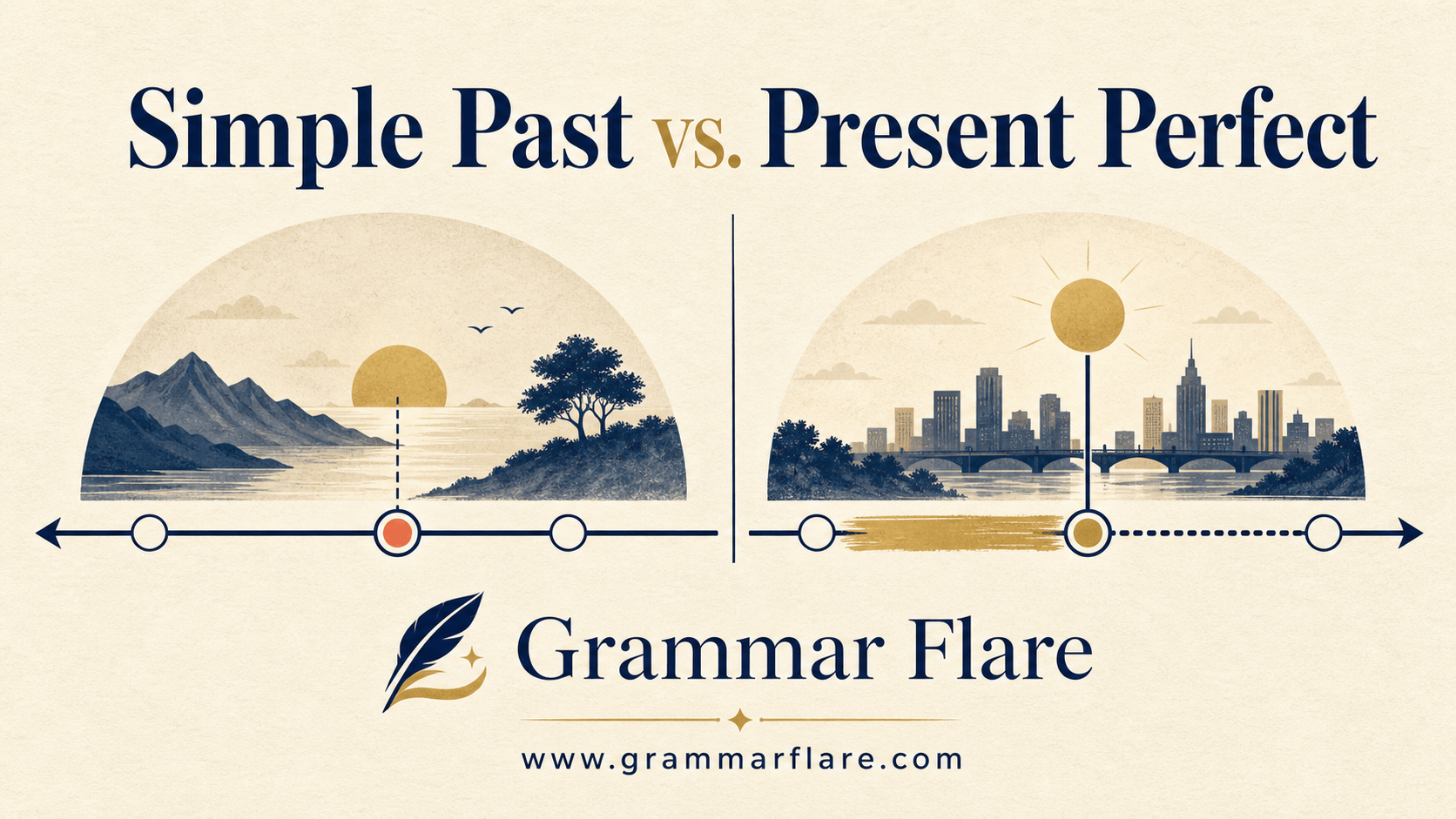
If you are not sure whether to write I finished or I have finished, you are asking the right question (Simple Past vs Present Perfect Difference).
Both tenses talk about the past, but they do not mean the same thing. The real difference is the time connection. The simple past points to a finished time in the past. The present perfect connects a past action to the present.
This guide explains the difference in plain English, with rules, examples, and a quick test you can use in real writing.
If you want more GrammarFlare grammar lessons, see Grammar Basics.
Quick Answer
Use simple past for a completed action at a finished time.
- I finished the report yesterday.
- She visited London in 2024.
Use present perfect for a past action that still matters now or when the exact time is not stated.
- I have finished the report.
- She has visited London three times.
One-sentence rule
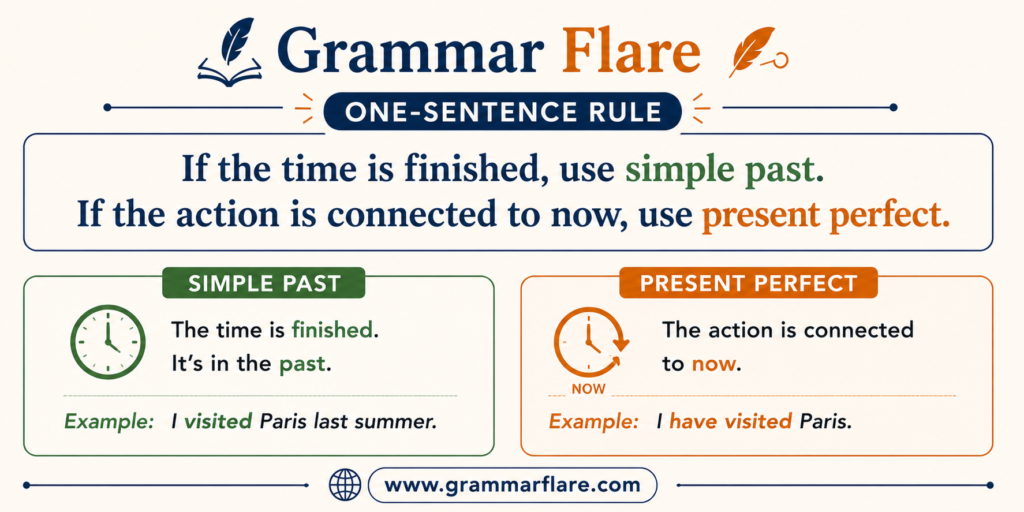
If the time is finished, use simple past. If the action is connected to now, use present perfect.
What Is the Difference in Simple Past vs Present Perfect?
The simple past tells you that something happened and finished in the past.
The present perfect tells you that something happened before now, but the exact time is not the focus or the result still matters now.
Compare these:
- I lost my keys yesterday.
The time is finished: yesterday. - I have lost my keys.
The result matters now: I still do not have them.
That is the core difference.
When Do You Use Simple Past?
Use simple past when the action happened at a specific, finished time in the past.
1. A finished time is stated or understood
Use simple past with time markers like:
- yesterday
- last night
- last week
- in 2024
- two days ago
- when I was in school
Examples:
- We met last year.
- I sent the email yesterday morning.
- He called me ten minutes ago.
2. You are telling a story or listing past events
Simple past is the normal tense for past sequences.
Examples:
- I opened the file, checked the numbers, and sent the update.
- She walked into the room, smiled, and sat down.
3. The past action is complete and separate from now
Examples:
- I lived in Dubai for two years.
This usually means I do not live there now. - They worked together in college.
That period is over.
When Do You Use Present Perfect?
Use present perfect when the action happened before now, but the connection to the present still matters.
1. The exact time is not important
Examples:
- I have seen that movie before.
- She has visited London three times.
- We have already discussed this issue.
The focus is not when it happened. The focus is the experience or result.
2. The result matters now
Examples:
- I have finished the report.
The report is ready now. - He has broken his glasses.
The glasses are broken now. - They have missed the train.
They are not on the train now.
3. The situation started in the past and continues to now
This often happens with for and since.
Examples:
- I have known her for ten years.
- We have lived here since 2021.
- She has worked remotely for six months.
These sentences still connect to the present.
When Should You Not Use Present Perfect?
Do not use present perfect with a clearly finished time expression.
Wrong:
- I have finished the report yesterday.
- She has called me last night.
- We have moved here in 2022.
Correct:
- I finished the report yesterday.
- She called me last night.
- We moved here in 2022.
This is one of the most common mistakes English learners make.
Simple Past vs. Present Perfect Table
| Use | Simple past | Present perfect |
|---|---|---|
| finished past time | I saw him yesterday. | not used |
| life experience | less common for this meaning | I have seen him before. |
| result now | possible, but weaker | I have lost my phone. |
| story sequence | She opened the door and laughed. | not typical |
| duration until now | not used | She has worked here since May. |
Signal Words That Often Help
Signal words are useful, but meaning matters more than the word list.
Common simple past signals
- yesterday
- ago
- last
- in 2024
- when
Examples:
- I spoke to her yesterday.
- We moved here two years ago.
Common present perfect signals
- already
- yet
- just
- ever
- never
- recently
- so far
- since
- for
Examples:
- I have already replied.
- Have you finished yet?
- We have lived here for five years.
Side-by-Side Examples
These pairs show the meaning change clearly.
Example 1: finished time vs experience
- I saw that movie last night.
- I have seen that movie before.
The first sentence gives a specific time. The second sentence gives experience.
Example 2: past action vs present result
- I lost my phone at the airport.
- I have lost my phone.
The first sentence reports a past event. The second stresses the current problem.
Example 3: completed period vs continuing situation
- She lived in Canada for three years.
- She has lived in Canada for three years.
The first usually means she does not live there now. The second means she still does.
Example 4: story event vs current status
- We finished the draft yesterday.
- We have finished the draft, so you can review it now.
The first sentence is about when the work happened. The second is about the current result.
A Fast Test You Can Use
Ask these two questions:
1. Is the time finished?
If yes, use simple past.
- I met him last week.
- She left an hour ago.
2. Does the sentence connect the past to now?
If yes, use present perfect.
- I have met him before.
- She has left her notebook here.
This quick test works in most everyday cases.
Common Mistakes to Avoid in Simple Past vs Present Perfect
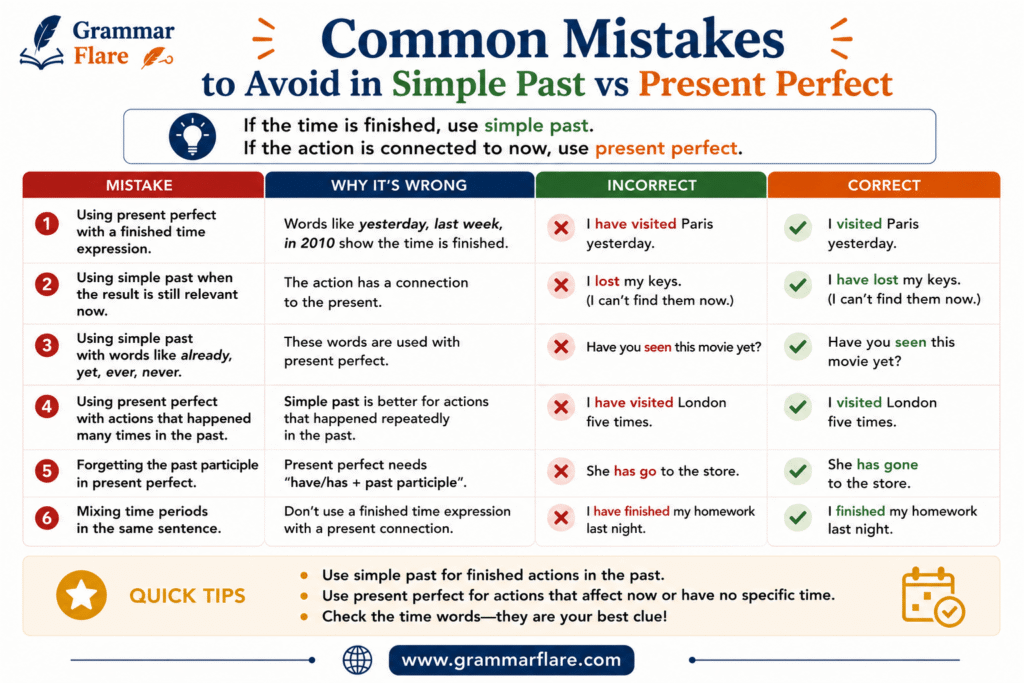
Using present perfect with yesterday, last, or ago
These words point to finished time, so simple past is the right choice.
Wrong: I have emailed him yesterday.
Correct: I emailed him yesterday.
Using simple past when the present result is the real point
Sometimes simple past is not wrong, but present perfect is more natural if the result matters now.
Compare
- I lost my keys.
This can sound like a past fact. - I have lost my keys.
This clearly shows the problem is current.
Treating the two tenses as interchangeable
They often translate the same way in other languages, but English uses them differently. That is why time expressions matter so much.
Forgetting that American and British English can differ slightly
In some situations, American English uses simple past where British English more strongly prefers present perfect.
For example, many American speakers say:
- Did you eat yet?
British English more often prefers:
- Have you eaten yet?
Both patterns exist, but the core rule in this article still holds.
Practice Sentences
Choose the correct tense.
- I _ (call) the client yesterday.
- She _ never _ (read) that author before.
- We _ (work) here since January.
- He _ (receive) the package an hour ago.
- _ you ever _ (try) sushi?
Answers
- called
- has, read
- have worked
- received
- Have, tried
Why This Difference (simple past vs present perfect) Matters in Writing
Tense choice affects clarity. If you pick the wrong one, readers may misunderstand whether something is finished, still true, or important now.
That matters in:
- emails
- school writing
- test preparation
- resumes and work updates
- everyday conversations
If you are also trying to make your wording more precise, GrammarFlare’s Commonly Confused Words archive is a useful related internal link.
Quick Summary
Use simple past when the action happened at a finished time.
Use present perfect when the exact time is not important or when the action still matters now.
That is the main rule most learners need.
FAQ
What is the main difference between simple past and present perfect?
Simple past is for finished past time. Present perfect is for past actions connected to the present or actions with no specific finished time.
Can I use present perfect with yesterday?
No. Yesterday is a finished time marker, so use simple past instead.
Why do people say both Did you eat? and Have you eaten?
Both can appear in real English. Have you eaten? follows the standard present-perfect pattern more clearly, while Did you eat? is common in conversational American English.
Which tense should I use for work updates?
Use simple past if you are describing what happened at a clear past time. Use present perfect if you are emphasizing what is completed now.
Is present perfect always more formal?
No. It is not mainly about formality. It is about meaning and the time connection.
Explore More on GrammarFlare
- How to Edit AI-Generated Writing Before You Publish
- How to Use a Colon in a Sentence: Simple Rules + Examples
- What Is an Independent Clause? Simple Rules and Examples
- What Is the Plural of Hoof? Hooves, Hoofs, or Both?
- What Is a Complex Sentence? Simple Rules and Examples
- Countable vs Uncountable Nouns: A Comparison

Ahmad Waheed has spent five years editing academic and professional writing for universities, publishers, and software companies. He founded Grammar Flare after noticing the same handful of mistakes in almost every draft that crossed his desk, and that most grammar guides explained the rule without explaining when it actually matters.
Ahmad writes every guide on this site, checking usage questions against Merriam-Webster, the Chicago Manual of Style, and the AP Stylebook, and noting where those sources disagree rather than quietly picking a side.