

If a sentence sounds a little off, subject-verb agreement is often the reason. This grammar rule is simple at its core, but it becomes confusing when extra words, compound subjects, or tricky pronouns get in the way.
The good news is that you do not need to memorize dozens of advanced grammar terms to get it right. You mostly need to identify the real subject and then choose the verb that matches it. If you want more core language guides after this one, our Grammar Basics collection covers sentence structure, tenses, and parts of speech.
Quick Answer
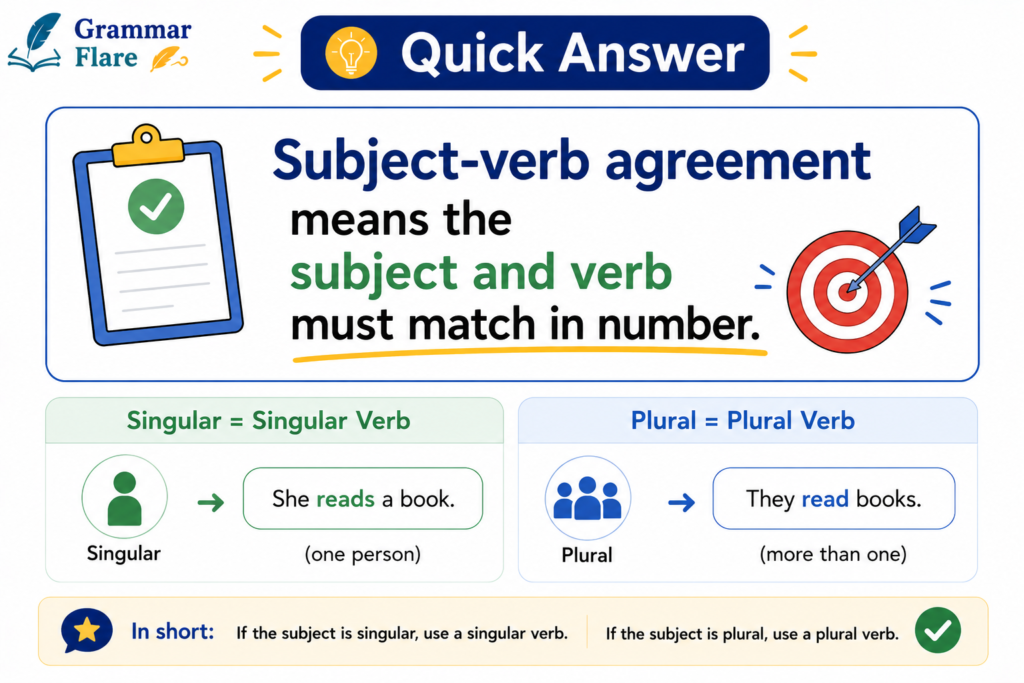
Subject-verb agreement means the subject and verb must match in number.
- A singular subject takes a singular verb.
- A plural subject takes a plural verb.
Examples
- The student writes every day.
- The students write every day.
That is the rule most sentences follow.
The Rule in One Sentence
Find the true subject first, then make the verb match it.
Writers often make mistakes because they match the verb to the noun that is closest, not the noun that actually controls the sentence.
What Is Subject-Verb Agreement?
Subject-verb agreement is the grammar rule that connects who or what the sentence is about with the action or state in the sentence.
The subject and the verb should agree in number:
- Singular subject -> singular verb
- Plural subject -> plural verb
This feels backward to some learners because singular verbs in the present tense often end in -s, while plural verbs usually do not.
Singular subjects take singular verbs
Examples
- The dog runs fast.
- My friend likes that podcast.
- This idea works well.
Plural subjects take plural verbs
Examples
- The dogs run fast.
- My friends like that podcast.
- These ideas work well.
Subject-Verb Agreement Examples in One Table
| Subject | Correct verb | Full example |
|---|---|---|
| The teacher | explains | The teacher explains the rule clearly. |
| The teachers | explain | The teachers explain the rule clearly. |
| My brother | is | My brother is ready. |
| My brothers | are | My brothers are ready. |
| Each student | has | Each student has a notebook. |
| Several students | have | Several students have notebooks. |
The Most Common Subject-Verb Agreement Mistakes
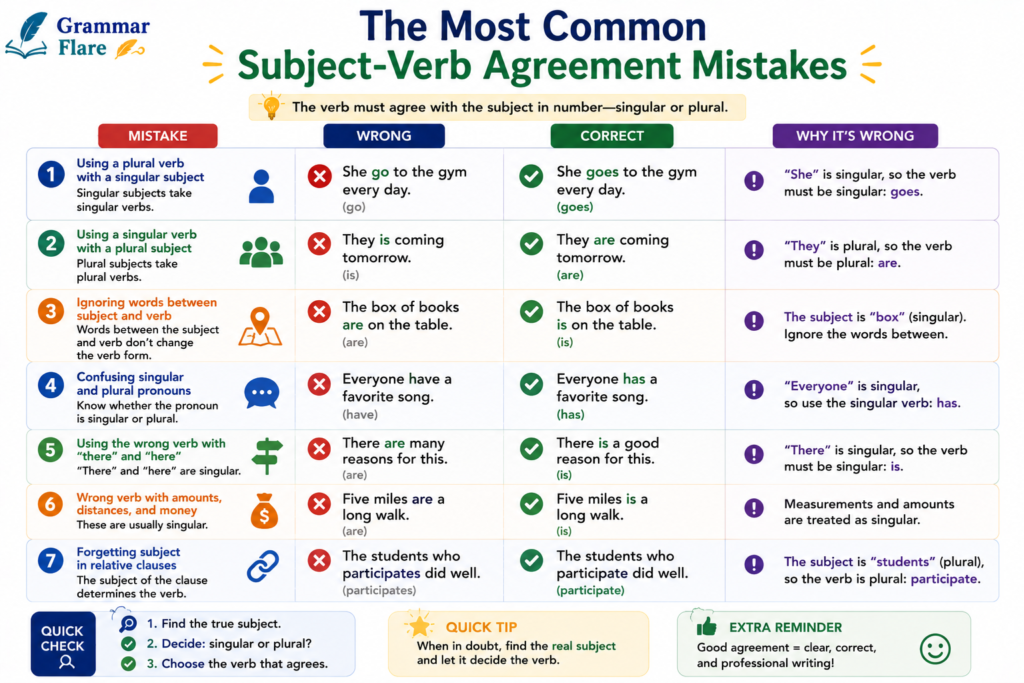
Most agreement mistakes happen in predictable patterns. Once you know those patterns, the rule gets much easier.
1. Extra words between the subject and the verb
Writers often get distracted by a nearby noun.
Incorrect: The list of items are on the desk.
Correct: The list of items is on the desk.
Why: list is the true subject, not items.
More examples
- The box of old photos was heavy.
- The results of the study show a clear pattern.
The distracting noun is almost always inside a prepositional phrase. Our list of prepositions covers how to spot them, which makes crossing them out much faster.
2. Sentences starting with “there is” or “there are”
These reverse the normal order, so the subject comes after the verb. Writers often default to there is regardless of what follows.
Incorrect: There is three reasons for the delay.
Correct: There are three reasons for the delay.
There is not the subject. Reasons is, and it is plural.
More examples
- There is a problem with the invoice.
- There are problems with the invoice.
- There was no warning.
- There were no warnings.
The same applies to here is and here are.
One honest note: there’s followed by a plural is extremely common in speech, as in there’s two things I wanted to ask. Most usage guides still treat it as nonstandard in writing, so use there are when you are being careful.
3. Compound subjects joined by and
When two subjects are joined by and, the verb is usually plural.
Examples
- Maya and Leo are coming.
- Grammar and tone matter in professional writing.
But if the two words name one combined idea, a singular verb can still be correct.
Example: Peanut butter and jelly is my usual lunch.
Joining two subjects with and raises a punctuation question as well. Our guide to the comma before “and” covers when the comma belongs there.
4. Either … or and neither … nor
With these pairings, the verb usually agrees with the subject closest to it.
Examples
- Either the manager or the assistants are answering the emails.
- Either the assistants or the manager is answering the emails.
- Neither the students nor the teacher was late.
If possible, rewrite awkward sentences like these for clarity.
Clearer version: The manager is answering the emails, or the assistants are.
5. Indefinite pronouns
Some indefinite pronouns are singular even though they sound broad or group-based.
Singular examples
- Everyone is ready.
- Each of the answers has a problem.
- Somebody knows the solution.
Plural examples
- Many are still deciding.
- Few understand the difference at first.
Some pronouns depend on the noun that follows them
- Some of the cake is gone.
- Some of the cookies are gone.
A number of, or the number of?
These two look almost identical and take opposite verbs.
- A number of students were absent.
- The number of students was surprising.
A number of means several, so the verb is plural. The number of refers to the total, which is a single figure, so the verb is singular.
6. Collective nouns
In American English, collective nouns are usually treated as singular when the group acts as one unit.
Examples
- The team is ready.
- The committee has made its decision.
If the sentence strongly emphasizes individuals acting separately, writers sometimes choose a plural idea by rewriting the sentence instead.
Clear rewrite: The team members are arguing among themselves.
7. Titles, amounts, and measurements
A title or amount can look plural but function as singular.
Examples
- “The Grapes of Wrath” is a famous novel.
- Ten dollars is enough for lunch.
- Five miles is too far to walk in this heat.
Correct and Incorrect Subject-Verb Agreement Examples
| Incorrect | Correct | Why |
|---|---|---|
| The group of students are waiting. | The group of students is waiting. | group is singular |
| Each of the players have a locker. | Each of the players has a locker. | each is singular |
| My brother and sister is here. | My brother and sister are here. | two subjects joined by and |
| Neither the teacher nor the students is ready. | Neither the teacher nor the students are ready. | closest subject is plural |
| Some of the water are cold. | Some of the water is cold. | water is singular/mass noun |
How to Check Subject-Verb Agreement Quickly
If you are proofreading and want a fast test, use this three-step method:
1. Cross out the extra words
Ignore prepositional phrases and side details for a moment.
Example: The stack of papers on the corner of the desk is falling over.
Now the core sentence is easier to see: The stack is falling over.
2. Ask who or what is doing the action
That answer is the subject.
Example: Who is falling over?
The stack.
3. Match the verb to that subject only
Do not let a nearby plural word trick you.
This method catches many agreement mistakes in seconds.
Finding the true subject is the same skill that lets you identify an independent clause, which is where most punctuation decisions start.
Why Subject-Verb Agreement Matters in Writing

Agreement mistakes can make clear writing look rushed. Even when a reader still understands the sentence, the error can weaken trust in academic writing, professional emails, blog posts, and polished everyday communication.
That is one reason proofreading matters. After you fix grammar basics, many writers also want smoother phrasing and clearer tone. GrammarFlare’s Better Ways to Say Things and Conversation Skills categories are useful next steps if you want your sentences to sound more natural as well as more correct.
A Simple Practice Set
Choose the correct verb in each sentence:
- The basket of clothes (is / are) in the hall.
- Neither the coach nor the players (was / were) satisfied.
- Each of these examples (shows / show) the rule.
- The news (is / are) surprising.
- My cousin and her roommate (lives / live) nearby.
Answers:
- is
- were
- shows
- is
- live
FAQ
What is subject-verb agreement in simple words?
Subject-verb agreement means the subject and verb must match. A singular subject takes a singular verb, and a plural subject takes a plural verb.
What is the easiest way to check subject-verb agreement?
The easiest way is to find the true subject first, ignore extra words, and then choose the verb that matches that subject only.
Why is everyone is correct and not everyone are?
Everyone is treated as a singular indefinite pronoun in standard English, so it takes the singular verb is.
Do words between the subject and verb change agreement?
No. Extra words can distract you, but they do not change which word controls the verb.
Is the team is or the team are correct?
In standard American English, the team is is usually correct when the team is acting as one unit.
Is it “there is” or “there are”?
Match the verb to what comes after it, not to there. There is one reason and there are three reasons. In this construction the subject follows the verb.
Short Answers for Quick Reference
- Best quick answer: Subject-verb agreement means a singular subject takes a singular verb and a plural subject takes a plural verb.
- Fast rule: Find the real subject first, then match the verb to it.
- Biggest mistake to avoid: Do not match the verb to the nearest noun if that noun is not the true subject.
More Reading at GrammarFlare
- What Is an Independent Clause?
- List of Prepositions With Clear Examples
- Simple Sentence: Meaning, Rules, Examples
- Countable vs Uncountable Nouns
- Past Perfect Tense Exercises
- Grammar Basics
Sources

Ahmad Waheed has spent five years editing academic and professional writing for universities, publishers, and software companies. He founded Grammar Flare after noticing the same handful of mistakes in almost every draft that crossed his desk, and that most grammar guides explained the rule without explaining when it actually matters.
Ahmad writes every guide on this site, checking usage questions against Merriam-Webster, the Chicago Manual of Style, and the AP Stylebook, and noting where those sources disagree rather than quietly picking a side.