
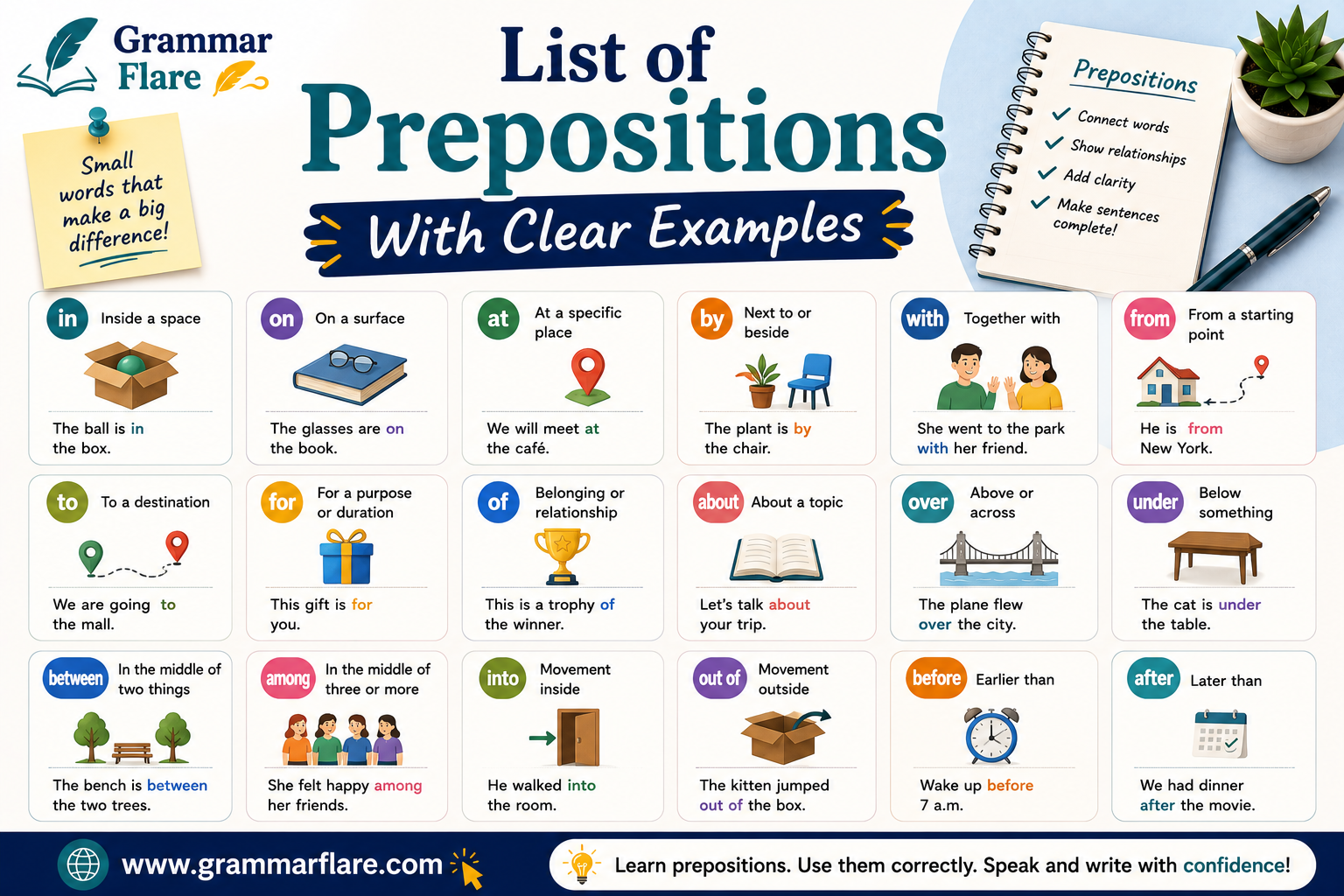
Before the list of prepositions, you should first understand what are prepositions?
Prepositions are small words, but they do a lot of work.
Words like in, on, at, by, for, from, with, under, and between help readers understand how people, places, things, and ideas connect.
Look at this sentence:
The book is on the table.
The word on tells you where the book is. Without it, the sentence loses an important relationship.
Now look at this one:
We will meet after lunch.
The word after tells you when the meeting will happen.
That is the basic job of a preposition. It shows a relationship. That relationship may involve place, time, direction, cause, manner, possession, or connection.
The quick answer is this:
A preposition is a word or phrase that comes before a noun, noun phrase, or pronoun and connects it to another word in the sentence.
Examples:
- in the room
- on the table
- after school
- before dinner
- with my friend
- under the bridge
- because of the rain
- in front of the house
In this guide, you will learn what prepositions are, see a useful list of prepositions, understand prepositional phrases, and practice with clear examples.
If you like simple GrammarFlare guides such as To vs Too: What’s the Difference? Simple Rules & Examples, Than vs Then: What’s the Difference? Simple Rules + Examples, and There vs Their vs They’re: Easy Rules, Examples & Memory Tricks, this post follows the same clear format.
Quick Answer: What Is a Preposition?
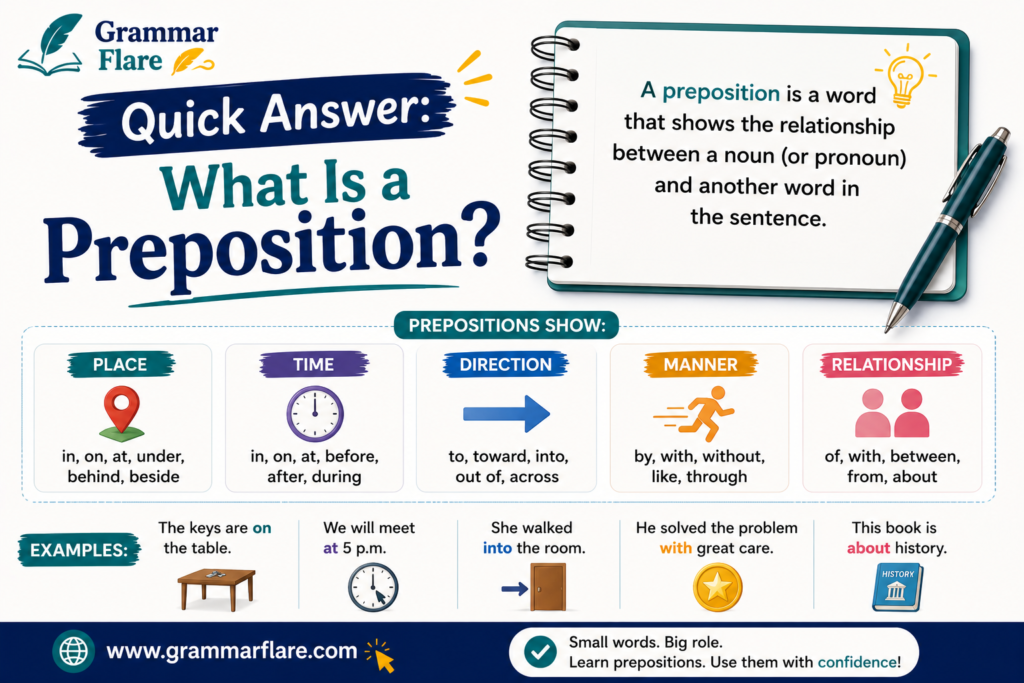
A preposition is a word that shows the relationship between a noun or pronoun and another part of the sentence.
A list of common prepositions include:
- at
- by
- for
- from
- in
- into
- of
- on
- over
- through
- to
- under
- with
Examples:
- She sat on the chair.
- We walked through the park.
- He arrived after dinner.
- The keys are inside the drawer.
- I sent the email to my teacher.
In each sentence, the preposition connects one idea to another.
The Cambridge Dictionary defines a preposition as a word used before a noun, noun phrase, or pronoun to connect it to another word. You can read its explanation here: Cambridge Dictionary: Preposition
List of Prepositions in One Simple Table
| Preposition | Main use | Example |
|---|---|---|
| at | exact place or time | Meet me at 5 p.m. |
| in | inside or within | The phone is in my bag. |
| on | surface or date | The book is on the desk. |
| by | near, method, or agent | She came by bus. |
| for | purpose or duration | I waited for an hour. |
| from | origin or starting point | He is from Canada. |
| to | direction or destination | We drove to the airport. |
| with | together or using | She wrote with a pen. |
| under | below something | The cat is under the bed. |
| between | in the middle of two | The shop is between two banks. |
This table gives you the basic idea, but prepositions become easier when you see them by category.
Why Prepositions Matter
Prepositions help answer important questions.
They can answer:
- Where? The keys are on the table.
- When? We met after class.
- How? She traveled by train.
- Why? The game was canceled because of rain.
- With whom? I went with my sister.
- From where? He came from Lahore.
- Toward what? She walked toward the door.
Without prepositions, sentences become unclear.
Unclear: The cup is the shelf.
Clear: The cup is on the shelf.
Unclear: We arrived dinner.
Clear: We arrived after dinner.
Prepositions may be short, but they hold sentences together.
List of Common Prepositions
Here is a useful list of common one-word prepositions:
- aboard
- about
- above
- across
- after
- against
- along
- among
- around
- as
- at
- before
- behind
- below
- beneath
- beside
- between
- beyond
- but
- by
- concerning
- despite
- down
- during
- except
- for
- from
- in
- inside
- into
- like
- near
- of
- off
- on
- onto
- opposite
- outside
- over
- past
- regarding
- since
- through
- throughout
- till
- to
- toward
- under
- underneath
- unlike
- until
- up
- upon
- via
- with
- within
- without
Important note: a word on this list of prepositions is not always a preposition. Its job depends on how it works in the sentence.
Example:
She walked around the room.
Here, around is a preposition because it connects the action to the room.
Example:
She turned around.
Here, around is not working the same way because it does not come before a noun or pronoun.
That is why context matters.
What Is a Prepositional Phrase?
A prepositional phrase begins with a preposition and includes the noun, noun phrase, or pronoun that follows it.
Examples:
- in the kitchen
- on the table
- after the meeting
- with my friends
- under the old bridge
- before the final exam
- because of the storm
The noun or pronoun after the preposition is called the object of the preposition.
In this phrase:
on the table
- on = preposition
- the table = object of the preposition
In this phrase:
with her
- with = preposition
- her = object of the preposition
Purdue OWL explains that prepositions often signal the start of a prepositional phrase. You can read more here: Purdue OWL: Prepositions
Prepositions of Place
Prepositions of place tell you where something is.
A list of common prepositions of place include:
- above
- across
- against
- among
- around
- at
- behind
- below
- beneath
- beside
- between
- by
- in
- inside
- near
- on
- opposite
- outside
- over
- under
- underneath
- within
Examples:
- The clock is above the door.
- We walked across the street.
- She leaned against the wall.
- The child stood among the crowd.
- The chairs were arranged around the table.
- I waited at the bus stop.
- The garden is behind the house.
- The shoes are under the bed.
- The dog slept beside the sofa.
- The bank is between the school and the pharmacy.
- The keys are inside the drawer.
- The painting hangs on the wall.
The preposition tells the reader where one thing is in relation to another.
At, In, and On for Place
Many English learners struggle with at, in, and on because these prepositions can overlap.
Use at for a point or specific location.
Examples:
- I am at the door.
- She is at school.
- Meet me at the station.
Use in when something is inside a space, area, or container.
Examples:
- The book is in my bag.
- He lives in New York.
- There is water in the glass.
Use on when something touches a surface.
Examples:
- The phone is on the desk.
- The picture is on the wall.
- There is a stain on your shirt.
Purdue OWL has a helpful explanation of at, in, and on for location here: Purdue OWL: Prepositions of Location
Prepositions of Time
Prepositions of time tell you when something happens.
A list of common prepositions of time include:
- after
- before
- by
- during
- for
- from
- in
- on
- since
- till
- until
- within
Examples:
- We left after lunch.
- Finish the report before Friday.
- She will arrive by noon.
- He slept during the movie.
- I studied for two hours.
- The shop is open from 9 to 5.
- The project begins in June.
- We met on Monday.
- They have lived here since 2020.
- Wait until the light turns green.
- Please reply within two days.
Prepositions of time help place an action on a timeline.
At, In, and On for Time
Use at for exact times.
Examples:
- at 7 p.m.
- at noon
- at midnight
- at sunrise
Use on for days and dates.
Examples:
- on Monday
- on July 4
- on my birthday
- on the weekend in American English
Use in for months, years, seasons, and longer periods.
Examples:
- in April
- in 2026
- in winter
- in the morning
- in the future
Cambridge Dictionary explains common uses of at, on, and in for time. You can read more here: Cambridge Dictionary: At, On and In for Time
Prepositions of Direction
Prepositions of direction show movement toward, into, onto, or away from something.
A list of common prepositions of direction include:
- across
- along
- around
- down
- from
- into
- onto
- out of
- through
- to
- toward
- up
Examples:
- She walked to the office.
- The cat jumped onto the chair.
- He ran into the room.
- We drove through the tunnel.
- The children ran across the field.
- They walked along the beach.
- He climbed up the ladder.
- She came from the market.
- The bird flew out of the cage.
- I moved toward the window.
Purdue OWL explains that to, onto, and into are often used to express movement toward something. See the guide here: Purdue OWL: Prepositions of Direction
Prepositions of Manner, Method, and Means
Prepositions can also show how something happens.
Common examples include:
- by
- with
- like
- through
- via
Examples:
- She traveled by train.
- He cut the paper with scissors.
- They communicated through email.
- We sent the file via Google Drive.
- He speaks like a teacher.
The preposition tells the reader the method, tool, or manner.
Compare:
She wrote the note.
She wrote the note with a pencil.
The second sentence gives more information.
Prepositions of Cause, Reason, and Purpose
Some prepositions show why something happened.
Common examples include:
- because of
- due to
- for
- from
- out of
- thanks to
Examples:
- The match was canceled because of rain.
- The delay happened due to traffic.
- She bought flowers for her mother.
- He acted out of fear.
- The team won thanks to strong defense.
- His hands were shaking from the cold.
Be careful with because of and due to. They are often similar, but because of works well in most everyday sentences.
Clear:
The picnic was canceled because of the storm.
Formal:
The delay was due to a technical problem.
Prepositions of Possession and Connection
Some prepositions show belonging, connection, or relationship.
Common examples include:
- of
- with
- to
- for
Examples:
- The cover of the book is blue.
- She is a friend of mine.
- The key to the room is missing.
- He has a talent for writing.
- The woman with the red bag is my aunt.
These prepositions help connect people, things, and ideas.
Compound Prepositions
A compound preposition is made of two or more words that work together as one preposition.
A list of common compound prepositions include:
- according to
- ahead of
- apart from
- as far as
- because of
- by means of
- due to
- except for
- in addition to
- in front of
- in place of
- in spite of
- instead of
- next to
- on account of
- on behalf of
- on top of
- out of
- prior to
- regardless of
- with regard to
Examples:
- We sat in front of the stage.
- She stayed home because of the rain.
- He spoke on behalf of the team.
- The cat slept on top of the car.
- They chose tea instead of coffee.
- According to the report, sales increased.
- The meeting was delayed due to technical issues.
- We finished the project ahead of schedule.
Even though these have more than one word, they act like single prepositions.
Preposition or Adverb?
Some words can be prepositions in one sentence and adverbs in another.
Look at outside.
Preposition:
The kids played outside the house.
Here, outside comes before the house, so it is a preposition.
Adverb:
The kids played outside.
Here, outside tells where they played, but it does not have an object after it.
Look at down.
Preposition:
She walked down the stairs.
Adverb:
Please sit down.
The same word can do different jobs. Always check the sentence.
Preposition or Conjunction?
Some words can also act as conjunctions.
Look at before.
Preposition:
We left before dinner.
Here, before comes before the noun dinner.
Conjunction:
We left before the movie started.
Here, before connects two clauses: we left and the movie started.
Look at after.
Preposition:
She rested after work.
Conjunction:
She rested after she finished work.
The word is the same, but its job changes.
Can You End a Sentence With a Preposition?
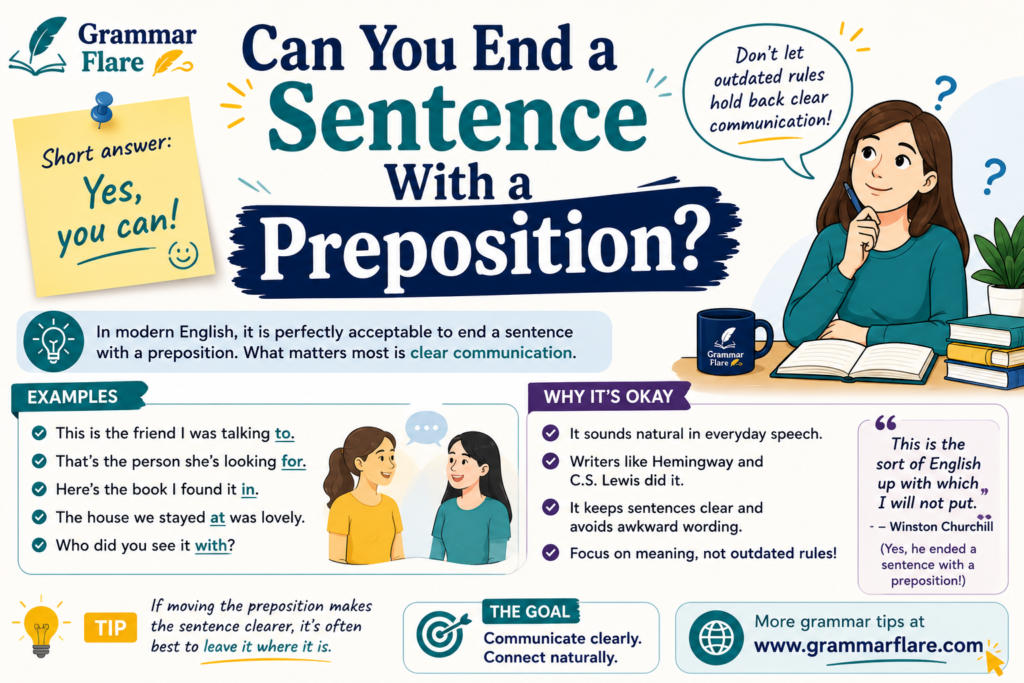
Yes, you can end a sentence with a preposition when it sounds natural.
This old “rule” is often overstated. In modern English, sentences ending with prepositions are common and often perfectly correct.
Natural:
Who are you talking to?
Stiff:
To whom are you talking?
Natural:
This is the file I was looking for.
Stiff:
This is the file for which I was looking.
In formal writing, you may choose the more traditional version if it sounds appropriate. But in everyday writing, ending with a preposition is not automatically wrong.
The best rule is this:
Do not end a sentence with a preposition when the sentence sounds careless, but do not force an unnatural structure just to avoid it.
Common Preposition Mistakes
Mistake 1: Using the wrong preposition with time
Incorrect:
I will meet you in Monday.
Correct:
I will meet you on Monday.
Mistake 2: Using “at” with a city or country
Incorrect:
She lives at Canada.
Correct:
She lives in Canada.
Mistake 3: Confusing “in” and “on”
Incorrect:
The picture is in the wall.
Correct:
The picture is on the wall.
Mistake 4: Adding unnecessary prepositions
Incorrect:
Where are you going to?
This can be correct in casual speech, but if where already makes the direction clear, a shorter sentence may work better:
Where are you going?
Mistake 5: Using “between” for more than two things
Many people learn that between is for two and among is for more than two. That is a useful starting point, but real English is more flexible.
Simple guide:
Use between when you are thinking of separate, distinct items.
Example:
The agreement is between the school, the parents, and the transport company.
Use among when you are thinking of a group collectively.
Example:
She felt comfortable among her classmates.
A Simple Preposition Test
Use this quick test when you are unsure whether a word is acting as a preposition.
Ask:
- Does the word come before a noun, noun phrase, or pronoun?
- Does it show a relationship to another word?
- Does the phrase answer where, when, how, why, or with whom?
Example:
The cat slept under the chair.
- under comes before the chair
- it shows the relationship between the cat and the chair
- it answers where the cat slept
So under is a preposition.
Example:
The cat jumped down.
- down does not come before a noun or pronoun
- it tells direction but has no object
So down is acting more like an adverb here.
Prepositions in Real-Life Writing
Prepositions appear everywhere.
Emails
- I will respond after the meeting.
- Please send the file to Sarah.
- We can discuss this during the call.
School Writing
- The character changes throughout the story.
- The evidence appears in the second paragraph.
- The poem focuses on memory and loss.
Resumes
- Skilled in project management.
- Experience with customer service.
- Responsible for monthly reports.
Daily conversation
- I left my keys on the counter.
- She is waiting outside the store.
- We are going to the park.
Prepositions may look small, but they help make your meaning exact.
Easy Memory Trick
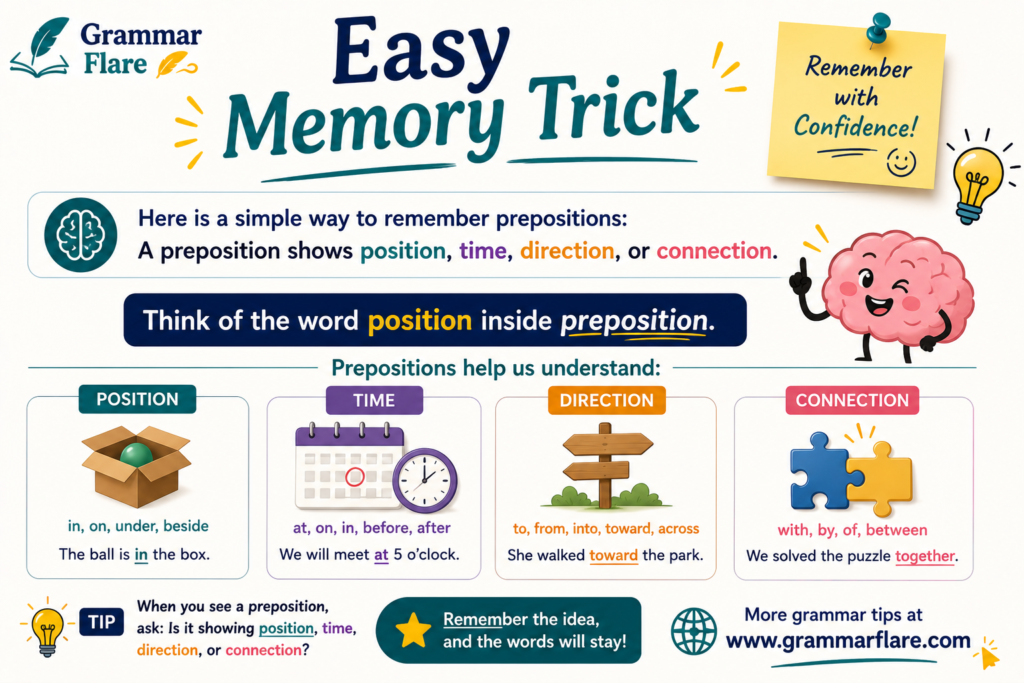
Here is a simple way to remember prepositions:
A preposition shows position, time, direction, or connection.
Think of the word position inside preposition.
Prepositions often show where something is positioned:
- on the table
- under the chair
- beside the door
- between the trees
But they also show time and connection:
- after dinner
- during class
- with my friend
- because of the rain
So when you see a small word before a noun or pronoun, ask:
What relationship is it showing?
That question usually reveals the preposition.
Mini Quiz: Find the Preposition
Find the preposition in each sentence.
- The phone is on the desk.
- We arrived after lunch.
- She walked through the gate.
- He sent the letter to his teacher.
- The dog slept under the table.
- They stayed because of the storm.
- I waited at the station.
- The book belongs to Maria.
- She traveled by train.
- The picture hangs above the sofa.
Answers
- on
- after
- through
- to
- under
- because of
- at
- to
- by
- above
FAQ
What is a preposition?
A preposition is a word or phrase that comes before a noun, noun phrase, or pronoun and connects it to another word in the sentence.
What are 10 common prepositions?
Ten common prepositions are in, on, at, by, for, from, to, with, under, and between.
What is a prepositional phrase?
A prepositional phrase starts with a preposition and includes its object. Examples include on the table, after school, and with my friend.
Is “to” always a preposition?
No. To can be a preposition, as in to the store, but it can also be part of an infinitive, as in to write or to study. For more help, read To vs Too: What’s the Difference? Simple Rules & Examples.
Can a preposition be more than one word?
Yes. Phrases like because of, in front of, according to, and on behalf of work as compound prepositions.
Is it wrong to end a sentence with a preposition?
No, not always. Ending with a preposition is common in natural English. The better choice depends on clarity, tone, and formality.
What is the easiest way to identify a preposition?
Look for a word before a noun or pronoun that shows place, time, direction, cause, method, or connection.
Related GrammarFlare Reading
If this guide helped, read these next:
- To vs Too: What’s the Difference? Simple Rules & Examples
- Than vs Then: What’s the Difference? Simple Rules + Examples
- There vs Their vs They’re: Easy Rules, Examples & Memory Tricks
- Your vs You’re: Simple Rule, Examples, and Easy Memory Trick
- It’s vs. Its: Simple Rule, Examples, and Easy Memory Trick
- Affect vs. Effect: What’s the Difference? Simple Rules + Examples
Sources
- Cambridge Dictionary: Preposition
- Cambridge Dictionary: Prepositions
- Cambridge Dictionary: At, On and In for Time
- Purdue OWL: Prepositions
- Purdue OWL: Prepositions of Location
- Purdue OWL: Prepositions of Direction
Final Takeaway
Prepositions are small words that show relationships.
They can show:
- place: on the table
- time: after dinner
- direction: to the store
- method: by train
- cause: because of rain
- connection: with my friend
The easiest way to recognize a preposition is to look for a word or phrase before a noun, noun phrase, or pronoun that connects it to another part of the sentence.
Once you understand that pattern, prepositions become much easier to spot and use correctly.