
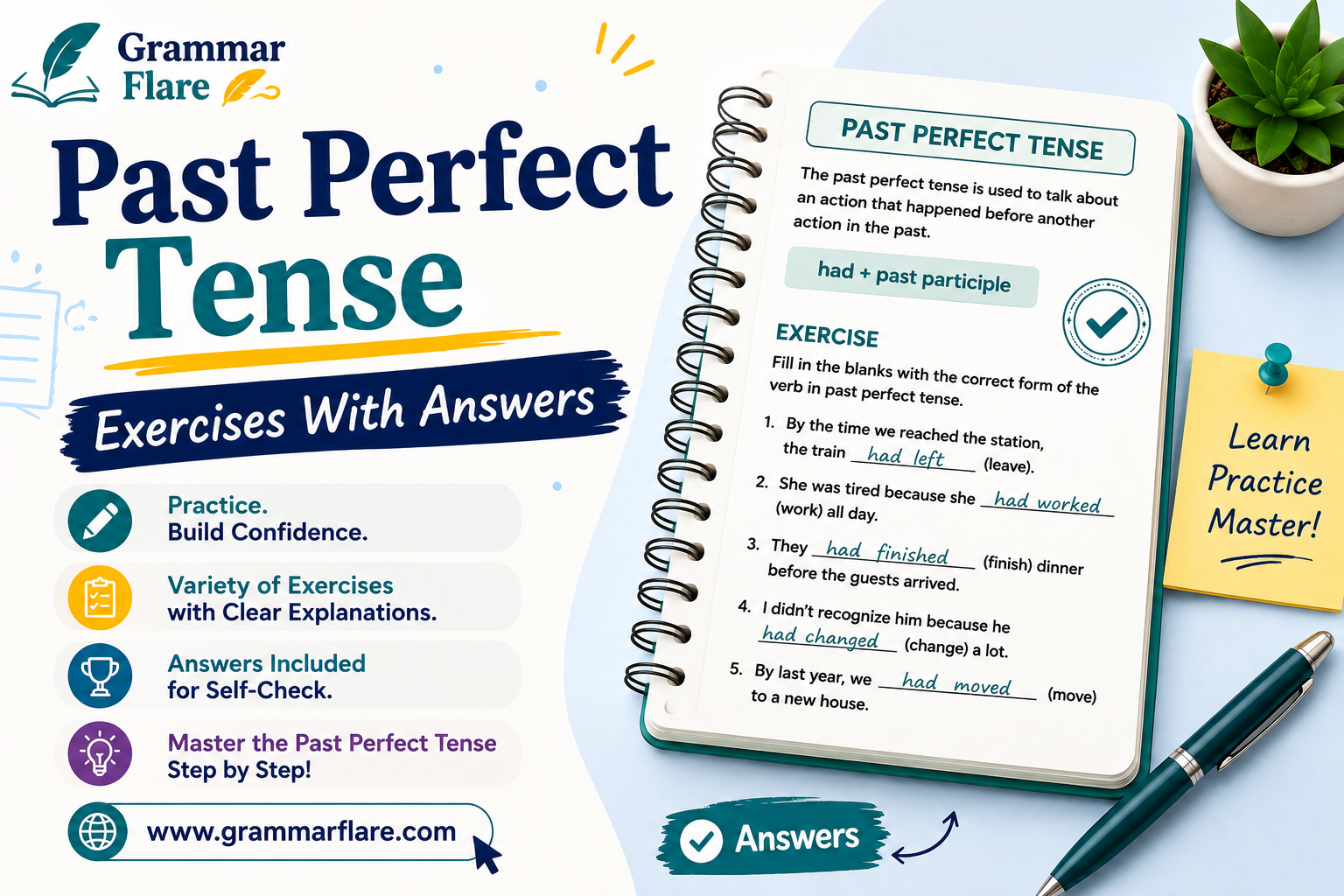
The past perfect tense can feel confusing at first because it talks about two past moments at the same time.
Look at this sentence:
She had finished her homework before dinner started.
Both actions happened in the past:
- She finished her homework.
- Dinner started.
But one action happened earlier. She finished her homework first. Dinner started later.
That is the main job of the past perfect tense. It shows that one past action happened before another past action.
The quick rule is simple:
Use had + past participle to show the earlier action in the past.
Examples:
- I had eaten before they arrived.
- She had left when I called.
- They had finished the project before the deadline.
- We had studied the rule before the quiz.
In this guide, you will learn how the past perfect tense works, when to use it, and how to practice it with clear exercises and answers.
Quick Answer: What Is the Past Perfect Tense?

The past perfect tense describes an action that was completed before another action or time in the past.
The structure is:
Subject + had + past participle
Examples:
- I had finished the report before the meeting began.
- She had left before I arrived.
- They had eaten dinner when we called.
- He had studied English before moving to Canada.
The past perfect usually helps answer this question:
Which past action happened first?
In this sentence:
I had locked the door before I went to bed.
The first action is:
I had locked the door.
The second action is:
I went to bed.
The past perfect makes the order clear.
Free printable worksheet: all six exercises plus a separate answer key, ready to print for a class. Download the PDF (9 pages, no signup).
Past Perfect Tense in One Table
| Sentence type | Structure | Example |
|---|---|---|
| Positive | subject + had + past participle | She had finished the lesson. |
| Negative | subject + had not + past participle | She had not finished the lesson. |
| Contraction | subject + hadn’t + past participle | She hadn’t finished the lesson. |
| Yes/no question | Had + subject + past participle? | Had she finished the lesson? |
| Wh-question | Question word + had + subject + past participle? | Why had she finished early? |
The form stays the same for all subjects.
Correct:
- I had gone.
- You had gone.
- He had gone.
- She had gone.
- It had gone.
- We had gone.
- They had gone.
You do not change had to has or have in the past perfect tense.
How to Form the Past Perfect Tense
The past perfect tense uses two parts:
had + past participle
The past participle is the third form of the verb.
For regular verbs, the past participle usually ends in -ed.
Examples:
- work → worked
- finish → finished
- clean → cleaned
- study → studied
- open → opened
Sentences:
- I had worked all day.
- She had finished the assignment.
- They had cleaned the room.
- We had studied the chapter.
- He had opened the door.
For irregular verbs, the past participle changes.
Examples:
- go → gone
- eat → eaten
- write → written
- see → seen
- take → taken
- begin → begun
- speak → spoken
- choose → chosen
Sentences:
- I had gone home.
- She had eaten lunch.
- They had written the report.
- We had seen the movie.
- He had taken the test.
The past perfect tense always uses had, even with singular subjects.
Correct:
- She had gone.
- He had eaten.
- The teacher had explained the rule.
Incorrect:
- She has gone before I arrived.
- He have eaten before we came.
- The teacher had explain the rule.
The third example is wrong because the verb after had must be the past participle: explained, not explain.
When to Use the Past Perfect Tense
Use the past perfect tense when you need to show that one action happened before another action in the past.
Example:
When I arrived, the class had started.
This means:
First: the class started.
Later: I arrived.
Without the past perfect, the order may be less clear.
Compare:
The class started when I arrived.
This could mean the class started at the moment I arrived.
Now compare:
The class had started when I arrived.
This clearly means the class started before I arrived.
That is why the past perfect is useful. It helps you show time order clearly.
Past Perfect With “Before”
The word before often appears with the past perfect tense.
Examples:
- She had packed her bag before the taxi arrived.
- We had finished dinner before the guests came.
- He had read the instructions before starting the test.
- They had left before the rain began.
- I had saved the file before the computer crashed.
In these sentences, the past perfect action happened first.
But here is an important note: when the word before already makes the order clear, the simple past can also work in many cases.
Correct:
She packed her bag before the taxi arrived.
Also correct:
She had packed her bag before the taxi arrived.
The past perfect adds extra emphasis to the fact that the first action was already complete.
Past Perfect With “After”
The word after also appears often with the past perfect tense.
Examples:
- After she had finished work, she went home.
- After we had eaten, we watched a movie.
- After he had checked the address, he left.
- After they had practiced, they performed on stage.
- After I had written the email, I sent it.
You can also write many of these sentences with the simple past:
After she finished work, she went home.
That sentence is also correct because after already shows the order.
So when should you use the past perfect?
Use it when you want to stress that the first action was completed before the second action started.
Past Perfect With “When”
The word when can be tricky because it does not always show which action happened first.
Look at this sentence:
When I arrived, she left.
This may mean she left at the moment I arrived.
Now look at this sentence:
When I arrived, she had left.
This means she left before I arrived.
The past perfect changes the meaning.
More examples:
- When we reached the station, the train had left.
- When I opened the fridge, someone had eaten the cake.
- When the teacher entered, the students had completed the exercise.
- When she checked her phone, he had already called three times.
The past perfect helps avoid confusion.
Past Perfect With “Already,” “Just,” and “Never”

Words like already, just, and never often work well with the past perfect.
Already
Use already when something happened earlier than expected.
Examples:
- She had already finished the book.
- They had already left when we arrived.
- I had already seen that movie.
- He had already submitted the form.
Just
Use just when something happened shortly before another past event.
Examples:
- We had just sat down when the phone rang.
- She had just left when I arrived.
- He had just started eating when the meeting began.
Never
Use never when something had not happened before a past moment.
Examples:
- I had never visited London before that trip.
- She had never eaten sushi before moving to Japan.
- They had never heard that story before.
These words make the time relationship clearer.
Past Perfect vs Simple Past
Many learners ask: should I use the past perfect or the simple past?
Use the simple past when you tell events in order.
Example:
I woke up, brushed my teeth, and left the house.
The order is already clear.
Use the past perfect when you move backward in time.
Example:
I left the house after I had brushed my teeth.
The later action is left the house. The earlier action is had brushed.
Here is another comparison:
Simple past:
She arrived at school and started the exam.
Past perfect:
She had studied all night before she started the exam.
The past perfect points to something that happened earlier than the main past event.
Past Perfect vs Present Perfect
The past perfect and present perfect look similar, but they connect to different time points.
Present perfect:
I have finished my homework.
This connects the action to the present. The homework is finished now.
Past perfect:
I had finished my homework before dinner.
This connects the action to another past moment. The homework was finished before dinner started.
Structure difference:
- Present perfect: have/has + past participle
- Past perfect: had + past participle
Examples:
Present perfect:
- She has eaten lunch.
- They have completed the task.
- I have seen that movie.
Past perfect:
- She had eaten lunch before the meeting.
- They had completed the task before the deadline.
- I had seen that movie before you recommended it.
The word had is your main clue for the past perfect.
The distinction between the simple past and the present perfect causes even more trouble than this one. Our guide to simple past vs present perfect works through it with a test you can apply to any sentence.
Common Mistakes With the Past Perfect Tense
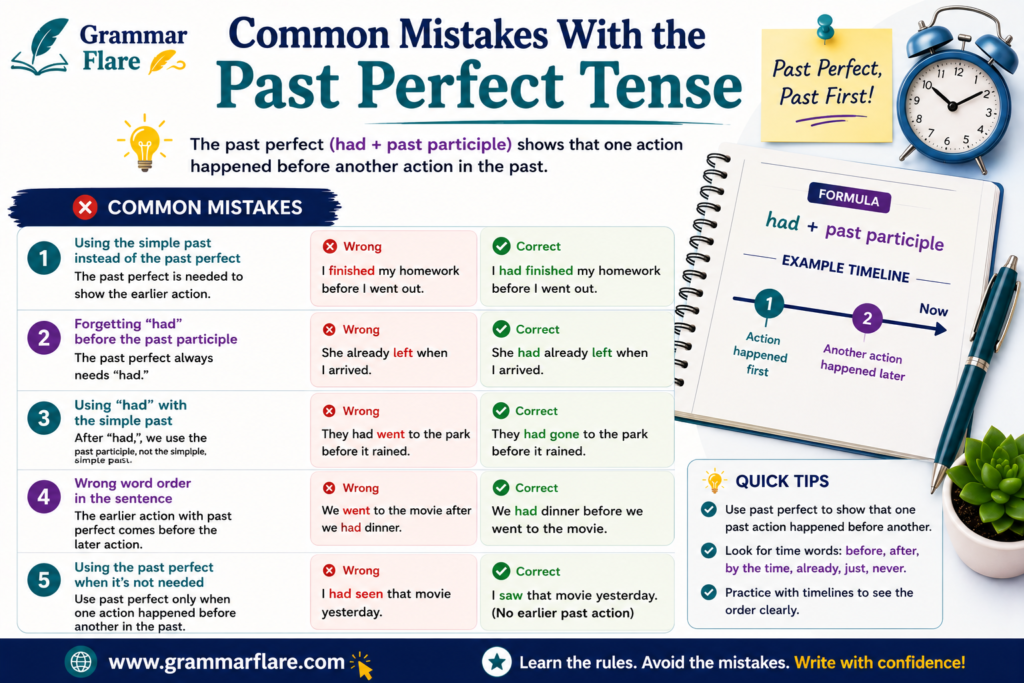
Mistake 1: Using the base verb after had
Incorrect:
She had finish the work.
Correct:
She had finished the work.
After had, use the past participle.
Mistake 2: Using has instead of had
Incorrect:
He has left before I arrived.
Correct:
He had left before I arrived.
Use had when both actions are in the past.
Mistake 3: Using past perfect when simple past is enough
Awkward:
I had woke up, had brushed my teeth, and had went to school.
Better:
I woke up, brushed my teeth, and went to school.
Use past perfect only when you need to show an earlier past action.
Mistake 4: Using the wrong irregular participle
Incorrect: They had went home.
Correct: They had gone home.
Incorrect: She had ate lunch.
Correct: She had eaten lunch.
Incorrect: He had wrote the answer.
Correct: He had written the answer.
Mistake 5: Confusing time order
Unclear: When I arrived, the meeting started.
This may mean the meeting started as I arrived.
Clear: When I arrived, the meeting had started.
This means the meeting started before I arrived.
Past Perfect Tense Examples in Everyday Writing
School writing
- The students had completed the worksheet before the bell rang.
- I had read the chapter before the quiz.
- The teacher had explained the topic before giving the homework.
- She had revised her essay before submitting it.
Work writing
- We had finalized the report before the client called.
- The manager had approved the budget before the project began.
- I had sent the email before the meeting started.
- The team had tested the software before launching it.
Daily conversation
- I had eaten before you came.
- She had left by the time I got there.
- We had already watched that show.
- He had forgotten his keys before he reached the car.
Storytelling
- The village had changed completely by the time he returned.
- She had hidden the letter before anyone entered the room.
- The storm had destroyed the bridge before the rescue team arrived.
- He had never felt so nervous before that night.
Exercise 1: Fill in the Blanks
Complete each sentence with the past perfect form of the verb in parentheses.
- She _______ her homework before dinner. (finish)
- They _______ the movie before we arrived. (start)
- I _______ the book before the class discussion. (read)
- He _______ his keys before leaving the house. (forget)
- We _______ breakfast before the bus came. (eat)
- The rain _______ before the match began. (stop)
- My friend _______ the answer before I explained it. (know)
- The guests _______ before we reached the restaurant. (leave)
- The teacher _______ the lesson before the quiz. (teach)
- I _______ the file before the computer shut down. (save)
Answers
- She had finished her homework before dinner.
- They had started the movie before we arrived.
- I had read the book before the class discussion.
- He had forgotten his keys before leaving the house.
- We had eaten breakfast before the bus came.
- The rain had stopped before the match began.
- My friend had known the answer before I explained it.
- The guests had left before we reached the restaurant.
- The teacher had taught the lesson before the quiz.
- I had saved the file before the computer shut down.
Exercise 2: Make Negative Sentences
Rewrite each sentence in the negative past perfect form.
Example:
She had finished the work.
She had not finished the work.
- He had eaten lunch.
- They had completed the project.
- I had seen the email.
- We had studied the chapter.
- She had locked the door.
- The train had left.
- You had answered the question.
- The team had practiced enough.
- My brother had cleaned his room.
- The students had submitted their work.
Answers
- He had not eaten lunch.
- They had not completed the project.
- I had not seen the email.
- We had not studied the chapter.
- She had not locked the door.
- The train had not left.
- You had not answered the question.
- The team had not practiced enough.
- My brother had not cleaned his room.
- The students had not submitted their work.
You can also use hadn’t instead of had not in everyday writing.
Example:
She hadn’t locked the door.
Exercise 3: Make Questions
Rewrite each sentence as a past perfect question.
Example:
She had finished the report.
Had she finished the report?
- They had left early.
- He had studied the notes.
- You had seen the message.
- The teacher had explained the rule.
- We had visited that museum.
- She had written the email.
- The workers had repaired the road.
- The dog had eaten its food.
- I had answered correctly.
- The guests had arrived before noon.
Answers
- Had they left early?
- Had he studied the notes?
- Had you seen the message?
- Had the teacher explained the rule?
- Had we visited that museum?
- Had she written the email?
- Had the workers repaired the road?
- Had the dog eaten its food?
- Had I answered correctly?
- Had the guests arrived before noon?
Exercise 4: Choose Simple Past or Past Perfect
Choose the correct form.
- When I arrived, the show _______.
a) started
b) had started - She _______ the door and walked inside.
a) opened
b) had opened - They were tired because they _______ all day.
a) worked
b) had worked - I _______ breakfast before I left for school.
a) ate
b) had eaten - He _______ his phone on the desk and went out.
a) put
b) had put - By the time we called, she _______ already left.
a) has
b) had - We _______ the movie last night.
a) watched
b) had watched - The students _______ the topic before the test began.
a) reviewed
b) had reviewed - She _______ her bag and walked to the bus stop.
a) picked up
b) had picked up - The plane _______ before we reached the airport.
a) took off
b) had taken off
Answers
- had started
- opened
- had worked
- had eaten
- put
- had
- watched
- had reviewed
- picked up
- had taken off
Exercise 5: Correct the Mistakes
Each sentence has a past perfect mistake. Rewrite it correctly.
- She had finish the test before the bell rang.
- They had went home before we arrived.
- He has left before I called.
- I had ate dinner before the movie.
- We had saw that place before.
- The teacher had gave the answer.
- She had wrote the letter.
- They had began the meeting early.
- I had not knew the rule.
- He had took my pen.
Answers
- She had finished the test before the bell rang.
- They had gone home before we arrived.
- He had left before I called.
- I had eaten dinner before the movie.
- We had seen that place before.
- The teacher had given the answer.
- She had written the letter.
- They had begun the meeting early.
- I had not known the rule.
- He had taken my pen.
Exercise 6: Write Your Own Sentences
Use the past perfect tense to complete these ideas.
- Before I went to bed, I had _______.
- By the time the class started, the teacher had _______.
- When we arrived at the station, the train had _______.
- Before she moved to Canada, she had _______.
- After they had _______, they went home.
Possible answers:
- Before I went to bed, I had finished my homework.
- By the time the class started, the teacher had written the topic on the board.
- When we arrived at the station, the train had already left.
- Before she moved to Canada, she had studied English for two years.
- After they had eaten dinner, they went home.
Your answers may be different. The important thing is to use:
had + past participle
Free printable worksheet: all six exercises plus a separate answer key, ready to print for a class. Download the PDF (9 pages, no signup).
Past Perfect Tense Timeline
Think of the past perfect as a timeline.
First action:
I had eaten dinner.
Second action:
My friend arrived.
Full sentence:
I had eaten dinner before my friend arrived.
Timeline:
- I ate dinner.
- My friend arrived.
The past perfect marks the first action.
Another example:
The train had left when we reached the station.
Timeline:
- The train left.
- We reached the station.
This is why the past perfect is useful in stories, reports, explanations, and essays. It tells the reader what happened first.
Easy Memory Trick
Use this memory trick:
Past perfect = past before past.
That means one action happened before another past action.
Formula:
had + past participle
Examples:
- had finished
- had eaten
- had gone
- had written
- had seen
- had taken
- had started
If you see two past actions and need to show which one happened first, the earlier action often uses the past perfect.
Mini Quiz: Past Perfect Tense
Choose the correct answer.
- She _______ the room before her mother came in.
a) cleaned
b) had cleaned - When we arrived, the bus _______.
a) left
b) had left - I _______ my homework and then watched TV.
a) finished
b) had finished - He was hungry because he _______ breakfast.
a) skipped
b) had skipped - He was exhausted because he _______ since dawn.
a) worked
b) had worked
Answers
- had cleaned
- had left
- finished
- had skipped
- had worked
FAQ
What is the past perfect tense?
The past perfect tense shows that one past action happened before another past action. It uses had + past participle.
What is the formula for the past perfect tense?
The formula is:
Subject + had + past participle
Example:
She had finished the work.
What are examples of the past perfect tense?
Examples include:
- I had eaten before they arrived.
- She had left when I called.
- They had finished the project before the deadline.
- We had never visited that city before.
When should I use the past perfect tense?
Use the past perfect when you need to show that one past action happened before another past action.
What is the difference between past perfect and simple past?
Use the simple past for completed actions in the past. Use the past perfect when one past action happened before another past action.
Example:
Simple past: I ate dinner.
Past perfect: I had eaten dinner before they arrived.
Can I use past perfect with “before”?
Yes. The past perfect often appears with before.
Example:
She had finished her work before the meeting started.
Can I use past perfect with “after”?
Yes. You can use past perfect with after when you want to emphasize that the first action was complete.
Example:
After we had eaten, we watched TV.
Is “had went” correct?
No. The correct form is had gone. After had, use the past participle.
Is “had ate” correct?
No. The correct form is had eaten.
Is “had finished” past perfect?
Yes. Had finished is the past perfect form of finish.
More Reading at GrammarFlare
- Simple Past vs Present Perfect
- Subject-Verb Agreement
- What Is an Independent Clause?
- Simple Sentence: Meaning, Rules, Examples
- List of Prepositions With Clear Examples
- Grammar Basics
Sources
- British Council LearnEnglish: Past Perfect
- Cambridge Dictionary: Past Perfect Simple
- Purdue OWL: Verb Tenses
Final Takeaway
The past perfect tense helps you show that one past action happened before another past action.
Use this structure:
had + past participle
Examples:
- I had eaten before they arrived.
- She had left when I called.
- They had finished the work before the deadline.
- We had never seen that movie before.
The easiest way to remember it is:
Past perfect means past before past.
Once you understand that timeline, the tense becomes much easier to use.

Ahmad Waheed has spent five years editing academic and professional writing for universities, publishers, and software companies. He founded Grammar Flare after noticing the same handful of mistakes in almost every draft that crossed his desk, and that most grammar guides explained the rule without explaining when it actually matters.
Ahmad writes every guide on this site, checking usage questions against Merriam-Webster, the Chicago Manual of Style, and the AP Stylebook, and noting where those sources disagree rather than quietly picking a side.