
A simple sentence sounds easy, and most of the time, it is.
But here is the part that confuses many learners: a simple sentence does not have to be short.
This is a simple sentence: The dog barked.
This is also a simple sentence: The tired little dog in the backyard barked loudly at the mail carrier.
The second sentence is longer, but it still has only one main clause. That is what makes it simple.
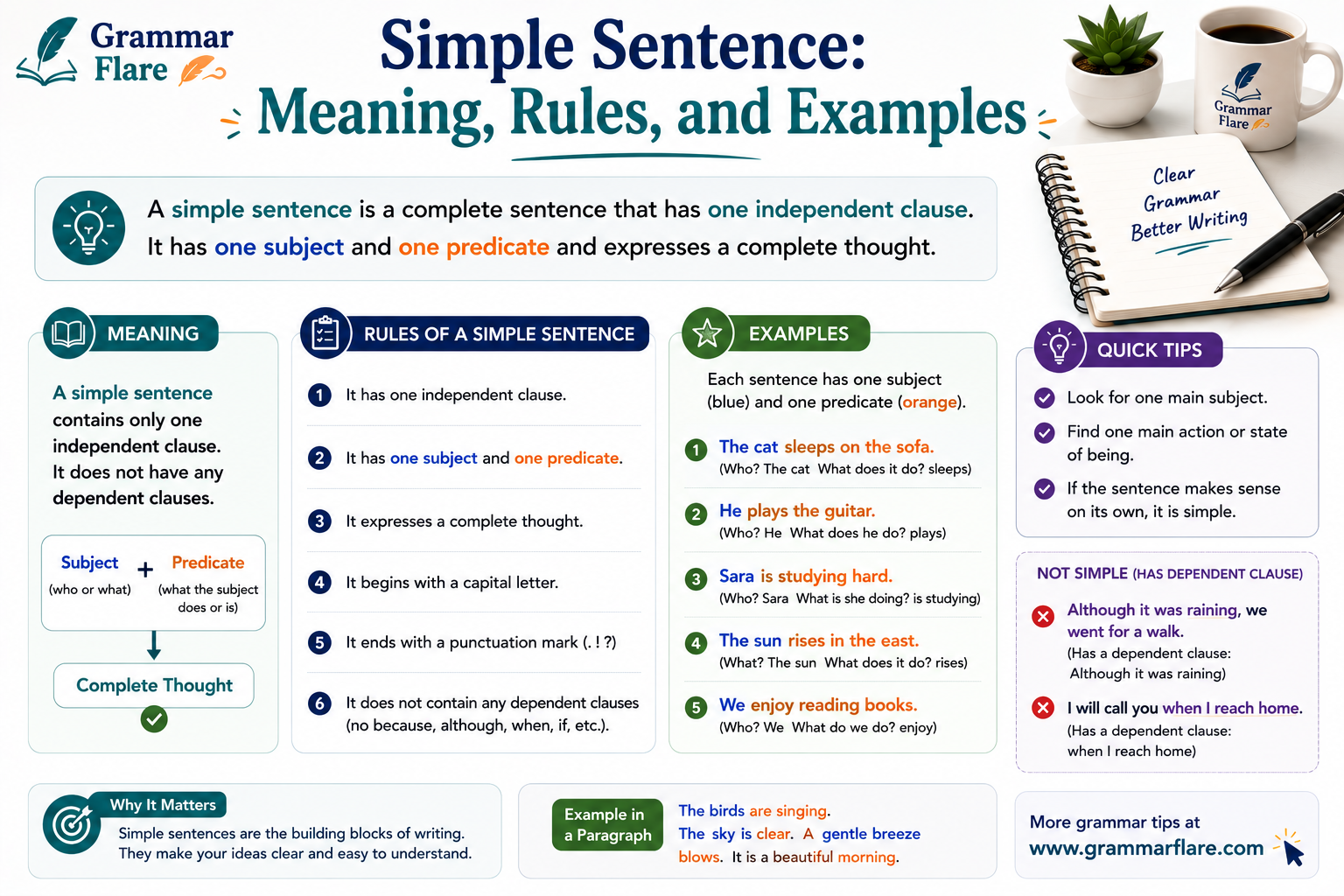
The quick answer is this: A simple sentence has one independent clause. It expresses one complete thought.
Examples
- I smiled.
- She opened the door.
- The students finished the quiz.
- My brother plays football after school.
- The bright yellow bus stopped outside the school.
Each sentence has one complete idea. Each one can stand alone.
A simple sentence can have a compound subject, a compound verb, modifiers, phrases, and extra details. But it still stays simple as long as it has only one independent clause.
If you like clear GrammarFlare guides such as What Is a Compound Sentence? Simple Rules and Examples, What Is a Complex Sentence? Simple Rules and Examples, and Comma Before But: Simple Rule and Examples, this guide follows the same practical format.
Quick Answer: What Is a Simple Sentence?

A simple sentence is a sentence with one independent clause.
An independent clause is a group of words that can stand alone as a complete sentence.
A simple sentence usually has:
- a subject
- a verb
- a complete thought
Examples
- Birds fly.
- I laughed.
- She writes poems.
- The baby slept.
- We watched the sunset.
Each sentence tells a complete idea.
A simple sentence does not need a dependent clause. It also does not join two complete thoughts.
That means this is simple: She reads every night.
This is compound: She reads every night, and her brother watches TV.
This is complex: She reads every night because she enjoys stories.
The difference is sentence structure.
Simple Sentence in One Table
| Sentence type | Structure | Example |
|---|---|---|
| Simple sentence | one independent clause | I finished the lesson. |
| Compound sentence | two or more independent clauses | I finished the lesson, and I took the quiz. |
| Complex sentence | one independent clause + one dependent clause | Because I finished the lesson, I took the quiz. |
| Compound-complex sentence | two independent clauses + one dependent clause | Because I finished the lesson, I took the quiz, and I passed. |
A simple sentence has one complete thought. That is the main rule.
The Basic Formula
The easiest formula for a simple sentence is:
Subject + verb + complete thought
Examples:
- The cat sleeps.
- I study.
- She sings.
- The phone rang.
- We waited.
The subject tells who or what the sentence is about.
The verb tells what the subject does or what happens.
In this sentence: The cat sleeps.
- Subject: the cat
- Verb: sleeps
The idea is complete.
Now look at this: The cat
That is not a sentence because it has no verb.
Now look at this: Sleeps under the chair
That is also incomplete because it does not clearly tell who sleeps.
A simple sentence needs enough information to express a complete thought.
What Is an Independent Clause?
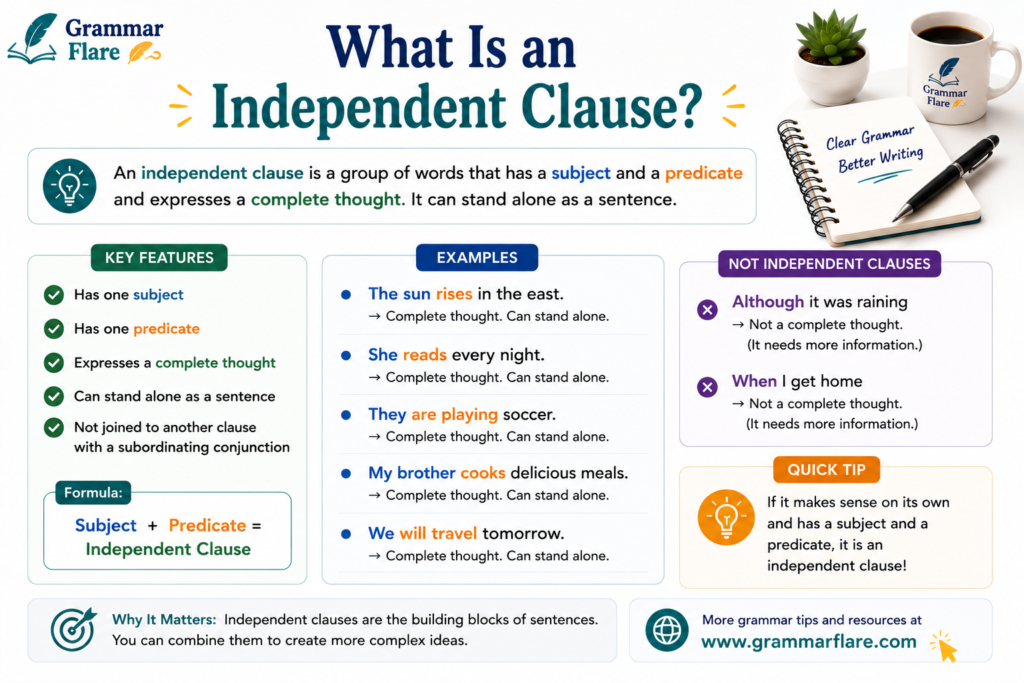
An independent clause can stand alone as a sentence.
It has a subject and a verb, and it makes sense by itself.
Examples
- The teacher smiled.
- I closed the window.
- My sister studies biology.
- The train arrived late.
- We ordered pizza.
Each example is complete.
You can put a period after each one, and the reader understands the message.
Now compare these:
- because the teacher smiled
- after I closed the window
- while my sister studies biology
- when the train arrived late
These groups of words have subjects and verbs, but they are not complete thoughts. They are dependent clauses, not simple sentences.
For example
Fragment: Because the teacher smiled.
Complete sentence: The teacher smiled.
Complex sentence: Because the teacher smiled, the students relaxed.
A simple sentence does not begin with a dependent word that leaves the idea unfinished. If you want the full picture on clauses, our guide to what an independent clause is covers how to spot one and how it differs from a dependent clause.
Simple Sentence Examples
Here are clear examples of simple sentences.
Very short simple sentences
- I waited.
- She laughed.
- Birds flew.
- The baby cried.
- We listened.
These are simple because each one has one independent clause.
Simple sentences with more detail
- I waited outside the classroom.
- She laughed at the funny story.
- Birds flew across the blue sky.
- The baby cried during the movie.
- We listened carefully to the teacher.
These are still simple sentences. The extra words add detail, but they do not add another independent clause.
Longer simple sentences
- The young teacher with the red notebook explained the grammar rule clearly.
- My cousin from Chicago arrived at the airport after midnight.
- The old wooden chair in the corner of the room looked uncomfortable.
- Several students in the front row answered the difficult question.
- A bright orange cat with green eyes slept under the kitchen table.
These sentences are longer, but each one has only one independent clause.
That is why sentence length alone does not decide whether a sentence is simple.
Simple Sentence Does Not Mean Short Sentence
This is one of the biggest misunderstandings.
A simple sentence can be short: The dog barked.
A simple sentence can also be long: The large brown dog behind the neighbor’s fence barked loudly at every passing bicycle.
The second sentence has more detail, but the core is still: The dog barked.
Everything else describes the dog, the place, the sound, or the situation.
Here is another example.
Simple and short: She wrote.
Simple and longer: She wrote a thoughtful email to her professor after the morning lecture.
The sentence is still simple because it has one subject-verb unit: She wrote.
Four Common Simple Sentence Patterns
Simple sentences can follow different patterns.
Pattern 1: Subject + verb
This is the shortest pattern.
Examples
- Birds fly.
- Dogs bark.
- I waited.
- She smiled.
- We listened.
Pattern 2: Subject + verb + object
This pattern tells what receives the action.
Examples
- I read the book.
- She opened the door.
- He wrote a letter.
- They watched the movie.
- We cleaned the room.
Pattern 3: Subject + linking verb + complement
A linking verb connects the subject to more information.
Common linking verbs include
- is
- are
- was
- were
- seems
- feels
- looks
- becomes
Examples
- The soup is hot.
- She seems happy.
- The test was difficult.
- They are ready.
- The sky looks clear.
Pattern 4: Subject + verb + extra phrase
A simple sentence can include prepositional phrases and other details.
Examples
- I waited at the station.
- She sat near the window.
- We walked through the park.
- The keys are in my bag.
- He works after school.
These extra phrases add information, but they do not create another independent clause.
For more help with prepositions, read List of Prepositions With Clear Examples.
Simple Sentence With a Compound Subject
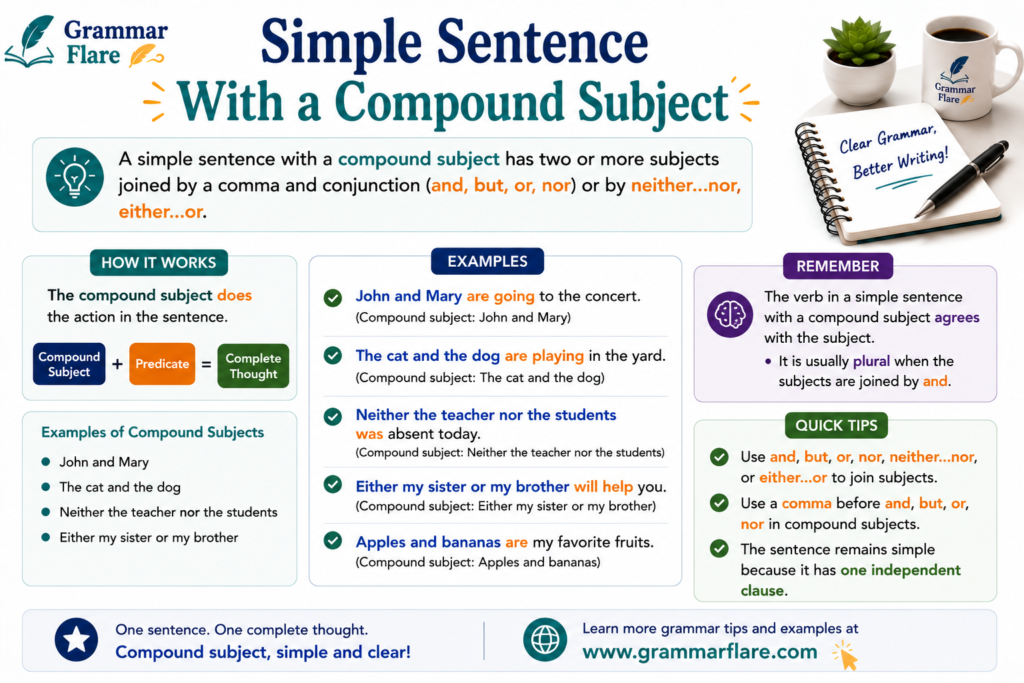
A simple sentence can have more than one subject.
This is called a compound subject.
Examples
- Sarah and Maya laughed.
- The teacher and the students waited.
- My brother and sister play tennis.
- Rain and wind damaged the roof.
- Coffee and tea are available in the lobby.
These are still simple sentences because they have one main clause.
Look at this sentence: Sarah and Maya laughed.
The compound subject is: Sarah and Maya
The verb is: laughed
The sentence expresses one complete thought.
Simple Sentence With a Compound Verb
A simple sentence can also have more than one verb.
This is called a compound verb or compound predicate.
Examples
- Sarah laughed and waved.
- The teacher opened the book and explained the lesson.
- I packed my bag and left the room.
- The children ran, jumped, and shouted.
- He cooked dinner and washed the dishes.
These are still simple sentences when the verbs share the same subject.
Compare
Simple sentence: Sarah laughed and waved.
Compound sentence: Sarah laughed, and Maya waved.
The first sentence has one subject doing two actions. The second sentence has two independent clauses. This is the same distinction that decides whether you need a comma before “but”: one subject means no comma, two subjects means a comma.
That difference matters.
Simple Sentence With a Compound Subject and Compound Verb
A simple sentence can have a compound subject and a compound verb.
Examples
- Sarah and Maya laughed and waved.
- The teacher and the assistant checked the papers and recorded the marks.
- My brother and sister packed their bags and left early.
- The players and coaches celebrated and thanked the fans.
- Rain and wind damaged the roof and flooded the street.
These sentences may look more advanced, but they are still simple because each one has only one independent clause.
A simple sentence can hold more than one person, thing, or action. It just cannot contain two separate complete thoughts joined together.
Simple Sentence vs Fragment
A sentence fragment is an incomplete sentence.
A simple sentence is complete.
Fragment: The boy in the blue jacket.
Simple sentence: The boy in the blue jacket ran across the field.
The fragment has a subject, but it does not have a complete verb idea.
Fragment: After the meeting.
Simple sentence: We talked after the meeting.
The fragment gives a time, but it does not tell what happened.
Fragment: Because I was tired.
Simple sentence: I went to bed early.
Complex sentence: Because I was tired, I went to bed early.
A simple sentence must make sense by itself.
Simple Sentence vs Compound Sentence
A simple sentence has one independent clause.
A compound sentence has two or more independent clauses.
Simple: I opened the file.
Compound: I opened the file, and she checked the title.
In the compound sentence, both parts can stand alone:
I opened the file.
She checked the title.
That makes it compound. The difference matters most when you punctuate. Joining two independent clauses needs a comma and a conjunction, which is why knowing when to put a comma before “and” depends on spotting the second clause.
More Examples
Simple: The lesson was short.
Compound: The lesson was short, but the examples were useful.
Simple: We stayed home.
Compound: It was raining, so we stayed home.
Simple: She likes grammar.
Compound: She likes grammar, and she enjoys writing.
For the full guide, read What Is a Compound Sentence? Simple Rules and Examples.
Simple Sentence vs Complex Sentence
A simple sentence has one independent clause and no dependent clause.
A complex sentence has one independent clause and at least one dependent clause.
Simple: I went to bed early.
Complex: Because I was tired, I went to bed early.
The dependent clause is: Because I was tired
That part cannot stand alone.
More Examples
Simple: She stayed home.
Complex: She stayed home because she was sick.
Simple: We went outside.
Complex: When the rain stopped, we went outside.
Simple: He studied the rule.
Complex: Although the rule was difficult, he studied it carefully.
For a full explanation, read What Is a Complex Sentence? Simple Rules and Examples.
Why Simple Sentences Matter

Simple sentences make writing clear.
They help you:
- state facts directly
- avoid confusion
- create emphasis
- break up long paragraphs
- make instructions easier
- improve readability
- help readers move through your ideas
Strong writing does not mean every sentence must be long. In fact, short simple sentences can make your point stronger.
Example: The rule is simple.
That sentence works because it is direct.
Now compare
Due to the nature of the grammatical concept under discussion, the rule may be considered relatively simple.
That sentence is longer, but not better.
Simple sentences are especially useful in blog writing, emails, instructions, and educational content.
Simple Sentences in Everyday Writing
Emails
- I attached the file.
- Please review the document.
- The meeting starts at 9 a.m.
- I will call you tomorrow.
- Thanks for your help.
School Writing
- The poem uses strong imagery.
- The character feels lonely.
- The experiment failed.
- The author supports the argument.
- The results show a clear pattern.
Blog Writing
- The rule is easy.
- Examples make it clearer.
- This mistake is common.
- The apostrophe matters.
- The quiz comes next.
Conversation
- I’m tired.
- She called me.
- We ordered pizza.
- The movie ended.
- He forgot his keys.
Simple sentences appear everywhere.
Common Mistakes With Simple Sentences
Mistake 1: Thinking a simple sentence must be short
Incorrect idea: A simple sentence must have only a few words.
Better idea: A simple sentence has one independent clause. It can be short or long.
Example: The old house at the end of the quiet street looked empty.
This is still simple.
Mistake 2: Confusing a compound verb with a compound sentence
Simple sentence: She opened the door and walked inside.
Compound sentence: She opened the door, and her brother walked inside.
The first sentence has one subject: she.
The second sentence has two independent clauses.
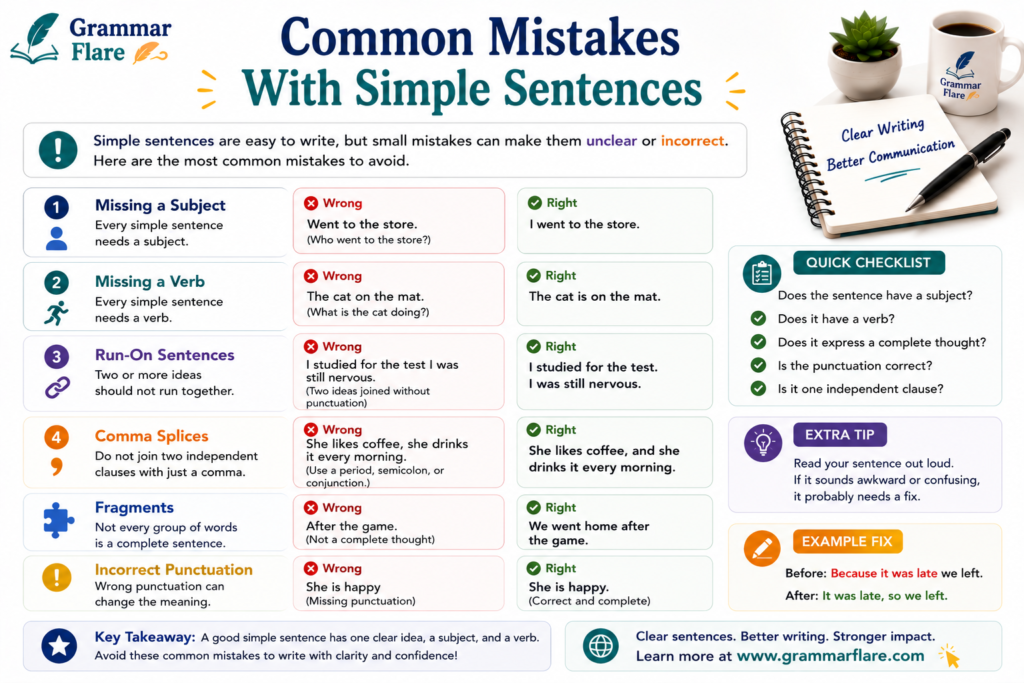
Mistake 3: Writing fragments instead of simple sentences
Fragment: During the long meeting.
Correct: I took notes during the long meeting.
Mistake 4: Creating a comma splice
Incorrect: I finished the work, I went home.
Correct: I finished the work, and I went home.
Also correct: I finished the work. I went home.
The incorrect version joins two simple sentences with only a comma. That error has four standard corrections, which our guide to fixing a comma splice works through with examples.
Mistake 5: Overusing simple sentences
Too many simple sentences can sound choppy.
Choppy: I woke up. I ate breakfast. I packed my bag. I went to school.
Better: I woke up, ate breakfast, packed my bag, and went to school.
Or: After breakfast, I packed my bag and went to school.
Good writing uses a mix of sentence types.
How to Write Better Simple Sentences
A simple sentence should be clear, complete, and purposeful.
Start with the core idea
Ask yourself: Who or what is the sentence about?
What happened?
Example: The student answered.
That is the core idea.
Add useful details
The student answered the question.
The nervous student answered the difficult question.
The nervous student in the front row answered the difficult question clearly.
The sentence grows, but it stays simple.
Remove empty words
Weak: The fact of the matter is that the student answered the question.
Better: The student answered the question.
Simple does not mean childish. Simple means clear.
How to Identify a Simple Sentence
Use this quick test.
Ask
- Does the sentence express a complete thought?
- Does it have one independent clause?
- Does it avoid joining two complete thoughts?
- Does it avoid dependent clauses such as because, although, when, or if?
Example: The teacher explained the rule clearly.
This is a simple sentence.
It has one subject (the teacher), one verb (explained), and it expresses one complete thought.
Now compare
The teacher explained the rule, and the students practiced.
This is compound because it has two complete thoughts.
Now compare
Because the teacher explained the rule, the students understood it.
This is complex because it has a dependent clause.
Simple Sentence Examples With Corrections
Fragment: The girl with the red backpack.
Correct simple sentence: The girl with the red backpack smiled.
Fragment: After the final exam.
Correct simple sentence: We celebrated after the final exam.
Comma splice: I finished the lesson, I closed the book.
Correct compound sentence: I finished the lesson, and I closed the book.
Correct as two simple sentences: I finished the lesson. I closed the book.
Run-on: The class ended the students left.
Correct compound sentence: The class ended, and the students left.
Correct as two simple sentences: The class ended. The students left.
Simple Sentence Examples by Pattern
Subject + verb
- The baby cried.
- The phone rang.
- Birds flew.
- I waited.
- She smiled.
Subject + verb + object
- I wrote a note.
- She cleaned the room.
- They watched the game.
- He fixed the bike.
- We read the article.
Subject + linking verb + complement
- The soup is hot.
- She seems calm.
- The sky looks gray.
- The answer was correct.
- The children are excited.
Compound subject
- John and Ali studied.
- Tea and coffee are ready.
- My mother and father smiled.
- The cat and dog slept.
- Teachers and students listened.
Compound verb
- I packed and left.
- She laughed and clapped.
- He cooked and cleaned.
- The children ran and shouted.
- We read, discussed, and practiced.
Easy Memory Trick
Use this memory trick:
Simple = one complete idea.
It may have extra details, but it still has one main thought.
Example:
The cat slept.
The black cat slept on the sofa.
The black cat with green eyes slept peacefully on the sofa after lunch.
All three are simple sentences because the main idea is still one complete thought:
The cat slept.
Mini Quiz: Is It a Simple Sentence?
Identify each sentence as simple, compound, or complex.
- The dog barked.
- The dog barked, and the baby woke up.
- Because the dog barked, the baby woke up.
- She opened the window and smiled.
- She opened the window, and her sister smiled.
- After the rain stopped, we went outside.
- The old clock on the wall stopped at midnight.
- I studied the rule, but I still made a mistake.
- My brother and sister play chess.
- When the class ended, the students left quietly.
Answers
- Simple
- Compound
- Complex
- Simple
- Compound
- Complex
- Simple
- Compound
- Simple
- Complex
Practice: Make Simple Sentences Longer
Add details to each simple sentence without adding another independent clause.
- The bird sang.
- I read.
- She walked.
- The teacher explained.
- The car stopped.
Possible answers:
- The small bird sang loudly in the tree.
- I read a mystery novel before dinner.
- She walked through the park after school.
- The teacher explained the grammar rule with clear examples.
- The red car stopped near the traffic light.
Each sentence is still simple because it has one independent clause.
FAQ
What is a simple sentence?
A simple sentence has one independent clause and expresses one complete thought. It usually has a subject and a verb.
What is an example of a simple sentence?
Here is an example: The dog barked. It has one subject, one verb, and one complete thought.
Can a simple sentence be long?
Yes. A simple sentence can be long if it still has only one independent clause. Extra details do not automatically make a sentence compound or complex.
Can a simple sentence have two subjects?
Yes. A simple sentence can have a compound subject. Example: Sarah and Maya laughed.
Can a simple sentence have two verbs?
Yes. A simple sentence can have a compound verb. Example: Sarah laughed and waved.
What is the difference between a simple and compound sentence?
A simple sentence has one independent clause. A compound sentence has two or more independent clauses.
What is the difference between a simple and complex sentence?
A simple sentence has one independent clause. A complex sentence has one independent clause and at least one dependent clause.
Is “She opened the door and smiled” a simple sentence?
Yes. It has one subject, she, and two verbs, opened and smiled. It is a simple sentence with a compound verb.
Is “She opened the door, and he smiled” a simple sentence?
No. That is a compound sentence because it has two independent clauses: She opened the door and he smiled.
Related GrammarFlare Reading
If this guide helped, read these next:
- What Is a Compound Sentence?
- What Is a Complex Sentence?
- What Is an Independent Clause?
- How to Fix a Comma Splice
- Comma Before “And”
- List of Prepositions With Clear Examples
Sources
- Cambridge Dictionary: Simple Sentence
- Cambridge Dictionary: Sentence
- Cambridge Dictionary: Independent Clause
- Purdue OWL: Sentence Punctuation Patterns
- Purdue OWL: Sentence Types
Final Takeaway
A simple sentence has one independent clause and expresses one complete thought.
Remember this pattern:
Subject + verb + complete thought = simple sentence
Examples:
- I smiled.
- She opened the door.
- The teacher explained the rule.
- My brother and sister watched a movie.
- The tired student packed her books and left the classroom.
A simple sentence can be short or long. It can have extra details, a compound subject, or a compound verb. The key is that it contains only one independent clause.
Once you understand that rule, simple sentences become easy to identify, easy to write, and useful for clear communication.

Ahmad Waheed has spent five years editing academic and professional writing for universities, publishers, and software companies. He founded Grammar Flare after noticing the same handful of mistakes in almost every draft that crossed his desk, and that most grammar guides explained the rule without explaining when it actually matters.
Ahmad writes every guide on this site, checking usage questions against Merriam-Webster, the Chicago Manual of Style, and the AP Stylebook, and noting where those sources disagree rather than quietly picking a side.