
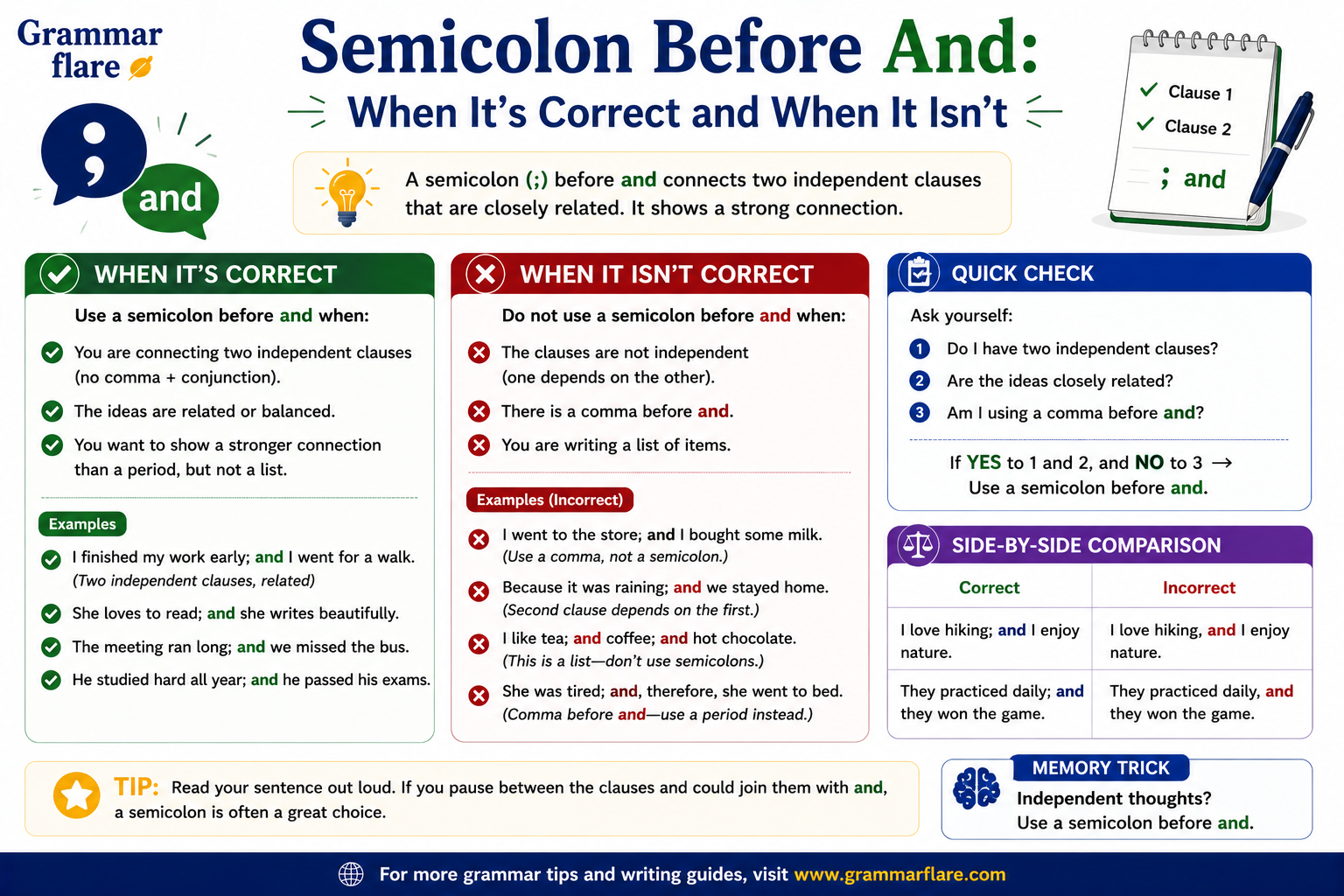
You’re writing a sentence, and it feels long. You want a pause. A comma seems too weak, but a period feels too final. So you reach for a semicolon. Then another question appears: Should you write a semicolon before and?
For example, is this sentence correct?
I finished the report; and I sent it to my manager.
Many writers are unsure because semicolons and conjunctions both connect ideas. They seem like they should work together. But in most cases, a semicolon before and is not needed.
The quick answer is this:
You usually do not need a semicolon before and. Use a comma before and when it joins two complete sentences. Use a semicolon when you want to connect two complete sentences without using and.
So this is correct:
I finished the report, and I sent it to my manager.
This is also correct:
I finished the report; I sent it to my manager.
But this usually sounds awkward:
I finished the report; and I sent it to my manager.
There are a few exceptions, especially in complex lists. This guide explains the rule in plain English, shows you when a semicolon before and can work, and gives you examples you can use right away.
If you like practical GrammarFlare guides such as Comma Before But: Simple Rule and Examples, To vs Too: What’s the Difference? Simple Rules & Examples, and Lose vs Loose: What’s the Difference? Simple Rule + Examples, this article follows the same simple format.
Quick Answer: Can You Use a Semicolon Before And?
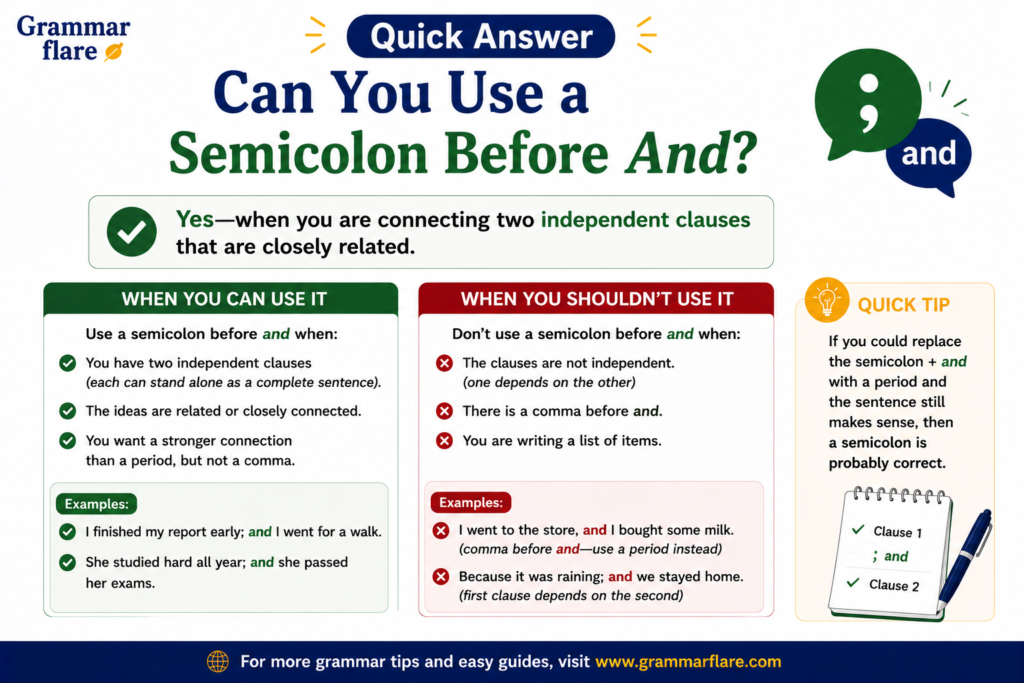
Yes, you can use a semicolon before and, but you usually should not.
In everyday writing, a semicolon before and is often unnecessary because the semicolon already connects two related independent clauses. The word and does a similar connecting job.
Better:
I cleaned the kitchen, and I took out the trash.
Also correct:
I cleaned the kitchen; I took out the trash.
Usually awkward:
I cleaned the kitchen; and I took out the trash.
The most common correct use of a semicolon before and appears in a complex list.
Correct:
The winners came from Austin, Texas; Miami, Florida; and Seattle, Washington.
In that sentence, the semicolon before and helps separate list items that already contain commas.
Here is the simple rule:
Use a semicolon before and mainly in complex lists. In regular sentences, use either a comma before and or a semicolon without and.
Semicolon Before And in One Table
| Sentence type | Best punctuation | Example |
|---|---|---|
| Two complete sentences joined by and | comma before and | I called her, and she answered. |
| Two complete sentences without and | semicolon | I called her; she answered. |
| Complex list with commas inside items | semicolon before and | We visited Paris, France; Rome, Italy; and Madrid, Spain. |
| Short phrase joined by and | no comma or semicolon | She smiled and waved. |
| Semicolon plus and in a normal sentence | usually avoid | I called her; and she answered. |
The main point is simple:
A semicolon and and usually do not need to work together unless the sentence structure requires extra clarity.
What Does a Semicolon Do?
A semicolon is stronger than a comma but softer than a period.
It connects two closely related complete thoughts.
Example:
The rain stopped; the streets were still wet.
Both sides can stand alone as complete sentences:
The rain stopped.
The streets were still wet.
The semicolon tells the reader that these two ideas are closely connected. A period would also be correct, but it would create a stronger break.
Correct:
The rain stopped. The streets were still wet.
Also correct:
The rain stopped; the streets were still wet.
The semicolon creates a smoother connection.
GrammarBook.com explains that a semicolon can separate two sentences when the conjunction has been left out. You can read their punctuation explanation here: GrammarBook.com: Using Semicolons
That idea matters for the semicolon before and question because and is a conjunction. If you keep and, you usually need a comma, not a semicolon.
What Does And Do in a Sentence?
The word and is a coordinating conjunction. It connects words, phrases, or complete clauses.
It can connect two words:
She bought apples and oranges.
It can connect two phrases:
He worked in the morning and after lunch.
It can connect two complete sentences:
She opened the file, and he reviewed the notes.
When and joins two independent clauses, you usually place a comma before it.
An independent clause is a group of words that can stand alone as a sentence.
Example:
She opened the file.
He reviewed the notes.
When you join them with and, you write:
She opened the file, and he reviewed the notes.
For more help with this kind of punctuation logic, read Comma Before But: Simple Rule and Examples. The same independent-clause idea applies to many conjunctions, including and, but, or, and so.
Why “; And” Often Looks Wrong
The phrase ; and often feels awkward because it doubles the connection.
The semicolon already connects the two independent clauses. The word and also connects them.
That means this sentence may feel heavy:
I wanted to leave early; and the meeting was still going.
You have two better choices.
Use a comma with and:
I wanted to leave early, and the meeting was still going.
Or use a semicolon without and:
I wanted to leave early; the meeting was still going.
Both versions are clean.
The version with ; and is not always grammatically impossible, but it is rarely the best choice in modern everyday writing. It can sound old-fashioned, dramatic, or unnecessarily formal.
Correct Use 1: Semicolon Before And in a Complex List
This is the clearest case where a semicolon before and is correct.
Use semicolons in a list when the list items already contain commas.
Simple list:
We visited Lahore, Karachi, and Islamabad.
No semicolons are needed because the items are simple.
Complex list:
We visited Lahore, Pakistan; Dubai, UAE; and Doha, Qatar.
Here, each item contains a comma between the city and country. If you used only commas, the sentence would become messy:
We visited Lahore, Pakistan, Dubai, UAE, and Doha, Qatar.
That version is harder to read because the reader has to figure out which words belong together.
The semicolons solve the problem:
We visited Lahore, Pakistan; Dubai, UAE; and Doha, Qatar.
Now each list item is clear.
The semicolon before and belongs there because it separates the final list item from the previous one.
More examples:
- The speakers were Dr. Allen, a neurologist; Ms. Rivera, a language teacher; and Mr. Shah, a curriculum designer.
- The project includes research, planning, and writing; editing, formatting, and proofreading; and final review, approval, and publication.
- We invited Sara, who handles design; John, who manages SEO; and Mina, who writes the newsletter.
- The finalists came from Boston, Massachusetts; Denver, Colorado; and Portland, Oregon.
In each sentence, the semicolon before and helps the reader follow the list.
Correct Use 2: Semicolon Before And for Style
Sometimes writers use a semicolon before and for rhythm or emphasis.
Example:
He knew the answer; and still, he stayed quiet.
This creates a dramatic pause. It slows the reader down before the second idea.
However, this use is stylistic. It is not usually necessary.
Most of the time, you can write:
He knew the answer, and still, he stayed quiet.
Or:
He knew the answer; still, he stayed quiet.
The second version may be stronger because still works like a transitional word.
Grammarist notes that using a semicolon before and is often considered outdated, though some writers use it for tone or emphasis. You can read their explanation here: Grammarist: Words to Use After a Semicolon
For most GrammarFlare readers, especially students, professionals, bloggers, and everyday writers, the best advice is this:
Avoid ; and unless you have a clear reason.
Correct Use 3: Semicolon Before And in Legal or Formal Lists
Legal, academic, and technical writing sometimes uses semicolons before and in long lists.
Example:
The agreement covers payment terms, including due dates and penalties; delivery obligations, including packaging and shipping; and dispute procedures, including mediation and arbitration.
That sentence is long, but the semicolons organize it.
Each major item includes extra explanation:
- payment terms, including due dates and penalties
- delivery obligations, including packaging and shipping
- dispute procedures, including mediation and arbitration
Because each item has internal commas, semicolons are helpful.
In this kind of writing, the semicolon before and is not only acceptable. It improves readability.
Still, use this structure carefully. If the sentence becomes too long, rewriting it as bullet points may be better.
For example:
The agreement covers:
- payment terms, including due dates and penalties
- delivery obligations, including packaging and shipping
- dispute procedures, including mediation and arbitration
That version is easier to scan, especially online.
When You Should Not Use a Semicolon Before And
Do not use a semicolon before and when and simply joins two complete sentences in ordinary writing.
Avoid:
I wrote the outline; and I drafted the introduction.
Better:
I wrote the outline, and I drafted the introduction.
Also correct:
I wrote the outline; I drafted the introduction.
Avoid:
She checked the grammar; and she corrected the spelling.
Better:
She checked the grammar, and she corrected the spelling.
Also correct:
She checked the grammar; she corrected the spelling.
Avoid:
The rule is simple; and the examples make it clear.
Better:
The rule is simple, and the examples make it clear.
Also correct:
The rule is simple; the examples make it clear.
If you already have and, you usually need a comma. If you want a semicolon, remove and.
Semicolon Before And vs Comma Before And
This is the main difference:
Use a comma before and when and joins two complete sentences.
Use a semicolon when you join two complete sentences without and.
Correct with comma:
I wanted to call, and she wanted to text.
Correct with semicolon:
I wanted to call; she wanted to text.
Usually awkward:
I wanted to call; and she wanted to text.
The comma plus and feels natural. The semicolon without and feels polished. The semicolon plus and often feels too heavy.
Here is another example:
Correct:
The article was long, and the examples were helpful.
Correct:
The article was long; the examples were helpful.
Less natural:
The article was long; and the examples were helpful.
When you are editing your own writing, choose the cleanest version.
Semicolon Before And vs Semicolon Before But
The same general rule applies to but.
Usually, use a comma before but when it joins two complete sentences.
Correct:
I wanted to go, but I was too tired.
You can also use a semicolon if you remove but and rewrite the connection.
Correct:
I wanted to go; I was too tired.
But this version often feels awkward:
I wanted to go; but I was too tired.
Some writers use it for emphasis, but most everyday writing does not need it.
If you want a full guide to but, read Comma Before But: Simple Rule and Examples.
Independent Clauses Explained Simply
To decide whether you need a comma, semicolon, or no punctuation, you need to recognize independent clauses.
An independent clause is a complete sentence.
It usually has:
- a subject
- a verb
- a complete thought
Examples:
- I finished the lesson.
- She opened the door.
- The website loaded slowly.
- The teacher explained the rule.
These can stand alone.
Now look at these:
- after the meeting
- and finished the file
- because the page was loading
- with clear examples
These cannot stand alone as complete sentences.
When and joins two independent clauses, use a comma.
Correct:
I finished the lesson, and she opened the door.
When you use a semicolon, both sides should also be independent clauses.
Correct:
I finished the lesson; she opened the door.
Do not use a semicolon between an independent clause and a fragment.
Incorrect:
I finished the lesson; and opened the door.
The words after the semicolon are not a complete sentence because there is no subject.
Correct:
I finished the lesson and opened the door.
No comma or semicolon is needed because one subject controls both verbs.
Common Mistakes With Semicolon Before And
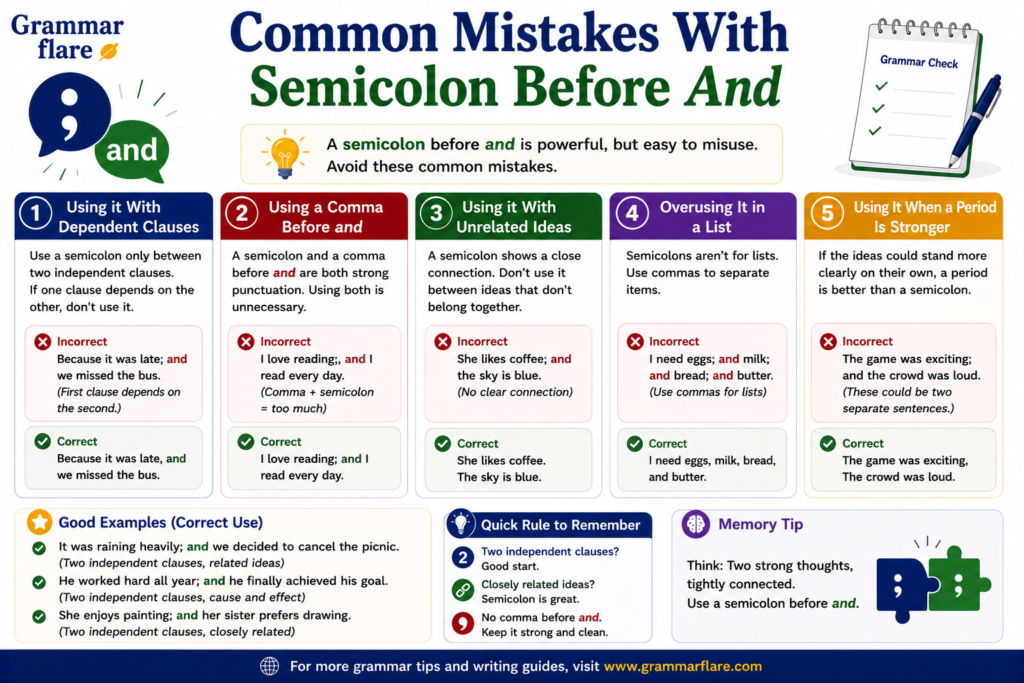
Mistake 1: Using “; and” because the sentence feels long
Incorrect:
The article explains the rule in detail; and it gives many examples.
Better:
The article explains the rule in detail, and it gives many examples.
Also correct:
The article explains the rule in detail; it gives many examples.
Length alone does not require a semicolon before and.
Mistake 2: Using a semicolon before an incomplete phrase
Incorrect:
She edited the draft; and checked the links.
The words and checked the links cannot stand alone as a sentence.
Correct:
She edited the draft and checked the links.
Mistake 3: Replacing every comma with a semicolon
Incorrect:
I bought bread; milk; and eggs.
Correct:
I bought bread, milk, and eggs.
Use semicolons in lists only when the items are complex or already contain commas.
Mistake 4: Using “; and” in every compound sentence
Incorrect:
He opened the laptop; and he started typing.
Better:
He opened the laptop, and he started typing.
Also correct:
He opened the laptop; he started typing.
Mistake 5: Forgetting semicolons in complex lists
Confusing:
The panel included Dr. Khan, a surgeon, Maria Lopez, a teacher, and Aaron Lee, an editor.
Clear:
The panel included Dr. Khan, a surgeon; Maria Lopez, a teacher; and Aaron Lee, an editor.
The semicolon before and is correct here because it separates list items clearly.
How to Fix “; And” Sentences
When you find ; and in your writing, use this quick repair method.
Step 1: Check whether the sentence is a complex list
If yes, the semicolon before and may be correct.
Example:
We hired designers from Austin, Texas; Portland, Oregon; and Atlanta, Georgia.
Keep it.
Step 2: Check whether both sides are complete sentences
If yes, decide whether you want comma + and or semicolon without and.
Original:
I finished the article; and I uploaded it.
Option 1:
I finished the article, and I uploaded it.
Option 2:
I finished the article; I uploaded it.
Step 3: Check whether the words after and are incomplete
If the second part is not a complete sentence, remove the semicolon.
Original:
She opened the document; and reviewed the comments.
Correct:
She opened the document and reviewed the comments.
Step 4: Choose the clearest version
When both options are possible, choose the one that sounds most natural.
Usually, comma + and sounds more conversational.
A semicolon without and sounds more formal or polished.
Side-by-Side Examples
Example 1
Awkward:
I studied the rule; and I passed the quiz.
Better:
I studied the rule, and I passed the quiz.
Also correct:
I studied the rule; I passed the quiz.
Example 2
Incorrect:
She smiled; and waved.
Correct:
She smiled and waved.
Example 3
Correct:
The winners were Aisha Khan, from Lahore; Daniel Reed, from Boston; and Maria Chen, from Toronto.
Example 4
Awkward:
The weather changed; and we canceled the picnic.
Better:
The weather changed, and we canceled the picnic.
Also correct:
The weather changed; we canceled the picnic.
Example 5
Correct:
The course covers grammar, punctuation, and usage; vocabulary, spelling, and style; and writing practice, editing, and proofreading.
Semicolon Before And in WordPress Blog Writing
If you write blog posts, keep punctuation clean and easy to scan.
Online readers move quickly. Long, complicated punctuation slows them down.
For blog writing, use this approach:
- Use shorter sentences when possible.
- Use commas with and for normal compound sentences.
- Use semicolons only when the relationship between two complete thoughts is strong.
- Use bullet points for long lists.
- Use semicolons in complex lists only when commas would confuse the reader.
For example, this sentence is heavy:
The guide explains comma rules, including commas before conjunctions; semicolon rules, including semicolons in complex lists; and apostrophe rules, including possessive forms.
For a blog post, this may work better:
This guide explains:
- comma rules
- semicolon rules
- apostrophe rules
Readers understand it faster.
That matters for SEO too. Clear formatting helps both human readers and AI search engines extract your answer more easily.
A Simple Memory Trick
Use this memory trick:
Comma + and.
Semicolon alone.
Semicolon + and only for complex lists.
Examples:
Comma + and:
I wrote the post, and I added images.
Semicolon alone:
I wrote the post; I added images.
Semicolon + and in a complex list:
The post includes examples from emails, resumes, and essays; notes on punctuation, style, and tone; and a short quiz, answer key, and summary.
That one rule will prevent most semicolon mistakes.
Quick Quiz: Semicolon Before And
Choose the best punctuation.
- I saved the draft ___ and I closed the laptop.
- The speakers came from Houston, Texas ___ Denver, Colorado ___ and Phoenix, Arizona.
- She proofread the article ___ and fixed the title.
- The page loaded slowly ___ the images were too large.
- He wanted to explain the rule ___ and the class wanted examples.
Answers
- I saved the draft, and I closed the laptop.
- The speakers came from Houston, Texas; Denver, Colorado; and Phoenix, Arizona.
- She proofread the article and fixed the title.
- The page loaded slowly; the images were too large.
- He wanted to explain the rule, and the class wanted examples.
FAQ
Can you use a semicolon before and?
Yes, but it is usually unnecessary. The most common correct use is in complex lists, such as Austin, Texas; Miami, Florida; and Seattle, Washington.
Is “; and” grammatically correct?
It can be correct in special cases, but in ordinary sentences it often sounds awkward or outdated. Most of the time, use a comma before and or remove and after the semicolon.
Should I use a comma or semicolon before and?
Use a comma before and when and joins two complete sentences. Use a semicolon when you connect two complete sentences without and.
When is a semicolon before and correct?
A semicolon before and is correct in complex lists where list items already contain commas. It can also appear for dramatic style, but that use is less common.
Is this correct: “I studied; and I passed”?
It is understandable, but it is not the best modern style. Write I studied, and I passed or I studied; I passed.
Can I use a semicolon before but?
You can, but it is usually better to use a comma before but or remove but after the semicolon. For more help, read Comma Before But: Simple Rule and Examples.
Related GrammarFlare Reading
If this guide helped, read these next:
- Comma Before But: Simple Rule and Examples
- To vs Too: What’s the Difference? Simple Rules & Examples
- Lose vs Loose: What’s the Difference? Simple Rule + Examples
- Your vs You’re: Simple Rule, Examples, and Easy Memory Trick
- It’s vs. Its: Simple Rule, Examples, and Easy Memory Trick
- Than vs Then: What’s the Difference? Simple Rules + Examples
Sources
- GrammarBook.com: Using Semicolons
- Grammarist: Words to Use After a Semicolon — Can I Use And or But?
- Purdue OWL: Semicolons
Final Takeaway
A semicolon before and is not usually needed.
For ordinary sentences, choose one of these clean patterns:
- Use comma + and: I wrote the email, and I sent it.
- Use semicolon alone: I wrote the email; I sent it.
Use semicolon + and mainly in complex lists:
The team visited Dallas, Texas; Chicago, Illinois; and Atlanta, Georgia.
That is the easiest way to remember the rule. A semicolon is powerful punctuation, but it works best when you use it with purpose, not just because a sentence feels long.