

AI writing tools are everywhere now. Students use them for brainstorming. Bloggers use them for outlines. Businesses use them for emails, ads, and website copy. Teachers, editors, and publishers are also asking a new question: Was this written by a human, AI, or both? That question has made two search terms very popular: AI detector vs AI checker.
At first, they sound like the same thing. Many websites even use them interchangeably. You may see a tool called an AI detector, an AI checker, an AI content detector, or an AI writing checker, and all of them promise to analyze text for signs of AI generation.
But there is a useful difference.
An AI detector usually focuses on identifying whether text looks AI-generated.
An AI checker often works more broadly. It may check for AI writing, plagiarism, grammar, tone, originality, or content quality, depending on the tool.
The quick answer is this:
Use AI detector when you mean a tool that estimates whether text was generated by AI. Use AI checker when you mean a broader tool that checks AI use along with other writing or originality issues.
That said, neither term guarantees perfect accuracy. AI detection tools can help you notice patterns, but they should not be treated as final proof.
Quick Answer: AI Detector vs AI Checker
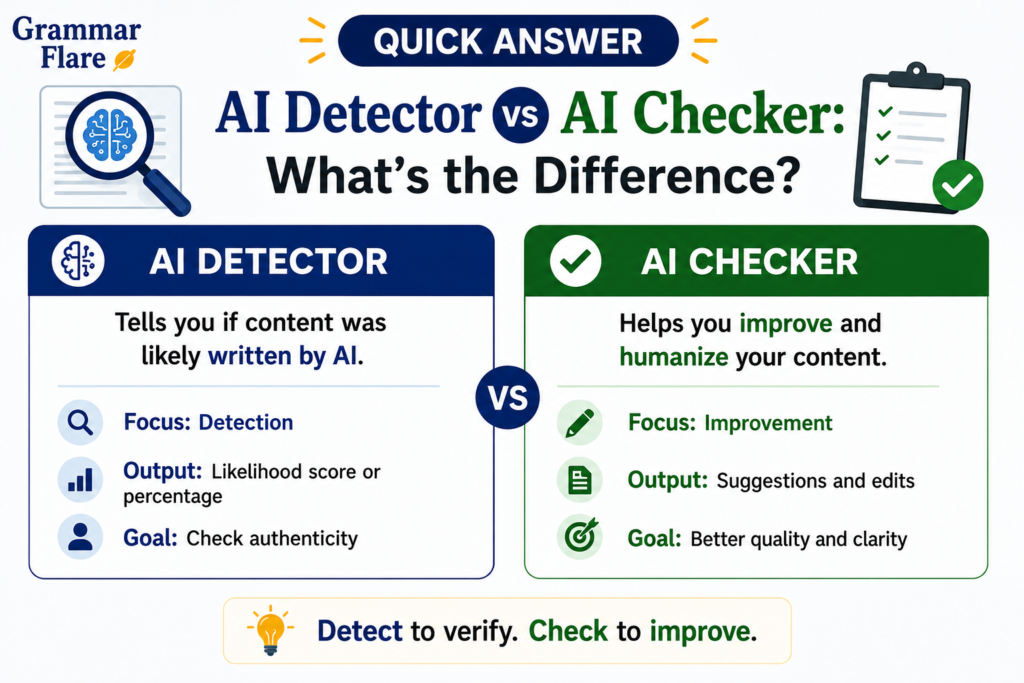
An AI detector is a tool that looks at text and estimates whether it was written by artificial intelligence.
An AI checker is often a broader tool that may check for AI writing, plagiarism, grammar mistakes, tone, readability, or originality.
In everyday use, people often use both terms to mean the same thing.
Examples:
- I ran the essay through an AI detector.
- The editor used an AI checker before publishing the article.
- The teacher checked the assignment with an AI writing checker.
- The website says its AI content detector can identify ChatGPT-style text.
The best way to understand the difference is this:
AI detector = focused on AI-generated text, while AI checker = may include AI detection plus other writing checks.
AI Detector vs AI Checker in One Table
| Term | Main meaning | Common use | Example |
|---|---|---|---|
| AI detector | A tool that estimates whether text is AI-generated | Teachers, editors, publishers, website owners | “This AI detector flagged three paragraphs.” |
| AI checker | A broader tool that may check AI, plagiarism, grammar, or originality | Students, writers, content teams, educators | “Use an AI checker before submitting the article.” |
| AI content detector | A detector focused on online content, essays, or articles | SEO teams, publishers, educators | “The AI content detector gave a probability score.” |
| AI writing checker | A writing tool that checks for AI patterns and writing quality | Writers, students, bloggers | “The AI writing checker also suggested grammar edits.” |
| ChatGPT checker | A tool that claims to identify ChatGPT-style writing | Students, teachers, editors | “The ChatGPT checker said the text looked AI-written.” |
The terms overlap, but the intention can be slightly different.
What Is an AI Detector?
An AI detector analyzes a piece of writing and estimates whether it looks like it was written by AI.
It may review:
- sentence structure
- word choice
- repetition
- predictability
- style patterns
- paragraph flow
- lack of personal detail
- unusual consistency in tone
The tool then gives some kind of result.
That result may appear as:
- a percentage
- a probability score
- a label such as “likely AI”
- highlighted passages
- a risk level
- a human vs AI breakdown
For example, a detector might say:
“68% likely AI-generated.”
Or:
“This document contains several passages that may have been written by AI.”
That sounds precise, but the score is not the same as proof. It is a prediction based on patterns.
A good way to think of an AI detector is this:
An AI detector is like a smoke alarm. It can warn you that something may need attention, but it cannot always tell you exactly what happened.
What Is an AI Checker?
An AI checker can mean the same thing as an AI detector, but it often has a wider meaning.
Some AI checkers only check whether text appears AI-generated. Others combine AI detection with writing tools.
An AI checker may include:
- AI detection
- plagiarism checking
- grammar checking
- spelling correction
- readability analysis
- tone suggestions
- citation checks
- originality reports
- writing improvement tips
That is why the word checker feels broader.
For example, a student might use an AI checker to see whether an essay sounds too machine-written. A teacher might use an AI checker inside a plagiarism platform. A blogger might use an AI checker to review an article before publishing.
The word checker suggests a review process. It does not always mean the tool only detects AI.
Are AI Detector vs AI Checker the Same Thing?
In many search results and tool names the two are not distinguished at all. They are used almost interchangeably.
A website may call its tool an “AI detector” in the title and an “AI checker” in the description. Another tool may use “AI writing checker” but mainly provide a detection score.
So, in everyday language, these terms overlap.
But if you want to be more precise, use them this way:
Use AI detector when the main job is to detect AI-generated writing.
Use AI checker when the tool checks writing more broadly.
For example:
- “I used an AI detector to see whether the article looked AI-generated.”
- “I used an AI checker to review AI risk, grammar, and originality.”
That small distinction can make your writing clearer.
This is similar to many English word choices. Two terms can overlap, but they do not always carry the exact same meaning. GrammarFlare often explains these small differences in guides like Loaned or Lent: Which Word Should You Actually Use? and Than vs Then: What’s the Difference? Simple Rules + Examples.
How Do AI Detectors Work?
Most AI detectors use machine learning and natural language processing. In simple terms, they compare your text with patterns found in human writing and AI-generated writing.
They may look at signals such as:
- how predictable the next word is
- how repetitive the sentence patterns are
- whether the writing has natural variation
- whether the tone feels too consistent
- whether examples sound personal or generic
- whether the vocabulary looks unusually smooth
- whether paragraphs follow a machine-like structure
AI-generated text often has a polished, balanced, predictable rhythm. Human writing tends to vary more. It may include sharper details, personal judgment, uneven sentence length, and natural quirks.
That does not mean polished writing is automatically AI. Strong human writers can also write clearly and smoothly. That is one reason AI detectors can make mistakes.
Copyleaks explains that AI detectors often use machine learning, natural language processing, and signals such as perplexity, burstiness, repetition, and style patterns. You can read more here: Copyleaks: How Do AI Detectors Work?
What Does an AI Detection Score Mean?
An AI detection score is usually a probability estimate.
It does not mean the tool knows exactly who or what wrote the text.
For example, a result like this can be misleading:
“92% AI-generated.”
That does not always mean 92% of the text was definitely written by AI. It usually means the tool found patterns that strongly resemble AI-generated writing.
A safer interpretation would be:
“The text has several patterns commonly associated with AI-generated writing.”
That wording matters.
AI detection scores can be affected by:
- short text length
- formal writing style
- non-native English writing
- heavy editing
- repeated sentence structures
- generic examples
- topic type
- academic wording
- simple vocabulary
- grammar-correction tools
- paraphrasing tools
So, the score should start a review, not end it.
Can AI Detectors Be Wrong?
Yes. AI detectors can be wrong.
They can create:
- false positives, where human writing is flagged as AI
- false negatives, where AI writing passes as human
- mixed results, where only some passages are flagged
- inconsistent scores across different tools
False positives are especially serious in schools, universities, and workplaces. A student, writer, or employee may be unfairly accused if someone treats a detection score as final proof.
Stanford researchers have warned that AI detectors can be biased against non-native English writers. Their research found that GPT detectors may misclassify writing by non-native English authors as AI-generated. You can read more here: Stanford HAI: AI Detectors Biased Against Non-Native English Writers
A peer-reviewed study available through Springer also found reliability concerns with AI-generated text detectors. See: Testing of Detection Tools for AI-Generated Text
This does not mean all AI detectors are useless. It means they should be used carefully.
Why AI Detection Is Difficult
AI detection is difficult because AI writing keeps changing.
Older AI writing often sounded stiff, generic, and repetitive. Newer AI models can create more natural text, vary sentence structure, follow complex instructions, and imitate different tones.
At the same time, human writing can sometimes look machine-like.
For example:
- A student writing in a second language may use simple, predictable sentence patterns.
- A business writer may use polished, formal language.
- A medical or legal writer may follow strict phrasing.
- A blogger may use clear headings and short paragraphs.
- A grammar tool may smooth out natural human quirks.
Any of these can confuse an AI detector.
That is why human review matters.
A responsible reviewer should ask:
- Does the writing match the person’s usual style?
- Can the writer explain the ideas?
- Is there a draft history?
- Are there notes, outlines, or earlier versions?
- Does the writing include real examples?
- Is there a clear thinking process?
- Are the sources real and relevant?
- Did the writer disclose AI use if required?
These questions are often more useful than one score.
How Teachers Use AI Detectors
Teachers may use AI detectors to review student work, but the best approach is careful and fair.
A teacher should not look at one AI score and immediately accuse a student. That can create serious problems, especially when the student wrote the work honestly.
Instead, teachers can use AI detection as one signal among many.
A fair process may include:
- reviewing the assignment instructions
- comparing the essay with the student’s previous work
- asking the student to explain their argument
- checking draft history
- reviewing notes or outlines
- looking for fabricated sources
- discussing acceptable AI use
- following school policy
OpenAI’s educator guidance encourages approaches such as asking students to share specific ChatGPT conversations when relevant, instead of relying only on detection tools. You can read the guidance here: OpenAI Help: How Can Educators Respond to Students Presenting AI-Generated Content as Their Own?
Turnitin also discusses false positives and the need to interpret AI writing reports carefully. See: Turnitin: Understanding False Positives Within AI Writing Detection
How Writers Should Use AI Checkers
Writers can use AI checkers as a quality-control tool, but not as a trick to hide AI use.
A responsible writer can use an AI checker to ask:
- Does my writing sound too generic?
- Have I included enough personal insight?
- Are my examples specific?
- Is my argument clear?
- Did I overuse repeated phrases?
- Does the article need more original detail?
- Are my sources accurate?
- Does my tone match my audience?
This is different from trying to “beat” a detector.
The goal should be better writing, not deception.
For example, if a checker says your blog post looks generic, do not simply replace words randomly. Instead, improve the article by adding:
- first-hand examples
- original explanations
- clearer reasoning
- better structure
- specific sources
- real screenshots or data if relevant
- practical tips from experience
That kind of improvement helps readers. It also helps Google and AI search engines understand that your content has genuine value.
That editing work is a skill in itself. Our guide to using AI without sounding robotic covers the three passes that actually change how a draft reads, rather than the word-swapping that only changes a score.
How Bloggers and Website Owners Should Use AI Detection
If you run a website, AI detection can help you review content quality, but it should not be your only editorial standard.
A blog post can pass an AI detector and still be weak.
It may be:
- thin
- generic
- repetitive
- inaccurate
- poorly structured
- missing examples
- missing sources
- written only to target keywords
A strong article should do more than avoid AI flags.
It should answer the reader’s question better than competing pages.
A strong article does more than clear a detector. It gives the reader something they could not get from a summary: a direct answer near the top, concrete examples, the cases where the rule bends, and a source they can check. Those are the things a detector cannot measure and a reader immediately notices.
AI Detector vs Plagiarism Checker
An AI detector is not the same as a plagiarism checker.
A plagiarism checker looks for text that matches existing sources.
An AI detector looks for patterns that resemble AI-generated writing.
Here is the difference:
| Tool | What it checks | Example result |
|---|---|---|
| Plagiarism checker | Similarity to existing online or database text | “This paragraph matches a published article.” |
| AI detector | Probability that text looks AI-generated | “This paragraph is likely AI-generated.” |
| Grammar checker | Grammar, spelling, punctuation, clarity | “Change this verb form.” |
| Originality checker | May combine plagiarism and AI checks | “This text has similarity and AI-risk issues.” |
A text can be original but AI-generated. A text can also be human-written but plagiarized. These are different problems.
For example:
- A student copies a paragraph from a website. That is plagiarism.
- A student asks AI to write a paragraph from scratch. That may not match any source, but it may still violate school policy.
- A writer drafts an article and uses grammar software to polish it. That may be allowed, depending on the rules.
Always check the policy that applies to your school, publication, or workplace.
AI Detector vs Grammar Checker
A grammar checker looks for writing mistakes.
It may suggest fixes for:
- spelling
- punctuation
- grammar
- clarity
- tone
- concision
- sentence structure
An AI detector looks for AI-like patterns.
These tools can overlap when an AI checker includes both features, but the purpose is different.
For example, a grammar checker might suggest:
Change “She go to school” to “She goes to school.”
An AI detector might say:
This paragraph has a high AI-likelihood score.
You can use both tools, but you should understand what each result means.
If grammar and punctuation are your main concern, GrammarFlare’s writing guides may be more helpful than an AI score. Start with It’s vs. Its: Simple Rule, Examples, and Easy Memory Trick or Comma Before But: Simple Rule and Examples.
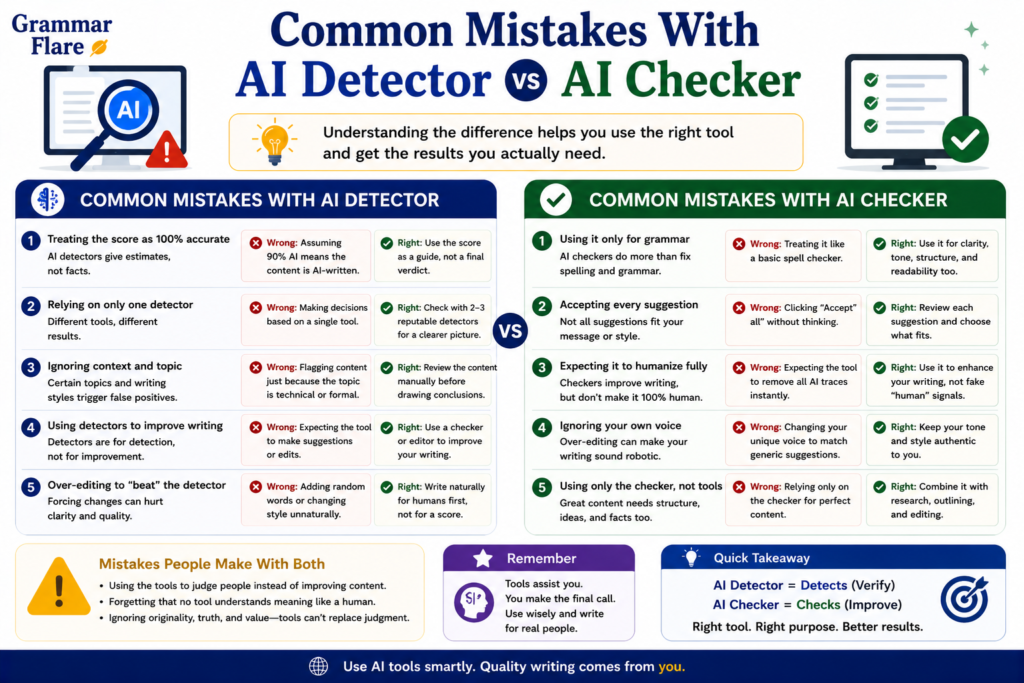
Common Mistakes With AI Detector vs AI Checker
Mistake 1: Treating the score as proof
An AI score is not proof. It is an estimate. Use it as a starting point for review.
Mistake 2: Checking very short text
Short text can confuse detectors. A 40-word paragraph may not give the tool enough information.
Mistake 3: Ignoring context
A formal essay, legal paragraph, or technical explanation may naturally sound more structured than casual writing.
Mistake 4: Assuming all detectors work the same way
Different tools use different models, thresholds, and training data. One detector may flag a text while another does not.
Mistake 5: Punishing writers without review
In education or workplace settings, always review the evidence before making a serious claim.
Mistake 6: Using AI checkers to hide AI use
That is the wrong goal. Use tools to improve clarity, originality, and honesty, not to deceive teachers, editors, or readers.
Responsible Use Checklist
Before you rely on an AI detector or AI checker, ask these questions:
- Is the text long enough for a meaningful check?
- Does the tool explain what it flagged?
- Could the writing style naturally look formal or predictable?
- Is the writer a non-native English speaker?
- Are there drafts, notes, or revision history?
- Can the writer explain the work?
- Does the institution or publisher have an AI policy?
- Are you using the score as a clue, not a final verdict?
- Have you reviewed the content yourself?
- Are you treating the writer fairly?
This checklist is especially important in schools and universities.
How to Improve Writing Without Misusing AI
Good writing does not depend on whether a detector likes it. Good writing serves the reader.
To make your writing stronger:
- use specific examples
- explain your reasoning
- avoid vague claims
- cite reliable sources
- vary sentence length naturally
- add original insight
- use clear headings
- remove filler
- answer the main question early
- proofread slowly
For example, instead of writing:
AI tools are important in the modern world because they help many people.
Write:
AI tools can speed up first drafts, but they also create new questions about authorship, originality, and trust.
The second sentence says more. It gives the reader a clear idea.
This same principle applies to grammar topics. Compare:
Bad:
Affect and effect are confusing.
Better:
Use affect when you mean “influence” and effect when you mean “result.”
For a full explanation, see Affect vs. Effect: What’s the Difference? Simple Rules + Examples.
If you draft with AI and then edit, the order of those edits matters more than most people expect. Our guide to improving AI writing sets out what to check first.
Mini Quiz: AI Detector or AI Checker?
Choose the better term.
- A tool only estimates whether a paragraph was written by AI.
- A tool checks AI risk, plagiarism, grammar, and originality.
- A teacher uses a report as one clue in a larger review.
- A website owner reviews whether a guest post may be AI-generated.
- A student checks grammar, clarity, and AI-likelihood before submission.
Answers
- AI detector
- AI checker
- AI detector or AI checker, depending on the platform
- AI detector
- AI checker
FAQ
What is the difference between an AI detector and an AI checker?
An AI detector usually focuses on identifying whether text looks AI-generated. An AI checker may be broader and include AI detection, plagiarism checking, grammar checking, tone review, or originality analysis.
Are AI detectors accurate?
AI detectors can be useful, but they are not perfect. They can produce false positives and false negatives, especially with short text, formal writing, non-native English writing, or heavily edited content.
Can an AI detector prove cheating?
No. An AI detection score should not be treated as final proof. It should be reviewed with context, draft history, writing samples, and a fair discussion.
What does an AI checker look for?
An AI checker may look for AI-like writing patterns, plagiarism, grammar issues, readability problems, tone, and originality depending on the tool.
Can human writing be flagged as AI?
Yes. Human writing can be flagged as AI, especially when it is formal, repetitive, highly polished, or written by a non-native English speaker.
Should bloggers use AI detectors?
Bloggers can use AI detectors as one editorial tool, but the better goal is to create original, helpful content with clear examples, useful sources, and real insight.
Is a plagiarism checker the same as an AI detector?
No. A plagiarism checker finds text that matches existing sources. An AI detector estimates whether text resembles AI-generated writing.
What should I do if my writing is falsely flagged as AI?
Keep drafts, outlines, notes, research links, and revision history. Explain your writing process calmly. A false positive should be handled with context, not panic.
More Reading at GrammarFlare
- How to Use AI to Improve Your Writing Without Sounding Robotic
- The Importance of Tone in Conversation
- Professional Ways to Say “Please Let Me Know”
- Comma Before “But”
- AI & Writing Tools
Sources
- OpenAI Help: How Can Educators Respond to Students Presenting AI-Generated Content as Their Own?
- Turnitin: Understanding False Positives Within AI Writing Detection
- Copyleaks: How Do AI Detectors Work?
- Stanford HAI: AI Detectors Biased Against Non-Native English Writers
- Springer: Testing of Detection Tools for AI-Generated Text
- MIT Sloan Teaching & Learning Technologies: AI Detectors Don’t Work. Here’s What to Do Instead.
Final Takeaway
The difference between AI detector and AI checker is small but useful.
An AI detector focuses on whether text looks AI-generated.
An AI checker may check AI risk along with grammar, plagiarism, originality, or writing quality.
In everyday use, people often use the terms interchangeably. That is fine in casual speech. But when accuracy matters, remember this:
AI detection tools give signals, not final proof.
Use them to guide a careful review. Do not use them to make unfair accusations. Strong writing still depends on clear thinking, original examples, honest sourcing, and human judgment.

Ahmad Waheed has spent five years editing academic and professional writing for universities, publishers, and software companies. He founded Grammar Flare after noticing the same handful of mistakes in almost every draft that crossed his desk, and that most grammar guides explained the rule without explaining when it actually matters.
Ahmad writes every guide on this site, checking usage questions against Merriam-Webster, the Chicago Manual of Style, and the AP Stylebook, and noting where those sources disagree rather than quietly picking a side.