

A complex sentence sounds difficult because of the word complex. But the grammar rule is actually simple.
A complex sentence is a sentence with one complete thought and at least one incomplete thought that depends on it.
Here is a quick example:
Because it was raining, we stayed inside.
This sentence has two parts:
- Because it was raining = dependent clause
- we stayed inside = independent clause
The second part can stand alone as a complete sentence. The first part cannot. It needs the main part to complete the idea.
That is the heart of a complex sentence.
The quick answer is this:
A complex sentence has one independent clause and one or more dependent clauses.
Examples:
- Because I was tired, I went to bed early.
- I called her after the meeting ended.
- Although the rule looks hard, the examples make it easy.
- The student who won the prize gave a short speech.
- We stayed home because the weather was bad.
Complex sentences help you show time, reason, contrast, condition, place, or extra detail. They make your writing more mature because they connect ideas instead of leaving everything short and separate.
Quick Answer: What Is a Complex Sentence?
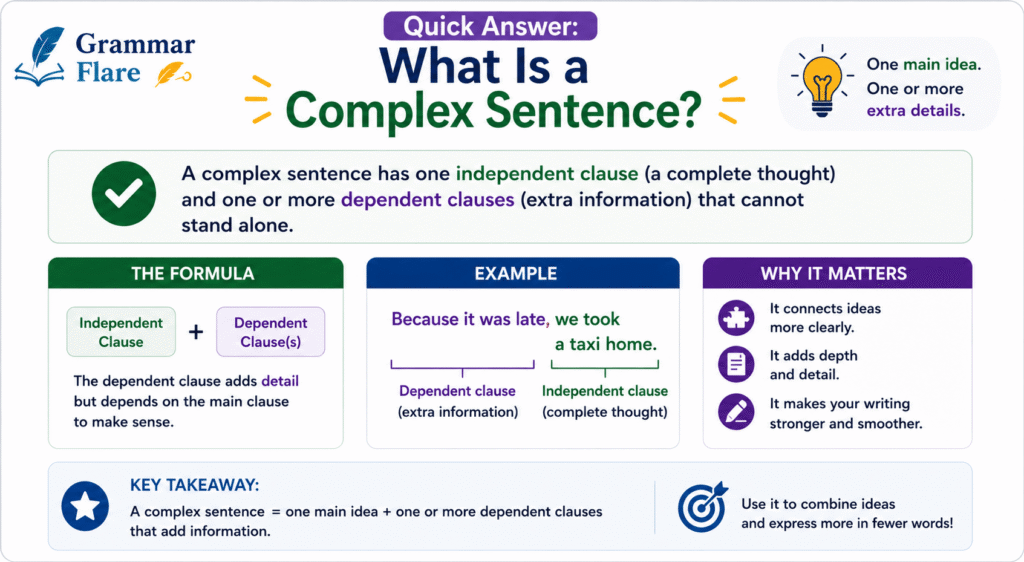
A complex sentence is a sentence that contains:
- one independent clause
- at least one dependent clause
An independent clause can stand alone as a complete sentence.
A dependent clause has a subject and verb, but it cannot stand alone as a complete sentence.
Example: Although she was nervous, she gave a great speech.
Independent clause: she gave a great speech
Dependent clause: although she was nervous
The dependent clause adds extra meaning, but it cannot stand alone.
Incorrect sentence fragment: Although she was nervous.
That feels unfinished.
Complete complex sentence: Although she was nervous, she gave a great speech.
Now the sentence makes sense.
Complex Sentence in One Table
| Sentence part | Can it stand alone? | Example |
|---|---|---|
| Independent clause | Yes | She gave a great speech. |
| Dependent clause | No | Although she was nervous |
| Complex sentence | Yes | Although she was nervous, she gave a great speech. |
A complex sentence needs both parts to work together.
The Simple Rule
Here is the easiest way to remember a complex sentence:
Complete sentence + dependent idea = complex sentence
Examples:
- I stayed home because I felt sick.
- When the movie ended, we went for coffee.
- She smiled although she was disappointed.
- The book that you recommended was excellent.
- If you practice daily, your writing will improve.
In each sentence, one part can stand alone. The other part depends on it.
That dependent part is what makes the sentence complex.
What Is an Independent Clause?
An independent clause is a complete thought.
It has a subject and a verb, and it can stand alone as a sentence.
Examples:
- I finished the report.
- She opened the window.
- The teacher explained the lesson.
- We walked to the store.
- The dog barked loudly.
Each one can stand alone.
You do not need to add anything else to make the meaning complete.
Independent clauses are the building blocks of many sentence types. They appear in simple sentences, compound sentences, complex sentences, and compound-complex sentences.
Our full guide to what an independent clause is covers how to spot one and how it differs from a dependent clause.
For example
Simple sentence: I finished the report.
Complex sentence: I finished the report before the meeting started.
The first version is complete. The second version adds a dependent clause.
What Is a Dependent Clause?
A dependent clause is a group of words with a subject and verb, but it does not express a complete thought.
It depends on another clause to finish the meaning.
Examples
- because I was tired
- although she tried hard
- when the bell rang
- if you need help
- after the rain stopped
- while we were waiting
- who lives next door
- that you recommended
Each example has a subject and a verb, but it feels incomplete by itself.
Fragment: Because I was tired.
The reader naturally asks: What happened because you were tired?
Complete sentence: Because I was tired, I went to bed early.
Now the idea is complete.
How Dependent Clauses Begin
Many dependent clauses begin with subordinating conjunctions.
Common subordinating conjunctions include:
- after
- although
- as
- because
- before
- even though
- if
- since
- though
- unless
- until
- when
- whenever
- where
- wherever
- while
Examples
- Because the train was late, we missed the meeting.
- Although he studied, he felt nervous.
- When the lights went out, everyone stopped talking.
- If you need help, call me.
- Before you leave, check the door.
- While she cooked, he set the table.
These words make the clause dependent. They signal that the idea needs another clause to complete it.
Compare
Complete: The train was late.
Dependent: Because the train was late.
The word because turns a complete idea into a dependent one.
Complex Sentence Examples
Here are clear examples of complex sentences.
Reason
- I stayed home because I was sick.
- She apologized because she made a mistake.
- We left early because the road was crowded.
Time
- When the bell rang, the students stood up.
- I called him after the meeting ended.
- She smiled as soon as she saw the puppy.
Contrast
- Although it was cold, we went outside.
- He kept working even though he was tired.
- Though the test was hard, she passed.
Condition
- If you study, you will improve.
- We can leave early unless the meeting runs late.
- If the weather changes, we will stay home.
Place
- Sit where you can see the screen.
- We stopped where the path ended.
- The children played where the grass was dry.
Extra detail
- The student who won the prize thanked her teacher.
- The article that you sent me was useful.
- The book which I bought yesterday is already on my desk.
All of these are complex sentences because they include a dependent clause.
Complex Sentence Formula
You can build a complex sentence in two main ways.
Formula 1: Dependent clause + comma + independent clause
Examples
- Because I was late, I took a taxi.
- When the rain stopped, we went outside.
- Although the room was noisy, she kept reading.
- If you need examples, read the next section.
When the dependent clause comes first, use a comma after it.
Formula 2: Independent clause + dependent clause
Examples
- I took a taxi because I was late.
- We went outside when the rain stopped.
- She kept reading although the room was noisy.
- Read the next section if you need examples.
When the independent clause comes first, you usually do not need a comma before the dependent clause.
This comma rule helps your sentence look clean and easy to follow.
For more punctuation practice, read Comma Before But: Simple Rule and Examples.
Comma Rules With Complex Sentences
The comma rule for complex sentences is simple:
Use a comma when the dependent clause comes first.
Correct
- Because I was tired, I went to bed.
- After the class ended, we talked to the teacher.
- Although she was nervous, she answered clearly.
- If you want better writing, practice every day.
Do not usually use a comma when the dependent clause comes after the main clause.
Correct
- I went to bed because I was tired.
- We talked to the teacher after the class ended.
- She answered clearly although she was nervous.
- Practice every day if you want better writing.
There are exceptions for emphasis or clarity, but this rule works most of the time.
Complex Sentence vs Simple Sentence
A simple sentence has one independent clause.
Examples
- I finished my homework.
- She opened the window.
- The dog slept under the table.
- We studied grammar.
A complex sentence has one independent clause and at least one dependent clause.
Examples
- I finished my homework before dinner started.
- She opened the window because the room was hot.
- The dog slept under the table while we watched TV.
- We studied grammar because the test was difficult.
Simple sentences are useful. They are clear and direct.
Complex sentences are useful when you want to show a relationship between ideas.
For more on the shortest of the four sentence types, see our guide to the simple sentence, including why simple does not mean short.
Complex Sentence vs Compound Sentence
A compound sentence has two or more independent clauses joined with a coordinating conjunction or semicolon.
Example: I finished the article, and I uploaded it.
This sentence has two complete ideas
- I finished the article.
- I uploaded it.
A complex sentence has one independent clause and at least one dependent clause.
Example: I uploaded the article after I finished it.
The dependent clause is: after I finished it
It cannot stand alone.
Here is another comparison:
Compound: She was tired, but she kept working.
Complex: Although she was tired, she kept working.
Both sentences show contrast. The structure is different.
Our guide to the compound sentence covers all seven coordinating conjunctions and the comma rules that come with them.
Complex Sentence vs Compound-Complex Sentence
A compound-complex sentence has:
- at least two independent clauses
- at least one dependent clause
Example
Because the deadline was close, I finished the article, and my editor reviewed it.
Independent clauses
- I finished the article.
- my editor reviewed it.
Dependent clause
- Because the deadline was close
This is more advanced than a complex sentence.
A complex sentence needs only one independent clause.
Complex: Because the deadline was close, I finished the article.
Compound-complex: Because the deadline was close, I finished the article, and my editor reviewed it.
Use compound-complex sentences carefully. They can be useful, but they can also become long and hard to read.
Why Writers Use Complex Sentences
Complex sentences help writers explain relationships.
They can show
- cause: because
- time: when, after, before
- condition: if, unless
- contrast: although, even though
- place: where
- extra detail: who, which, that
Without complex sentences, writing can feel choppy.
Choppy: I was tired. I went to bed early.
Better: Because I was tired, I went to bed early.
Choppy: The test was hard. She passed.
Better: Although the test was hard, she passed.
Choppy: I saw the movie. You recommended it.
Better: I saw the movie that you recommended.
Complex sentences make writing smoother because they connect ideas naturally.
Complex Sentences in Everyday Writing
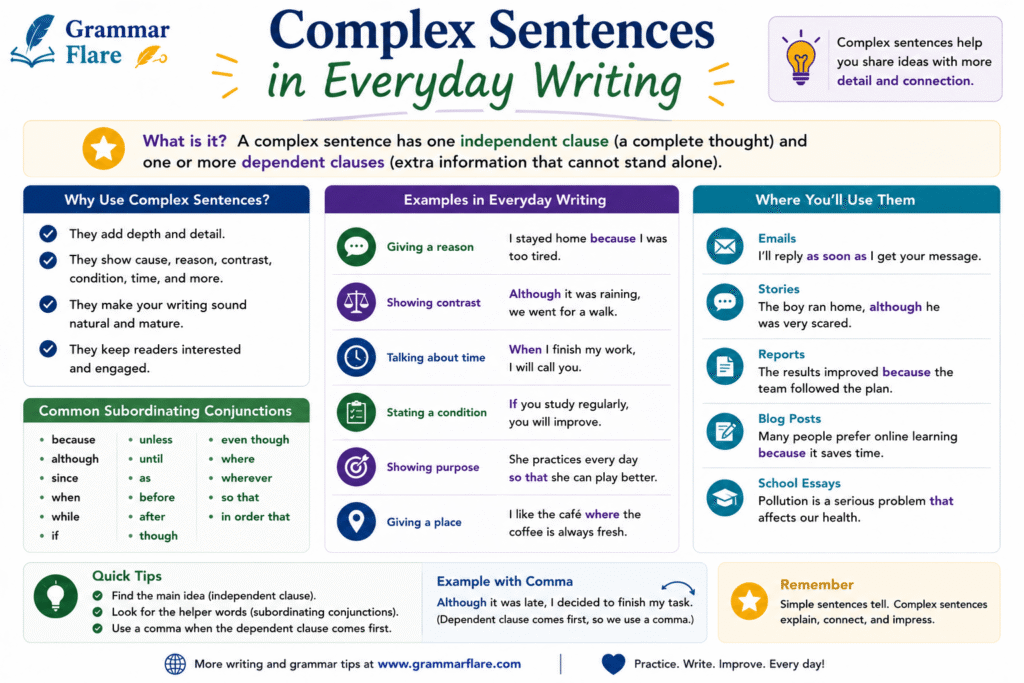
In emails
- If you have time, please review the attachment.
- I will call you after the meeting ends.
- Because the file was too large, I sent it through Google Drive.
In school writing
- Although the character seems confident, he is afraid of failure.
- The author uses imagery because it helps readers picture the scene.
- The argument is stronger when the writer adds evidence.
In blog writing
- If you want clearer writing, start with shorter sentences.
- Readers stay longer when examples are easy to understand.
- A grammar rule becomes easier because the examples show how it works.
In conversation
- I’ll text you when I get home.
- We can go outside if it stops raining.
- She laughed because the story was funny.
Complex sentences are not just for school. You use them every day.
Common Complex Sentence Starters
Here are useful words that often begin dependent clauses.
| Starter | Meaning | Example |
|---|---|---|
| because | reason | Because I was tired, I slept early. |
| although | contrast | Although it rained, we played. |
| when | time | When class ended, we left. |
| after | time | After dinner ended, we cleaned up. |
| before | time | Before you go, call me. |
| if | condition | If you practice, you will improve. |
| unless | condition | Unless it rains, we will go. |
| while | time/action happening together | While she cooked, he cleaned. |
| since | reason or time | Since you asked, I will explain. |
| even though | strong contrast | Even though he was tired, he smiled. |
These words are helpful, but use them carefully. A dependent clause still needs a main clause.
Common Mistakes With Complex Sentences
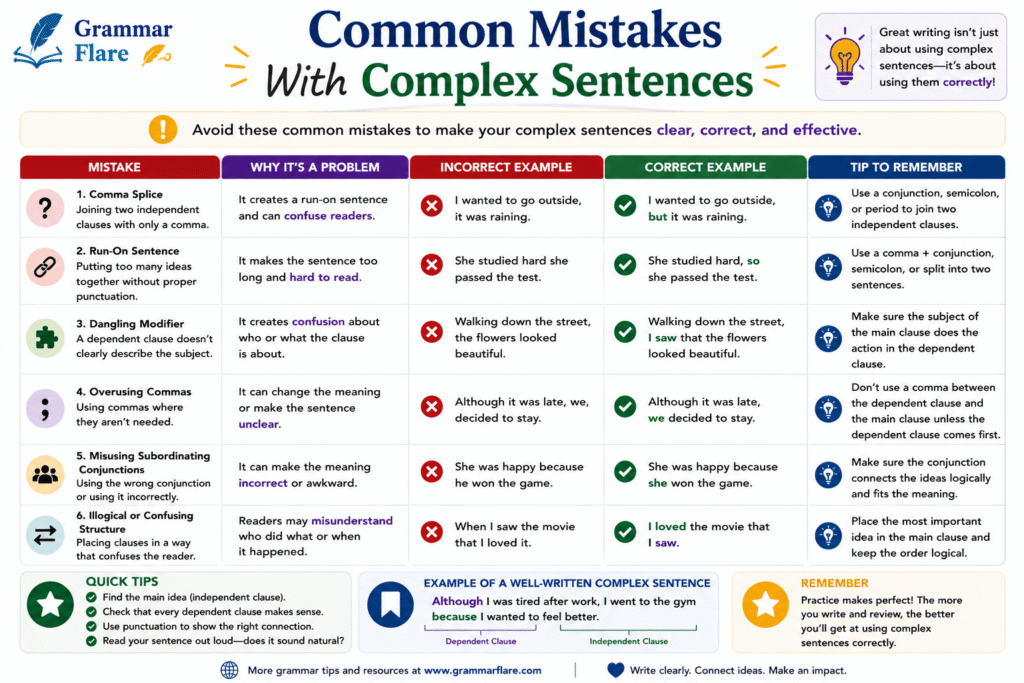
Mistake 1: Writing a dependent clause as a full sentence
Incorrect: Because I was tired.
Correct: Because I was tired, I went to bed.
A dependent clause cannot stand alone.
Mistake 2: Forgetting the comma after an opening dependent clause
Incorrect: Because I was tired I went to bed.
Correct: Because I was tired, I went to bed.
Use a comma when the dependent clause comes first.
Mistake 3: Adding an unnecessary comma before a final dependent clause
Usually incorrect: I went to bed, because I was tired.
Usually better: I went to bed because I was tired.
When the dependent clause comes after the main clause, you usually do not need a comma.
Mistake 4: Confusing compound and complex sentences
Compound: I was tired, so I went to bed.
Complex: Because I was tired, I went to bed.
Both are correct, but they use different structures.
Mistake 5: Making the sentence too long
Too long: Because I was tired after working all day and because the room was noisy and because I still had many things to do, I tried to finish the report that my manager had requested before the meeting that was scheduled for the next morning.
Better: Because I was tired after working all day, I struggled to finish the report. My manager needed it before the morning meeting.
Complex sentences are helpful, but clarity comes first.
How to Write a Complex Sentence
Use this simple method.
Step 1: Write one complete sentence
Example: I stayed home.
Step 2: Add a dependent idea
because it was raining
Step 3: Combine them
I stayed home because it was raining.
Now you have a complex sentence.
Try another one.
Complete sentence: She passed the test.
Dependent idea: although it was difficult
Combined: Although it was difficult, she passed the test.
Here is one more
Complete sentence: We waited in the car.
Dependent idea: until the storm ended
Combined: We waited in the car until the storm ended.
How to Fix Sentence Fragments
A sentence fragment is an incomplete sentence.
Many fragments are actually dependent clauses.
Fragment: When the class ended.
Fix: When the class ended, we packed our bags.
Fragment: Although he studied hard.
Fix: Although he studied hard, he felt nervous.
Fragment: Because the road was closed.
Fix: Because the road was closed, we took another route.
The fix is simple: Add an independent clause.
Complex Sentence Examples With Corrections
Incorrect: Because the teacher explained the rule.
Correct: Because the teacher explained the rule, the students understood it.
Incorrect: Although the article was long.
Correct: Although the article was long, it was easy to read.
Incorrect: When the website loaded.
Correct: When the website loaded, I clicked the first link.
Incorrect: If you need help.
Correct: If you need help, ask a question.
Incorrect: After the meeting ended.
Correct: After the meeting ended, we reviewed the notes.
Mixing Sentence Types for Readable Writing
Complex sentences can make blog writing smoother, but they should not make it harder to read.
Too many simple sentences can sound robotic.
Example: A complex sentence has two parts. One part is complete. One part is dependent. The dependent part adds meaning.
Better: A complex sentence has one complete idea and one dependent idea that adds meaning.
That version is smoother.
But too many long complex sentences can exhaust readers.
The best style uses variety.
Short: The rule is simple.
Medium: A complex sentence has one independent clause and at least one dependent clause.
Complex: When the dependent clause comes first, use a comma before the independent clause.
That mixture keeps the writing natural.
Easy Memory Trick
Use this memory trick: Complex means connected.
A complex sentence connects a complete idea with a dependent idea.
Example
Complete idea: We stayed inside.
Dependent idea: because it was raining
Complex sentence: We stayed inside because it was raining.
If one part cannot stand alone, but it adds meaning to the main idea, you probably have a complex sentence.
Quick Test: Is It a Complex Sentence?
Ask these three questions:
- Does the sentence have at least one complete thought?
- Does it have another clause that cannot stand alone?
- Does the dependent clause add time, reason, contrast, condition, place, or detail?
If the answer is yes, the sentence is complex.
Example
Although the lesson was short, it explained the rule clearly.
Complete thought: it explained the rule clearly
Dependent clause: Although the lesson was short
Yes, this is a complex sentence.
Mini Quiz: Complex Sentences
Identify each sentence as simple, compound, or complex.
- I finished the lesson.
- I finished the lesson, and I took the quiz.
- Because I finished the lesson, I understood the quiz.
- She smiled when she saw the puppy.
- The rain stopped, but the road was still wet.
- Although he was nervous, he answered the question.
- We stayed home because the storm was strong.
- The teacher explained the rule.
- I opened the file, and she checked the title.
- If you practice daily, your writing will improve.
Answers
- Simple
- Compound
- Complex
- Complex
- Compound
- Complex
- Complex
- Simple
- Compound
- Complex
Practice: Make These Sentences Complex
Combine each pair into one complex sentence.
- I was hungry. I made a sandwich.
- The rain stopped. We went outside.
- She studied hard. She still felt nervous.
- You finish your homework. You can watch TV.
- The movie ended. We went for dinner.
Possible answers:
- Because I was hungry, I made a sandwich.
- When the rain stopped, we went outside.
- Although she studied hard, she still felt nervous.
- If you finish your homework, you can watch TV.
- After the movie ended, we went for dinner.
Your answers may differ, but each should include one independent clause and one dependent clause.
FAQ
What is a complex sentence?
A complex sentence has one independent clause and at least one dependent clause. The independent clause can stand alone. The dependent clause cannot.
What is an example of a complex sentence?
Here is an example: Because it was raining, we stayed inside. The dependent clause is because it was raining, and the independent clause is we stayed inside.
How do you identify a complex sentence?
Look for one complete thought and one clause that depends on it. Dependent clauses often begin with words like because, although, when, if, after, before, or while.
Does a complex sentence need a comma?
Use a comma when the dependent clause comes first: Because I was tired, I slept early. You usually do not need a comma when the dependent clause comes after the main clause: I slept early because I was tired.
What is the difference between a compound sentence and a complex sentence?
A compound sentence has two independent clauses. A complex sentence has one independent clause and at least one dependent clause.
Can a complex sentence have two dependent clauses?
Yes. Example: Because I was tired and because the room was noisy, I left early. However, keep your sentence clear and avoid adding too many dependent clauses.
Is “because I was tired” a sentence?
No. It is a dependent clause. It needs a main clause: Because I was tired, I went to bed.
More Reading at GrammarFlare
- What Is a Compound Sentence?
- Simple Sentence: Meaning, Rules, Examples
- What Is an Independent Clause?
- How to Fix a Comma Splice
- Comma Before “But”
- Grammar Basics
Sources
- Purdue OWL: Identifying Independent and Dependent Clauses
- Purdue OWL: Punctuation in Types of Sentences
- Cambridge Dictionary: Sentences
- Cambridge Dictionary: Subordinate Clause
- British Council TeachingEnglish: Subordinate Clause
Final Takeaway
A complex sentence is not scary. It simply connects one complete idea with one dependent idea.
Remember this pattern:
Independent clause + dependent clause = complex sentence
Examples:
- I stayed home because I was tired.
- Because I was tired, I stayed home.
- She smiled although she was nervous.
- If you practice daily, your writing will improve.
The easiest way to identify a complex sentence is to look for one part that can stand alone and one part that cannot. Once you can spot that pattern, complex sentences become easy to understand and easy to write.

Ahmad Waheed has spent five years editing academic and professional writing for universities, publishers, and software companies. He founded Grammar Flare after noticing the same handful of mistakes in almost every draft that crossed his desk, and that most grammar guides explained the rule without explaining when it actually matters.
Ahmad writes every guide on this site, checking usage questions against Merriam-Webster, the Chicago Manual of Style, and the AP Stylebook, and noting where those sources disagree rather than quietly picking a side.